


Related on Lably
Through Afghanistan, Population (human biology) and Central Asia
Approximately 43% of the population was under the age of 15, and about 74% of Afghans lived in rural areas as of 2016. The country has one of the highest fertility rates in the world outside of Africa, with the average woman giving birth to five children over her lifetime. Around 6.8% of infants die during childbirth or early infancy. According to the World Health Organization (WHO), the nation's average life expectancy was estimated at about 63 years as of 2019. The prevalence of HIV remains very low, affecting only about 0.04% of the population.
Pashto (پښتو) and Dari (دری) are the official languages of Afghanistan. Dari serves as the inter-ethnic lingua franca across most of the country, particularly in northern and eastern provinces as well as in most major cities. Pashto is predominantly spoken in regions south of the Hindu Kush mountains and extends eastward toward the Indus River in neighbouring Pakistan. Smaller languages such as Uzbek and Turkmen are spoken in parts of northern Afghanistan. Multilingualism is widespread, particularly in the major urban centres.
Up to 89.7% of the population adheres to Sunni Islam and follows the Hanafi school of Islamic jurisprudence, while between 10% and 15% are followers of Shia Islam, with the majority belonging to the Twelver branch, and smaller communities adhering to Ismaili traditions. The remaining 0.3% of the population practices other religions, including Sikhism and Hinduism. Outside the principal urban centres, much of the population is organized into tribal or other kinship-based groups that maintain their own traditional customs.
Population size and distribution
Anatol Lieven of Georgetown University in Qatar wrote in 2021 that "it may be noted that in the whole of modern Afghan history there has never been a census that could be regarded as remotely reliable."
Historical
The first and only nationwide census of Afghanistan was carried out in 1979. It revealed a population of 13,051,358 (rural 11,037,231, urban 2,014,127). Previously there had been scattered attempts to conduct censuses in individual cities. According to the 1876 census, Kabul had a population of 140,700 people. In Kandahar in 1891 a population census was carried out, according to which 31,514 people lived in the city, of which 16,064 were men and 15,450 were women.
From 1979 until the end of 1983, some 5 million people left the country to take shelter in neighbouring northwestern Pakistan and eastern Iran. This exodus was largely unchecked by any government. The Afghan government in 1983 reported a population of 15.96 million, which presumably included the exodus.
It is assumed that roughly 600,000 to as high as 2 million Afghans may have been killed during the various 1979–2001 wars. These figures are questionable and no attempt has ever been made to verify if they were actually killed or had moved to neighbouring countries as refugees.
As no census has been performed after 1979 and millions of people may have left the country, the current population of Afghanistan can only be guessed.
Current and latest
As of 2021, the total population of Afghanistan is around 37.5 million, which includes the 3 million Afghan nationals living in both Pakistan and Iran. About 26% of the population is urbanite and the remaining 74% lives in rural areas.
Afghanistan's Central Statistics Organization (CSO) stated in 2011 that the total number of Afghans living inside Afghanistan was about 26 million and by 2017 it reached 29.2 million. Of this, 15 million are males and 14.2 million are females. The country's population is expected to reach 82 million by 2050.
Urban areas have experienced rapid population growth in the last decade, which is due to the return of over 5 million expats. The only city in Afghanistan with over a million residents is its capital, Kabul.
Structure of the population
Structure of the population (2012.01.07) (Data refer to the settled population based on the 1979 Population Census and the latest household prelisting. The refugees of Afghanistan in Iran, Pakistan, and an estimated 1.5 million nomads, are not included):
Population Estimates by Sex and Age Group (01.VII.2012) (Data refer to the settled population based on the 1979 Population Census and the latest household prelisting. The refugees of Afghanistan in Iran, Pakistan, and an estimated 1.5 million nomads, are not included.):
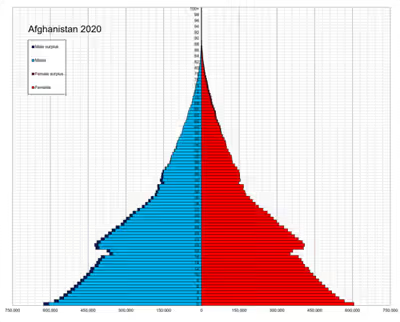
Population Estimates by Sex and Age Group (01.VII.2020) (Data refer to the settled population based on the 1979 Population Census and the latest household prelisting. The refugees of Afghanistan in Iran, Pakistan, and an estimated 1.5 million nomads, are not included.):
View source data. View source data. View source data. View source data.
Sign in to keep reading
4 more chapters are free with a Lably account.
Vital statistics
Vital statistics since 1950 (UN estimates)
Fertility rate
Before 1950
Fertility data by province
Estimations from 2015 (DHS Survey) and 2022–23 (MICS Survey).
Infant-related statistics
Afghanistan 2024 total fertility rate has been estimated at 4.4. In 2022 it was 4.5, about twice the world average rate. The rate has fallen since the early 1990s.
Crude Birth Rate (CBR), Total Fertility Rate (TFR) and Wanted Fertility Rate (WFR)
Life expectancy
Source: UN World Population Prospects
Ethnicity
An approximate distribution of the ethnolinguistic groups are listed in the chart below:
The recent estimate in the above chart is somewhat supported by the below national opinion polls, which were aimed at knowing how a group of about 804 to 8,706 local residents in Afghanistan felt about the current war, political situation, as well as the economic and social issues affecting their daily lives. Ten surveys were conducted between 2004 and 2015 by the Asia Foundation (a sample is shown in the table below; the survey in 2015 did not contain information on the ethnicity of the participants) and one between 2004 and 2009 by a combined effort of the broadcasting companies NBC News, BBC, and ARD.
Languages
Dari and Pashto are both official languages of Afghanistan. Uzbek and Turkmen are spoken as native languages in northern provinces, mainly among the Uzbeks and Turkmens. Smaller number of Afghans are also fluent in English, Urdu, Balochi, Arabic and other languages. An approximate distribution of languages spoken in the country is shown in the chart below:
Based on information from the latest national opinion polls, up to 51% stated that they can speak or understand Pashto and up to 79% stated that they can speak or understand Dari. Uzbek was spoken or understood by up to 11% and Turkmen by up to 7%. Other languages that can be spoken are Arabic (4%) and Balochi (2%).
Religion
Almost the entire Afghan population is Muslim, with less than 1% being non-Muslim. Despite attempts to secularise Afghan society, Islamic practices pervade all aspects of life. Likewise, Islamic religious tradition and codes, together with traditional practices, provide the principal means of controlling personal conduct and settling legal disputes. Islam was used as the main basis for expressing opposition to the progressive reforms of Afghanistan by King Amanullah in the 1920s.
The members of Sikh and Hindu communities are mostly concentrated in urban areas. They numbered hundreds of thousands in the 1970s but over 90% have since fled due to the Afghan wars and persecution.
- Islam: 99.7% of the total population
- Sunni Muslim: 84.7–89.7%
- Shia Muslim: 7-15%
- others: 0.3%
- Baha'is In the hundreds
- Sikhism: In the hundreds
- Hinduism: In the hundreds
- Zoroastrianism: Unknown/unreported
- Christianity: Unknown
- Judaism: 0
- Buddhism: Unknown