

Dhammacakkappavattana Sutta
First sermon preached by the Buddha at Sarnath
- 10 min read
- 6 chapters

Related on Lably
Through The Buddha, Four Noble Truths and Buddhism
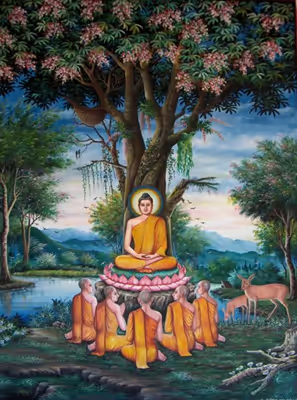
According to Buddhist tradition, the Buddha delivered this discourse on the day of Asalha Puja, in the month of Ashadha, in a deer sanctuary in Isipatana. This was seven weeks after he attained Enlightenment. His audience consisted of five ascetics who had been his former companions: Kondañña, Assaji, Bhaddiya, Vappa, and Mahānāma.
Definitions
Dhamma (Pāli) or dharma (Sanskrit) can mean a variety of things depending on its context; in this context, it refers to the Buddha's teachings or his "truth" that leads to one's liberation from suffering. Cakka (Pāli) or cakra (Sanskrit) can be translated as "wheel." The dhammacakka, which can be translated as "Dhamma-Wheel," is a Buddhist symbol referring to Buddha's teaching of the path to enlightenment. Pavattana (Pāli) can be translated as "turning" or "rolling" or "setting in motion."
Sign in to keep reading
5 more chapters are free with a Lably account.
Texts
Manuscripts
There are numerous parallel versions of the sutra in various collections, including:
- Theravāda versions in the Saṃyutta Nikāya (SN 56.11) and in the Khandhaka (Vin Kd 1.6)
- A Mūlasarvāstivāda version in the Chinese translation of the Saṃyukta Āgama (SĀ 379)
- A Mūlasarvāstivāda version in the Tibetan Canon (Toh 337)
- A Mūlasarvâstivāda version in the Mūlasarvâstivāda Vinaya's Kṣudrakavastu (T110, T1451.292a29-c15)
- A Mahīśāsaka version in their Five-Part Vinaya (T1421.104b23-105a02)
- A Dharmaguptaka version in their Four-Part Vinaya (T1428.787c28-788c07)
- Two versions found in the Ekottarika āgama (EĀ 19.2 and 24.5)
- A Mahāsāṃghika version in the Mahāvastu
- A version contained within the Catusparisat-sūtra
Epigraphic witnesses
Stone wheels of the law made in central Thailand during the Dvaravati period carry excerpts from the Pali sutta. Eng Jin Ooi and Peter Skilling note that the passage chosen is almost always the dvādasākāra, which sets out the four realities in three phases and twelve aspects. The space available on a wheel shows that the introduction and the conclusion were not meant to be included. They group the Siamese epigraphs in three types. The first agrees broadly with the printed editions while marking omissions with peyyāla, and comprises the wheel from Chai Nat, the wheel in the Newark Museum and a fragment from Lopburi. The second is abridged, dropping ariya- and the repeated cakkhuṃ udapādi clause, and is represented by the wheel from the Phra Pathommachedi. The third carries only a verse on the knowledge of the four realities, on a socle from Kamphaeng Saen and a pillar from Sap Champa.
No Pali manuscripts survive from South or Southeast Asia from the period of these inscriptions, so they stand about a thousand years earlier than the oldest manuscript witnesses to the text. Ooi and Skilling add that Sri Lanka has no early Pali inscriptions at all, and that Burma has many of about the same date but none carrying this sutta. Rather less than half of the Chai Nat wheel survives, and the recension they reconstruct from it runs to some 714 syllables. The spokes of that wheel carry keywords of the soḷasa ākāra, the sixteen aspects. Ooi and Skilling leave open whether these follow the Paṭisambhidāmagga or the Visuddhimagga.
Key topics
The Theravāda sutta contains the following topics:
- The two extremes to be avoided (sensual indulgence and self-mortification)
- The Middle Way
- The Four Noble Truths
- The Noble Eightfold Path
- The Twelve Insights of the Four Noble Truths
- Proclamation of release from the cycle of rebirth (commonly referred to as nibbana)
- The Opening of the Dhamma Eye (the attainment of right view) of the first awakened disciple, Aññā Kondañña
- Proclamation of the devas upon the setting of the Wheel of Dhamma in motion by the Buddha
- Response of the Buddha to Aññā Kondañña's comprehension of his teachings
Not all versions contain all these elements.
Traditional background
According to the Buddhist tradition, the Dhammacakkappavattana Sutta is the first teaching given by the Buddha after he attained enlightenment. According to Buddhist tradition, the Buddha attained enlightenment and liberation while meditating under the Bodhi Tree by the Nerañjarā river in Bodh Gaya. Afterwards, he remained silent for forty-nine days. According to MN 26 and MĀ 204, after deciding to teach, the Buddha initially intended to visit his former teachers, Āḷāra Kālāma and Uddaka Rāmaputta, to teach them his insights, but they had already died and born in a place where it is not apt to preach or they were deaf, so he decided to visit his five former companions. On his way, he encountered a spiritual seeker named Upaka. The Buddha proclaimed that he had achieved full awakening, but Upaka was not convinced and "took a different path".The Buddha then journeyed from Bodh Gaya to Sarnath, a small town near the sacred city of Varanasi in central India. There he met his five former companions, the ascetics with whom he had shared six years of hardship. His former companions were at first suspicious of the Buddha, thinking he had given up his search for the truth when he renounced their ascetic ways (MN 26). The Buddha was able to convince them to listen to him and then gave the teaching that was later recorded as the Dhammacakkappavattana Sutta, which introduces fundamental concepts of Buddhist thought, such as the Middle Way and the Four Noble Truths.
Development of the sutta
Retaining the oldest teachings
Modern scholars agree that the teachings of the Buddha were passed down in an oral tradition for approximately a few hundred years after the passing of the Buddha; the first written recordings of these teachings were made hundreds of years after the Buddha's passing. According to academic scholars, inconsistencies in the oldest texts may reveal developments in the oldest teachings. While the Theravada tradition holds that it is likely that the sutras date back to the Buddha himself, in an unbroken chain of oral transmission, academic scholars have identified many of such inconsistencies, and tried to explain them. Information of the oldest teachings of Buddhism, such as on the Four Noble Truths, which are an important topic in the Dhammacakkappavattana Sutta, has been obtained by analysis of the oldest texts and these inconsistencies, and are a matter of ongoing discussion and research.
Development of the sutta
According to Bronkhorst this "first sermon" is recorded in several suttas, with important variations. In the Vinaya texts, and in the Dhammacakkappavattana Sutta which was influenced by the Vinaya texts, the four truths are included, and Kondañña is enlightened when the "vision of Dhamma" arises in him: "whatever is subject to origination is all subject to cessation." Yet, in the Ariyapariyesanā Sutta ("The Noble Search", Majjhima Nikāya 26) the four truths are not included, and the Buddha gives the five ascetics personal instructions in turn, two or three of them, while the others go out begging for food. The versions of the "first sermon" which include the four truths, such as the Dhammacakkappavattana Sutta, omit this instruction, showing that
...the accounts which include the Four Noble Truths had a completely different conception of the process of liberation than the one which includes the Four Dhyanas and the subsequent destruction of the intoxicants.
According to Bronkhorst, this indicates that the four truths were later added to earlier descriptions of liberation by practicing the four dhyanas, which originally was thought to be sufficient for the destruction of the arsavas. Anderson, following Norman, also thinks that the four truths originally were not part of this sutta, and were later added in some versions. According to Bronkhorst, the "twelve insights" are probably also a later addition, born out of unease with the substitution of the general term "prajna" for the more specific "four truths".
According to Bhikkhu Anālayo, there is no compelling basis for questioning the traditional account that the four truths were the topic of the Buddha’s first sermon, arguing that they are present in other, parallel versions of the sutra and the canon. He argues that the consistent presence of the Four Noble Truths across parallel versions supports their early and foundational role in early Buddhist doctrine. What remains uncertain, however, is how far these four truths were from the outset qualified as “noble.”
The "essence" of Buddhism
According to Cousins, many scholars are of the view that "this discourse was identified as the first sermon of the Buddha only at a later date." According to Richard Gombrich,
Of course we do not really know what the Buddha said in his first sermon [...] and it has even been convincingly demonstrated that the language of the text as we have it is in the main a set of formulae, expressions which are by no means self-explanatory but refer to already established doctrines. Nevertheless, the compilers of the Canon put in the first sermon what they knew to be the very essence of the Buddha's Enlightenment.
Yet, the understanding of what exactly constituted this "very essence" also developed over time. What exactly was regarded as the central insight "varied along with what was considered most central to the teaching of the Buddha." "Liberating insight" came to be defined as "insight into the four truths," which is presented as the "liberating insight" which constituted the awakening, or "enlightenment" of the Buddha. When he understood these truths he was "enlightened" and liberated, as reflected in Majjhima Nikaya 26:42: "his taints are destroyed by his seeing with wisdom" - despite the fact that the four truths point to a gradual path of cultivation, and not to understanding the four truths as liberating in themselves. The four truths were superseded by pratityasamutpada (Pāli: paṭiccasamuppāda), and still later by the doctrine of the non-existence of a substantial self or person.
According to Anderson, a long recognized feature of the Theravada canon is that it lacks an "overarching and comprehensive structure of the path to nibbana." The sutras form a network or matrix, which have to be taken together. Within this network, "the four noble truths are one doctrine among others and are not particularly central," but are a part of "the entire dhamma matrix." The four noble truths are set and learnt in that network, learning "how the various teachings intersect with each other," and refer to the various Buddhist techniques, which are all explicitly and implicitly part of the passages which refer to the four truths. According to Anderson,
There is no single way of understanding the teachings: one teaching may be used to explain another in one passage; the relationship may be reversed or altered in other talks.
Translations into English
From the Pali version
In the Pāli Canon, this sutta is found in the Samyutta Nikaya, chapter 56 ("Saccasamyutta" or "Connected Discourses on the Truths"), sutta number 11 (and, thus, can be referenced as "SN 56.11"). There are multiple English translations of the Pali version of this sutta, including:
- Bhikkhu Bodhi (trans.), Setting in Motion the Wheel of the Dhamma
- Ñanamoli Thera (trans.) (1993). Dhammacakkappavattana Sutta: Setting Rolling the Wheel of Truth.
- Piyadassi Thera (trans.) (1999). Dhammacakkappavattana Sutta: Setting in Motion the Wheel of Truth.
- Thanissaro Bhikkhu (trans.) (1993). Dhammacakkappavattana Sutta: Setting the Wheel of Dhamma in Motion.
- Bhikkhu Sujato (trans.) (2018). Rolling Forth the Wheel of Dhamma.
- Thich Nhat Hanh (trans.) (1999). "Discourse on Turning the Wheel of the Dharma: Dhamma Cakka Pavattana Sutta". In The Heart of the Buddha's Teaching, p. 257.
- Ven. Dr. Rewata Dhamma (trans.) (1997). "The First Discourse of the Buddha: Turning the Wheel of Dhamma". In The First Discourse of the Buddha, Wisdom, pp. 17–20.
- Walpola Rahula (trans.) (2007). "Setting in Motion the Wheel of Truth". In What the Buddha Taught.
From Tibetan, Chinese and Sanskrit versions
- The Tibetan ‘Missing Translator’s Colophon’ Version of the Dharma Wheel Discourse (chos kyi ‘khor lo’i mdo ‘gyur byang med pa): A New Translation into English by Erick Tsiknopoulos (2013) This is a translation of one of two versions of the Dharma Wheel Sutra in Tibetan, known as the 'Missing Translator's Colophon' version (Tib: 'gyur byang med pa). It has a correlate in Chinese, translated into English by Lapiz Lazuli Texts and listed below.
- Lapis Lazuli Texts: Saṃyuktāgama 379. Turning the Dharma Wheel. This is a translation from the Chinese canon; the Chinese version is based on the Sarvastivadin Sanskrit version of the text (Dharmacakra Pravartana Sutra).
- Thich Nhat Hanh has produced a notable rendering of the first teaching of the Buddha in his biography of the Buddha entitled Old Path White Clouds. Thich Nhat Hanh relied on multiple sources for this rendering. This rendering is also included in Thich Nhat Hanh's book Path of Compassion: Stories from the Buddha's Life. See Turning the Wheel of Dharma
The 26th chapter of the Lalitavistara Sutra contains a Mahayana version of the first turning that closely parallels the Dhammacakkappavattana Sutta. The following English translations of this text are available:
- The Play in Full: Lalitavistara (2013), translated by the Dharmachakra Translation Committee. Translated from Tibetan into English and checked against the Sanskrit version.
- Voice of the Buddha: The Beauty of Compassion (1983), translated by Gwendolyn Bays, Dharma Publishing (two-volume set). This translation has been made from French into English and then checked with the original in Tibetan and Sanskrit.