

Early Dynastic Period of Egypt
Era after unification, c. 3150–2686 BC
- 5 min read
- 3 chapters

Related on Lably
Through Neolithic, Copper and Mesopotamia
Before the unification of Egypt, the land was settled with autonomous villages. With the early dynasties, and for much of Egypt's history thereafter, the country came to be known as "The Two Lands" (referencing Upper and Lower Egypt). The pharaohs established a national administration and appointed royal governors, and buildings of the central government were typically open-air temples constructed of wood or sandstone. The earliest Egyptian hieroglyphs appear just before this period, though little is known of the spoken language that they represent.
Cultural evolution
By about 3600 BC, Neolithic Egyptian societies along the Nile had based their culture on the raising of crops and the domestication of animals. Shortly after 3600 BC, Egyptian society began to grow and advance rapidly toward refined civilization. New and discrete pottery styles related to those of Palestine appeared and copper became more extensively used. The Mesopotamian process of sun-dried bricks, and architectural building principles—including the use of the arch and recessed walls for decorative effect—became popular.
Concurrent with these cultural advances, a process of unification of the societies and towns of the upper Nile River, or Upper Egypt, occurred. At the same time, the societies of the Nile Delta, or Lower Egypt also underwent a unification process. Warfare between Upper and Lower Egypt occurred often. During his reign in Upper Egypt, King Narmer defeated his enemies on the Delta and merged both the Kingdom of Upper and Lower Egypt under his single rule. Narmer is shown on palettes wearing the double crown, composed of the lotus flower representing Upper Egypt and the papyrus reed representing Lower Egypt - a sign of the unified rule of both parts of Egypt which was followed by all succeeding rulers. In mythology, the unification of Egypt is portrayed as the falcon-god, called Horus and identified with Lower Egypt, as conquering and subduing the god Set, who was identified with Upper Egypt. Divine kingship, which would persist in Egypt for the next three millennia, was firmly established as the basis of Egypt's government. The unification of societies along the Nile has also been linked to the end of the African humid period.
Funeral practices for non-elites would have been the same as in predynastic times, but the rich demanded more elaborate rituals. Thus, the Egyptians began construction of the mastabas which became models for the later Old Kingdom constructions such as the step pyramid. Cereal agriculture and centralization contributed to the success of the state for the next 800 years.
It seems certain that Egypt became unified as a cultural and economic domain long before its first king ascended to the throne in the lower Egyptian city of Memphis. Political unification proceeded gradually, perhaps over a period of a few centuries, as local districts established trading networks and as the ability of their governments to organize agriculture labor on a larger scale increased. Divine kingship may also have gained spiritual momentum as the cults of gods like Horus, Set and Neith associated with living representatives became widespread in the country.
Writing system
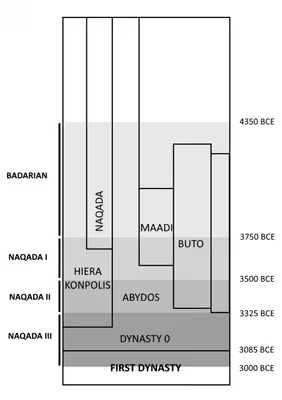
It was also during this period that the Egyptian writing system was further developed. Initially, Egyptian writing had been composed primarily of a few symbols denoting amounts of various substances. The Second Dynasty of Egypt sees the advent of the first known complete sentences in Egyptian hieroglyphs. Probably the first known such sentence is a seal impression from Peribsen's tomb, at the end of the Second Dynasty, dating to ca. 2660–2650 BC. The sentence relates to the unification of Egypt: "Sealing of everything of Ombos (i.e., Naqada): He of Ombos has joined the Two Lands for his son, the Dual King Peribsen." By the end of the 3rd dynasty it had been expanded to include more than 200 symbols, both phonograms and ideograms. In all likelihood, Naqada III saw the earliest codification of signs, where royal serekhs—a rectangular cartouche representing the niched or gated façade of a palace surmounted by the Horus falcon—are also first seen, painted on jars and impressed on their sealings. These goods were often traded "abroad through the northern Sinai to southern Palestine."
Sign in to keep reading
2 more chapters are free with a Lably account.
First Pharaoh
According to Manetho, the first monarch of the unified Upper and Lower Egypt was Menes, who is now identified with Narmer, the earliest recorded First Dynasty monarch. Narmer appears first on the necropolis seal impressions of Den and Qa'a. This shows that Narmer was recognized by the first dynasty kings as an important founding figure. Narmer is also the earliest king associated to the symbols of power over the two lands (see in particular the Narmer Palette, a votive cosmetic palette showing Narmer wearing the crowns of Upper and Lower Egypt) and may therefore be the first king to achieve the unification. Consequently, the current consensus is that "Menes" and "Narmer" refer to the same person. Alternative theories hold that Narmer was the final king of the Naqada III period and Hor-Aha is to be identified with "Menes".
Egyptians in Canaan and Nubia
Egyptian settlement and colonization are attested from about 3200 BC onward all over the area of southern Canaan with almost every type of artifact: architecture (fortifications, embankments and buildings), pottery, vessels, tools, weapons, seals, etc. 20 serekhs attributed to Narmer—the first ruler of the Early Dynastic Period—have been found in Canaan. The Egyptian colonial domain in the region was likely administered from Tell es-Sakan, a fortified settlement inhabited from 3300 to 3000 BC.
There is also evidence of Egyptian settlement and occupation in lower Nubia after the Nubian A-Group culture came to an end. By the Early Dynastic Period, the Egyptian state had likely imposed its authority as far north as modern Tel Aviv and as far south as the second cataract in Nubia.
Artifacts of the First Dynasty contain numerous depictions of captured foreigners, possibly alluding to the campaign to conquer Lower Egypt and the Nile Delta, and the accomplishment of the unification of Upper and Lower Egypt. Various ethnic types seems to be represented: Asiatic-looking foreigners with full beards and straight hair, possibly alluding to vanquished people from the eastern parts of the Nile delta, or naked individuals with curly hair, possibly Libyan tribes from the western Nile delta. Depiction of West-Asiatic-looking foreigners were found in the tomb of Pharaoh Qa'a, and the Narmer Palette also exhibits similar scenes of conquest over alien people.