


Related on Lably
Through Asia, United Nations and ASEAN
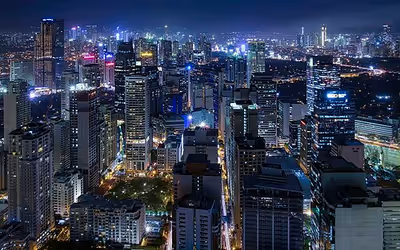
The Philippine economy is a service-oriented economy, with relatively more modest contributions from the manufacturing and agriculture sectors. It has experienced significant economic growth and transformation in the past, posting one of the highest GDP growth rates in Asia. With an average annual growth rate of around 6 percent since 2010, the country has emerged as one of the fastest-growing economies in the world. The Philippines is a founding member of the United Nations, Association of Southeast Asian Nations, Asia-Pacific Economic Cooperation, East Asia Summit and the World Trade Organization. The Asian Development Bank (ADB) is headquartered in the Ortigas Center located in the city of Mandaluyong, Metro Manila.
The country's primary exports include semiconductors and electronic products, transport equipment, garments, chemical products, copper, nickel, abaca, coconut oil, and fruits. Its major trading partners include Japan, China, the United States, Singapore, South Korea, the Netherlands, Hong Kong, Germany, Taiwan, and Thailand. In 2017, the Philippine economy was projected to become the 9th largest in Asia and 19th largest in the world by 2050. By 2035, the Filipino economy is predicted to be the 22nd largest in the world.
The Philippines has been named as one of the Tiger Cub Economies, alongside Indonesia, Malaysia, Vietnam, and Thailand. However, major problems remain, mainly related to alleviating the wide income and growth disparities between the country's different regions and socioeconomic classes, reducing corruption, and investing in the infrastructure necessary to ensure future growth. In 2024, the World Economic Forum chief Børge Brende said that "there is a real opportunity for this country to become a $2-trillion economy."
The Philippines exhibits one of the highest economic densities in Southeast Asia, characterized by a high concentration of economic output relative to its land area. As of 2024–2025, the Philippines ranks third among ASEAN nations in GDP Density (Nominal GDP per square kilometer), trailing only the city-state of Singapore and the resource-rich sultanate of Brunei. This is so, because there is such large economic activity that is happening on such low amount of land area that's scattered amongst a fragmented archipelagic geography. This is expressed in the concept called GDP density.
In 2025, the Philippines enacted Republic Act No. 12252, amending the Investors’ Lease Act to allow foreign investors to lease private land for up to 99 years, up from the previous limit of 75 years (50 + 25 extension). This reform aims to enhance the country's competitiveness in attracting long-term foreign direct investment by offering greater leasehold security for commercial and industrial projects. A project called the "Luzon Economic Corridor" is on the works, which will further develop the Philippine economy. It is the first country in the world to put its entire national budget under blockchain technology.
Composition by sector
As a newly industrialized country, the Philippines is still an economy with a large agricultural sector; however, the country's service industry has expanded recently. Much of the industrial sector is based on processing and assembly operations in the manufacturing of electronics and other high-tech components, usually from foreign multinational corporations.
Filipinos who go abroad to work–-known as Overseas Filipino Workers or OFWs—are a significant contributor to the economy but are not reflected in the below sectoral discussion of the domestic economy. OFW remittances is also credited for the Philippines' recent economic growth resulting in investment status upgrades from credit ratings agencies such as the Fitch Group and Standard & Poor's. From more than US$2 billion worth of remittance from Overseas Filipinos sent to the Philippines in 1994, this significantly increased to a record US$38.34 billion in 2024 and represented 8.3 percent of the country's GDP.
Agriculture, aquaculture and forestry
As of 2022, agriculture employs 24 percent of the Filipino workforce accounting for 8.9 percent of the total GDP. The type of activity ranges from small subsistence farming and fishing to large commercial ventures with significant export focus.
The Philippines is the world's third largest producer of coconuts, and the world's largest exporter of coconut products. Coconut production is generally concentrated in medium-sized farms. The Philippines is also the world's third largest producer of pineapples, producing 2,862,000 metric tons (2,817,000 long tons; 3,155,000 short tons) in 2021.
Rice production in the Philippines is important to the food supply in the country and economy. The Philippines is the 7th largest rice producer in the world as of the 1st half of 2026, accounting for 2 percent of global rice production. Rice is the most important food crop, a staple food in most of the country; it is produced extensively in Central Luzon), Western Visayas, Cagayan Valley, Soccsksargen, and Ilocos Region.
The Philippines is one of the largest producers of sugar in the world. At least 17 provinces located in eight regions of the nation have grown sugarcane crops, of which the Negros Island Region accounts for half of the country's total production. As of Crop Year 2012–2013, 29 mills are operational divided as follows: 13 mills in Negros, 6 mills in Luzon, 4 mills in Panay, 3 mills in Eastern Visayas and 3 mills in Mindanao. A range from 360,000 to 390,000 hectares (890,000 to 960,000 acres) are devoted to sugarcane production. The largest sugarcane areas are found in the Negros Island Region, which accounts for 51 percent of sugarcane areas planted. This is followed by Mindanao which accounts for 20 percent; Luzon with 17 percent; Panay with 7 percent and Eastern Visayas with 4 percent.
Blue economy
As an archipelagic country, the Philippines relies heavily on the blue economy. Its main ocean-based sectors are fisheries, shipping, offshore renewable energy, and marine tourism. The blue economy made up nearly 4 percent of the country's gross domestic product (PHP1 trillion) in 2024. Although important for the country's economic growth, only 2 percent of the development aid the country receives is directed to the blue economy.
Mangrove forests, which cover more than 1% of the country's land area, provide a wide range of benefits its coastal communities and blue economy. By providing food and shelter, mangroves function as breeding and nursery grounds for fish. In effect, this leads to a higher abundance of fish, crustaceans, and shellfish around these areas which local small-scale fisheries rely on for food and livelihood. Mangrove forests also help mitigate climate change by absorbing carbon from the atmosphere, and offer locals protection from natural hazards such as tropical cyclones, and reduce coastal erosion by strengthening the soil. 22% of mangroves in the Philippines can be found in Palawan where local livelihoods rely on them as fishing grounds, for harvesting mangrove honey, and as a site for ecotourism.
Automotive and aerospace
The ABS used in Mercedes-Benz, BMW, and Volvo cars are made in the Philippines. Automotive sales in the Philippines increased to 467,252 in 2024 from 429,807 units a year prior. Toyota sells the most vehicles in the country followed by Mitsubishi, Ford, Nissan, and Suzuki. Honda and Suzuki produce motorcycles in the country. Since around the 2010s, several Chinese car brands have entered the Philippine market; these include Chery and Foton Motor.
Aerospace products in the Philippines are mainly for the export market and include manufacturing parts for aircraft built by both Boeing and Airbus. Moog is the biggest aerospace manufacturer with base in Baguio; the company produces aircraft actuators in their manufacturing facility. Total export output of aerospace products in the Philippines reached US$780 million in 2019.
Electronics
A Texas Instruments plant in Baguio has been operating for 20 years and is the largest producer of DSP chips in the world. Texas Instruments' Baguio plant produces all the chips used in Nokia cell phones and 80% of chips used in Ericsson cell phones in the world. Toshiba hard disk drives are manufactured in Santa Rosa, Laguna. Printer manufacturer Lexmark has a factory in Cebu City. Electronics and other light industries are concentrated in Laguna, Cavite, Batangas and other Calabarzon provinces with sizable numbers found in Southern Philippines that account for most of the country's export.
The Philippine Electronics Industry is classified into (73%) Semiconductor Manufacturing Services (SMS) and (27%) Electronics Manufacturing Services (EMS) according to SEIPI, the largest organization of foreign and Filipino electronics companies in the Philippines. Electronic products continued to be the country's top export with total earnings of US$45.66 billion and accounted for 57.8 percent of the total export of goods in 2022.
Semiconductor
The semiconductor industry plays a critical role in the Philippine economy by integrating the Philippines into the global electronics value chain. The country is primarily involved in the assembly, testing, and packaging stages of semiconductor production rather than chip design or wafer fabrication, serving as a key link in the global supply chain for electronic components.
According to the Semiconductor and Electronics Industries in the Philippines Foundation (SEIPI), semiconductor manufacturing services account for the majority of the country’s electronics industry output. Semiconductor products are widely used in consumer electronics, telecommunications equipment, automotive systems, and industrial applications.
Semiconductor manufacturing facilities in the Philippines are largely operated by multinational firms and are concentrated in major industrial zones, particularly in the CALABARZON region as well as parts of Central Luzon and the Visayas. The industry benefits from a skilled technical workforce, competitive production costs, and government investment incentives.
As part of the broader electronics sector, semiconductors contribute significantly to export earnings, employment generation, and foreign direct investment. The industry also supports technology transfer and skills development, reinforcing its role as one of the Philippines’ most important high-technology manufacturing sectors.
Mining and extraction
Philippine gold, nickel, copper, palladium and chromite deposits are among the largest in the world. Other important minerals include silver, coal, gypsum, and sulphur. Significant deposits of clay, limestone, marble, silica, and phosphate exist.
About 60 percent of total mining production are accounted for by non-metallic minerals, which contributed substantially to the industry's steady output growth between 1993 and 1998, with the value of production growing 58 percent. Philippine mineral exports amounted to US$4.22 billion in 2020. Low metal prices, high production costs, lack of investment in infrastructure, and a challenge to the new mining law have contributed to the mining industry's overall decline.
The industry rebounded starting in late 2004 when the Supreme Court upheld the constitutionality of an important law permitting foreign ownership of Philippines mining companies. In 2019, the country was the 2nd largest world producer of nickel and the 4th largest world producer of cobalt. According to Philippine Statistics Authority, the total monetary value of four key metallic minerals which were appraised to Class A namely: copper, chromite, gold and nickel were valued at US$10.23 billion in 2025. Class A mineral resources are commercially recoverable that could contribute to economy annually.
Offshoring and outsourcing
Business process outsourcing (BPO) and the call center industry contribute to the Philippines' economic growth resulting in investment status upgrades from credit ratings agencies such as Fitch and S&P. In 2008, the Philippines has surpassed India as the world leader in business process outsourcing (BPO). The industry generated 100,000 jobs, and total revenues were placed at US$960 million for 2005. In 2011, BPO sector employment ballooned to over 700,000 people and is contributing to a growing middle class; this increased to around 1.3 million employees by 2022. BPO facilities are concentrated in IT parks and centers in economic zones across the Philippines: Metro Manila, Metro Cebu, Metro Clark, Bacolod, Davao City, and Iloilo City; other areas with significant presence of the BPO industry include Baguio, Cagayan de Oro, Dasmariñas, Dumaguete, Lipa, Naga, and Santa Rosa, Laguna. The majority of the top ten BPO firms of the United States operate in the Philippines.
Call centers began in the Philippines as plain providers of email response and managing services and is a major source of employment. Call center services include customer relations, ranging from travel services, technical support, education, customer care, financial services, online business to customer support, and online business-to-business support. The Philippines is considered as a location of choice due to its many outsourcing benefits such as less expensive operational and labor costs, the high proficiency in spoken English of a significant number of its people, and a highly educated labor pool.
The growth in the BPO industry is promoted by the Philippine government. The industry is highlighted by the Philippines Development Plan as among the 10 high potential and priority development areas. The government provides incentive programs such as tax holidays, tax exemptions, and simplified export and import procedures. Additionally, training is also available for BPO applicants.
Shipbuilding and repair
The Philippines is a significant player in the global shipbuilding industry with 118 registered shipyards in 2021 distributed in Subic, Cebu, Bataan, Navotas and Batangas. As of 2022, it is the seventh largest shipbuilding nation by gross tonnage. Subic-made cargo vessels are exported to countries where shipping operators are based. South Korea's Hanjin started production in Subic in 2007 of the 20 ships ordered by German and Greek shipping operators. Bulk carriers, container ships and big passenger ferries are built in the country's shipyards. General Santos' shipyard is mainly for ship repair and maintenance.
Surrounded by waters, the country has abundant natural deep-sea ports ideal for development as production, construction and repair sites. In the ship repair sector, the Navotas complex in Metro Manila is expected to accommodate 96 vessels for repair. Shipbuilding is part of Philippines' maritime heritage; employing over 600,000 people and contributing almost 15 percent of revenues to the ocean-based industries.
Construction and real estate
The Community Mortgage Program is a socialized housing initiative of the Philippine Government. By 2001, 106,273 families had found secure tenure.
Banking and finance
Education
Education in the Philippines is compulsory at the basic education level, composed of kindergarten, elementary school (grades 1–6), junior high school (grades 7–10), and senior high school (grades 11–12). The educational system is managed by three government agencies by level of education: the Department of Education (DepEd) for basic education; the Commission on Higher Education (CHED) for higher education; and the Technical Education and Skills Development Authority (TESDA) for technical and vocational education. Public education is funded by the national government.
Private schools are generally free to determine their curriculum in accordance with existing laws and regulations. Institutions of higher education are classified as public or private; public institutions are subdivided into state universities and colleges (SUCs) and local colleges and universities (LCUs).
Enrollment in basic education has increased steadily since the effectivity of the K-12 curriculum, first implemented on May 20, 2008, through its 9 years of implementation until June 5, 2017, on April 24, 2012, with over 28 million students enrolled in the 2022–2023 school year. In 2020, there were approximately 32 million learners aged 5 to 24 enrolled nationwide. An additional 640,000 out-of-school youth participated in the Alternative Learning System, while 1.6 million children aged 5 to 17 remained out of school as of 2023. Completion rates for primary and lower secondary education are relatively high, but drop-out rates and barriers to upper secondary and tertiary education remain, particularly among lower-income students.
Healthcare
Health care in the Philippines varies with private, public and barangay health centers (many in rural municipalities). Most of the national burden of health care is provided by private health providers, with the cost shouldered by the state or by patients. The 2019 Universal Health Care Act (UHC Act) represents a significant effort to bridge the quality and accessibility gap, aiming to enroll all Filipinos in the National Health Insurance Program (PhilHealth). However, disparities persist, particularly between urban and rural areas, and funding constraints continue to impact service delivery. The Philippine healthcare system categorizes hospitals into three distinct levels, reflecting their capabilities and resources, with Level 1 representing basic care and Level 3 the most advanced. The essential criteria for each level are:
Beyond these levels, Philippine hospitals are further differentiated by their ownership structure (government/public vs private) and the breadth of medical services they offer (generic vs specialised vs emergency, etc.).
The Philippine healthcare system, a blend of public and private sectors, faces challenges in providing equitable and comprehensive care. Historically rooted in traditional medicine and shaped by colonial influences, the system now navigates a landscape where private providers shoulder much of the burden, with costs borne by the state or patients. Despite the UHC Act's intent to improve care for all, the system remains fragmented, with significant disparities in service quality and quantity between the wealthy and the poor. Factors contributing to this include low budgets, personnel shortages exacerbated by nurse migration, and historical neglect of underserved populations. Compared to developed nations, the Philippines allocates a comparatively small percentage of its GDP to healthcare. Addressing these challenges remains a priority for the nation.
Retail
Tourism
Tourism is an important sector for the Philippine economy. The travel and tourism industry contributed 8.1% to the country's GDP in 2025; this was lower than the 12.7% recorded in 2019 prior to the COVID-19 lockdowns. Coastal tourism, encompassing beach and diving activities, constitutes 25% of the Philippines' tourism revenue, serving as its primary income source in the sector. Popular destinations among tourists include Boracay, Palawan, Cebu and Siargao. While the Philippines has encountered political and social challenges that have affected its tourism industry, the country has also taken steps to address these issues. Over the past years, there have been efforts to improve political stability, enhance security measures, and promote social inclusivity, all of which contribute to creating a more favorable environment for tourism, such as the Boracay rehabilitation.
As of 2025, 7.70 million Filipinos were employed in the tourism industry, it generated ₱2.27 trillion (US$44.1 billion) in revenue from foreign tourists, coming mostly from South Korea, the United States and Japan. The country attracted a total of 5,360,682 foreign visitors in 2015 through its tourism campaign of It's More Fun in the Philippines! In 2019, foreign arrivals peaked at 8,260,913.The country is also home to one of the New 7 Wonders of Nature, the Puerto Princesa Subterranean River National Park, and one of the New 7 Wonders Cities, the Heritage City of Vigan. It is also home to six UNESCO World Heritage Sites scattered in nine different locations, three UNESCO biosphere reserves, three UNESCO intangible cultural heritage, four UNESCO memory of the world documentary heritage, three UNESCO creative cities, two UNESCO World Heritage cities, seven Ramsar wetland sites, and 14 ASEAN Heritage Parks.
Sign in to keep reading
9 more chapters are free with a Lably account.
Infrastructure
Energy
The Philippines relies on a mix of fossil fuels and renewable resources for its energy needs. Electricity demand is driven by population growth, urbanisation and industry. Energy policy and planning are overseen by the Department of Energy. Usage patterns vary across Luzon, the Visayas and Mindanao, reflecting differences in generation assets, grid interconnections and local demand.
The population of the Philippines is over 101 million people, and as a rapidly developing nation, has seen a rapid increase in GDP, averaging 6.1% from 2011 to 2015. Energy-intensive manufacturing and retail industries are the driving factors of the Philippines' economic growth. Given its large population and rapidly growing economy, the country's energy needs are growing rapidly. According to the Philippines Department of Energy, the Philippines consumed 75,266 gigawatt-hours (GWh) of electricity in 2013. Of this, 27.39% went to powering residential areas, 24.31% to commercial establishments and 27.46% to the industrial sector. With 72.84% of electrical energy being consumed by Luzon, 14.75% by Visayas, and 12.41% by Mindanao in 2013.
The Philippines is rich in mineral and geothermal energy resources. In 2019, it produced 1,928 megawatts (2,585,000 hp) of electricity from geothermal sources (7.55% of total electricity production). A 1989 discovery of natural gas reserves in the Malampaya oil fields off the island of Palawan is being used to generate electricity in three gas-powered plants.
The Philippines has significant potential in solar energy; however, as of 2021, most of the domestically produced electricity is based on fossil fuel resources, particularly coal. The country produced 7,399 megawatts (9,922,000 hp) of renewable energy in 2019.
On November 15, 2022, the renewable energy sector was granted the ability to operate with 100 percent foreign ownership, an increase from the previous 40 percent limit. This change allows for the infusion of foreign capital into the renewable energy (RE) industries. The Department of Energy is targeting an increase in the share of renewable energy in the country's power generation mix, aiming for 35 percent by 2030 and 50 percent by 2040, up from the current 22 percent. Danish firm Copenhagen Infrastructure Partners (CIP) is investing US$5 billion to develop three offshore wind energy projects with a potential capacity of 2,000 megawatts (2,700,000 hp); it will be located in Camarines Norte and Camarines Sur (1000 MW), Northern Samar (650 MW), Pangasinan and La Union (350 MW). In 2022, the share of RE in the energy mix was at 22.8 percent.
The electricity sector in the Philippines provides electricity through power generation, transmission, and distribution to many parts of the country. The Philippines is divided into three electrical grids, one each for Luzon, the Visayas and Mindanao.
As of June 2016, the total installed capacity in the Philippines was 20,055 megawatts (MW), of which 71.5% was on the Luzon grid. About 12% of Filipinos have no access to electricity. The Philippines is also one of the countries in the world that has a fully functioning electricity market since 2006 called the Philippine Wholesale Electricity Spot Market (WESM) and is operated by an independent market operator. By 2017, coal-powered electric energy began to comprise more than 50% of the nationwide power generation in the country.
As of 2025, the Philippines has the second-highest electricity rate in Southeast Asia after Singapore.
Telecommunications
Telecommunications in the Philippines are well-developed due to the presence of modern infrastructure facilities. The industry was deregulated in 1995 when President Fidel V. Ramos signed Republic Act No. 7925 (The Public Telecommunications Policy Act of the Philippines). This law opened the sector to more private players and improved the provision of telecom services are better and fairer rates, leading to the creation of many telecommunication service providers for mobile, fixed-line, Internet and other services.
Transport
Transportation in the Philippines covers the transportation methods within the archipelagic nation of over 7,600 islands. From a previously underdeveloped state of transportation, the government of the Philippines has been improving transportation through various direct infrastructure projects, and these include an increase in air, sea, road, and rail transportation and transport hubs. However, relative to the size of population and level of income, public transportation remains underdeveloped in the Philippines.
Jeepneys are a popular and iconic public utility vehicle; they have become a symbol of the Philippine culture. Another popular mode of public transportation in the country is the motorized tricycles, especially common in smaller urban and rural areas. The Philippines has four railway lines: Manila Light Rail Transit System Line 1 (LRT Line 1), LRT Line 2, MRT Line 3, and the PNR Metro Commuter Line operated by the Philippine National Railways. There are also steam engines found in the Visayas, mostly Negros island, which operate sugar mills such as Central Azucarera. Taxis and buses are also important modes of public transport in urban areas.
The Philippines has 12 international airports and more than 20 major and minor domestic airports serving the country. Ninoy Aquino International Airport is the country's chief airport.
Labor, income and welfare
The labor policy in the Philippines is primarily defined by the Labor Code of the Philippines and other related labor laws. As of 2025, these laws apply to approximately 38 million Filipinos who are part of the labor force, including, to some extent, overseas workers. They are intended to establish the legal rights of workers and set limitations concerning the hiring process, working conditions, employee benefits, labor policymaking within companies, and employer-employee relations.
The Labor Code and other labor legislation are implemented mainly by government agencies, including the Department of Labor and Employment and the Department of Migrant Workers (formerly the Philippine Overseas Employment Administration). Non-governmental entities, such as trade unions and employer organizations, also contribute to the development and enforcement of labor standards in the country.
Regional accounts
For the year 2022, all economies of the 17 regions in the Philippines recorded positive growths; Western Visayas had the highest growth (9.3 percent), followed by Cordillera Administrative Region (8.7 percent), and Davao Region (8.15 percent).
According to the Philippine Statistics Authority (PSA), gross regional domestic product (GRDP) is GDP measured at regional levels. Figures below are for the year 2019.
Provincial accounts
According to the Philippine Statistics Authority (PSA), Provincial Product Account (PPA) is GDP measured at provincial levels. Figures below are for the year 2022.
Source: Philippine Statistics Authority
City accounts
Figures below are Provincial Product Accounts (PPA) for Highly Urbanized Cities (HUC) or Independent Cities. No data available for cities within Metro Manila.
source: Philippine Statistics Authority
International comparisons
Statistics
GDP-related data can be found here:
- Industries: electronics assembly, aerospace, agribusiness, automotive, IT and business process outsourcing, shipbuilding, garments, footwear, pharmaceuticals, chemicals, wood products, financial services, food processing, petrochemical, metalcasting and mining, real estate, textile, tourism
- Electricity – production: 106,115 GWh (2021)
- Agriculture – products: abaca, bananas, sugarcane, coconuts, durian, rice, corn, cassavas, mangoes; pork, eggs, beef, pineapples, fish
- Exports – commodities/products: Semiconductors and electronic products, machinery, transport equipment, aerospace/parts, automotive/parts, garments, chemicals, copper, nickel, petroleum products, coconut oil, fruits
- Imports – commodities/products: electronic products, machinery, telecommunication and transport equipment, automotive, chemicals, petroleum, cereals, livestocks, cement and steel, fruits
- Manufacturing Growth: 5.9% (April 2024)
- PMI Manufacturing: 52.2 (April 2024)
- Yield Curve: 10-Year Bond 6.70% (June 2024)
- Net International Investment Position: –$51.317 billion (2023 est.)
Government budget
The national government budget for 2025 has set the following budget allocations:
History
The Philippine economy has been growing steadily over decades and the International Monetary Fund in 2014 reported it as the 39th largest economy in the world. The Philippines posted a high GDP growth rate of 7.6 percent in 2022. However, the country is not a part of the Group of 20 nations; instead, it is grouped in a second tier for emerging markets or newly industrialized countries.
Notes for economic growth (1980–2023):
1980-82: Slower economic growth due to mismanagement
1983-86: Recession due to factors like corruption
1987-90: Recovery from 1984 crisis
1991-1992: Inflation and natural disasters (notably Mount Pinatubo eruption) caused slower growth
1993-97: Fast growth
1998: Minor recession due to the 1997 Asian financial crisis
1999-2001: Recovery
2002: Recession due to the EDSA II Protest
2002-2008: Post-EDSA II recovery
2009: Effects of the Great Recession
2010-2019: Philippines as a Tiger Economy
2020: Coronavirus Outbreak
2021-2023: Rebound
A chart below outlines selected statistics showing trends in the gross domestic product of the Philippines using data taken from the International Monetary Fund.
- Indicates economic growth
- Indicates contraction / recession
- Indicates IMF forecast