


Related on Lably
Through Taste
History
Golden Delicious arose from a chance seedling, possibly a hybrid of Grimes Golden and Golden Reinette. The original tree was found on the family farm of J. M. Mullins in Clay County, West Virginia, and was locally known as Mullins' Yellow Seedling. Mullins sold the tree and propagation rights to Stark Brothers Nurseries for $5000, which first marketed it as a companion of their Red Delicious in 1914. For much of the twentieth century, the Golden Delicious, the Red Delicious, and the Granny Smith were the top three apple varieties in the United States in terms of sales at supermarkets. According to the U.S. Apple Association, as of 2025, the Golden Delicious and two of its descendants, the Gala and Honeycrisp, remain in the top nine most popular varieties in that country.
Golden Delicious was designated the official state fruit of West Virginia by a Senate resolution on February 20, 1995. Clay County has hosted an annual Golden Delicious Festival since 1972. The Golden Delicious was one of four varieties honored by the United States Postal Service in a 2013 set of four 33¢ stamps commemorating historic strains, joined by the Northern Spy, Baldwin, and Granny Smith apples.
In 1943, the New York State Agricultural Experiment Station in Geneva, New York developed the Jonagold apple by cross-breeding Golden Delicious and Jonathan trees. The cultivar was officially released in 1968 and went on to become the leading apple cultivar in Europe. As of 2025, the Golden Delicious is still one of the top apples in the European Union.
In 2010, an Italian-led consortium announced they had decoded the complete genome of the Golden Delicious apple. It had the highest number of genes (57,000) of any plant genome studied to date.
Sign in to keep reading
2 more chapters are free with a Lably account.
Appearance and flavor
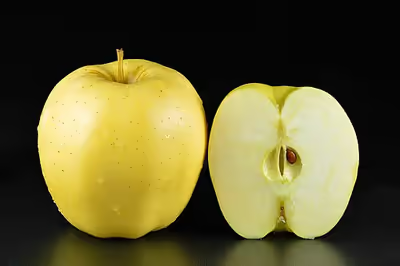
Golden Delicious is a large, yellowish-green skinned cultivar and very sweet to the taste. It is prone to bruising and shriveling, so it needs careful handling and storage. It is a favorite for eating plain, as well as for use in salads, apple sauce, and apple butter. America's Test Kitchen, Food Network, and Serious Eats all list Golden Delicious apples as one of the best apples for baking apple pie due to its balanced flavor and its high pectin content that allows it to stay intact when cooked.
- Density 0.79 g/cc
- Sugar 13.5%
- Acid 5.6 gram/litre
- Vitamin C 10–20 mg/litre
Season
Golden Delicious are harvested 130–150 days after full bloom.
Golden Delicious mutants
- Lucky Rose Golden A patented Golden Delicious mutant