


Related on Lably
Through Cloning
Appearance and flavor
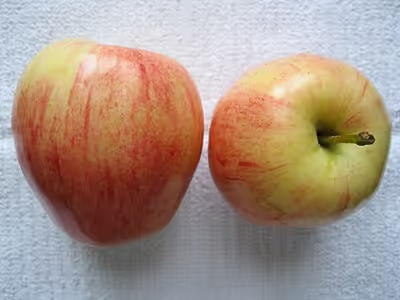
Gala apples are non-uniform in color, usually vertically striped or mottled, with an overall orange color. They have creamy white flesh, which is sweet, fine textured, and aromatic. In addition to being eaten raw and cooked they are especially suitable for creating sauces.
- Density 0.86 g/cc
- Sugar 13.5%
- Acidity 4.2 grams/liter
- Vitamin C 0–5 mg / 100 gram
Sign in to keep reading
3 more chapters are free with a Lably account.
History
The first Gala apple tree was one of many seedlings resulting from a cross between a Golden Delicious and a Kidd's Orange Red planted in Greytown, Wairarapa, New Zealand in the 1930s by orchardist J.H. Kidd. Selected in 1939, introduced in 1960. Donald W. McKenzie, an employee of Stark Bros Nursery, obtained a US plant patent for the cultivar on October 15, 1974. By the early twenty-first century, it has become one of the most popular apple varieties worldwide; productions continue to grow, as of the 2020s.
It is a relatively new introduction to the UK, first planted in commercial volumes during the 1980s. The variety now represents about 20% of the total volume of the commercial production of eating apples grown in the UK, often replacing Cox's Orange Pippin.
During the 2000s the provincial government of Nova Scotia, Canada, subsidized apple producers to replace older trees, mainly the McIntosh, with newer higher-return varieties of apples, including the Gala. Elsewhere in Canada, apple orchardists made the switch as well. By the 2020s, the Gala has become one of the top apple varieties in Canada, alongside the Ambrosia and Honeycrisp. Most Canadian Gala apples are grown in Ontario and British Columbia. The most common strains or sports are the Imperial and Royal Gala.
During the 1980s, American wholesalers began searching for new apple varieties, and one they picked was the Gala. In 2018, the Gala surpassed Red Delicious as the apple cultivar with the highest production in the United States, according to the US Apple Association. It was the first time in over 50 years that any cultivar was produced more than Red Delicious. By 2024, the Gala accounted for 17% of sales in the United States, more than any other apple. The majority of American Gala apples are harvested in Washington State, Michigan, and New York State.
In Brazil, the Gala and Fuji together commanded 95 percent of the apple market in the middle 2020s.
Sports (mutations)
Many sports of Gala have been selected, mostly for increased red color, including the popular Royal Gala. The original cultivar produced fruit with orange stripes and a partial orange blush over a yellow background. Since then, several un-patented sports have been recognized. Additionally, more than twenty sports have received US plant patents:
Unpatented varieties
Descendant cultivars
Season
Gala apples are grown from May through September in the northern hemisphere, but, like most apples, are available almost all year through the use of cold storage and controlled atmosphere storage. Australian Gala are available from late January. California fruit is available until October. While the season usually lasts only 9 or 10 months, they are able to last all year round. However, due to some apples continuing to be grown in some orchards, and the fact that they can be refrigerated for some months leads to the availability of the Gala apple year-round in some Australian markets. These usually taste different (slightly less sweet) from those in season. The UK season begins in late summer (August). Storage makes the UK fruit available nearly year-round as with fruit from other origins.
Royal Gala sport
Royal Gala is a Gala sport, patented by Stark in 1977, which produces redder fruits than the original cultivar. It is a pink-red dessert apple and is therefore usually eaten fresh. Royal Galas are usually harvested in early to late February in the Southern Hemisphere. In New Zealand, the pinker original Gala has almost disappeared as a commercial apple in favor of the darker-skinned Royal Gala.