

Khmelnytskyi
City and administrative center of Khmelnytskyi Oblast, Ukraine
- 12 min read
- 10 chapters

Related on Lably
The city was first mentioned in 1431 as a military outpost. Under the Polish rule it was known as Płoskirów. It was seized by Cossacks during the Khmelnytsky Uprising and was later ruled by the Ottomans until 1699. The city was passed to Russia in 1793 as a result of the Second Partition of Poland, and became part of the newly-formed Podolia Governorate, where it became known as Proskuriv or Proskurov. From 1917 to 1920, it was controlled by the short-lived Ukrainian People's Republic before becoming part of Soviet Ukraine. The city's Jewish population fell from 42 per cent in 1939 to 10 per cent in 1959 as a result of the Holocaust. In 1954, it was renamed Khmelnytskyi in honor of the Cossack leader Bohdan Khmelnytsky.
Khmelnytskyi is the location of a rail junction and an important industrial centre, as well as a centre for higher education such as the Khmelnytskyi National University and the Khmelnytskyi Oblast Ukrainian Music and Drama Theater.
Names
Khmelnytskyi had several names throughout history. In the oldest written evidence about this settlement, the name of the city was mentioned as Ploskirowce, while later documents mentioned its name as Płoskirów, which probably comes from the name of the Ploska River.
In 1793, the city was renamed Proskurov, which appeared on the decree to create Podolia Governorate. This toponym is very similar to the name "proskura", which is a bread in the liturgical service.
On 16 January 1954, celebrating the Union of Russia and Ukraine Tercentenary, Proskuriv was renamed to Khmelnytskyi in honor of Bohdan Khmelnytsky, the Cossack hetman who rebelled against the Polish–Lithuanian Commonwealth.
Sign in to keep reading
9 more chapters are free with a Lably account.
History
Ancient, medieval and early modern eras
The city foundation date is uncertain. The territory where Khmelnytskyi is situated has been inhabited for a very long time. Many archaeological discoveries have been made in the city suburbs. For example, to the East of Lezneve district, there was a settlement from the Bronze Age 2000 B.C., and from Scythian times from 7–3 century B.C. The first mention of the city was written with Cyrillic alphabet. The earliest known mention in historical sources was in 1431, when it was known as Płoskirów (Ploskirov, Плоскиров) and was part of the Kingdom of Poland. It was a royal city of Poland, administratively located in the Podolian Voivodeship in the Lesser Poland Province.
In 1550 King Sigismund II Augustus granted the town to standard-bearer Maciej Włodek as a reward for his military service. In 1578, King Stephen Bathory established weekly markets and three annual fairs. After the death of Stanisław Włodek, son of Maciej, Płoskirów became again a royal city of Poland. It was completely devastated during the Khmelnytsky Uprising, thus as of 1662 it had only 12 inhabitants, who did not pay any taxes. Płoskirów became a private town of the magnate Zamoyski family.
Polish rule was briefly interrupted by the Ottomans between 1672 and 1699. During this period, it was a subdivision of Mejibuji sanjak in Podolia Eyalet as Poloskiruf. The recovery of the city was halted by Ottoman rule. After Poland regained the city, the Zamoyski family came back and brought Poles from Mazovia to resettle the city, exempting the new inhabitants from taxes for the first few years. As of 1765, the city had furriers', weavers' and coopers' guilds. In 1775 King Stanisław August Poniatowski to help further rebuild the city established two additional annual fairs, each lasting two weeks.
19th and early 20th century
After the Second Partition of Poland in 1793, the city was annexed by the Russian Empire and was renamed Proskurov (Проскуров). Russification policies were enacted and intensified after the unsuccessful Polish uprisings of 1830–31 and 1863–65. Nevertheless, local Poles retained their language and customs, including folk costumes inspired by the Biłgoraj area. Writer Maria Dunin-Kozicka noted that Polish was still widely spoken in the city. According to the Russian census of 1897, Proskurov with a population of 22,855 was the fifth largest city of Podolia after Kamianets-Podilskyi, Uman, Vinnytsia and Balta.
With the fall of the Russian Empire, the city was contested by Poles, Ukrainians and Soviets. During that period, a series of anti-Jewish pogroms were carried out in the region, known together as the Proskurov pogrom. According to Vinnytsia's city archives, the pogrom was conducted on the Friday night of February 15, 1919, by one of the otamans (generals) of the Ukrainian People's Army, Otaman Semysenko (also rendered as Semesenko). Estimates vary as to the number of victims, some putting the death toll at 1,500 Jews in Proskurov alone, with 600 more killed in nearby Filshtein.
The Chief Otaman Petliura had been appointed head of state just two days prior to the tragedy, on February the 13th. Petliura issued Order 131 in which he mentioned the fact that numerous Jewish parties in Ukraine (Bund, Poale Zion, Folks-Partei, Unificationists) rose to defend the sovereignty of the Ukrainian Republic and were cooperating with the Ukrainian government. He condemned such pogroms, calling those initiating them deserters and enemies of the State that must be liquidated. The order was co-signed by the Chief of Staff, Otaman Yunakiv. The order was published in the Ukraina newspaper on February 20 (March 4, new style). Later, Petliura issued a special order to execute Semysenko for being the pogrom initiator. According to sources the order was carried out on March 20, 1920. Other sources claim that he was released.
During the Schwartzbard trial, at the end of which Petliura's assassin was pardoned on the grounds of self-trail (revenge), the main argument of the defense was that Schwartzbard had acted as an avenger of the Jews killed in pogroms perpetrated during Petliura's rule.
During the Polish–Soviet War, in the first half of 1920 the city was controlled by Poland as part of the Podolian District, and afterwards it passed to Soviet Ukraine.
Interwar period
As part of korenizatsiia, in 1924, a Polish village council was established in the then village of Hrechany (Polish: Hreczany; now a district of the city), whose entire population was Polish. Hrechany was designed to become the capital of a new Polish National District, however, the plan was abandoned by the Soviet authorities. In 1936, part of the Polish population was expelled to Kazakhstan. During the Polish Operation of the NKVD, the local Polish population was persecuted with mass deportations and executions. It was one of two cities in Podolia where the most Poles were executed (alongside Kamianets-Podilskyi).
World War II
At the start of World War II, on 11 September 1939, the Ukrainian Front of the Red Army was formed shortly before the Soviet invasion on Poland, and its headquarters was located in Proskuriv.
The town was occupied by the German Army from July 8, 1941 to March 25, 1944. On November 4, 1941, 5300 Jewish inhabitants of the town and surrounding villages were shot by an Einsatzgruppe. A ghetto was formed on December 14, 1941, where all surviving Jewish inhabitants had to resettle and were subjected to forced labor. They were subsequently killed in the fall of 1942. More than 9500 Jews were killed in the town in total. Some remaining local Poles were deported by the German occupiers to forced labour in Germany. Since 1943, Poles, who were previously deported east from Proskuriv by the Soviets, were allowed to join the Polish People's Army, and many joined.
Postwar period
In 1954 the city was finally renamed Khmelnytskyi (Хмельницький) in the honor of the 300th anniversary of a treaty negotiated by Bohdan Khmelnytsky.
Khmelnytskyi was home to the 19th Division of the 43rd Rocket Army of the Soviet Strategic Rocket Forces during the Cold War. The intercontinental ballistic missile silos of the division that were housed there were removed and destroyed, partially with U.S. Cooperative Threat Reduction funding, during the 1990s.
After new archival sources had been presented at the 2006 conference City of Khmelnytskyi in the Context of Ukrainian History post-dated the city’s earliest mention from 1493 to 1431, it changed its official 513th anniversary commemoration to its 575th.
Until 18 July 2020, Khmelnytskyi was incorporated as a city of oblast significance and served as the administrative center of Khmelnytskyi Raion though it did not belong to the raion. In July 2020, as part of the administrative reform of Ukraine, which reduced the number of raions of Khmelnytskyi Oblast to three, the city of Khmelnytskyi was merged into Khmelnytskyi Raion.
Russian invasion of Ukraine
On 10 October 2022, during the Russian invasion of Ukraine, the city was targeted by Russian cruise missiles as part of a major retaliation strike for the Crimean Bridge explosion, causing a blackout in the city and limiting water supply.
During a missile attack on 31 December, a gas station and a military facility inside the city was hit by two Russian cruise missiles, killing at least one civilian and wounding nine. The attack also caused a partial blackout and damaged more than a dozen cars and several residential buildings, including a kindergarten.
On 23 February 2023, Russian forces hit Khmelnytskyi with 3 Iranian-made UAVs of the "Shahed type", killing one person and wounding four. Additionally, the attack caused a fire and damaged multiple buildings.
Geography
Khmelnytskyi is the regional center of the Khmelnytskyi region which is located in the western part of Ukraine in the middle of Podillia, its total area makes up 8,624 ha (21,310 acres). Khmelnytskyi has a favorable geographical position. Khmelnytskyi is crossed by one of the longest rivers of Ukraine – the Southern Bug. Coincidentally, through the western portion of the city flows the small river Ploska.
The most abundant make up for the ground in Khmelnytskyi are layers of the following overburden: loess and loess-type rocks. The ground-climatic conditions of Khmelnytskyi are favorable for the cultivation of winter wheat and rye, sugar beet, potato and other crops. Khmelnytskyi is also ideal for the development of gardening and vegetable growing. In the territory of Khmelnytskyi there are the vegetations of two geobotanical zones of Ukraine: Polissya and forest-steppe. Khmelnytskyi and its greater region supplies many rock products, particularly building materials such as limestone, plaster, chalk, tripoli powder, crystal layers (granites, gneisses), sand, sandstones, and also graphite, saponite, kaolin, phosphorite, lithographic stone, and roofing slate. There are also deposits of peat, bitumen, shale, and oil.
Climate
The climate of Khmelnytskyi is moderately continental. The average temperature of Khmelnytskyi in its warmest month (July) is 20 to 22 °C (68 to 72 °F), and the average temperature in the coldest month (January) is −5 to −6 °C (23 to 21 °F). The maximum temperatures in the summer on average reaches 36 to 38 °C (97 to 100 °F), and the minimum temperatures in the winter on average is −24 to −30 °C (−11 to −22 °F). Khmelnytskyi's average annual temperature is 7 to 8 °C (45 to 46 °F). Khmelnytskyi's average annual precipitation is 510 to 580 mm (20.08 to 22.83 in).
Demographics
According to a 2017 survey, 94% of the population are ethnic Ukrainians and 3% are Russians. As of the 2001 Ukrainian census, 88.4% of the population were Ukrainians, 7.9% had an ethnic Russian background and 2% were ethnic Poles. Smaller minorities were Belarusians, Armenians and Ashkenazi Jews. The exact ethnic composition was as follows:
Language
Distribution of the population by native language according to the 2001 census:
According to a survey conducted by the International Republican Institute in April–May 2023, 88% of the city's population spoke Ukrainian at home, and 9% spoke Russian.
Education
Khmelnytskyi hosts 6 universities, 2 academies, 3 institutes, 12 colleges, 4 technical schools and 15 representative offices of other Ukrainian HEIs.
Transport
Khmelnytskyi has infrastructure for transportation connections with Moscow, Prague, Bratislava, Warsaw, Budapest, Belgrade and all major Ukrainian cities. The distance from Khmelnytskyi to Kyiv by railway is estimated to be 366 km (227 mi), by highway it is estimated to be 384 km (239 mi). The highways Kyiv-Lviv, Odesa-Lviv and Chernivtsi-Kyiv pass through Khmelnytskyi. The city is served by the Khmelnytskyi Ruzhychna Airport. Khmelnytskyi's airport has a 2,200 m (7,217.85 ft) concrete runway; at the airport there is a check point for crossing the state border of Ukraine.
Sports
Khmelnytskyi is home to the competitive football team FC Podillya Khmelnytskyi.
Points of interest
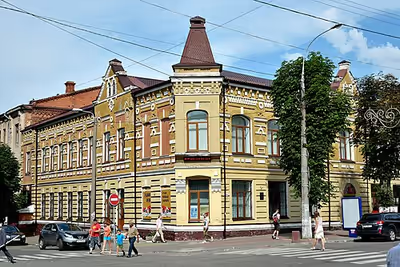
- Proskurivska street, a modern central pedestrian street of the city, preserved buildings of the end of the 19th - the beginnings of 20th century in the styles of modernist, eclecticisms, Baroque, stone (characteristic only for Proskuriv).
- The house of the former Oleksiyivske real school (now it is the building of the City Executive Committee)
- The house of O. Brusilov (now is the House of Ceremonial events)
- The church of Nativity of the Virgin (the first stone construction in the city)
- The Protection cathedral
- St. George church
- Andriy Pervozvannyi church in "Dubovo" district
Notable people
- Boris Berenfeld (born 1947), biophysicist
- Nellie Casman (1896–1984) an actress and singer in Yiddish theatre in New York.
- Ariel Durant (1898–1981) an American author and historian
- Svyatoslav Fyodorov (1927–2000) a Russian ophthalmologist, politician and professor
- Alberto Gerchunoff (1883–1950), Argentine author and journalist
- Max Husmann (1888–1965), Swiss peacemaker, helped Operation Sunrise in WWII
- Anatoly Kashpirovsky (born 1939), Russian psychotherapist and psychic healer
- Jack Liebowitz (1900–2000), an American accountant and co-owner of what became DC Comics
- Harry A. Marmer (1885–1953), American mathematician and oceanographer
- Mischa Mischakoff (1895–1981), American violinist, teacher, and conductor
- Lesia Nikitiuk (born 1987), Ukrainian TV presenter
- Oleksandr Ponomaryov (born 1973), Ukrainian singer
- Alexander Rutskoy (born 1947), Russian politician
- Oksana Shachko (1987–2018), Ukrainian artist and activist with FEMEN
- Alexandra Shevchenko (born 1988), FEMEN activist
- Maria Tuchka (born 1992), known professionally as Tucha, Ukrainian singer-songwriter and record producer
- Mikhail Tsekhanovsky (1889—1965) artist, animation director, book illustrator, screenwriter and sculptor.
- Natalia Valevska (born 1981), Ukrainian pop and dance singer
- Alla Zahaikevych (born 1966) composer of contemporary classical music and performance artist.
- Klemens Zamoyski (1738–1767) a Polish nobleman and 8th Ordynat of Zamość estate
- Tomasz Józef Zamoyski (1678–1725) a Polish nobleman and the 5th Ordynat of Zamość estate.
Sport
- Vitaliy Balytskyi (1978–2018) a Ukrainian football player with 297 club caps
- Dmytro Bezotosnyi (born 1983) a Ukrainian football goalkeeper with over 300 club caps.
- Lyudmyla Holovchenko (born 1978) a retired amateur Ukrainian freestyle wrestler
- Dmytro Ianchuk (born 1992) sprint canoeist and bronze medallist at the 2016 Summer Olympics
- Andriy Kirlik (born 1974) footballer with over 350 club caps and an ordained deacon
- Ruslan Kostyshyn (born 1977) a Ukrainian retired footballer with 547 club caps
- Leonid Krupnik (born 1979) an American-Israeli former soccer player with over 300 club caps, and current coach.
- Oksana Masters (born 1989), American Paralympic rower and cross-country skier
- Serhei Nahorny (born 1956) sprint canoeist, silver and gold medallist at the 1976 Summer Olympics
- Vita Palamar (born 1977) a female high jumper from Ukraine.
- Serhiy Petrenko (born 1956) sprint canoeist, twice gold medallist at the 1976 Summer Olympics
- Olga Polyuk (born 1987), freestyle skier, specializing in aerials, three time Olympian.
- Bohdan Shershun (1981–2024), footballer with over 330 club caps and 4 for Ukraine
International relations
Khmelnytskyi confidently sets a course for European integration. The city of Khmelnytskyi became the winner of The Europe Prize in 2021 – it is the highest honor Parliamentary Assembly of the Council of Europe, which is awarded to cities for spreading European ideals.
Twin towns – sister cities
Khmelnytskyi is twinned with:
- Modesto, United States (1987)
- Silistra, Bulgaria (1992)
- Bor, Serbia (1995)
- Bălți, Moldova (1996)
- Kramfors, Sweden (1997)
- Ciechanów, Poland (1997)
- Shijiazhuang, China (1998)
- Šiauliai, Lithuania (2001)
- Manises, Spain (2002)
- Starobilsk, Ukraine (2022)
- Sheffield, United Kingdom (2022)
- Prague 6, Czech Republic (2022)
In addition, Khmelnytskyi also developed solidary partnership with Stuttgart and Dresden in Germany.
In January 2016, the Khmelnytskyi city council terminated its twinned relations with the Russian cities Tver and Ivanovo due to the Russian military intervention in Ukraine (2014–present).