


Related on Lably
Description
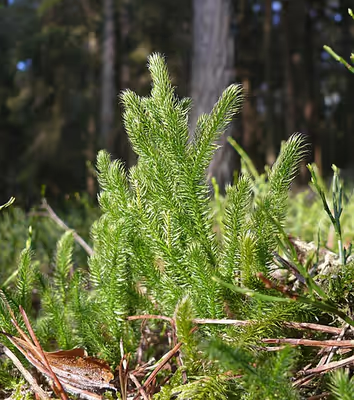
They are flowerless, vascular, terrestrial or epiphytic plants, with widely branched, erect, prostrate, or creeping stems, with small, simple, needle-like or scale-like leaves that cover the stem and branches thickly. The stems usually creep along the ground, forking at intervals. The leaves contain a single, unbranched vascular strand, and are microphylls by definition. They are usually arranged in spirals. The kidney-shaped (reniform) spore-cases (sporangia) contain spores of one kind only, (isosporous, homosporous), and are borne on the upper surface of the leaf blade of specialized leaves (sporophylls) arranged in a cone-like strobilus at the end of upright stems. Each sporangium contains numerous small spores. The club-shaped appearance of these fertile stems gives the clubmosses their common name.
Lycopods reproduce asexually by spores. The plants have an underground sexual phase that produces gametes, and this alternates in the lifecycle with the spore-producing plant. The prothallium developed from the spore is a subterranean mass of tissue of considerable size, and bears both the male and female organs (antheridia and archegonia). They are more commonly distributed vegetatively, though, through above- or below-ground rhizomes.
Sign in to keep reading
2 more chapters are free with a Lably account.
Taxonomy
The genus Lycopodium was first published by Carl Linnaeus in 1753. He placed it in the Musci (mosses) along with genera such as Sphagnum, and included species such as Lycopodium selaginoides, now placed in the genus Selaginella in a different order from Lycopodium. Different sources use substantially different circumscriptions of the genus. Traditionally, Lycopodium was considered to be the only extant genus in the family Lycopodiaceae, so includes all the species in the family, although sometimes excluding one placed in the monotypic genus Phylloglossum. Other sources divide Lycopodiaceae species into three broadly defined genera, Lycopodium, Huperzia (including Phylloglossum) and Lycopodiella. In this approach, Lycopodium sensu lato has about 40 species. In the Pteridophyte Phylogeny Group classification of 2016 (PPG I), the broadly defined genus is equivalent to the subfamily Lycopodioideae, and Lycopodium is one of 16 genera in the family Lycopodiaceae, with between 9 and 15 species.
Species
Using the narrow circumscription of Lycopodium, in which it is one of nine genera in the subfamily Lycopodioideae, the Checklist of Ferns and Lycophytes of the World recognized the following species as of June 2024:
- Lycopodium clavatum L. – stag's-horn clubmoss; subcosmopolitan
- Lycopodium diaphanum (P.Beauv.) Sw. – Tristan da Cunha
- Lycopodium japonicum Thunb. – eastern Asia (Japan west and south to India and Sri Lanka)
- Lycopodium lagopus (Laest. ex C.Hartm.) Zinserl. ex Kuzen. – circumpolar arctic and subarctic
- Lycopodium papuanum Nessel – New Guinea
- Lycopodium venustulum Gaudich. – Hawaii, Western Samoa, the Society Islands
- Lycopodium vestitum Desv. ex Poir. – northwest South America (Andes)
Uses
The spores of Lycopodium species are harvested and are sold as lycopodium powder.
Lycopodium sp. herb has been used in the traditional Austrian medicine internally as tea or externally as compresses for treatment of disorders of the locomotor system, skin, liver and bile, kidneys and urinary tract, infections, rheumatism, and gout, though claims of efficacy are unproven. It has also been used in some United States government chemical warfare test programs such as Operation Dew. Lycopodium powder was also used to determine the molecular size of oleic acid. Also known as a homeopathic remedy.