

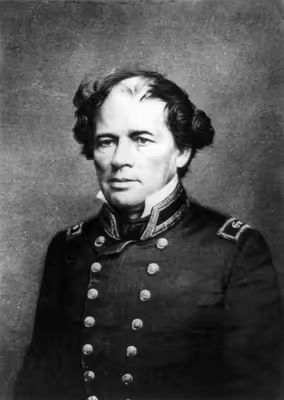
Matthew Fontaine Maury
American oceanographer and naval officer (1806–1873)
- 43 min read
- 8 chapters

Related on Lably
Through American Civil War and Piracy
He was nicknamed "Pathfinder of the Seas" and is considered a founder of modern oceanography. He wrote extensively on the subject, and his book, The Physical Geography of the Sea (1855), was the first comprehensive work on oceanography to be published.
In 1825, at 19, Maury obtained, through U.S. Representative Sam Houston, a midshipman's warrant in the United States Navy. As a midshipman on board the frigate USS Brandywine, he almost immediately began to study the seas and record methods of navigation. When a leg injury left him unfit for sea duty, Maury devoted his time to studying navigation, meteorology, winds, and currents.
He became Superintendent of the Depot of Charts and Instruments, later renamed the United States Naval Observatory, in 1844. There, Maury studied thousands of ships' logs and charts. He published the Wind and Current Chart of the North Atlantic, which showed sailors how to utilize the ocean's currents and winds to their advantage, thereby drastically reducing the length of ocean voyages. Maury's uniform system of recording oceanographic data was adopted by navies and merchant marines worldwide and was used to develop charts for all the major trade routes.
With the outbreak of the American Civil War, Maury, a Virginian, resigned his commission as a U.S. Navy commander and joined the Confederacy. He spent the war in the Southern United States, and Great Britain and France as a Confederate envoy. He helped the Confederacy acquire a ship, CSS Georgia, while trying to convince several European powers to intervene on behalf of the Confederacy. Following the war, Maury was eventually pardoned; he accepted a teaching position at the Virginia Military Institute in Lexington, Virginia.
He died at the institute in 1873 after completing an exhausting state-to-state lecture tour on national and international weather forecasting. He had also completed his book, Geological Survey of Virginia, and a new series on geography for young people.
Early life and career
Maury was a descendant of the Maury family, a prominent Virginia family of Huguenot ancestry that can be traced back to 15th-century France. His grandfather (the Reverend James Maury) was an inspiring teacher to a future U.S. president, Thomas Jefferson. Maury also had Dutch-American ancestry from the Minor family of early Virginia.
He was born in 1806 in Spotsylvania County, Virginia, near Fredericksburg; his parents were Richard Maury and Diane Minor Maury. The family moved to Franklin, Tennessee when he was five. He wanted to emulate the naval career of his older brother, Flag Lieutenant John Minor Maury, an officer in the U.S. Navy, who caught yellow fever after fighting pirates. As a result of John's painful death, Matthew's father, Richard, forbade him from joining the Navy. Maury strongly considered attending West Point to get a better education than the Navy could offer. Instead, he obtained a naval appointment through the influence of Tennessee Representative Sam Houston, a family friend, in 1825, at the age of 19, with the rank of acting midshipman.
Maury's first assignment was on the newly built frigate Brandywine, which was to carry the elderly Marquis de Lafayette home to France following his famous 1824 visit to the United States. Brandywine left from the Potomac River on 9 September 1825, and soon proved to be a fast sailer, making 11 knots as she left Chesapeake Bay and entered the Atlantic. They reached France on 4 October, and the Marquis went ashore at Le Havre. They then sailed to Cowes on the Isle of Wight, where the ship was calked. Maury was anxious to learn as much as possible about navigation, and during his time ashore was able to buy a copy of Norie's Epitome of Practical Navigation. They next sailed for the Mediterranean, reaching Gibralter on 2 November, where there was again shore leave. Maury wished to learn Spanish, and bought a Spanish dictionary and a Spanish textbook of navigation. They then left for Port Mahon on Minorca, the winter American naval rendezvous. Brandywine then returned to the United States, leaving on 26 February 1826, and arriving off Sandy Hook on 17 April. Once back in New York, Maury received his warrant confirming his position as midshipman.
After taking the opportunity to visit relatives, Maury returned to New York on 1 June 1826 to rejoin Brandywine. They were to sail in company with the newly built sloop-of-war USS Vincennes for duty in the Pacific. They left in August headed for Rio de Janeiro. As they sailed into the South Atlantic, Maury was able to see the constellations of the southern skies and the Magellanic Clouds for the first time. They arrived in Rio on 28 October. After some difficulties with the authorities caused by the ongoing war between Brazil and Argentina, they left on 18 November, and as they sailed south, the ships were prepared for the stormy passage around Cape Horn, which took 17 days. On 26 December, the two ships anchored in Valparaíso where they liaised with other American ships, as well as HMS Cambridge of the Royal Navy, and carried out maintenance. On 24 January, Brandywine and Vincennes, together with the United States and Dolphin sailed north to Callao, arriving there on 9 February.
On 9 March 1827 Maury received orders to transfer to Vincennes, which was occupied in patrol duties on the west coast of South America from 1827 to 1829. These were unsettled times in the aftermath of the defeat of Spanish colonial rule, and there was a need to provide protection for American shipping in the event of war. During this time Maury continued his own studies, which at his stage included the works of the mathematician Edward Riddle on spherical trigonometry and lunar observations. In June 1829, Vincennes was ordered to sail across the Pacific to Canton. They set sail on 4 July. The ship's chaplain was Charles Samuel Stewart, who included Maury on many of the excursions he took on the voyage. Stewart wrote an account of the cruise, which was published in two volumes in 1833.
The first port of call was Nuku Hiva in the Marquesas (then known as the Washington Group). Maury had good reason to be interested in this island, as his brother John Minor had been stranded there for nearly two years during the War of 1812. He made several trips to the island with Stewart, on one of which he was able to meet the old Happa chief who had known his brother. They then sailed to Tahiti, arriving at Papeete on 17 August, and then to the Hawaiian Islands. In both Tahiti and Hawaii, William Bolton Finch, the ship's commander, had diplomatic duties, relating to trade, to the welfare of Americans in the islands, return of deserters, and settlement of debts. Vincennes then left the Hawaiian Islands heading for China, anchoring off Macao on 1 January 1830. Finch's mission was both diplomatic, dealing with the Chinese authorities, and obtaining information from the many American traders there. Maury was able to visit the merchants' factories outside the walls of Canton, 70 miles upriver from Macao, but not to enter the city. Vincennes then sailed from Macao on 22 January, and arrived at Manila Bay in the Philippines on 29 January. Maury was able to visit Manila with other officers and chaplain Stewart. On 9 February they left Manila, provisioning in Java, then heading west into the Indian Ocean towards South Africa. During this trip, Maury worked through Euclid and studied the mathematics of Laplace. They arrived in Cape Town on 7 April. The next stop was St Helena, where they visited the tomb of Napoleon. They arrived off the New Jersey shore on 8 June 1830. Vincennes became the first US warship to travel round the world. Maury had been away from the United States for nearly four years, and had learned much, of sailing, weather and navigation, but also seen the importance of practical diplomacy.
Given three months leave, Maury travelled to visit relatives, including his father in Tennessee. Returning via Virginia, he stayed with the Herndon family in Fredericksburg, and renewed his acquaintance with the 19 year old Ann Hull Herndon. In October 1830, Maury reported to the school for midshipmen in New York where he was to prepare for his examination. He was dissatisfied with the teaching at the school, and requested leave to study on his own. This was granted, and in December he moved to Washington, staying with his cousin Richard B. Maury, who was register of the Navy Department and lived in Georgetown. During this time, Ann came to visit. Maury was summoned to take his examination on 3 March 1831. He passed, but was rated 27th out of a class of 40. This low placement may be explained by the account Maury later wrote of his experience:
He who repeats "by heart" the rules of Bowditch, though he does not understand the mathematical principles involved in one of them, obtains a higher number from the Board than he who, skilled in mathematics, goes up to the blackboard, and drawing his diagram, can demonstrate every problem in navigation.
After passing his examination, Maury returned to Fredericksburg, to visit Ann, and they soon became engaged. Maury's next assignment was with the Falmouth, which was scheduled for patrol in the Pacific. He joined the ship on 11 June 1831 as acting sailing master. Being directly responsible for navigation, he wanted to find out about the winds and current he might expect to encounter during the voyage, but to his surprise was unable to find such information. The ship left Sandy Hook on 5 July. After calling at Rio de Janeiro, Falmouth headed south towards Cape Horn. On his second rounding of the Horn, Maury, faced with a contrary westerly gale, took the option of a long tack to the south and found more favourable winds. Another ship, HMS Volage rounding the Cape at about the same time took the inshore passage and was twice blown back before finally managing to beat her way west, taking days longer and sustaining considerable damage in the process. This experience led Maury to write one of his first published works On the Navigation of Cape Horn. As in his previous voyage, Maury visited Valparaiso and Callao. As well as his navigation duties, Maury conducted a number of surveys while on patrol on the coast of South America. His performance was approved sufficiently that he received Lieutenant's pay for the latter part of this tour of duty. In November 1833 in Callao, Maury transferred to the Potomac, which was returning to the United States. On 10 March, after rounding the Horn, the Potomac encountered strong gales and many icebergs, colliding with one in the fog, but without being seriously damaged. After repairs in Rio de Janeiro, the ship headed home, arriving in Boston on 24 May. Granted three months leave, Maury travelled to Fredericksburg, and on 15 July 1834 he and Ann were married.
Sign in to keep reading
7 more chapters are free with a Lably account.
Scientific career
In the same month as the wedding, the American Journal of Science and Arts published Maury's article on the navigation of Cape Horn, as well as an article describing a device he had invented for determining lunar distances. While on the Falmouth, Maury had considered writing a textbook on navigation for the instruction of midshipmen. It would cover both the theoretical and practical aspects of the subject, unlike Bowditch, which relied on learning rules by rote. With no indication of when he might be ordered to a new posting, he set to work on the book, which he completed at the end of April 1835. The manuscript was accepted by the Philadelphia publishers, Key and Biddle. Maury was frustrated by the slow progress of publication, and travelled to Philadelphia to try to speed things up. The book, A New Theoretical and Practical Treatise on Navigation was finally published on 29 April 1836.
Navigation, as the book was generally called, was well-received, with favourable reviews by Edgar Allan Poe as well as a number of naval officers including Maury's former Captain on the Brandywine Francis Gregory who described it as "far superior as a book of instruction than Bowditch". Benjamin Silliman, editor of the American Journal of Science and Arts which had published Maury's articles in 1834, and to whom Maury had dedicated his book, wrote "The estimation in which the work is held among those best qualified to appreciate is worth, may be inferred from the fact that a copy has been ordered to be placed on board all our nautical vessels. It cannot fail to be of important service to the interests of nautical science". It became the standard textbook for midshipmen for many years. Maury was promoted Lieutenant on 10 June 1836.
In the summer of 1836 Maury took employment in a local gold mine. Maury was responsible for a team of fifty men involved in both mining and refining operations. The refining involving amalgamating the ore with mercury to extract the gold, then distillation to separate the gold from the mercury. There was a loss of both metals in this process which Maury thought was excessive, and he invented an alembic that would prevent this loss. This was described in a paper in the American Journal of Arts. On 30 August Professor Silliman visited the mine as part of a tour of the gold-mining region. Maury showed him the mine and its facilities, and was thus able to meet for the first time the man to whom he had dedicated his Navigation.
Maury had seen at first hand the disputes and delays involved in preparation for the United States Exploring Expedition which finally set out in 1838. Frustrated with this, and more generally with what he had seen of the way the navy was managed, he wrote a series of highly critical articles under the pseudonym "Harry Bluff", which appeared in the Richmond Whig and Public Advertiser in August and September of that year. He then composed a series of letters from an equally pseudonymous "Will", to his old messmate Harry. These commented on the issues raised, and were published ion the same paper in December. During the same period, Maury wrote his first article concerning issues specific to the southern States of the USA. A scheme for rebuilding Southern commerce: direct trade with the south was published in the Southern Literary Messenger in January 1839. Maury's next naval assignment was a local one, starting in December 1838, surveying on the Atlantic coast between North Carolina and Georgia, initially in a small steamer, the Engineer. The work was then transferred to the Brig Consort, which would not be ready until October. Given leave until then, Maury visited his parents in Tennessee.
Returning from leave to join Consort in New York, Maury was travelling by stagecoach through Ohio. On the night of 17 October 1839, the stagecoach overturned, and Maury, who was travelling on the top, was thrown to the ground. His right leg suffered multiple fractures, and his knee was dislocated. As a result of this serious injury he spent two years convalescing, but though he improved considerably, in November 1841 it was finally accepted that he would never be fit enough to return to service at sea. During this period, he reviewed his experiences in the Navy, and decided to write about the bungling, and inefficiency in the Navy, which he thought might jeopardise the future of the nation. He revived the "Harry Bluff" pseudonym, and chose to submit the articles to the Southern Literary Messenger which had a broad circulation, and had already published one of his pieces. The series was aimed at a general audience, who might be unfamiliar with naval issues, and was called Scraps from the lucky bag, the lucky bag being a receptacle for lost and found objects at sea. Articles dealt with the necessity of a navy both for security and national prestige, the need for coastal fortifications, the state of education and the status of officers, the cost of naval shipbuilding and repairs, and the need for re-organisation. The articles gained a wide readership, being reprinted and also circulated by naval officers, and generated considerable controversy.
Maury was elected a corresponding member of the National Institute for the Promotion of Science. The first bulletin of the Institute published in 1841 included a letter from him arguing for exploration of the bottom of the ocean, suggesting that this could be done by equipping revenue cutters with trolls to drag the bottom in the areas they were working, and instructing their crews in carrying out and recording the results of this work. Maury continued to write articles for the Messenger both under the pseudonym "Harry Bluff" and also "Union Jack". In an 1841 Letter to Mr Clay he argued for the development of a Navy yard in Memphis which would help support defences in the Gulf of Mexico, and also suggested a canal should be built to link the Upper Mississippi River to the Great Lakes to support the Naval defence of that area. The following year, he raised the question of the search of American vessels by the Royal Navy on anti-slavery patrol. He likened the British behaviour to a return to the abuses that had led to war between Great Britain and the United States thirty years earlier. Maury made it clear that he did not want war with Britain, but stated "In the Navy, there is but one sentiment ... avert war honorably if you can: if not, let it come: right or wrong the stars and stripes shall not be disgraced on the ocean."
In June 1842, Maury was appointed officer-in-charge of the Navy's "Depot of Charts and Instruments". He arrived in Washington on July 4. This was a significant period for the Navy, as two bills were being discussed in Congress. The first was a bill to re-organise the Navy, and it included many of the measures that Maury had advocated in his "Harry Bluff" articles, including the abolition of the three-officer Board of Commissions, which Maury and many other officers saw as a source of inefficiency in naval procurement. The second was an appropriation bill authorising spending on a new building for the Depot as well as an attached observatory. Both bills passed in August. Maury located a suitable building on Pennsylvania Avenue, and moved the records and equipment of the Depot there. The equipment included chronometers, sextants, barometers and thermometers, as well as a telescope mounted to determine transit times and thus to rate chronometers according to solar and sidereal time. With the approval of additional funds, purchasing of astronomical instruments in Europe, as well as local manufacture, was organised.
Among the records for which Maury was responsible were the logbooks that officers kept during a voyage with a daily record of position, speed, winds, currents, and other weather conditions and observations. The archive contained logs for most of the voyages made by Navy ships since the Navy was created. Maury quickly realised the value of this information, which if properly organised could provide the kind of data he was unsuccessfully looking for when preparing for his assignment on Falmouth as sailing master. Maury decided to start with voyages from New York to Rio de Janeiro, a frequently made voyage for which there were many logbooks. Maury and his assistants worked to extract and summarise the data to provide average conditions for each season of the year for the sea areas along the route. Analysis of the many logs convinced Maury that navigators were not following the best routes, and that substantial savings could be made, and safety improves, if the data were made generally available. But there were many gaps, and he needed additional data to produce satisfactory charts. Maury prepared an abstract log for collection of data in a standard format. This was authorised by the Navy, and an order issued for its use by all naval vessels in late 1842. A version of the log was also prepared for the merchant service.
The first published product of the work on logs was Directions for approaching the west coast of Sumatra which appeared in March 1843. This helped Maury to publicise his plan, which he presented at a meeting of the National Institute for the Advancement of Science in July. He also published a paper aimed at the general public in the Southern Literary Messenger in August. While waiting for more data, Maury continued analysing the old logbooks, and also carried on with the other work of the Depot, including maintaining and calibrating nautical instruments, managing charts, and preparing weather reports, which were issued weekly. He was much involved in the organisation of the "first national Congress of Scientific men" which the National Institute was holding in April 1844. Maury gave a presentation entitled The Gulf Stream and Currents of the Sea on April 2. This was published in the Southern Literary Messenger. During 1844, work on the new observatory building, authorised in 1842, was nearing completion. He was confirmed as head of the Observatory, as well as of the Depot.
Taking up his duties in the Observatory on 8 October 1844, Maury was distressed to find that the instruments had been damaged as a result of being mounted before the building had stabilised and dust had settled, and because of the use of inappropriate materials in construction. Delays resulted while instruments were cleaned and repaired, and the mountings properly prepared. All was in order by April 1, 1845, when former president John Quincy Adams, who had been an early supporter of the Observatory, visited, and was curious to see the "lighthouse in the sky". He thought that there should be a house for the superintendent, and said he would like to return and look through some of the instruments. Maury arranged this on a clear night, and Adams recorded in his memoirs that "Lieutenant Maury came with a hack and took me to the Observatory, where I looked through the large Fraunhofer refractor at the nebula Orionis, at the cluster of spangles in Auriga, at the blazing light of Sirius, and at the double stars, orange and blue, in Andromeda."
Maury put together a team of nine naval officers who were trained as astronomical observers, and he carried out many observations himself. An important part of the work was cataloguing stars, both to provide additional information to that in existing catalogues, and to explore a new area of the sky. The existing star catalogues only covered the sky to 15°S. The Washington observatory, being considerably further south than the main observatories in Europe, could cover the skies to 30°S, and thus provide new and valuable information. Maury also pointed out that the sky is not static. Stars change in brightness, sometimes dramatically, and stars and nebulae are not fixed in position. With the power of telescopes it had become possible to show this movement, which suggested that our galaxy is rotating about a centre remote from our solar system. Thus continual observations are needed to track these processes. Maury made an unexpected observation on the night of January 13, 1846. He was observing Biela's Comet which had the short orbital time of 6.6 years. Until then, it was notable mainly as the only comet known to intersect the earth's orbit. When Maury turned his telescope to it, he saw a second object slightly to the north, and surmised the Biela had split in two. This was subsequently confirmed, and on the next expected return in 1852 both companions were seen. But in 1872 instead of the comets there was a spectacular meteor shower, indicating that the comet had disintegrated.
In Autumn 1847, Maury sent a report on progress to John Quincy Adams in the form of a letter, which was published early the following year in the Southern Literary Messenger. He pointed out that astronomy was a rapidly advancing subject, and discussed some of the recent advances, both in the science and the attitudes toward it. Thus comets were seen in previous centuries as portents of doom, but were now subjects of eager interest. He gave an account of the instruments in the observatory and their purposes, and described the plan of observations and cataloguing to be carried out, and noted the progress that had already been made. He reminded his readers of the practical uses of astronomy, especially in navigation and surveying, but also the potential to help provide a universal basis for standards of weights and measures. He also dealt with the other activities for which he was responsible, those of the original Depot, of managing charts, records, and instruments, and making meteorological observations. He described the progress of the preparation of Wind and Current Charts, which would present the results of the work summarising data from the ships' logs. The first of eight sheets of the Atlantic had already been published, the others were with the engraver.
On the basis of the wind and current data, Maury was convinced that mariners sailing to Rio de Janeiro from the Eastern USA were taking an unnecessarily devious course, in particular sailing too for to the eastward. He recommended sailing no further east that 30°W when crossing the equator. The Doldrums, an area of variable, light, and often non-existent winds lies near the equator, but winds are more reliable further west. He then recommended staying fairly close to the Brazilian coast when rounding Cape St. Roque on the easterly "bulge" of Brazil. This ran counter to conventional wisdom among mariners, who preferred to stay well away from the Brazilian coast, but at the risk of calms or contrary winds. The first to try the new route was Captain Jackson of the Baltimore bark W. H. D. C. Wright who sailed to Rio in early 1848. Ho took 38 days, which was a saving of 17 days compared to the normal time. On his return trip he made a similar saving. This achievement was widely publicised, and did much to increase demand for Maury's charts. As Maury did not sell the charts, but made them freely available to those who would complete the abstract logs, it also did much to increase the amount of information coming into the depot.
In 1848, the American Association for the Advancement of Science (AAAS) was formed by the amalgamation of the American Association of Geologists and Naturalists, and the National Institute, of which Maury was a member. He gave a presentation at the Association's first meeting in September, giving a scientific account of the Wind and Current Charts and of the success in gaining the cooperation of navigators in submitting information. He asserted that "Never before was such a corps of observers known; and never before could the commercial marine of any country boast of such a body of navigators as those of America." The meeting adopted a resolution to set up a committee to promote cooperation with other nations to obtain observations to "extend and perfect" the charts for the benefit of all. The charts were certainly gaining international recognition. The "fair way to Rio", as Maury called it, was only the first of many routes to benefit from Maury's efforts. He suggested that by sailing further to the north, vessels from New York could save a day on the voyage to Liverpool, and a week on that to Le Havre. He also looked at voyages from Europe to south of the equator. Whether headed for Cape Horn or the Cape of Good Hope, the advice was the same as for the Rio passage - sail further to the west to avoid the worst of the doldrums.
Maury's first series of charts, the track charts, covered all the major oceans, and were referred to as series A. Series B covered trade winds and monsoons. Series C, known as Pilot Charts, showed summarised data for 5° X 5° rectangles of latitude and longitude, with the winds from each of the 16 compass points charted by month of the year. Series D were charts of temperature, with colour coding. Series E were storm charts, and Series F were whale charts. To complement the charts, Maury provided a series of explanations. The first two editions were published in 1850, with the title Notice to Mariners. A much expanded third edition appeared in 1851 with the title Explanations and sailing directions to accompany the Wind and Current Charts, and this continued to be revised and expanded until the eight edition, in two volumes, in 1858/1859. The content of Explanations went well beyond issues directly concerned with navigation and meteorology, including material on the saltiness of the seas, deep-sea sounding and the nature of the sea floor, and microscopic life in the sea.
Maury's work on ocean currents and investigations of the whaling industry led him to suspect that a warm-water, ice-free northern passage existed between the Atlantic and Pacific. He thought he detected a warm surface current pushing into the Arctic, and logs of old whaling ships indicated that whales killed in the Atlantic bore harpoons from ships in the Pacific (and vice versa). The frequency of these occurrences seemed unlikely if the whales had travelled around Cape Horn.
Maury was active in the debates concerning transcontinental railroads. In 1849, as the gold rush to California was increasing, Maury advocated construction of a railroad across the Isthmus of Panama. This was built, opening to traffic in 1855. However, Maury considered a railroad through United States territory to be much more important than an isthmus link, for two reasons. Firstly, a railroad provided collateral advantages to the county and people in its vicinity, with improved communications and increased property values, which would not arise from a link in Central America. Secondly he saw that a railroad had military importance, enabling rapid transport of reinforcements and ordnance, which again would only be fully realised with a rail link within the United States. The military consideration also had implications for the Pacific terminus of the railroad, which in Maury's view needed to be at a port which would provide facilities for a naval base. In his view this could not be at the mouth of the Columbia River, another alternative being considered, as it was "under the very guns of our rival" the British, based on Nearby Vancouver Island. Maury argued for either San Francisco or Monterey, as being halfway along the U.S. Pacific coast, and having good harbours. The defence writer John Fass Morton has remarked that "Maury was among the first to appreciate and articulate the strategic military importance of the telegraph and railroads". In October 1849 there was a convention held in Memphis to discuss railroad routes and policies. Maury was selected as president of the convention. Various routes were suggested, starting at Natchez, Alabama, Vicksburg and Memphis. The most favoured was a route from Memphis to Monterey, California, which could also could open up commerce with the northern states of Mexico. This was popularly known as the Maury plan.
The third meeting of the AAAS was held in Charleston in March 1850. Maury presented four papers: On the Gulf Stream; Electro-chronography in determining the figure of the earth; Atlantic currents; and Atmospheric circulation.
In 1851, Maury was able to report that the use of his charts had shortened the passage from New York to San Francisco by 40–44 days. The average for ships using the charts was 144.5 days, for those not using the charts it was 187.5 days. The clippers, which were becoming increasingly popular at this time, achieved faster times. Flying Cloud set a record of 90 days in 1851, using Maury's charts. This stimulated great competition between clipper captains. In effect, the 15,000 mile route between New York and San Francisco became a race-course. A celebrated race, in 1852, was between the Wild Pigeon, the John Gilpin, the Flying Fish, and the Trade Wind. Flying fish won with a time of 92 days. The slowest passage was 118 days. The race was described in detail by Maury in his Physical Geography of the Sea. Another famous race was between Flying Cloud and the Hornet, which the Flying Cloud won with a passage of 104 days, against 106 for Hornet. These passage times were much used in advertising by the shipping companies. The savings in time meant both savings in costs, and a decrease in the hazards of these voyages. These were appreciated by merchants and shippers, by insurance companies, and by governments. For example, the British government noted the liberality of American provision of Wind and Current Charts charts, subject only to conditions which were regarded as "easy and just". Savings were estimated to be, at a minimum £2,000,000 a year on the Indian Ocean routes.
For his scientific endeavors, Maury was elected to the American Philosophical Society in 1852.
International meteorological conference
Maury recognised the need for international cooperation in gathering information from the oceans of the world, writing:
The field is as wide as the world, and as broad as the ocean, and the work is for the benefit of all who use the sea, and therefore it appeared appropriate that all who use the sea should be invited to contribute, each his quota towards its safe and easy navigation. Every right-minded seaman will, I am sure, he glad of the invitation, because it affords him the privilege of increasing the value of this great magazine of nautical information.
In November 1851, Secretary of State Daniel Webster received a communication from the British Government suggesting United States co-operation in international land-based meteorological observations. This was passed to Maury, who saw the opportunity to expand this proposal to include sea-based observations, stating that "no general system of meteorological observation can be considered complete unless it embrace the sea as well as the land". He suggested that an international meteorological congress be held, at which a universal system of making meteorological observations could be agreed, and a programme of international collaboration collecting such data established. Webster and Secretary of the Navy William A. Graham approved this plan, and the proposal was sent as an official reply to the British. Maury was authorised to confer with relevant officials in at home and abroad on implementing the proposal. He first contacted diplomats representing and dealing with countries both in Europe and Latin America, as well as Turkey, Hawaii and China. He then obtained support from many prominent scientists abroad, including Alexander von Humboldt. He had less success at home. Both Joseph Henry, secretary of the Smithsonian Institute and Alexander Dallas Bache, superintendent of the U.S. Coastal Survey were suspicious of government initiatives in scientific matters, and Henry, who was working on land meteorology was actively opposed to the inclusion of land observations in the international programme. There was also opposition from London's Royal Society to the inclusion of land observations, probably because many countries already had established land-based programmes, and it would be more difficult to get agreement than for the sea, where work was much less advanced. However, the Royal Society's report to the Government strongly supported the idea of international sea-based meterology.
The United States decided early in 1853 that an invitation should be issued to an international conference for agreeing a universal system for observations at sea. In April, Britain had still not indicated whether it would take part, and Lord Wrottesley, a distinguished astronomer, made an important speech in the House of Lords supporting the proposal. When this had no immediate effect, the United States decided to send the invitation anyway, as several of the most important countries had already indicated their intention to send delegates. This was done, the International Maritime Meteorological Conference being announced to be held starting on 23 August 1853 in Brussels.
Maury was the United States representative at the conference, and sailed from New York to Liverpool on 23 July 1853. In Liverpool he addressed a meeting of shipowners and underwriters in the Town Hall. This resulted in a petition to the British Government to take part in the forthcoming conference. He then stayed with Lord Wrottesley near Wolverhampton, who was still trying to convince the government to take part in the Brussels conference. He then addressed a meeting at Lloyd's of London. Just before leaving England for the conference itself he heard that the British Government had agreed to take part.
The countries sending delegates to he conference were: Belgium, Denmark, France, Great Britain, The Netherlands, Norway, Portugal, Russia, Sweden, and the United States. The Belgian astronomer Adolphe Quetelet was elected presiding officer. Maury gave the opening address, in which he presented the system being used by the United States. He explained that charts would be made available freely to navies and merchant vessels of other nations on the same basis as to those of the United States, i.e. to those who agreed to provide log data in return. The system would be voluntary for merchant ships, but he suggested that participating navies would order their ships to use the system. Detailed discussions took place over a two-week period on the specific observations that would be made, and their frequency, the instruments to be used, the form of the abstract log, and the instructions to be given. Agreement was reached, and the final vote, to adopt the system, and to encourage the participation of additional counties, was unanimous. The conference closed on 8 September.
After visiting scientists in Holland Germany France and Britain, Maury returned home, arriving in Washington on 5 October. His report was approved, and he started work on implementation of the plan. Within four months of the conference, Prussia, Spain, Portugal, the Free City of Hamburg, the Republic of Bremen, Chile, Brazil, and others agreed to join the enterprise. By 1858, Mary could state that nations owning more than nine-tenths of the world's shipping of the world's shipping were sending their oceanographic observations to Maury at the Naval Observatory, where the information was evaluated and the results were given worldwide distribution. The Pope established honorary flags of distinction for the ships of the Papal States, which could be awarded only to the vessels that filled out and sent to Maury in Washington, DC, the Maury abstract logs.
Proposed deportation of enslaved people to Brazil
Maury had long been interested in Latin America, and had argued for increased direct trade from southern ports such as Norfolk and Charleston to Latin America as a way of strengthening the economy of the American south. His interest in Brazil was particularly aroused by Brazil's "closed-door" policy towards Amazon navigation, prohibiting steamboat access for both trade and exploration. In 1852 he submitted a Memorial to Congress advocating the establishment of a mail steamboat line between Norfolk or Charleston and Pará at the mouth of the Amazon, which would both stimulate the commerce of the southern states, and facilitate direct trade between the USA and Brazil.
Maury had another reason for wanting to see the Amazon valley opened up. He saw the Black population of the southern states as a problem. He pointed out that when the northern states abolished slavery, they did not necessarily emancipate their slaves. Most states had a gradual policy that allowed the slaveholders to go south with their slaves and either settle in the south or sell the slaves and return home. Thus he saw the northern policy as effectively banishment of their Black population. But no such option existed for the South. Enslaved people could not go out of slave territory: "The South could not, if she would, banish her slaves and tell the world that it is emancipation; for she has no place of banishment to send them to". Maury did not believe that black and white could freely co-exist peaceably: "the time will come ... when the two races will join in the death struggle for mastery". He did not consider African colonisation a practical option, but thought the valley of the Amazon was the solution. It was already slave territory; and it was, in his view, largely a wilderness that could be tamed by African labour. Thus he saw the valley of the Amazon as "the safety-valve of the South." Maury expressed these views in an article in the Southern Literary Messenger, and in a letter to his cousin in New York,.
Maury's position was criticised at the time, by Marcus C. M. Hammond of South Carolina, for implying the probable future extinction of slavery in the South. Hammond argued that the anti-slavery movement was running to seed, that Britain would re-establish slavery in its colonies in due course, that "slavery, this day, stands on a firmer basis than it has ever done!", and that if necessary the South could break the cordon restricting slavery by conquering Mexico to establish slavery there, or could introduce slavery into California and Oregon. While Maury was not himself a slaveholder, modern critics have tended to see His position as pro-slavery, international and expansionist, emphasising his reference to the work in clearing the Amazonian "wilderness" for cultivation which was "to be done by the African with the American axe in his hand."
While exploration of the Amazon by steamboat was forbidden, Maury proposed an alternative plan for exploration to William Alexander Graham, Secretary of the Navy. This involved sending explorers to cross over the Andes from Lima in Peru into the headwaters of the Amazon, and then to descend the river "as they might", gathering information on the way. Two naval officers led the expedition. One was Maury's brother-in-law, Lieutenant William Lewis Herndon, the other was midshipman Lardner Gibbon. The expedition left Lima on 21 May 1851. Herndon and Gibbon arrived back in the USA the next year, having taken different routes and experienced great hardship, and both men discussed their findings with Maury in detail. Maury wrote extensively about Brazil under the pseudonym "Inca". The first articles appeared in late 1852 as a series of letters in the Daily National Intelligencer. In these, He wrote at length on the geography and climate of the Amazon and La Plata valleys, emphasising their fertility, and the relative mildness of the climate compared to areas in other continents at similar latitudes. He described resources including gold, diamonds, ornamental woods, and other important plants. He pointed out the importance of the five republics whose territory included navigable tributaries of the Amazon, Bolivia, Peru, Granada (mainly present-day Colombia), Ecuador, and Venezuela, and which were forced by Brazil's policy to export commodities over the mountains to the Pacific or Caribbean coasts, rather than down the Amazon and to the Atlantic. He argued that Brazil had no right to shut of the navigation of these countries, and compared their policy unfavourably with that of Japan, which closed commerce only with its own territory. He suggested that it should be the policy of the great commercial nations not to permit such a situation to continue.
The interest aroused by the publication of the account of Herndon and Gibbon's expedition led the editor of De Bow's Review to request additional articles from Maury, which were published in 1853. The situation of La Plata had changed, and that valley had been opened to navigation. Also, Brazil had started steamboat navigation on the Amazon, but only by its own boats. Maury re-iterated the demand that Brazil opened its waters to international traffic, arguing that it would be beneficial to Brazil's prosperity as well as to other nations. He cited the fact that Brazil had ordered the arrest of the explorer Alexander von Humboldt if he ever entered Brazil, as evidence for the absurdity of the policy. However, Emperor Pedro II's government firmly rejected the proposals, and Brazil maintained its closed-door policy until 1866, when it was at war against Paraguay, and free navigation in the area had become necessary.
American Civil War
Maury staunchly opposed secession, but in 1860, he wrote letters to the governors of New Jersey, Pennsylvania, Delaware, and Maryland urging them to stop the momentum toward war. When Virginia declared secession in April 1861, Maury nonetheless resigned his commission in the U.S. Navy, choosing to fight against the North. With the outbreak of the American Civil War, Maury joined the Confederacy.
Upon his resignation from the U.S. Navy, the Virginia governor appointed Maury commander of the Virginia Navy. When this was consolidated into the Confederate Navy, Maury was appointed Commander in the Confederate States Navy and became chief of the Naval Bureau of Coast, Harbor, and River Defense. In this role, Maury helped develop the first electrically controlled naval mine, which caused significant damage to U.S. shipping. Maury had experience with transatlantic cable and electricity flowing through wires underwater when working with Cyrus West Field and Samuel Finley Breese Morse. The naval mines, called torpedoes at that time, were similar to present-day contact mines and were described by the Secretary of the Navy in 1865 as "to have cost the Union more vessels than all other causes combined."
In September 1862, Maury, partly because of his international reputation, and partly due to jealousy of superior officers who wanted him placed at some distance, was ordered on special service to England. There, he sought to purchase and fit ships for the Confederacy and persuade European powers to recognize and support the Confederacy. Maury traveled to England, Ireland, and France, acquiring and fitting out ships for the Confederacy and soliciting supplies. Through speeches and newspaper publications, Maury unsuccessfully called for European nations to intercede on behalf of the Confederacy and help end the American Civil War. Maury established relations for the Confederacy with Emperor Napoleon III of France and Archduke Maximilian of Austria, who, on April 10, 1864, was proclaimed Emperor of Mexico.
At an early stage in the war, the Confederate States Congress assigned Maury and Francis H. Smith, a mathematics professor at the University of Virginia, to develop a system of weights and measures.
Later life
Maury was in the West Indies on his way back to the Confederacy when he learned of its collapse. The war had brought ruin to many in Fredericksburg, where Maury's immediate family lived. On the advice of Robert E. Lee and other friends, he decided not to return to Virginia but sent a letter of surrender to U.S. naval forces in the Gulf of Mexico and headed for Mexico. There Maximilian, whom he had met in Europe, appointed him "Imperial Commissioner of Colonization". Maury and Maximilian planned to entice former Confederates to emigrate to Mexico, building Carlotta and New Virginia Colony for displaced Confederates and immigrants from other lands. Upon learning of the plan, Lee wrote Maury saying, "The thought of abandoning the country, and all that must be left in it, is abhorrent to my feelings, and I prefer to struggle for its restoration, and share its fate, rather than to give up all as lost." In the end, the plan did not attract the intended immigrants and Maximilian, facing increasing opposition in Mexico, ended it. Maury then returned to England in 1866 and found work there.
In 1868, he accepted a pardon from the U.S. government. He returned to the US, teaching physics at the Virginia Military Institute in Lexington, Virginia. While in Lexington, he conducted a physical survey of Virginia, which he documented in the book The Physical Geography of Virginia. He had once been a gold mining superintendent outside Fredericksburg and had studied geology intensely during that time, so he was well-equipped to write such a book. He aimed to assist war-torn Virginia in rebuilding by discovering and extracting minerals, improving farming practices, and other efforts. He lectured extensively in the United States and abroad. He advocated for creating a state agricultural college as an adjunct to the Virginia Military Institute. This led to the establishment of the Virginia Agricultural and Mechanical College in Blacksburg in 1872, later renamed Virginia Polytechnic Institute and State University. Maury was offered the position as its first president but turned it down because of his age.
He had previously been suggested as president of the College of William & Mary in Williamsburg, Virginia, in 1848 by Benjamin Blake Minor in his publication the Southern Literary Messenger. He considered becoming president of St. John's College in Annapolis, Maryland, the University of Alabama, and the University of Tennessee. From statements that he made in letters, it appears that he preferred being close to General Robert E. Lee in Lexington, where Lee was president of Washington College. Maury served as a pallbearer for Lee. He also gave talks in Europe about cooperation on a weather bureau for land, just as he had charted the winds and predicted storms at sea many years before. He gave speeches until his last days, when he collapsed while giving one. He went home after he recovered and told his wife Ann Hull Herndon-Maury, "I have come home to die."
Death and burial
He died at home in Lexington at 12:40 pm on Saturday, February 1, 1873. He was exhausted from traveling throughout the nation, giving speeches promoting land meteorology. His eldest son, Major Richard Launcelot Maury, and son-in-law, Major Spottswood Wellford Corbin, attended him at the time. Maury asked his daughters and wife to leave the room. His last words, recorded verbatim, were "all's well," a nautical expression meaning calm conditions at sea.
His body was placed on display in the Virginia Military Institute library. Maury was initially buried in the Gilham family vault in Lexington's cemetery, across from Stonewall Jackson, until, after some delay, his remains were taken through Goshen Pass to Richmond, Virginia the following year He was reburied between Presidents James Monroe and John Tyler in Hollywood Cemetery in Richmond, Virginia.
Legacy
After decades of national and international work, Maury received fame and honors, including being knighted by several nations and given medals with precious gems as well as a collection of all medals struck by Pope Pius IX during his pontificate, a book dedication and more from Father Angelo Secchi, who was a student of Maury from 1848 to 1849 in the United States Naval Observatory. The two remained lifelong friends. Other religious friends of Maury included James Hervey Otey, first Episcopal Bishop of Tennessee and his former teacher who, before 1857, worked with Bishop Leonidas Polk on the construction of the University of the South in Tennessee. While visiting, Maury was convinced by his old teacher to deliver the "cornerstone speech."
As a U.S. Navy officer, he declined awards from foreign nations. Some were offered to Maury's wife, Ann Hull Herndon-Maury, who accepted them on her husband's behalf. Some have been placed at Virginia Military Institute or lent to the Smithsonian. He became a commodore (often a title of courtesy) in the Virginia Provisional Navy and a Commander in the Confederacy.
Maury advocated for naval reform, including a school for the Navy that would rival the Army's United States Military Academy. That reform was heavily promoted by Maury's "Scraps from the Lucky Bag" and other articles printed in newspapers. Some of these articles were reprinted and circulated by naval officers who supported his ideas. This helped to bring about numerous changes in the Navy, including Maury's long-awaited dream of creating the United States Naval Academy, which was established in 1845.
Maury's Wind and Current Charts provided a model for a class of charts that continue to the present as "Pilot Charts" or "Routeing Charts". Well into the 20th Century, the U.S. charts carried an acknowledgement to Maury as the originator of the series.
Maury has been honoured in a number of ways, including statues, and the naming of buildings, ships, paths, and natural features in his memory. These memorials have been contested due to Maury's role as a confederate officer and advocate. An early example of this was the action of the Salem Marine Society during the American Civil War. When Maury was in charge of the Naval Observatory, the Society elected him an honorary member on account of his labours to lessen the destruction of life and property on the sea. But they expelled him "when he turned traitor and sided with the rebels", and turned his portrait to the wall, hung head-down. The protests following the death of George Floyd in May 2020 led to calls for the removal of statues of confederate politicians and military leaders, and the removal of their names from buildings, and Maury was among those targeted.
Buildings on several college campuses have been named in his memory. Maury Hall was the home of the Naval Science Department at the University of Virginia and headquarters of the university's Navy ROTC battalion until being renamed in 2022. The original building of the College of William & Mary Virginia Institute of Marine Science was named Maury Hall as well, but renamed York River Hall in 2020. Another Maury Hall housed the Electrical and Computer Engineering Department and the Robotics and Control Engineering Department at the United States Naval Academy in Annapolis, Maryland. On February 17, 2023, the Academy announced that it had renamed this building in honor of Jimmy Carter, the only Naval Academy graduate to become President of the United States. The change had been recommended by a naming commission created by federal law to reexamine Confederate-related names and symbols on military installations. James Madison University also has a Maury Hall, the university's first academic and administrative building. In the wake of the 2020 George Floyd protests, JMU student organizations called for renaming the building. On Monday, June 22, 2020, hearing the calls of students and alums, the university president announced it would recommend to the JMU board of visitors to rename Maury Hall, along with Ashby Hall and Jackson Hall.
Ships have been named in his memory, including various vessels named USS Maury; USS Commodore Maury (SP-656), a patrol vessel and minesweeper of World War I; and a World War II Liberty Ship. Additionally, Tidewater Community College, based in Norfolk, Virginia, owns the R/V Matthew F. Maury. The ship is used for oceanography research and student cruises. In March 2013, the U.S. Navy launched the oceanographic survey ship USNS Maury (T-AGS-66), in 2023 the ship was renamed USNS Marie Tharp.
The Mariners' Lake, in Newport News, Virginia, had been named after Maury but had its name changed during the George Floyd protests. The lake is located on the Mariners' Museum property and is encircled by a walking trail.
The Maury River, entirely in Rockbridge County, Virginia, near Virginia Military Institute (where Maury taught), also memorializes the scientist, as does Maury crater, on the Moon.
Matthew Fontaine Maury High School in Norfolk, Virginia, is named after him. Matthew Maury Elementary School in Alexandria, Virginia, was built in 1929. The school was renamed Naomi L. Brooks Elementary School in 2021 based on Maury's association with the Confederacy , with the school's student moniker changed from "Mariners" to "Bees". Nearby Arlington, Va., renamed its 1910 Clarendon Elementary to memorialize Maury in 1944; Since 1976, the building has been home to the Arlington Arts Center (rebranded in 2022 as the Museum of Contemporary Art Arlington). There is a county historical marker outside the former school. Matthew Fontaine Maury School in Fredericksburg was built in 1919-1920 and closed in 1980. The building was converted into condominiums and is on the National Register of Historic Places. Adjoining it is Maury Stadium, built in 1935 and still used for local high school sports events.
Numerous historical markers commemorate Maury throughout the South, including those in Richmond, Virginia, Fletcher, North Carolina, Franklin, Tennessee, and several in Chancellorsville, Virginia. Maury’s portrait, along with others, is painted on the ceiling of the State Library room in the Tennessee State Capitol in Nashville, Tennessee.
The Matthew Fontaine Maury Papers collection at the Library of Congress contains over 14,000 items. It documents Maury's extensive career and scientific endeavors, including correspondence, notebooks, lectures, and written speeches.
On July 2, 2020, Richmond Mayor Levar Stoney ordered the removal of a statue of Maury, erected in 1929 on Richmond's Monument Avenue. The mayor used his emergency powers to bypass a state-mandated review process, calling the statue a "severe, immediate and growing threat to public safety."
Maury's methods of data collection and analysis used for his charts have been seen by a number of authors as pioneering approaches that would be used in modern information technology. Thus his use of mariners to record wind, currents and weather on their voyages, and to provide the results on standardised forms, has been seen as an early form of crowd-sourcing. Viktor Mayer-Schönberger and Kenneth Cukier see Maury's analysis and presentation of the wind and current data as an early example of big data. They write:
Commander Maury, the "pathfinder of the seas" was among the first to realise that there is a special value in a huge corpus of data that is lacking in smaller amounts- a core tenet of big data. More fundamentally, he understood that the Navy's musty logbooks actually constituted "data" that could be extracted and tabulated. In so doing, he was one of the pioneers of datafication, of unearthing data from material that no one thought had any value.