


Related on Lably
Through Port, Urban area and Tropical monsoon climate
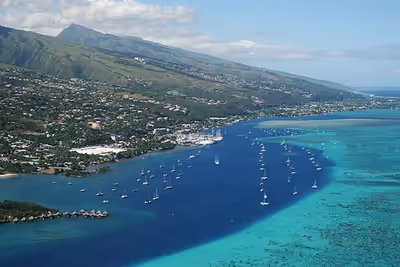
It is the primary center of Tahitian and French Polynesian public and private governmental, commercial, industrial, and financial services, the hub of French Polynesian tourism and a commonly used port of call. The Windward Islands are themselves part of the Society Islands. The name Papeʻete, means "water from a basket"— this was an effect of a naming taboo during Pōmare I's reign where the Tahitian contemporary word for water vai was substituted with pape, the old name Vaiʻete is still recognised in some areas such as the Marquesas. The urban area of Papeʻete had a total population of 124,274 inhabitants at the 2022 census, 26,654 of whom lived in the commune of Papeʻete proper.
Geography
The commune of Papeʻete is subdivided into eleven quartiers (wards):
Climate
Papeʻete features a tropical monsoon climate (Am according to the Köppen climate classification) with a wet season and dry season, bordering a tropical rainforest climate, with high temperatures and humidity year round. However, precipitation is observed even during the city's dry season. The dry season is short, covering only the months of August and September. The rest of the year is wet, with the heaviest precipitation falling in the months of December and January. Sunshine is moderately high, as most precipitation comes as thunderstorms and cyclones, and does not last for long.
Sign in to keep reading
10 more chapters are free with a Lably account.
History of Papeʻete
Before the emergence of an urban settlement, the area of the later Papeʻete formed part of Te Porionuʻu, one of the chiefly territorial divisions of Tahiti and the domain controlled by the lineage that became the Pōmare dynasty. The extent of settlement at the future townsite before sustained European contact is uncertain. A synthesis of the historical evidence published in the Encyclopédie de la Polynésie notes disagreement over whether Papeʻete existed as a distinct settlement at all, but concludes that the site had no substantial concentration of population; the advantages of its sheltered lagoon and broad, deep pass became much more important with the arrival of European sailing vessels than they had been in a society whose maritime transport was based on canoes and whose exchange was largely non-monetary. Archaeological remains nevertheless attest older Polynesian occupation within the present commune, including the petroglyph of Tipaerui and traditional marae sites and remains in the Fautaua valley. In March 1818, London Missionary Society missionary William Pascoe Crook established a station at the anchorage, which he called Wilks Harbour. When Pierre-Adolphe Lesson visited in 1823, he described the population around Crook's small chapel as sparse; although he regarded Papeʻete as the best anchorage on that part of Tahiti, European vessels were still using Matavai Bay and Taone in preference to it. During the 1820s European and American ships increasingly began calling at Papeʻete and merchants established themselves there. Its political importance increased at the same time: in 1827 the principal royal residence was transferred from Papaoa in ʻĀrue to Papeʻete and the Tahitian legislative assembly met there. By November 1835, Charles Darwin described Papeʻete, where the queen resided, as Tahiti's capital and seat of government and noted that almost all visiting ships called there.
The establishment of the Tahitian kingdom as a French protectorate in 1842 transformed the existing royal and commercial port into the center of the French administration. Captain Armand Joseph Bruat arrived at Papeʻete on 4 November 1843 as governor of the Marquesas and royal commissioner and established himself there. Rather than relocate the colonial headquarters to Matavai or Port Phaëton, Bruat and naval officer Rimbaud developed the existing settlement, constructing fortifications, bridges and drainage works as well as barracks and administrative buildings; the resulting military expenditure also stimulated local commerce and crafts. During the Franco-Tahitian War the settlement consequently resembled a military encampment as much as a civilian town: the traveller Ida Pfeiffer estimated only 300–400 civilian inhabitants in 1847, while the French military establishment on Tahiti numbered roughly 1,600 men at the beginning of 1848, some stationed in outlying forts and posts. Bruat had meanwhile issued the first formal definition of the town's boundaries in October 1845; the delimited settlement lay mainly in the district of Pare, with a smaller portion extending across the Paofai boundary into Faʻʻā. Subsequent expansion incorporated additional surrounding districts, and a decree of 20 May 1890 formally created the commune of Papeʻete and established substantially the municipal boundaries that remain in use.
In 1902, it became necessary to move the post office of Papeʻete to another location. Instead of demolishing it and rebuilding it at the new site, it was lifted from the subsoil and moved as a whole on a Decauville railway.
Previously, during the construction of the Faʻaiere water tower with a capacity of 150,000 litres for the drinking water supply of the city of Papeʻete, a difference in altitude of 37 metres (121 ft) was overcome with a light railway laid on a 220 metres (720 ft) long inclined plane. A winch driven by a 12-horsepower Fowler or Decauville locomobile carried three narrow gauge railway trucks at a time, consuming up to 200 kilograms (440 lb) of coal per day for about sixty journeys. Paul Decauville mentioned in a letter to Governor Theodore Lacascade, dated 18 June 1891, an order for "15 kilometres (9.3 mi) of 600 mm (1 ft 11+5⁄8 in) portable rail tracks and about 12,000 francs of rolling stock, payable in three years", presumably for a tramway from Papeʻete to Punaʻauia operated by hand or animals.
Following the outbreak of World War I, Papeʻete was shelled by German vessels, causing loss of life and significant damage.
The growth of the city was boosted by the decision to move the French nuclear weapon test range from Algeria, which had become independent, to the atolls of Moruroa and Fangataufa, some 1,500 km (930 mi) to the east of Tahiti. This was motivated, in particular, by the construction of the Faʻaʻā International Airport, the only international airport in French Polynesia, near Papeʻete. In 1983, The Church of Jesus Christ of Latter-day Saints built the Papeʻete Tahiti Temple here because of its large number of members in the region. On 5 September 1995 the government of Jacques Chirac conducted the first of a series of nuclear test detonations off the shores of Moruroa. A resulting riot in Papeʻete lasted for two days and damaged the international airport, injured 40 people, and scared away tourism for some time. Similar rioting had occurred after another French nuclear test in the same area in 1987.
Transportation
The streets of the town center are very busy, and traffic can be a problem since they are very narrow. The Tahiti freeway starts close to the town center as Pōmare Boulevard, named after the Tahitian Royal Family of the 19th century. By air, passengers depart from the Faʻaʻā International Airport. Domestic interisland service is operated by Air Tahiti with international flights being operated by Air Tahiti Nui, Air France, LATAM Chile, United and other airlines. By sea, passengers can use a marine ferry service for travel to Moorea or a Bora Bora cruise line service for travel to Bora Bora.
Demographics
The urban area of Papeʻete had a total population of 124,724 inhabitants at the 2022 census, 26,654 of whom lived in the commune of Papeʻete proper. The urban area of Papeʻete is made up of six communes. They are listed from northeast to southwest:
- Māhina
- ʻĀrue
- Pīraʻe
- Papeʻete (historically the most populous commune in the urban area, and still the administrative capital)
- Faʼaʼā (which became in 1988 the most populous commune in the urban area)
- Punaʻauia
Historical population
Average population growth of the Papeʻete urban area:
- 1956–1962: +1,107 people per year (+3.5% per year)
- 1962–1971: +3,597 people per year (+7.6% per year)
- 1971–1977: +2,025 people per year (+2.9% per year)
- 1977–1983: +2,400 people per year (+2.9% per year)
- 1983–1988: +2,158 people per year (+2.2% per year)
- 1988–1996: +1,489 people per year (+1.4% per year)
- 1996–2002: +1,873 people per year (+1.6% per year)
- 2002–2007: +913 people per year (+0.7% per year)
- 2007–2012: +386 people per year (+0.3% per year)
- 2012–2017: +631 people per year (+0.5% per year)
Migrations
The places of birth of the 136,771 residents in the Papeʻete urban area at the 2017 census were the following (2007 census in parentheses):
- 72.5% were born in Tahiti (up from 68.4% at the 2007 census)
- 11.3% in Metropolitan France (down from 12.8% at the 2007 census)
- 6.2% in the Society Islands (other than Tahiti) (down from 6.8% at the 2007 census)
- 2.9% in the Tuamotu-Gambier (down from 3.6% at the 2007 census)
- 1.9% in the Marquesas Islands (down from 2.1% at the 2007 census)
- 1.6% in the Austral Islands (down from 2.0% at the 2007 census)
- 1.3% in the overseas departments and territories of France other than French Polynesia (0.9% in New Caledonia and Wallis and Futuna; 0.4% in the other overseas departments and collectivities) (down from 1.6% at the 2007 census)
- 0.6% in Southeast Asia and East Asia (down from 0.7% at the 2007 census)
- 0.4% in North Africa (most of them Pieds-Noirs) (down from 0.5% at the 2007 census)
- 1.3% in other foreign countries (down from 1.5% at the 2007 census)
Languages
At the 2017 census, 98.4% of the population in the urban area of Papeʻete whose age was 15 years and older reported that they could speak French (up from 98.2% at the 2007 census). 96.7% reported that they could also read and write it (up from 96.5% at the 2007 census). Only 0.7% of the population whose age was 15 years and older had no knowledge of French (down from 1.2% at the 2007 census).
At the same census, 83.9% of the population in the urban area of Papeʻete whose age was 15 years and older reported that the language they spoke the most at home was French (up from 79.7% at the 2007 census). 13.5% reported that Tahitian was the language they spoke the most at home (down from 16.5% at the 2007 census). 1.2% reported another Polynesian language (down from 1.7% at the 2007 census), 0.9% reported a Chinese dialect (down from 1.6% at the 2007 census), half of whom speak Hakka, and 0.5% reported another language (same as in 2007).
19.8% of the population in the urban area of Papeʻete whose age was 15 years and older reported that they had no knowledge of any Polynesian language at the 2017 census (up from 19.5% at the 2007 census), whereas 80.2% reported that they had some form of knowledge of at least one Polynesian language (down from 80.5% at the 2007 census).
Travel and tourism
Travelling tourists arrive and depart Papeʻete by private yacht or via cruise ship at Papeʻete Harbor, or by air at Faʻaʻā International Airport, which was completed and opened in 1962.
Main sights
- The waterfront esplanade.
- Bougainville Park (once named Albert Park, in honour of a former Belgian king and World War One hero), is now named for Louis Antoine de Bougainville, the first French explorer to circumnavigate the globe.
- Cathedral of Notre Dame of Papeʻete.
- The Territorial Assembly is the heart of the Polynesian government and contains the Territorial Assembly building, the High Commissioner's residence and also a once popular clubhouse of Paul Gauguin. It was also once the site of the royal residence and palace of Queen Pōmare IV of Tahiti, who ruled from 1827 to 1877.
- Presidential palace.
- Papeʻete Market
- The Papeʻete Tahiti Temple of the Church of Jesus Christ of Latter-day Saints.
- The Monument to Pouvanaʻa a Oʻopa (a decorated World War I hero, Tahitian nationalist, and deputy to Paris for the Tahitian Territorial Assembly).
- The Mairie (town hall).
In popular culture
- The film El pasajero clandestino deals with several people trying to take control of the inheritance of a recently deceased English film magnate, who traveled to Papeʻete to look for the heir.
- Papeʻete is mentioned in the songs "Southern Cross" by Crosby, Stills & Nash and "Somewhere Over China" by Jimmy Buffett.
- Papeʻete is mentioned in Bruce Brown's surf film The Endless Summer as one of the surf sites visited by the two longboarders chasing the summer season around the world. The beach at Papeʻete is dubbed "Ins and outs" because the steep shore causes waves to break in both directions—toward the beach and out to sea.
- The first chapter of Robert A. Heinlein's 1984 novel Job: A Comedy of Justice is set in Papeʻete.
- Papeʻete is where Robert Louis Stevenson's "The Ebb Tide" begins.
- Papeʻete is a setting in Mutiny on the Bounty.
- Papeʻete, a schooner built by Matthew Turner, who had extensive business interests in Tahiti, was known for a fast passage from San Francisco to Tahiti of 17 days.
- Papeʻete is mentioned in Paul Thomas Anderson's crime-drama film Inherent Vice as a possible destination (never reached) of Burke Stodger in a getaway on his boat after being blacklisted by Hollywood.
Economy
Air Moana has its head office in the Fare Tony in Papeʻete.
Air Tahiti Nui formerly had its head office in the Immeuble Dexter in Papeʻete.
Education
The Lycée Paul-Gauguin is located in the city.
Notable people
- Chantal Galenon, politician and women's rights activist
- Unutea Hirshon, politician and activist
- Andy Tupaia, musician
General and cited references
- Kay, Robert F. (2001). Hidden Tahiti. Berkeley, California: Ulysses Press. ISBN 1-56975-222-2.