


Related on Lably
Through Belgium, Holy Roman Empire and Maze
History
From 1301, the upper Meuse roughly marked the western border of the Holy Roman Empire with the Kingdom of France, after Count Henry III of Bar had to receive the western part of the County of Bar (Barrois mouvant) as a French fief from the hands of King Philip IV. In 1408, a Burgundian army led by John the Fearless went to the aid of John III against the citizens of Liège, who were in open revolt. After the battle, which saw the men from Liège defeated, John ordered the drowning in the Meuse of burghers and noblemen in Liège whose loyalties he suspected.
The border remained relatively stable until the annexation of the Three Bishoprics Metz, Toul and Verdun by King Henry II in 1552 and the occupation of the Duchy of Lorraine by the forces of King Louis XIII in 1633. Its lower Belgian (Walloon) portion, part of the sillon industriel, was the first fully industrialized area in continental Europe.
The Afgedamde Maas was created in the late Middle Ages, when a major flood made a connection between the Maas and the Merwede at the town of Woudrichem. From that moment on, the current Afgedamde Maas was the main branch of the lower Meuse. The former main branch eventually silted up and is today called the Oude Maasje. In the late 19th century and early 20th century the connection between the Maas and Rhine was closed off and the Maas was given a new, artificial mouth – the Bergse Maas. The resulting separation of the rivers Rhine and Maas reduced the risk of flooding and was considered to be the greatest achievement in Dutch hydraulic engineering before the completion of the Zuiderzee Works and Delta Works. The former main branch was, after the dam at its southern inlet was completed in 1904, renamed Afgedamde Maas and no longer receives water from the Maas.
The Meuse and its crossings were a key objective of the Battle of France, the Battle of Sedan and also for the last major German WWII counter-offensive on the Western Front, the Battle of the Bulge in December 1944 and January 1945.
The Meuse is represented in the documentary The River People released in 2012 by Xavier Istasse.
In July 2021, the Meuse basin was one of the many regions in Europe to experience catastrophic flooding during the 2021 European floods.
Sign in to keep reading
7 more chapters are free with a Lably account.
Etymology
The name Meuse is derived from the French name of the river, derived from its Latin name, Mosa, which ultimately derives from the Celtic or Proto-Celtic name *Mosā. This probably derives from the same root as English "maze", referring to the river's twists and turns.
The Dutch name Maas descends from Middle Dutch Mase, which comes from the presumed but unattested Old Dutch form *Masa, from Proto-Germanic *Masō. Modern Dutch and German Maas and Limburgish Maos preserve this Germanic form. Despite the similarity, the Germanic name is not derived from the Celtic name, judging from the change from earlier o into a, which is characteristic of the Germanic languages.
Geography
The Meuse rises in Pouilly-en-Bassigny, commune of Le Châtelet-sur-Meuse on the Langres plateau in France from where it flows northwards past Sedan (the head of navigation) and Charleville-Mézières into Belgium.
At Namur it is joined by the Sambre. Beyond Namur the Meuse winds eastwards and passes Liège before turning north. The river then forms part of the Belgian-Dutch border, except that at Maastricht the border lies further to the west. In the Netherlands it continues northwards through Venlo closely along the border to Germany, then turns towards the west, where it runs parallel to the Waal and forms part of the extensive Rhine–Meuse–Scheldt delta, together with the Scheldt to its south and the Rhine to the north. The river has been divided near Heusden into the Afgedamde Maas on the right and the Bergse Maas on the left. The Bergse Maas continues under the name of Amer, which is part of De Biesbosch. The Afgedamde Maas joins the Waal, the main stem of the Rhine at Woudrichem, and then flows under the name of Boven Merwede to Hardinxveld-Giessendam, where it splits into Nieuwe Merwede and Beneden Merwede. Near Lage Zwaluwe, the Nieuwe Merwede joins the Amer, forming the Hollands Diep, which splits into Grevelingen and Haringvliet, before finally flowing into the North Sea.
The Meuse is crossed by railway bridges between the following stations (on the left and right banks respectively):
- Belgium:
- Hasselt (Belgium) – Maastricht (Netherlands)
- Netherlands:
- Weert - Roermond
- Blerick – Venlo
- Cuijk – Mook-Molenhoek
- Ravenstein – Wijchen
- 's-Hertogenbosch – Zaltbommel
There are also numerous road bridges and around 32 ferry crossings.
The Meuse is navigable over a substantial part of its total length: In the Netherlands and Belgium, the river is part of the major inland navigation infrastructure, connecting the Rotterdam-Amsterdam-Antwerp port areas to the industrial areas upstream: 's-Hertogenbosch, Venlo, Maastricht, Liège, Namur. Between Maastricht and Maasbracht, an unnavigable section of the Meuse is bypassed by the 36 km (22.4 mi) Juliana Canal. South of Namur, further upstream, the river can only carry more modest vessels, although a barge as long as 100 m (328 ft). can still reach the French border town of Givet.
From Givet, the river is canalized over a distance of 272 kilometres (169 mi). The canalized Meuse used to be called the "Canal de l'Est — Branche Nord" but was recently rebaptized into "Canal de la Meuse". The waterway can be used by the smallest barges that are still in use commercially almost 40 m (131 ft) long and just over 5 metres (16 ft) wide. Just upstream of the town of Commercy, the Canal de la Meuse connects with the Marne–Rhine Canal by means of a short diversion canal.
The Cretaceous sea reptile Mosasaurus is named after the river Meuse. The first fossils of it were discovered outside Maastricht in 1780.
Basin area
An international agreement was signed in 2002 in Ghent, Belgium, about the management of the river amongst France, Germany, Luxembourg, the Netherlands, and Belgium. Also participating in the agreement were the Belgian regional governments of Flanders, Wallonia, and Brussels (which is not in the basin of the Meuse but pumps running water into the Meuse).
Most of the basin area (approximately 36,000 km2) is in Wallonia (12,000 km2), followed by France (9,000 km2), the Netherlands (8,000 km2), Germany (2,000 km2), Flanders (2,000 km2) and Luxembourg (a few km2).
An International Commission on the Meuse has the responsibility of the implementation of the treaty.
The costs of this Commission are met by all these countries, in proportion of their own territory in the basin of the Meuse: Netherlands 30%, Wallonia 30%, France 15%, Germany 14.5%, Flanders 5%, Brussels 4.5%, Kingdom of Belgium 0.5%, and Luxembourg 0.5%.
The map of the basin area of Meuse was joined to the text of the treaty.
As for culture, as a major communication route the River Meuse is the origin of Mosan art, principally (Wallonia and France).
The first landscape painted in the Renaissance was the landscape of Meuse by Joachim Patinir. He was likely the uncle of Henri Blès, who is sometimes defined as a Mosan landscape painter active during the second third of the 16th century (i.e. second generation of landscape painters).
Tributaries
The main tributaries of the Meuse are listed below in downstream-upstream order, with the town where the tributary meets the river:
- Dieze (near 's-Hertogenbosch)
- Aa (in 's-Hertogenbosch)
- Binnendieze (in 's-Hertogenbosch)
- Dommel (in 's-Hertogenbosch)
- Gender (in Eindhoven)
- Raam (in Grave)
- Niers (in Gennep)
- Swalm (in Swalmen)
- Rur/Roer (in Roermond)
- Wurm (in Heinsberg, Germany)
- Merzbach (in Linnich, Germany)
- Inde (in Jülich, Germany)
- Kingbeek (near Illikhoven)
- Geleenbeek (near Maasbracht)
- Geul (near Meerssen)
- Geer/Jeker (in Maastricht)
- Yerne (in Lens-sur-Geer)
- Voer/Fouron (in Eijsden)
- Berwinne/Berwijn (near Moelingen, part of Voeren)
- Ourthe (in Liège)
- Weser/Vesdre (near Liège)
- Amel/Amblève (in Comblain-au-Pont)
- Salm (in Trois-Ponts)
- Warche (near Malmedy)
- Hoyoux (in Huy)
- Mehaigne (in Wanze)
- Sambre (in Namur)
- Houyoux (in Namur)
- Bocq (in Yvoir)
- Molignée (in Anhée)
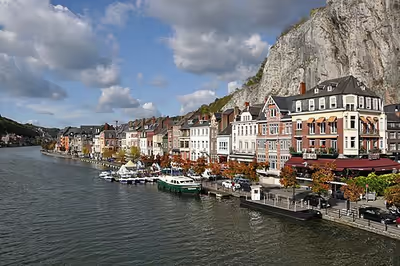
- Lesse (in Anseremme, part of Dinant)
- Viroin (in Vireux-Molhain)
- Faux (in Revin)
- Semois or Semoy (in Monthermé)
- Sormonne (in Warcq)
- Bar (near Dom-le-Mesnil)
- Chiers (in Bazeilles)
- Othain (in Montmédy)
- Vair (in Maxey-sur-Meuse)
- Mouzon (in Neufchâteau, Vosges)
- Saônelle (in Coussey)
Distributaries
The mean annual discharge rate of the Meuse has been relatively stable over the last few thousand years. One recent study estimates that average flow has increased by about 10% since 2000 BC. The hydrological distribution of the Meuse changed during the later Middle Ages, when a major flood forced it to shift its main course northwards towards the river Merwede. From then on several stretches of the original Merwede were renamed "Maas" (i.e. Meuse) and served as the primary outflow of that river. Those branches are currently known as the Nieuwe Maas and Oude Maas.
However during another series of severe floods the Meuse found an additional path towards the sea, resulting in the creation of the Biesbosch wetlands and Hollands Diep estuaries. Thereafter the Meuse split near Heusden into two main distributaries, one flowing north to join the Merwede and one flowing direct to the sea. The branch of the Meuse leading direct to the sea eventually silted up (and now forms the Oude Maasje stream), but in 1904 the canalised Bergse Maas was dug to take over the functions of the silted-up branch. At the same time the branch leading to the Merwede was dammed at Heusden (and has since been known as the Afgedamde Maas) so that little water from the Meuse entered the old Maas courses or the Rhine distributaries. The resulting separation of the rivers Rhine and Meuse is considered to be the greatest achievement in Dutch hydraulic engineering before the completion of the Zuiderzee Works and Delta Works. In 1970 the Haringvlietdam has been finished. Since then the reunited Rhine and Meuse waters have reached the North Sea either at this site or, during times of lower discharges of the Rhine, at Hook of Holland.
A 2008 study notes that the difference between summer and winter flow volumes has increased significantly in the last 100–200 years. It points out that the frequency of serious floods (i.e. flows > 1000% of normal) has increased markedly. They predict that winter flooding of the Meuse may become a recurring problem in the coming decades.
Départements, provinces and towns
The Meuse flows through the following departments of France, provinces of Belgium, provinces of the Netherlands and towns:
- Haute-Marne
- Vosges: Neufchâteau
- Meuse: Commercy, Saint-Mihiel, Verdun, Stenay
- Ardennes: Sedan, Charleville-Mézières, Givet
- Namur: Dinant, Namur
- Liège: Huy, Liège, Visé
- Limburg: Eijsden, Maastricht, Stein, Maasbracht, Roermond, Venlo, Gennep
- Limburg: Stokkem, Maaseik (between Stein and Maasbracht)
- North Brabant: Boxmeer, Cuijk, Grave, Ravenstein, Lith, Heusden, Aalburg, Woudrichem
- Gelderland: Maasdriel
- South Holland: Dordrecht, Maassluis, Rotterdam
Detailed route
Main cities and tributaries will be in bold.
Mention in patriotic songs
The Meuse (Maas) is mentioned in the first stanza of Germany's old national anthem, the Deutschlandlied. However, since its re-adoption as national anthem in 1952, only the third stanza of the Deutschlandlied has been sung as the German national anthem, the first and second stanzas being omitted. This was confirmed after German reunification in 1991 when only the third stanza was defined as the official anthem. The lyrics written in 1841 describe a then–disunited Germany with the river as its western boundary, where King William I of the Netherlands had joined the German Confederation with his Duchy of Limburg in 1839. Though the duchy's territory officially became an integral part of the Netherlands by the 1867 Treaty of London, the text passage remained unchanged when the Deutschlandlied was declared the national anthem of the Weimar Republic in 1922.
The name of the rivers also forms part of the title of "Le Régiment de Sambre et Meuse", written after the French defeat in the Franco-Prussian War of 1870, and a popular patriotic song for the rest of the 19th century and into the 20th.