

Mongolian Plateau
Part of the Central Asian Plateau
- 2 min read
- 4 chapters

Related on Lably
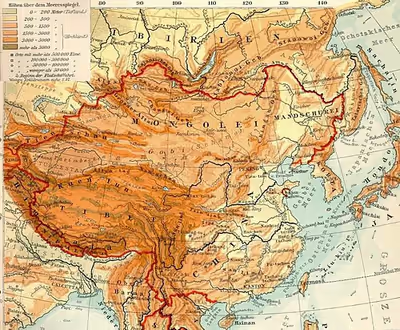
Politically, the plateau spans all of Mongolia, along with parts of China and Russia. Inner Mongolia and parts of the Dzungarian Basin in Xinjiang encompass the Chinese portion of the plateau. In Russia, the plateau forms Transbaikal, part of Buryatia, and the southern Irkutsk Oblast. The Mongolian Plateau comprises the majority of the area known as the Mongol heartland.
Geography
The average elevation of the Mongolian Plateau ranges from 915 to 1,525 meters (3,002 to 5,003 ft) above sea level. The highest point in the plateau is found in Tavan Bogd at 4,374 meters (14,350 ft) above sea level.
Sign in to keep reading
3 more chapters are free with a Lably account.
Ecology
The ecology of Mongolia is complex, having varying regions of highland and lowland areas. Grazing species such as yaks, Przewalski's horses, domesticated sheep, saiga antelope, Siberian ibex and Argali are common. Predator species include the Eurasian lynx, snow leopards, Corsac foxes as well as carnivorous birds such as the bearded vulture, saker falcon, and the cinereous vulture. Marmots are common throughout the region including the Tarbagan marmot with large parts of its range located in the Mongolian plateau.
History
The plateau was inhabited and conquered by various groups, including (chronologically) the Xiongnu, Xianbei, Göktürks, Tang dynasty, Liao dynasty, Mongol Empire, Yuan dynasty, Northern Yuan dynasty, and Qing dynasty.
Environmental changes
Between 1980 and 2010, rising global temperatures and direct human activity (particularly the use of lake water for mining and agriculture) have contributed to a significant loss of lake surface area across the Plateau. Qagaan Nurr and XinKai Lake have shrunk by two-thirds of their surface area during that time, while others (including Huangqihai Lake and Naiman Xihu) have dried up entirely. Some exceptions, such as East Juyan Lake and Had Paozi, have grown, but overall the average total surface area of lakes in the region has shrunk by 30%. The region also suffers from a high rate of desertification.