

Nanchong
Prefecture-level city in Sichuan, People's Republic of China
- 6 min read
- 10 chapters

Related on Lably
Through Drainage basin and Monsoon
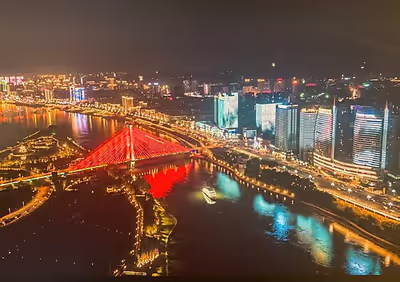
Nanchong (Chinese: 南充; pinyin: Nánchōng; Wade–Giles: Nan-ch'ung; Sichuanese: lan2cong1) is a prefecture-level city in the northeast of Sichuan province, China, with an area of 12,479.96 km2 (4,818.54 sq mi). At the 2020 census it was home to 5,607,565 people, of whom 1,936,534 lived in the built-up (or 'metro') area made of three urban districts. It is the second most populated city of Sichuan Province, after Chengdu. The administrative center is Shunqing District. At the end of 2024, the resident population of the city was 5.489 million, a decrease of 22,000 from the previous year. The resident population of urban areas is 2.949 million, and the resident population of rural areas is 2.54 million. The urbanization rate of the resident population is 53.73%, an increase of 0.9 percentage points over the previous year. At the end of the year, the registered population of the city was 6.977 million, a decrease of 55,000 compared with the end of the previous year.
History
Nanchong was in the territory of the state of Ba before it was conquered by the Qin in 314 BC. The Qin set up an administrative center at modern Langzhong County-level City. Anhan City was established in Shunqinq district at the beginning of the Han dynasty.
In 202 BC, Emperor Gaozu of Han instituted the Anhan (simplified Chinese: 安汉; traditional Chinese: 安漢) County in this place. Anhan literally means "to establish or stabilize Han". In 8 AD, the name was changed to Anxin (安新) when Wang Mang seized the throne of the Western Han dynasty, but it reverted to Anhan in 25 AD. It was again changed to Guozhou (果州; 'fruit state') in 621 AD (Tang dynasty), and then to Nanchong in 742 AD. The nickname of Nanchong is Guocheng (果城), derived from Guozhou.
Sign in to keep reading
9 more chapters are free with a Lably account.
Geography
Nanchong is in the northeast of Sichuan Province. To the east of Nanchong is Dazhou, to the west are Mianyang and Suining, to the north are Bazhong and Guangyuan, and to the south is Guang'an.
The vast majority of this area is hilly. The woodland coverage is 25%.
The Jialing River, a tributary of the Yangtze River, crosses the prefecture from north to south. There are another 30 rivers in the prefecture with a drainage basin of more than 30 km2 (12 mi2).
Climate
As with the rest of the Sichuan Basin, Nanchong has a monsoon-influenced humid subtropical climate (Köppen Cwa) with high humidity year-round; winters are short and mild while summers long, hot, and humid. The monthly 24-hour average temperature ranges from 6.5 °C (43.7 °F) in January to 27.3 °C (81.1 °F) in July; the annual mean is 17.38 °C (63.3 °F). Frost is uncommon, and the frost-free period lasts 290−320 days.
Over 70% of the 1,003 mm (39.5 in) of annual precipitation occurs from May to September. With monthly percent possible sunshine ranging from around 9% in December to 47% in August, the city receives only 1,135 hours of bright sunshine annually. Spring (March–April) tends to be sunnier and warmer in the day than autumn (October–November).
Subdivisions
Demographics
The Han people are the largest ethnic group in this area, contributing to 99.88% of its population; another 48 ethnic groups can be found in the city. Langzhong has a large Hui Muslim community.
As in other cities of China, the population of Nanchong can be divided into two parts: upper urban population and lower rural population. The registered urban population is about 1.2 million.
Shunqing District, downtown, is the densest area in Nanchong. At the center of Shunqing District, and the proverbial heart of the city, is Five Star Garden (五星花园); a large roundabout with five exits leading to other sections of the city.
Culture
Nanchong City has a long history and culture and is one of the important cultural centers in northeastern Sichuan.
Food culture
Guokui stuffed with jelly(锅盔灌凉粉): the outer skin is crispy, and the inner filling is Sichuan jelly, which tastes spicy and delicious.
Nanchong rice noodles(南充米粉): a rich variety of rice noodles and a clever combination of various seasonings
Shunqing Mutton Rice Noodles(顺庆羊肉粉): The rice noodles are as fine as silk and smooth in the texture, while the mutton soup exudes a rich aroma
Steamed buns with white sugar(白糖蒸馍): naturally fermented, they only have the aroma of wheat and do not have the alkaline taste of steamed buns.
Yingshan Cold Noodles(营山凉面): The cold noodles are golden in color, delicious in appearance, aroma and taste, and refreshing.
Economy
Agriculture
Agriculture is the pillar of Nanchong's economy, with 80% of Nanchong's population in rural areas and committed to traditional agricultural activities. Nanchong's manufacturing industry also relies on raw materials, which are provided by agriculture.
Nanchong's main agricultural product is food. A large quantity of rice, orange, silk worms, and pork are produced to support related manufacturers.
Manufacturing
Nanchong's main manufacturing outputs are petroleum products, automobiles and parts, mechanical equipment, textiles, and building materials.
Natural resources
There is a large quantity of rock oil and natural gas found in Nanchong, and it has the largest slate mine in the west of China. The dams on Jialing River and its branches have a large potential to increase electric power generation. But the largest resource of Nanchong is human: Nanchong is one of the main providers of Chinese cheap migrant workers.
Transport
Transportation in Nanchong is quite convenient compared with other cities in Sichuan province because of its extensive express railway network, shipping, and air service.
Nanchong is a transport hub of the northeast Sichuan Province. It is crossed by the strategic China National Highway 318, built by the Chinese government in the 1930s, and China National Highway 212 and newly built expressways — Cheng-Nan and Nan-Guang expressway — which link the city to Chengdu and another prefecture-level city: Guang'an. The expressway to Chongqing is under construction.
The Dazhou–Chengdu Railway through Nanchong links Chengdu and Dazhou. The Chongqing–Lanzhou Railway, in 2015, will link Lanzhou (Gansu) and Chongqing, and turn Nanchong into a railway hub in northeast Sichuan province. The Nanchong railway station provides passenger and cargo services to regional and national economic centres such as Shanghai, Beijing, Chongqing, Wuhan, Chengdu and Shenzhen.
The old Nanchong airport was built in the 1950s and closed in 2003. The new Nanchong Gaoping Airport which has capacity to land bigger planes, provides regular air services to Beijing, Shanghai, Guangzhou, Shenzhen, Kunming, Xi'an and Sanya.
Nanchong is suggested as a tradition shipping hub in ancient times. Ships from Gansu could reach Chongqing along the Jialing river, but the river is not suitable for modern shipping.
Education
Higher education
There are five academic institutions in Nanchong that provide higher education.
- Southwest Petroleum University (www.swpu.edu.cn)
- China West Normal University (http://www.cwnu.edu.cn)
- North Sichuan Medical College (www.nsmc.edu.cn)
- Nanchong Professional Technic College (www.nczy.com)
- Hope College of Southwest Jiaotong University (www.swjtuhc.cn)
- Nanchong Vocational College of Culture and Tourism (https://www.ncvcct.com/)
- Nanchong Film Industry Vocational Academy (https://ncdyxy.com/)
- Nanchong Vocational College of Science and Technol (https://www.nstc.edu.cn/)
- Nanchong Technician College (http://www.ncjsxy.net/)
Secondary Education
Nanchong City has relatively complete secondary education, which ranks among the best in Sichuan Province. Among them, the well-known high schools include:
Nanchong Senior High School (https://www.scncgz.net/)
Nanchong No. 1 Middle School (http://www.ncyzedu.cn/)
Nanchong No. 10 Middle School (http://www.ncsz.net/)
Nanchong Baita High School (https://www.ncbtzx.net/)
Langzhong High School
Nanbu High School
Yilong High School
There are also some schools that are relatively well known in the junior high school stage, such as
Nanchong No. 5 Middle School (https://www.ncswz.com/)
Nanchong No. 7 Middle School
Nanchong No. 9 Middle School
Nanchong Shiyan Middle School (https://www.ncssyzx.net/dist/)
Nanchong Gaoping Middle School (https://www.ncgpzx.cn/)
Parks
- Nanchong White Tower Park
Notable persons
- Chen Shou, historian in the Western Jin dynasty, the author of San guo zhi (the record of Three Kingdoms)
- Luo Ruiqing, general of the Chinese Army, former minister of Public Security of People's Republic of China
- Zhang Lan, former vice-president of People's Republic of China
- Zhang Side, a soldier of the People's Liberation Army of the People's Republic of China. He was posthumously honored by Chairman Mao and became an icon of self-sacrifice and noble character.
- Zhu De, one of the leaders of the Chinese Communist Party, Chinese communist government, and People's Liberation Army
- Li Jialong, singer and rapper, winner of Rap of China 2020.