

Plotinus
Hellenistic Greek philosopher (c. 204/5–270)
- 19 min read
- 8 chapters

Related on Lably
Through Middle Ages, Renaissance and Egyptians
Plotinus was a student of the self-taught philosopher Ammonius Saccas, who belonged to the Platonic tradition. Historians in the 19th century coined the term "Neoplatonism" to describe Plotinus and his philosophy. This philosophical tradition was vastly influential during late antiquity, the Middle Ages, and the Renaissance.
In his metaphysical writings, Plotinus described three fundamental principles: the One, the Intellect, and the Soul. His works have inspired generations of pagan, Jewish, Christian, Gnostic, and early Islamic metaphysicians and mystics. His ideas shaped metaphysical works, particularly his work on duality of the One. These ideas later influenced several mainstream theological concepts within different religions.
Early life
Plotinus' student and biographer Porphyry records in his Life of Plotinus that Plotinus died at the age of sixty-six at the end of the second year of the reign of the Roman emperor Claudius II (269/70 AD), and therefore calculates that Plotinus was born in the thirteenth year of the reign of Septimius Severus (204/5 AD). Eunapius reported that Plotinus was born in Lyco, which could either refer to the modern Asyut in Upper Egypt or Deltaic Lycopolis, in Lower Egypt. This has led to speculations that his family was either (Hellenized) Egyptian, Greek, or Roman. Historian Lloyd P. Gerson states that Plotinus was "almost certainly" a Greek. A.H. Armstrong, one of the foremost authorities on the philosophical teachings of Plotinus, writes that: "All that can be said with reasonable certainty is that Greek was his normal language and that he had a Greek education". Plotinus himself was said to have had little interest in his ancestry, birthplace, or that of anyone else for that matter. His native language was Greek.
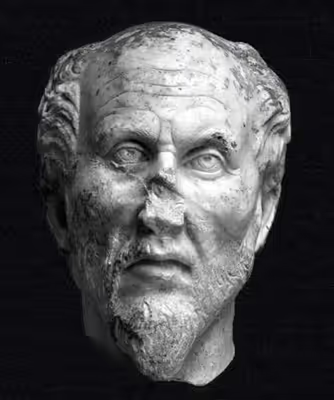
Plotinus had an inherent distrust of materiality (an attitude common to Platonism), holding to the view that phenomena were a poor image or mimicry (mimesis) of something "higher and intelligible" (Enneads VI.I) which was the "truer part of genuine Being". This distrust of material world extended to the human body, including his own; it is reported by Porphyry that at one point he refused to have his portrait painted, presumably because he regarded bodily appearance as an inferior representation. Likewise, Plotinus never discussed his ancestry, childhood, or his place or date of birth. From all accounts his personal and social life exhibited the highest moral and spiritual standards.
Sign in to keep reading
7 more chapters are free with a Lably account.
Thought
Plotinus took up the study of philosophy at the age of twenty-eight, around the year 232, and travelled to Alexandria to study. There he was dissatisfied with every teacher he encountered, until an acquaintance suggested he listen to the ideas of the self-taught Platonist philosopher Ammonius Saccas. Upon hearing Ammonius' lecture, Plotinus declared to his friend: "this is the man I was looking for". He began to study intently under his new instructor and remained with him as his student for eleven years. Besides Ammonius, Plotinus was also influenced by the philosophical works of Aristotle, the pre-Socratic philosophers Empedocles and Heraclitus, the Middle Platonist philosophers Alexander of Aphrodisias and Numenius of Apamea, along with various Stoics and Neopythagoreans.
Career
Expedition to Persia and return to Rome
After having spent eleven years in Alexandria, he then decided, at the age of around thirty-eight, to investigate the philosophical teachings of the Persian and Indian philosophers. In the pursuit of this endeavor he left Alexandria and joined the army of the Roman emperor Gordian III as it marched on Persia (242–243). However, the campaign ended in a failure and after Gordian's eventual death, Plotinus found himself abandoned in a hostile land. It was with great difficulty that found his way back to safety in Antioch.
At the age of forty, during the reign of Emperor Philip the Arab, he came to Rome, where he stayed for most of the remainder of his life. There he attracted a number of students. His innermost circle included Porphyry, Amelius Gentilianus of Tuscany, the senator Castricius Firmus, and Eustochius of Alexandria, a doctor who devoted himself to learning from Plotinus and attended to him until his death. Other students included: Zethos, an Arab by ancestry who died before Plotinus, leaving him a legacy and some land; Zoticus, a critic and poet; Paulinus, a doctor of Scythopolis; and Serapion from Alexandria. He had students amongst the Roman Senate beside Castricius, such as Marcellus Orontius, Sabinillus, and Rogantianus. Women were also numbered amongst his students, including Gemina, in whose house he lived during his residence in Rome, and her daughter, also Gemina; and Amphiclea, the wife of Ariston, the son of Iamblichus. Finally, Plotinus corresponded with the philosopher Cassius Longinus.
Later life
While living in Rome, Plotinus gained the respect of the Roman Emperor Gallienus and his wife Salonina. At one point, Plotinus attempted to persuade Gallienus to rebuild an abandoned settlement in Campania as the 'City of Philosophers', where the inhabitants would live under the constitution as set out in Plato's Laws. An Imperial subsidy was never granted for reasons unknown to Porphyry, who reports the incident.
Death
Plotinus subsequently went to live in Sicily. He spent his final days in seclusion on an estate in Campania which his friend Zethos had bequeathed him. According to the account of Eustochius, who attended him at the end, Plotinus' final words were: "Try to raise the divine in yourselves to the divine in the all." Eustochius records that a snake crept under the bed where Plotinus lay, and slipped away through a hole in the wall; at the same moment the philosopher died.
Porphyry reported that Plotinus was sixty-six years old when he died in 270 AD and calculated his birthdate from that figure.
Philosophy
The One
Plotinus taught that there is a supreme, totally transcendent "One" (τὸ Ἕν, tò Hén), containing no division, multiplicity, or distinction; beyond all categories of being and non-being. His "One" "cannot be any existing thing", nor is it merely the sum of all things (compare the Stoic doctrine of disbelief in non-material existence), but "is prior to all existents". Plotinus identified his "One" with the concept of 'Good' and the principle of 'Beauty'. (I.6.9)
His "One" concept encompassed thinker and object. Even the self-contemplating intelligence (the noesis of the nous) must contain duality. "Once you have uttered 'The Good,' add no further thought: by any addition, and in proportion to that addition, you introduce a deficiency." (III.8.11) Plotinus denies sentience, self-awareness or any other action (ergon) to the One (V.6.6). Rather, if we insist on describing it further, we must call the One a sheer potentiality (dynamis) without which nothing could exist. (III.8.10) As Plotinus explains in both places and elsewhere (e.g. V.6.3), it is impossible for the One to be Being or a self-aware Creator God. At (V.6.4), Plotinus compared the One to "light", the Divine Intellect/Nous (Νοῦς, Nous; first will towards Good) to the "Sun", and lastly the Soul (Ψυχή, Psyche) to the "Moon" whose light is merely a "derivative conglomeration of light from the 'Sun'". The first light could exist without any celestial body.
The One, being beyond all attributes including being and non-being, is the source of the world—but not through any act of creation, since activity cannot be ascribed to the unchangeable, immutable One. Plotinus argues instead that the multiple cannot exist without the simple. The "less perfect" must, of necessity, "emanate", or issue forth, from the "perfect" or "more perfect". Thus, all of "creation" emanates from the One in succeeding stages of lesser and lesser perfection. These stages are not temporally isolated, but occur throughout time as a constant process.
The One is not just an intellectual concept but something that can be experienced, an experience where one goes beyond all multiplicity. Plotinus writes, "We ought not even to say that he will see, but he will be that which he sees, if indeed it is possible any longer to distinguish between seer and seen, and not boldly to affirm that the two are one."
Emanation by the One
Although Plotinus never mentions Christianity in any of his works, he seems to offer an alternative to the orthodox Christian notion of creation ex nihilo (out of nothing), though this is disputed. The metaphysics of emanation (ἀπορροή aporrhoe (ΙΙ.3.2) or ἀπόρροια aporrhoia (II.3.11)) (literally a flowing, ροη, out, απο), similar to the metaphysics of Creation, describes the absolute transcendence of the One or of the Divine, as the source of the Being of all things, but which remains transcendent of them in its own nature. The One is in no way affected or diminished by these emanations, just as the Christian God in no way is augmented or diminished by the act of Creation. Plotinus, using a venerable analogy that would become crucial for the (largely neoplatonic) metaphysics of developed Christian thought, likens the One to the Sun which emanates light indiscriminately without thereby diminishing itself, or reflection in a mirror which in no way diminishes or otherwise alters the object being reflected.
The first emanation is Nous (Divine Mind, Logos, Order, Thought, Reason), identified metaphorically with the Demiurge in Plato's Timaeus. It is the first Will toward Good. From Nous proceeds the World Soul, which Plotinus subdivides into upper and lower, identifying the lower aspect of Soul with nature. From the world soul proceed individual human souls, and finally, matter, at the lowest level of being and thus the least perfected level of the cosmos. Plotinus asserted the ultimately divine nature of material creation since it ultimately derives from the One, through the mediums of Nous and the world soul. It is by the Good or through beauty that we recognize the One, in material things and then in the Forms. (I.6.6 and I.6.9)
The essentially devotional nature of Plotinus' philosophy may be further illustrated by his concept of attaining ecstatic union with the One (henosis). Porphyry relates that Plotinus attained such a union four times during the years he knew him. This may be related to enlightenment, liberation, and other concepts of mysticism common to many Eastern traditions.
The true human and happiness
Authentic human happiness for Plotinus consists of the true human identifying with that which is the best in the universe. Because happiness is beyond anything physical, Plotinus stresses the point that worldly fortune does not control true human happiness, and thus “… there exists no single human being that does not either potentially or effectively possess this thing we hold to constitute happiness.” (Enneads I.4.4) The issue of happiness is one of Plotinus’ greatest imprints on Western thought, as he is one of the first to introduce the idea that eudaimonia (happiness) is attainable only within consciousness.
The true human is an incorporeal contemplative capacity of the soul, and superior to all things corporeal. It then follows that real human happiness is independent of the physical world. Real happiness is, instead, dependent on the metaphysical and authentic human being found in this highest capacity of Reason. “For man, and especially the Proficient, is not the Couplement of Soul and body: the proof is that man can be disengaged from the body and disdain its nominal goods.” (Enneads I.4.14) The human who has achieved happiness will not be bothered by sickness, discomfort, etc., as his focus is on the greatest things. Authentic human happiness is the utilization of the most authentically human capacity of contemplation. Even in daily, physical action, the flourishing human’s “… Act is determined by the higher phase of the Soul.” (Enneads III.4.6) Even in the most dramatic arguments Plotinus considers (if the Proficient is subject to extreme physical torture, for example), he concludes this only strengthens his claim of true happiness being metaphysical, as the truly happy human being would understand that which is being tortured is merely a body, not the conscious self, and happiness could persist.
Plotinus offers a comprehensive description of an individual who has achieved eudaimonia. “The perfect life” involves a man who commands reason and contemplation. (Enneads I.4.4) A happy person will not sway between happy and sad, as many of Plotinus' contemporaries believed. Stoics, for example, question the ability of someone to be happy (presupposing happiness is contemplation) if they are mentally incapacitated or even asleep. Plotinus disregards this claim, as the soul and true human do not sleep or even exist in time, nor will a living human who has achieved eudaimonia suddenly stop using its greatest, most authentic capacity just because of the body’s discomfort in the physical realm. “… The Proficient’s will is set always and only inward.” (Enneads I.4.11)
Overall, happiness for Plotinus is "... a flight from this world's ways and things." (Theaet. 176) and a focus on the highest, i.e. Forms and the One.
Plotinus regarded happiness as living in an interior way (interiority or self-sufficiency), and this being the obverse of attachment to the objects of embodied desires.
Henosis
Henosis is the word for mystical "oneness", "union", or "unity" in classical Greek. In Platonism, and especially neoplatonism, the goal of henosis is union with what is fundamental in reality: the One (τὸ Ἕν), the Source, or Monad.
As is specified in the writings of Plotinus on henology, one can reach a state of tabula rasa, blank state where the individual may grasp or merge with The One. This absolute simplicity means that the nous or the person is then dissolved, completely absorbed back into the Monad. Here within the Enneads of Plotinus the Monad can be referred to as the Good above the demiurge. The Monad or dunamis (force) is of one singular expression (the will or the one which is the good); all is contained in the Monad and the Monad is all (pantheism). All division is reconciled in the one; the final stage before reaching singularity, called duality (dyad), is completely reconciled in the Monad, Source or One (see monism). As the one source or substance of all things, the Monad is all encompassing. As infinite and indeterminate all is reconciled in the dunamis or one. It is the demiurge or second emanation that is the nous in Plotinus. It is the demiurge (creator, action, energy) or nous that "perceives" and therefore causes the force (potential or One) to manifest as energy, or the dyad called the material world. Nous as being; being and perception (intellect) manifest what is called soul (World Soul).
Henosis for Plotinus was defined in his works as a reversing of the ontological process of consciousness via meditation (in the Western mind to uncontemplate) toward no thought (Nous or demiurge) and no division (dyad) within the individual (being). Plotinus words his teachings to reconcile not only Plato with Aristotle but also various World religions that he had personal contact with during his various travels. Plotinus' works have an ascetic character in that they reject matter as an illusion (non-existent). Matter was strictly treated as immanent, with matter as essential to its being, having no true or transcendential character or essence, substance or ousia (οὐσία). This approach is called philosophical Idealism.
Relation with contemporary philosophy and religion
Plotinus's Relation to Plato
For several centuries after the Protestant Reformation, neoplatonism was condemned as a decadent and 'oriental' distortion of Platonism. In a 1929 essay, E. R. Dodds showed that key conceptions of neoplatonism could be traced from their origin in Plato's dialogues, through his immediate followers (e.g., Speusippus) and the neopythagoreans, to Plotinus and the neoplatonists. Thus Plotinus' philosophy was, he argued, 'not the starting-point of neoplatonism but its intellectual culmination.' Further research reinforced this view and by 1954 Merlan could say 'The present tendency is toward bridging rather than widening the gap separating Platonism from neoplatonism.'
Since the 1950s, the Tübingen School of Plato interpretation has argued that the so-called 'unwritten doctrines' of Plato debated by Aristotle and the Old Academy strongly resemble Plotinus's metaphysics. In this case, the neoplatonic reading of Plato would be, at least in this central area, historically justified. This implies that neoplatonism is less of an innovation than it appears without the recognition of Plato's unwritten doctrines. Advocates of the Tübingen School emphasize this advantage of their interpretation. They see Plotinus as advancing a tradition of thought begun by Plato himself. Plotinus's metaphysics, at least in broad outline, was therefore already familiar to the first generation of Plato's students. This confirms Plotinus' own view, for he considered himself not the inventor of a system but the faithful interpreter of Plato's doctrines.
Plotinus and the Gnostics
At least two modern conferences within Hellenic philosophy fields of study have been held in order to address what Plotinus stated in his tract Against the Gnostics and to whom he was addressing it, in order to separate and clarify the events and persons involved in the origin of the term "Gnostic". From the dialogue, it appears that the word had an origin in the Platonic and Hellenistic tradition long before the group calling themselves "Gnostics"—or the group covered under the modern term "Gnosticism"—ever appeared. It would seem that this shift from Platonic to Gnostic usage has led many people to confusion. The strategy of sectarians taking Greek terms from philosophical contexts and re-applying them to religious contexts was popular in Christianity, the Cult of Isis and other ancient religious contexts including Hermetic ones (see Alexander of Abonutichus for an example).
According to A. H. Armstrong, Plotinus and the neoplatonists viewed Gnosticism as a form of heresy or sectarianism to the Pythagorean and Platonic philosophy of the Mediterranean and Middle East. Also according to Armstrong, Plotinus accused them of using senseless jargon and being overly dramatic and insolent in their distortion of Plato's ontology." Armstrong argues that Plotinus attacks his opponents as untraditional, irrational and immoral and arrogant. Armstrong believed that Plotinus also attacks them as elitist and blasphemous to Plato for the Gnostics despising the material world and its maker.
For decades, Armstrong's was the only translation available of Plotinus. For this reason, his claims were authoritative. However, a modern translation by Lloyd P. Gerson doesn't necessarily support all of Armstrong's views. Unlike Armstrong, Gerson didn't find Plotinus to be so vitriolic against the Gnostics. According to Gerson:
As Plotinus himself tells us, at the time of this treatise’s composition some of his friends were ‘attached’ to Gnostic doctrine, and he believed that this attachment was harmful. So he sets out here a number of objections and corrections. Some of these are directed at very specific tenets of Gnosticism, e.g. the introduction of a ‘new earth’ or a principle of ‘Wisdom’, but the general thrust of this treatise has a much broader scope. The Gnostics are very critical of the sensible universe and its contents, and as a Platonist, Plotinus must share this critical attitude to some extent. But here he makes his case that the proper understanding of the highest principles and emanation forces us to respect the sensible world as the best possible imitation of the intelligible world.
Plotinus seems to direct his attacks at a very specific sect of Gnostics, most notably a sect of Gnostics that held anti-polytheistic and anti-daemon views, and that preached salvation was possible without struggle. At one point, Plotinus makes clear that his major grudge is the way Gnostics 'misused' Plato's teachings, and not their own teachings themselves:
There are no hard feelings if they tell us in which respects they intend to disagree with Plato [...] Rather, whatever strikes them as their own distinct views in comparison with the Greeks’, these views – as well as the views that contradict them – should be forthrightly set out on their own in a considerate and philosophical manner.
The neoplatonic movement (though Plotinus would have simply referred to himself as a philosopher of Plato) seems to be motivated by the desire of Plotinus to revive the pagan philosophical tradition. Plotinus was not claiming to innovate with the Enneads, but to clarify aspects of the works of Plato that he considered misrepresented or misunderstood. Plotinus does not claim to be an innovator, but rather a communicator of a tradition. Plotinus referred to tradition as a way to interpret Plato's intentions. Because the teachings of Plato were for members of the academy rather than the general public, it was easy for outsiders to misunderstand Plato's meaning. However, Plotinus attempted to clarify how the philosophers of the academy had not arrived at the same conclusions (such as misotheism or dystheism of the creator God as an answer to the problem of evil) as the targets of his criticism.
Against causal astrology
Plotinus seems to be one of the first to have argued against the then popular notion of causal astrology. In the late tractate 2.3, "Are the stars causes?", Plotinus makes the argument that specific stars influencing one's fortune (a common Hellenistic theme) attributes irrationality to a perfect universe, and invites moral depravity. He does, however, claim the stars and planets are ensouled, as witnessed by their movement.
Legacy
Ancient world
The emperor Julian the Apostate was deeply influenced by Neoplatonism, as was Hypatia of Alexandria. Neoplatonism influenced many Christians as well, including Pseudo-Dionysius the Areopagite. St. Augustine, though often referred to as a "Platonist", acquired his Platonist philosophy through the mediation of the Neoplatonist teachings of Plotinus.
Christianity
Plotinus' philosophy had an influence on the development of Christian theology. In A History of Western Philosophy, philosopher Bertrand Russell wrote that:
To the Christian, the Other World was the Kingdom of Heaven, to be enjoyed after death; to the Platonist, it was the eternal world of ideas, the real world as opposed to that of illusory appearance. Christian theologians combined these points of view, and embodied much of the philosophy of Plotinus. [...] Plotinus, accordingly, is historically important as an influence in moulding the Christianity of the Middle Ages and of theology.
The Eastern Orthodox position on energy, for example, is often contrasted with the position of the Roman Catholic Church, and in part this is attributed to varying usages of Aristotelian and Plotinian concepts, either through Thomas Aquinas for the Roman Catholics or Gregory Palamas for the Orthodox Christians.
Islam
Neoplatonism and the ideas of Plotinus influenced medieval Islam as well, since the Mutazilite Abbasids fused Greek concepts into sponsored state texts, and found great influence amongst the Ismaili Shia and Persian philosophers as well, such as Muhammad al-Nasafi and Abu Yaqub Sijistani. By the 11th century, neoplatonism was adopted by the Fatimid state of Egypt, and taught by their da'i. Neoplatonism was brought to the Fatimid court by Hamid al-Din al-Kirmani, although his teachings differed from Nasafi and Sijistani, who were more aligned with the original teachings of Plotinus. The teachings of Kirmani in turn influenced philosophers such as Nasir Khusraw of Persia.
Judaism
As with Islam and Christianity, neoplatonism in general and Plotinus in particular influenced speculative thought. Notable thinkers expressing neoplatonist themes are Solomon ibn Gabirol (Latin: Avicebron) and Moses ben Maimon (Latin: Maimonides). As with Islam and Christianity, apophatic theology and the privative nature of evil are two prominent themes that such thinkers picked up from either Plotinus or his successors.
Renaissance
In the Renaissance the philosopher Marsilio Ficino set up an Academy under the patronage of Cosimo de Medici in Florence, mirroring that of Plato. His work was of great importance in reconciling the philosophy of Plato directly with Christianity. One of his most distinguished pupils was Pico della Mirandola, author of An Oration on the Dignity of Man.
England
In England, Plotinus was the cardinal influence on the 17th-century school of the Cambridge Platonists, and on numerous writers from Samuel Taylor Coleridge to W. B. Yeats and Kathleen Raine.
India
Sarvepalli Radhakrishnan and Ananda Coomaraswamy used the writing of Plotinus in their own texts as a superlative elaboration upon Indian monism, specifically Upanishadic and Advaita Vedantic thought. Coomaraswamy has compared Plotinus' teachings to the Hindu school of Advaita Vedanta (advaita meaning "not two" or "non-dual"). M. Vasudevacharya says, "Though Plotinus never managed to reach India, his method shows an affinity to the 'method of negation' as taught in some of the Upanishads, such as the Brhadaranyaka Upanishad, and also to the practice of yoga."
Advaita Vedanta and neoplatonism have been compared by J. F. Staal, Frederick Copleston, Aldo Magris and Mario Piantelli, Radhakrishnan, Gwen Griffith-Dickson, and John Y. Fenton.
The joint influence of Advaitin and Neoplatonic ideas on Ralph Waldo Emerson was considered by Dale Riepe in 1967.
Film studies
Plotinian concepts have been discussed in a cinematic context and relate Plotinus' theory of time as a transitory intelligible movement of the soul to Bergson’s and Deleuze’s time-image.