


Related on Lably
Through Epigraphy
The earliest Proto-Sinaitic inscriptions are mostly dated to between the mid-19th (early date) and the mid-16th (late date) century BC.
The principal debate is between an early date, around 1850 BC, and a late date, around 1550 BC. The choice of one or the other date decides whether it is proto-Sinaitic or proto-Canaanite, and by extension locates the invention of the alphabet in Egypt or Canaan respectively.
However, the discovery of the two Wadi el-Hol inscriptions near the Nile River suggests that the script originated in Egypt. The evolution of Proto-Sinaitic and the small number of Proto-Canaanite inscriptions from the Bronze Age is based on rather scant epigraphic evidence; it is only with the Bronze Age collapse and the rise of new Semitic kingdoms in the Levant that Proto-Canaanite is clearly attested (Byblos inscriptions 10th–8th century BC, Khirbet Qeiyafa inscription c. 10th century BC).
The first published group of Proto-Sinaitic inscriptions were discovered in the winter of 1904–1905 in Sinai by Hilda and Flinders Petrie. These ten inscriptions, plus an eleventh published by Raymond Weill in 1904 from the 1868 notes of Edward Henry Palmer, were reviewed in detail, and numbered (as 345–355), by Alan Gardiner in 1916. To this were added a number of short Proto-Canaanite inscriptions found in Canaan and dated to between the 17th and 15th centuries BC, and more recently, the discovery in 1999 of the two Wadi el-Hol inscriptions, found in Middle Egypt by John and Deborah Darnell. The Wadi el-Hol inscriptions strongly suggest a date of development of Proto-Sinaitic writing from the mid-19th to 18th centuries BC.
Discovery
According to William Albright, in his book "The Proto-Sinaitic Inscriptions And Their Decipherment", the first inscriptions in the category now known as Proto-Sinaitic were discovered and copied by E.H Palmer in Wadi Magharah during the winter of 1868–1869. His text was not published until 1904. However, E.H. Palmer notes that he was not the first, others had done work before him and as such his work was more of a "Re-discovery". In the winter of 1905, Flinders Petrie and his wife Hilda were conducting a series of archaeological excavations in the Sinai Peninsula. During a dig at Serabit el-Khadim, an extremely lucrative turquoise mine used between the Twelfth and Thirteenth Dynasty and again between the Eighteenth and mid-Twentieth Dynasty, Petrie discovered a series of inscriptions at the site's massive invocative temple to Hathor, as well as some fragmentary inscriptions in the mines themselves. Petrie immediately recognized hieroglyphic characters in the inscriptions, but upon closer inspection realized the script was not the combination of logograms and syllabics as in Egyptian script proper. He thus assumed that the inscriptions showed a script that the turquoise miners had devised themselves, using linear signs that they had borrowed from hieroglyphics. He published his findings in London the following year.
Ten years later, in 1916, Alan Gardiner, one of the premier Egyptologists of the early and mid-20th century, published his own interpretation of Petrie's findings, arguing that the glyphs appeared to be early versions of the signs used for later Semitic languages such as Phoenician, and was able to assign sound values and reconstructed names to some of the letters by assuming they represented what would later become the common Semitic abjad. One example was the character , to which Gardiner assigned the ⟨b⟩ sound, on the grounds that it derived from the Egyptian glyph for 'house' , and was very similar to the Phoenician letter bet, whose name derives from the Semitic word for “house”, bayt. Using his hypothesis, Gardiner was able to affirm Petrie's hypothesis that the mystery inscriptions were of a religious nature, as his model allowed an often recurring word to be reconstructed as lbʿlt, meaning "to Ba'alat" or more accurately, "to (the) Lady" – that is, the "lady" Hathor. Likewise, this allowed another recurring word mʿhbʿlt to be translated as "Beloved of (the) Lady", a reading which became very acceptable after the lemma was found carved underneath a hieroglyphic inscription which read "Beloved of Hathor, Lady of Turquoise". Gardiner's hypothesis allowed researchers to connect the letters of the inscriptions to modern Semitic alphabets, and resulted in the inscriptions becoming much more readable, leading to the immediate acceptance of his hypothesis.
Sign in to keep reading
3 more chapters are free with a Lably account.
Development
The letters of the earliest script used for Semitic languages were derived from Egyptian hieroglyphs. In the 19th century, the theory of Egyptian origin competed alongside other theories that the Phoenician script developed from Akkadian cuneiform, Cretan hieroglyphs, the Cypriot syllabary, and Anatolian hieroglyphs. Then the Proto-Sinaitic inscriptions were studied by Alan Gardiner who identified the word bʿlt "Lady" occurring several times in inscriptions, and also attempted to decipher other words. In the 1950s and 1960s, William Albright published interpretations of Proto-Sinaitic as the key to show the derivation of the Canaanite alphabet from hieratic.
According to the "alphabet theory", the early Semitic proto-alphabet reflected in the Proto-Sinaitic inscriptions would have given rise to both the Ancient South Arabian script and the Proto-Canaanite alphabet by the time of the Late Bronze Age collapse (1200–1150 BC).
For example, the hieroglyph for pr "house" (a rectangle partially open along one side, "O1" in Gardiner's sign list) was adopted to write Semitic , after the first consonant of baytu, the Semitic word for "house".
A transitional stage between Proto-Canaanite and Old Phoenician (1000–800 BC) has been proposed by authors such as Werner Pichler as the origin of the Libyco-Berber script used among Ancient Libyans (i.e. Proto-Berbers) – citing common similarities to both Proto-Canaanite proper and its early North Arabian descendants.
Inscriptions
Serabit inscriptions
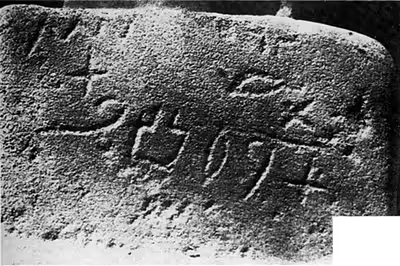
The Sinai inscriptions are best known from the Serabit el-Khadim proto-Sinaitic inscriptions, carved graffiti and votive texts from a mountain in the Sinai called Serabit el-Khadim and its temple to the Egyptian goddess Hathor (ḥwt-ḥr). The mountain contained turquoise mines which were visited by repeated expeditions over 800 years. Many of the workers and officials were from the Nile Delta, and included large numbers of Semitic peoples (i.e. speakers of an early form of Northwest Semitic ancestral to the Canaanite languages of the Late Bronze Age) who had been allowed to settle the eastern Delta.
Most of the forty or so inscriptions have been found among much more numerous hieratic and hieroglyphic inscriptions, scratched on rocks near and in the turquoise mines and along the roads leading to the temple.
The date of the inscriptions is mostly placed in the 17th or 16th century BC. An alternative view dates most of the inscriptions to the reign of Amenemhat III or his successor circa 1800 BC. It has been suggested that the dating period includes the reign of pharaoh Senwosret III.
Four inscriptions have been found in the temple, on two small human statues and on either side of a small stone sphinx. They are crudely done, suggesting that the workers who made them were illiterate apart from this script.
Wadi el-Hol inscriptions
The two Wadi el-Hol inscriptions (Arabic: وادي الهول Wādī al-Hawl 'Ravine of Terror') were carved on the stone sides of an ancient high-desert military and trade road linking Thebes and Abydos, in the heart of literate Egypt. They have been dated to somewhere between 1900 and 1800 BC. They are in a wadi in the Qena bend of the Nile, at approx. 25°57′N 32°25′E / 25.950°N 32.417°E, among dozens of hieratic and hieroglyphic inscriptions. Rock inscriptions in the valley appear to show the oldest examples of phonetic alphabetic writing discovered to date.
The inscriptions are graphically very similar to the Serabit inscriptions, but show a greater hieroglyphic influence, such as a glyph for a man that was apparently not read alphabetically: The first of these (h1) is a figure of celebration [Gardiner A28], whereas the second (h2) is either that of a child [Gardiner A17] or of dancing [Gardiner A32]. If the latter, h1 and h2 may be graphic variants (such as two hieroglyphs both used to write the Canaanite word hillul "jubilation" corresponding to הלל hallel or hillel in Hebrew) rather than different consonants.
Hieroglyphs representing, reading left to right, celebration, a child, and dancing. The first appears to be the prototype for h1, while the latter two have been suggested as the prototype for h2.
Brian Colless has published a translation of the text, in which some of the signs are treated as logograms (representing a whole word, not just a single consonant) or rebuses:
- [Vertical] mšt r h ʿnt ygš ʾl
- [Vertical] Excellent banquet (mšt r[ʾš]) of the celebration (h[illul]) of ʿAnat (ʿnt). [It] will provide (ygš) ʾEl (ʾl)
- [Horizontal] rb wn mn h ngṯ h ʾ p mẖ r
- [Horizontal] plenty (rb) of wine (wn) [and] victuals (mn) for the celebration (h[illul]). We will sacrifice (ngṯ) to her (h) an ox (ʾ[lp]) and (p) a prime fatling (mẖ r[ʾš])."
Here, aleph, whose glyph depicts the head of an ox, is a logogram used to represent the word "ox" (*ʾalp), he, whose glyph depicts a man in celebration, is a logogram for the words "celebration" (*hillul) and "she/her" (hiʾ), and resh, whose glyph depicts a man's head, is a logogram for the word "utmost/greatest" (*raʾš). This interpretation fits into the pattern in some of the surrounding Egyptian inscriptions, with celebrations for the goddess Hathor involving inebriation.
Other possible inscriptions
Archaeological excavations at the site of Umm el-Marra have uncovered four inscribed clay cylinders dating to ca. 2300 BC whose incisions have been hypothesized to be Early Alphabetic Semitic writing, which would make them the oldest such examples.
In 2009, Stephanie Dalley published several tablets from the Schøyen Collection dating to the times of the First Sealand dynasty, four of which have been identified as examples of Early Alphabetic inscriptions. Other probable examples of Early Alphabetic inscriptions include an ostracon from a tomb in western Thebes and an inscribed sherd from Lachish, both dating to the 15th century BC.
In 2010, Stefan Wimmer published an inscription discovered at Timna Valley which he also identified as written in proto-Sinaitic writing, although he also noted that its authenticity is not certain.
Table of symbols
Below is a table synoptically showing selected Proto-Sinaitic signs and the proposed correspondences with Phoenician letters and Egyptian hieroglyphs. Each glyph's inscription of origin is listed in parentheses. A full repertoire of the currently known letterforms can be found on pages 8 and 9 here: https://www.unicode.org/L2/L2019/19299-revisiting-proto-sinaitic.pdf. Also shown are the reconstructed sound values and names.