


Related on Lably
Through Amazon rainforest, South America and Morphology (biology)
Taxonomy and systematics
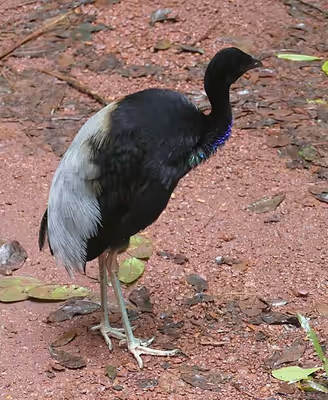
The genus Psophia was introduced in 1758 by the Swedish naturalist Carl Linnaeus, in the tenth edition of his Systema Naturae, as containing a single species, the grey-winged trumpeter (Psophia crepitans). The genus name is from the Ancient Greek psophos meaning "noise".
The genus' taxonomy is far from settled; anywhere from three to six species (with varying numbers of subspecies) are accepted by different taxonomic systems.
The International Ornithological Committee's treatment is the most conservative. They accept three species, two of which have three subspecies:
- Grey-winged trumpeter, Psophia crepitans
- P. c. crepitans
- P. c. napensis
- P. c. ochroptera
- Pale-winged trumpeter, Psophia leucoptera
- Dark-winged trumpeter, Psophia viridis
- P. v. viridis
- P. v. dextralis
- P. v. obscura
The Clements taxonomy splits P. v. dextralis and adds English names to the subspecies:
- Grey-winged trumpeter, Psophia crepitans
- P. c. crepitans (grey-winged)
- P. c. napensis (Napo)
- P. c. ochroptera (ochre-winged)
- Pale-winged trumpeter, Psophia leucoptera
- Dark-winged trumpeter, Psophia viridis
- P. v. viridis (green-backed)
- P. v. dextralis (dusky-backed)
- P. v. interjecta (Xingu)
- P. v. obscura (black-backed)
BirdLife International's Handbook of the Birds of the World (HBW) accepts six species:
- Grey-winged trumpeter, Psophia crepitans
- P. c. crepitans
- P. c. napensis
- Ochre-winged trumpeter, Psophia ochroptera
- White-winged trumpeter, Psophia leucoptera
- Green-winged trumpeter, Psophia viridis
- Olive-winged trumpeter, Psophia dextralis
- P. d. dextralis
- P. d. interjecta
- Black-winged trumpeter, Psophia obscura
Traditionally, only three species of trumpeters have been recognised. A 2008 review of the morphology of the dark-winged trumpeter resulted in the recommendation that it be divided into three species. A 2010 review of the phylogeny and biogeography of all members of the family resulted in a suggested total of eight species, with two in the grey-winged trumpeter complex, two in the pale-winged trumpeter complex, and four in the dark-winged trumpeter complex.
Sign in to keep reading
2 more chapters are free with a Lably account.
Behaviour and ecology
Trumpeters fly weakly but run fast; they can easily outrun dogs. They are also capable of swimming across small rivers; large rivers are however a major barrier to them, with the distribution boundaries of the species being defined by major rivers, including the Amazon, and its tributaries the Madeira, the Tapajós, and the Tocantins. They spend most of the day in noisy flocks, sometimes numbering more than 100, on the forest floor. They feed on fallen fruit (particularly fruit knocked down by monkeys). They also eat a small amount of arthropods, including ants and flies, and even some reptiles and amphibians. At night they fly with difficulty into trees to roost 6 to 9 metres (20 to 30 ft) above the ground.
Trumpeters nest in a hole in a tree or in the crown of a palm tree. They lay 2 to 5 eggs with rough, white shells, averaging about 76 grams (2.7 ounces). In the pale-winged trumpeter and the grey-winged trumpeter, groups of adults care for a single clutch.
Relationship with humans
Trumpeters are often used as "guard dogs" because they call loudly when alarmed, become tame easily, and are believed to be adept at killing snakes. One source states their skill at hunting snakes as a fact, and the nineteenth-century botanist Richard Spruce gave an account of the friendliness and snake-killing prowess of a tame grey-winged trumpeter. For these reasons, Spruce recommended that England import trumpeters to India. However, another source says this prowess is "reputed".