

Pudong
District in Shanghai, People's Republic of China
- 11 min read
- 9 chapters

Related on Lably
Through Bank (geography)
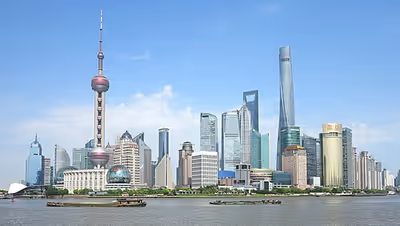
The traditional area of Pudong is now home to the Lujiazui Finance and Trade Zone and the Shanghai Stock Exchange and many of Shanghai's best-known buildings, such as the Oriental Pearl Tower, the Jin Mao Tower, the Shanghai World Financial Center, and the Shanghai Tower. These modern skyscrapers directly face Puxi's historic Bund, a remnant of former foreign concessions in China. The rest of the new area includes the Port of Shanghai, the Shanghai Expo and Century Park, Zhangjiang Hi-Tech Park, Shanghai Pudong International Airport, the Jiuduansha Wetland Nature Reserve, Nanhui New City, and the Shanghai Disney Resort.
History
Pudong—literally "The East Bank of the Huangpu River"—originally referred only to the less-developed land across from Shanghai's Old City and foreign concessions. The area was mainly farmland and only slowly developed, with warehouses and wharfs near the shore administered by the districts of Puxi on the west bank: Huangpu, Yangpu, and Nanshi. Pudong was originally established as a county in 1958 until 1961 when the county was split among Huangpu, Yangpu, Nanshi, Wusong and Chuansha County.
Premier Li Peng announced the policy of Pudong's opening and development on April 18, 1990. Speaking at a celebration for the fifth anniversary of the Shanghai Volkswagen Corporation, Li stated that "some policies of the economic and technological zones and Special Economic Zones can be implemented in the Pudong area". Li stated that future investors from Hong Kong, Macau, and Taiwan were welcomed and that China would provide preferential conditions for cooperation and improve the investment environment. The occasion is often described as Pudong's "birthday". Nonetheless, development in the area was slow for the rest of 1990.
On October 1, 1992, the original area of Pudong County and Chuansha County merged and established Pudong New Area.
In 1993, the Chinese government set up a Special Economic Zone in Chuansha, creating the Pudong New Area. Deng Xiaoping had initiated its development three years earlier to build further confidence in Reform and Opening Up. Pudong's description as a New Area served to distinguish it from existing SEZs. It had even more open policies than existing SEZs, in terms of attracting foreign direct investment and developing the local economy.
The western tip of the Pudong district was designated as the Lujiazui Finance and Trade Zone and has become a financial hub of modern China. Several landmark buildings were constructed, including the Oriental Pearl Tower, and the supertall Jin Mao Building (420.5 m or 1,380 ft), Shanghai World Financial Center (494 m or 1,621 ft) and Shanghai Tower (632 m or 2,073 ft), the world's first trio of adjacent supertall skyscrapers. These buildings—all along Century Avenue and visible from the historic Bund—now form the most common skyline of Shanghai.
In official discourses on urbanization in China, Pudong is considered the paradigmatic example of the 1990s approach to urbanization.
On May 6, 2009, it was disclosed that the State Council had approved the proposal to merge Nanhui District with Pudong and comprise the majority of eastern Shanghai. In 2010, Pudong was host to the main venues of the Shanghai Expo, whose grounds now form a public park.
Pudong New Area consists of the original Pudong County (northeastern portion of Shanghai County), Chuansha County, and Nanhui County.
Sign in to keep reading
8 more chapters are free with a Lably account.
Climate
Pudong has a humid subtropical climate (Köppen climate classification Cfa), influenced by monsoons and Siberian winds as well as rains and typhoons from the Pacific. The average annual temperature in Pudong is 17.2 °C (63.0 °F). The temperatures are highest on average in July and August, at around 28.6 °C (83.5 °F), and lowest in January, at around 5.1 °C (41.2 °F).
Government
Districts of the Direct-Controlled Municipality of Shanghai are administratively on the same level as prefecture-level cities. However, the government of Pudong has a status equivalent to that of a sub-provincial city, which is a half-level above a prefecture-level city. This is due to Pudong's size and importance as the financial hub of China. The Pudong Communist Party Secretary is the top office of the district, followed by the district governor of Pudong. The Pudong party chief is customarily also a member of the Shanghai Party Standing Committee.
On April 27, 2015, the People's Government of Pudong New Area is working with China (Shanghai) Pilot Free-Trade Zone Administrative Committee.
Demographics
Pudong is bounded by the Huangpu River in the west and the East China Sea in the east. Pudong is distinguished from Puxi ("West Bank"), the older part of Shanghai. It has an area of 1,210.4 square kilometres (467.3 sq mi) and, according to the 2024 census, a population of 5.79 million inhabitants. Pudong's resident population growth is well above national average because it is a popular immigration destination. The 2020 census shows an 8% increase in the last decade, or an annual pace of 0.8%.
Excluding immigrants, the birth rate in 2010 was 0.806% while the death rate is 0.729, resulting a net growth of 0.077%. The total fertility rate is 1.03, well below the replacement level. The district actually has a negative registered household population growth if immigrants are excluded, thus the growth is purely driven by immigration.
The 2020 census shows a population density of 3,006/km2. About 3/4 of the population live in the northern part and part of city center called "Northern Territory". 1/4 live in the "Southern Territory" that was the Nanhui District. The Northern Territory has a 6,667 population density, while the Southern Territory has 1,732/km2. Suburbs saw a greater increase in population during 2000–2010 with the help of the city's suburb expansion policy. Some counties in the traditional city center saw a population decrease.
Subdistricts and towns
- * – Liuzao town merged into Chuanshaxin town.
- ** – Luchaogang town and Shengang Subdistrict merged and form Nanhui Xincheng town.
Education
Universities and higher education
- Shanghai Maritime University
- Shanghai Dianji University
- Shanghai Fisheries University
- China Executive Leadership Academy in Pudong
- Fudan University in Zhangjiang
- New York University Shanghai
- ShanghaiTech University
Primary and secondary schools
Public schools:
- No. 2 High School Attached to East China Normal University
- Jianping High School
- Dongchang High School of ECNU
- Pudong Foreign Languages School of Shanghai International Studies University
- Shanghai Jincai Experimental Junior Middle School
International schools:
- Dulwich College Shanghai
- French School of Shanghai Pudong Campus
- Nord Anglia International School Shanghai Pudong
- German School Shanghai Pudong Campus
- Shanghai American School Pudong Campus
- Shanghai Japanese School (SJS) Pudong Campus (elementary and junior high), and SJS Senior High School
- Wellington College International Shanghai
- Concordia International School Shanghai Pudong Campus
Other private schools:
- Shanghai Gold Apple Bilingual School
- Shanghai Shangde Experimental School
- Shanghai Pinghe School
Economy
With the Nanhui District merger in May 2009, the size of Pudong's economy grew. The district's 2025 gross domestic product amounts to an estimated CN¥1.88 trillion (US$263 billion), corresponding to around 33% of Shanghai's economy. Its GDP per capita in 2022 was CN¥323,682, corresponding to around US$45,315 by nominal values.
The area is divided into four distinct economic districts. Apart from Lujiazui Trade and Finance Zone, there is Waigaoqiao Free Trade Zone, the largest free trade zone in mainland China covering approximately 10 square kilometres (3.9 sq mi) in north-east Pudong. The Jinqiao Export Processing Zone is another major industrial area in Pudong covering 19 square kilometres (7.3 sq mi). Zhangjiang Hi-Tech Park is a special area for technology-oriented businesses.
The Pudong area continues to experience rapid development, especially in the commercial sector, with 1.3 million square meters of prime office space reaching completion in 2008, more than the previous two years combined. Pudong has also attracted considerable fixed asset and real estate investment, reporting 87.268 billion RMB in fixed asset investment and 27.997 billion RMB in real estate investment in 2008.
The newest Disney resort, with a Disneyland included, is located in Pudong, which opened to tourists in June 2016.
Businesses
Bao Steel has its head office in the Bao Steel Tower (simplified Chinese: 宝钢大厦; traditional Chinese: 寶鋼大廈; pinyin: Bǎogāng Dàshà) in Pudong. Comac has its head office in Pudong. The headquarters of Yangtze River Express, a cargo airline, are in the Pufa Tower (浦发大厦; 浦发大廈; Pǔfā Dàshà) in Pudong. Juneyao Air has its headquarters in the district.
Hang Seng Bank has its mainland offices in the Hang Seng Bank Tower in Pudong. Kroll has an office in the Hang Seng Bank Tower. Google has its Shanghai offices in the Shanghai World Financial Center.
One unusual commercial development in Pudong is the Shanghai Pentagonal Mart, a Pentagon-shaped shopping complex completed in 2009 that was later reported as one of Shanghai's largest vacant buildings.
Transportation
The Shanghai Pudong International Airport started its construction in October 1997 and officially opened on September 16, 1999. By 2025, Pudong airport has become the busiest airport in China and 5th busiest airport worldwide by passenger traffic and 2nd busiest airport worldwide by cargo traffic.
In the same year, Line 2 of the Shanghai Metro commenced services. An extension brought the line further east, where it serves the airport. Other lines, namely Lines 4, 6, 7, 8, 9, 10, 11, 12, 13, 14, 16, and 18 also have sections that serve parts of Pudong. A magnetic levitation train began operating in 2004, moving passengers between the airport and Longyang Road Metro station.
Pudong is connected to downtown Puxi by fourteen tunnels (out of eighteen cross-Huangpu tunnels in total) and four major bridges (out of eleven in total). The first of these bridges were the Nanpu Bridge (1991) and the Yangpu Bridge (1993). The Xupu Bridge opened in 1996. The latest of these is Lupu Bridge, which is the world's second longest arch bridge and was completed in 2002. Currently, there are fourteen tunnels that link Pudong and downtown Puxi. Dapu Rd. Tunnel is the first tunnel across the Huangpu River, followed by Yan'an Rd. Tunnel (running east–west), Waihuan Tunnel (one part of the Shanghai Outer Ring Expressway), Dalian Rd. Tunnel (running north–south), and Fuxing Rd. Tunnel (complementing the Yan'an Rd. Tunnel). Many new tunnels have been constructed since then, especially around the Lujiazui area.
Roads in Pudong have no particular longitudinal or latitudinal orientation. Major thoroughfares Pudong Avenue, Zhangyang Road and Yanggao Road run east–west until Yangpu Bridge before turning gradually to become north–south. Century Avenue crosses all three major roads and extends from Lujiazui to Century Park. Yanggao Road extends south to the S20 Shanghai Outer Ring Expressway, which runs east–west from Xupu Bridge and then north–south beginning at the interchange near Renxi Village, when the east–west expressway turns into Yingbin Avenue, headed for Pudong International Airport.
Metro
Pudong is currently served by thirteen metro lines operated by Shanghai Metro and one maglev line operated by Shanghai Maglev Train, in addition to the Airport Link Line:
- Line 2 - Lujiazui 14 , Dongchang Road, Century Avenue 4 6 9 , Shanghai Science and Technology Museum, Century Park, Longyang Road 7 16 18 Maglev , Zhangjiang Hi-Tech Park, Jinke Road, Guanglan Road, Tangzhen, Middle Chuangxin Road, East Huaxia Road, Chuansha, Lingkong Road, Yuandong Avenue, Haitiansan Road, Pudong International Airport Maglev
- Line 4 - Pudong Avenue 14 , Century Avenue 2 6 9 , Pudian Road (4), Lancun Road 6 , Tangqiao
- Line 6 - Gangcheng Road 10 , North Waigaoqiao Free Trade Zone, Hangjin Road, South Waigaoqiao Free Trade Zone, Zhouhai Road, Wuzhou Avenue, Dongjing Road, Jufeng Road 12 , Wulian Road, Boxing Road, Jinqiao Road, Yunshan Road 14 , Deping Road, Beiyangjing Road, Minsheng Road 18 , Yuanshen Stadium, Century Avenue 2 4 9 , Pudian Road (6)), Lancun Road 4 , Shanghai Children's Medical Center, Linyi Xincun, West Gaoke Road 7 , Dongming Road 13 , Gaoqing Road, West Huaxia Road, Shangnan Road, South Lingyan Road, Oriental Sports Center 8 11
- Line 7 - Houtan, Changqing Road 13 , Yaohua Road 8 , Yuntai Road, West Gaoke Road 6 , South Yanggao Road, Jinxiu Road, Fanghua Road, Longyang Road 2 16 18 Maglev , Huamu Road
- Line 8 - China Art Museum, Yaohua Road 7 , Chengshan Road 13 , Yangsi, Oriental Sports Center 6 11 , Lingzhao Xincun Station
- Line 9 - Shangcheng Road, Century Avenue 2 4 6 , Middle Yanggao Road 18 , Fangdian Road, Lantian Road 14 , Taierzhuang Road, Jinqiao, Jinji Road, Jinhai Road 12 , Gutang Road, Minlei Road, Caolu
- Line 10 - Shuangjiang Road, West Gaoqiao, Gaoqiao, Gangcheng Road 6 , Jilong Road
- Line 11 - Disney Resort, Kangxin Highway, Xiuyan Road, Luoshan Road 16 , Yuqiao 18 , Pusan Road, East Sanlin, Sanlin, Oriental Sports Center 6 8
- Line 12 - Donglu Road, Jufeng Road 6 , North Yanggao Road, Jinjing Road, Shenjiang Road, Jinhai Road
- Line 13 - Shibo Avenue, Changqing Road 7 , Chengshan Road 8 , Dongming Road 6 , Huapeng Road, Xianan Road, Beicai, Chenchun Road, Lianxi Road 18 , Middle Huaxia Road 16 , Zhongke Road, Xuelin Road, Zhangjiang Road
- Line 14 - Lujiazui 2 , South Pudong Road, Pudong Avenue 4 , Yuanshen Road, Changyi Road 18 , Xiepu Road, Longju Road, Yunshan Road 6 , Lantian Road 9 , Huangyang Road, Yunshun Road, Pudong Football Stadium, Jinyue Road, Guiqiao Road 9
- Line 16 - Longyang Road 2 7 18 Maglev , Middle Huaxia Road 13 , Luoshan Road 11 , East Zhoupu, Heshahangcheng, East Hangtou, Xinchang, Wild Animal Park, Huinan, East Huinan, Shuyuan, Lingang Avenue, Dishui Lake
- Line 18 - Changyi Road 14 , Minsheng Road 6 , Middle Yanggao Road 9 , Yingchun Road, Longyang Road 2 7 16 Maglev , Fangxin Road, Beizhong Road, Lianxi Road 13 , Yuqiao 11 , Kangqiao, Zhoupu, Fanrong Road, Shenmei Road, Hetao Road, Xiasha, Hangtou
- Shanghai maglev train - Longyang Road 2 7 16 18 , Pudong International Airport 2
Twin towns – sister cities
Pudong is twinned with:
- Beverly Hills, California
- Kuopio