

Shanghai Pudong International Airport
Main airport serving Shanghai, China
- 6 min read
- 6 chapters

Related on Lably
Through International airport and Runway
Pudong Airport serves both international flights and a smaller number of domestic flights, while the city's other major airport, Shanghai–Hongqiao, mainly serves domestic and regional flights in East Asia. Located about 30 km (19 mi) east of the city center, Pudong Airport occupies a 40-square-kilometre (10,000-acre) site adjacent to the coastline in eastern Pudong. The airport is operated by Shanghai Airport Authority.
The airport is the main hub for China Eastern Airlines and Shanghai Airlines, and a major international hub for Air China, as well as a secondary hub for China Southern Airlines. It is also the hub for privately owned Juneyao Air and Spring Airlines, and an Asia-Pacific cargo hub for FedEx, UPS and DHL. The DHL hub, opened in July 2012, is reportedly the largest express hub in Asia.
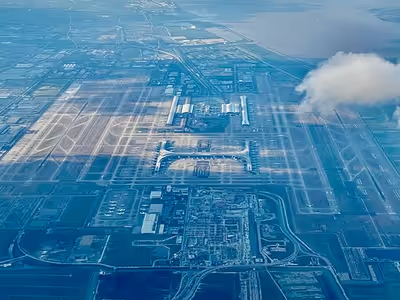
Pudong Airport has two main passenger terminals, flanked on both sides by four operational parallel runways. Construction of a third passenger terminal was started in 2021, in addition to a satellite terminal and two additional runways, which will raise its annual capacity from 60 million passengers to 80 million, along with the ability to handle six million tons of freight.
Pudong Airport is a fast-growing hub for both passenger and cargo traffic. With 3,778,331 metric tons handled in 2024, the airport is the world's second-busiest airport by cargo traffic. Pudong Airport also served a total of 84,994,548 passengers in 2025, making it the busiest airport in China, third-busiest in Asia, and the fifth-busiest in the world. It is also the busiest international gateway of mainland China, with 35.25 million international passengers.
In the first quarter of 2026, Pudong Airport served with 21.739 million passengers (8.1046 million passengers are international), surpassing Baiyun Airport served total 22.539 million passengers (4.784 million passengers are international). In the first half of year 2026, the total passengers throughput of Pudong Airport reached 42.691 million passengers. In June 2026, the total passengers throughput of Pudong Airport reached 6.864 million passengers.
Shanghai Pudong is the busiest international hub in China, and about half of its total passenger traffic is international. Pudong Airport is connected to Shanghai Hongqiao Airport by Shanghai Metro Line 2, the Shanghai maglev train via Pudong Airport Terminal 1&2 station and the Airport Link Line (Shanghai Suburban Railway). There are also airport buses connecting it with the rest of the city.
History
Early development
Construction of the first phase of the new Shanghai Pudong International Airport began in October 1997, took two years to build at a cost of RMB 12 billion (US$1.67 billion), and was officially opened on 16 September 1999 and it replaced Shanghai Hongqiao International Airport as Shanghai's primary airport which was the city's only commercial airport until the completion of Pudong International Airport. Most international flights were gradually moved to Pudong after its opening.
A second runway was opened on 17 March 2005, and construction of phase two (including a second terminal, a third runway and a cargo terminal) began in December 2005 and started operation on 26 March 2008, in time for the Beijing 2008 Summer Olympics.
In November 2011, Pudong Airport received approval from the national government for a new round of expansion which includes two runways. The 3,800-metre (12,467 ft) fourth runway, along with an auxiliary taxiway and traffic control facilities, is projected to cost 2.58 billion yuan (US$403 million). The 3,400-metre (11,155 ft) fifth runway, along with a new traffic tower, will cost 4.65 billion yuan (US$726.6 million). Construction was completed in 2015 and has doubled the capacity of the airport.
Ongoing expansion
Pudong International Airport officially started the third phase of the Pudong International Airport expansion with the construction on a new south satellite terminal on 29 December 2015. The new satellite terminal will be the world's largest single satellite terminal with a total construction area of 622,000 square metres (6,700,000 sq ft), which is larger than the Pudong International Airport T2 terminal building (485,500 square metres [5,226,000 sq ft]). The satellite terminal is composed of two halls, S1 and S2, forming an H-shaped structure. It will have an annual design capacity of 38 million passengers, The total cost of the project is estimated to be about 20.6 billion yuan. Halls S1 and S2 will have 83 gates. A high capacity people mover connecting T1 to S1 and T2 to S2 will be constructed. After the completion of the satellite terminal in 2019, Pudong International Airport will have an annual passenger capacity of 80 million passengers, ranking among the top ten airports in the world by capacity.
As of October 2019, the satellite terminal is in operation and connected by people movers to the main Terminals 1 and 2.
By 6 January 2021, work on Pudong Airport T3 began on the south side of the airfield. The new terminal is anticipated to serve 50 million annual passengers when it opens according to city officials, while the entire airport is expected to have 130 million passengers by 2030. Several public transport lines will be extended to T3.
Sign in to keep reading
5 more chapters are free with a Lably account.
Facilities
Terminal 1 was opened to public and officially opened on 1 October 1999 along with a 4,000-metre (13,000 ft) runway and a cargo hub.
Terminal 2 was officially opened to the public on 26 March 2008 along with the third runway, making the entire airport capable of handling 60 million passengers and 4.2 million tons of cargo annually. Terminal 2 is shaped like Terminal 1, although it more closely resembles a wave, and is slightly larger than Terminal 1. Terminal 2 also has more floor areas than Terminal 1. Terminal 2 is primarily used by Air China and other Star Alliance members.
Construction on an additional satellite concourse facility to accommodate further gates and terminal space started on 29 December 2015 and officially opened in September 2019. It is the largest stand-alone satellite airport terminal buildings in the world at 622,000 square metres (6,700,000 sq ft).
The satellite terminals (S1 and S2) are connected to the main terminals (T1 and T2) by the Shanghai Pudong Airport automatic people mover, an underground automated metro system. The West line connects terminals T1 and S1, and the East line connects terminals T2 and S2.
The airport has been using the Airport Collaborative Decision Making system (A-CDM) developed by the aviation data service company VariFlight since January 2017. The system is aimed to improve on-time performance and safety of the airport's operations. By June 2017, Shanghai Pudong airport recorded 62.7% punctuality rate, which was a 15% increase compared to the same period previous year.
Airlines and destinations
Passenger
Statistics
Ground transportation
Rail transit
Metro
Line 2 of the Shanghai Metro was extended directly to the airport on 8 April 2010. The station was renamed Pudong Airport Terminal 1 & 2 on 21 September 2024, in advance of the opening of the suburban rail station with the same name.
Suburban rail
The Airport Link Line of Shanghai Suburban Railway commenced operation on 27 December 2024.
High-speed rail
The airport will be directly linked to Shanghai East railway station when it opens in 2027.
Accidents and incidents
- On 28 November 2009, Avient Aviation Flight 324, a McDonnell Douglas MD-11F operating a scheduled international cargo to Bishkek, Kyrgyzstan, overran the runway on takeoff and crashed into a ravine, killing three of the seven occupants.
- On 22 July, 2020, Ethiopian Airlines Cargo Flight 3739, a Boeing 777-F60 operating a scheduled international cargo flight departing for Santiago, Chile with three stopovers, caught fire on the ground shortly before takeoff. All five crew members on board evacuated safely, but the aircraft was destroyed. The fire was caused by the spontaneous ignition of chlorine dioxide pills in the cargo hold.