


Related on Lably
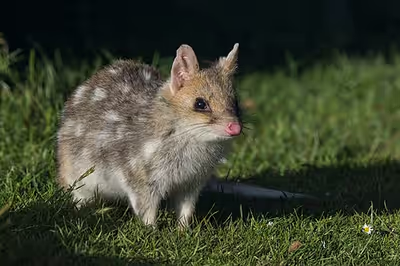
Genetic evidence indicates that quolls evolved around 15million years ago in the Miocene, and that the ancestors of the six species had all diverged by around four million years ago. The six species vary in weight and size, from 300 g (11 oz) to 7 kg (15 lb). They have brown or black fur and pink noses. They are largely solitary, but come together for a few social interactions, such as mating, which occurs during the winter season. A female gives birth to up to 30 pups, but the number that can be raised to adulthood is limited by the number of teats (six or seven). They have a lifespan of 1–5 years (species dependent).
Quolls eat smaller mammals, small birds, lizards, and insects. All species have drastically declined in numbers since Australasia was colonised by Europeans, with one species, the eastern quoll, becoming extinct on the Australian mainland in the 1960s. Major threats to their survival include the toxic cane toad, predators such as feral cats and foxes, urban development, and poison baiting. Conservation efforts include captive-breeding programs and reintroductions.
Taxonomy and naming
The generic name Dasyurus (from Ancient Greek: δασύουρος, dasúouros) means "hairy-tail". Étienne Geoffroy Saint-Hilaire coined the name in 1796 in his formal description in Magasin encyclopédique.
In 1770, Captain Cook collected quolls on his exploration of the east coast of Australia, adopting an Aboriginal name for the animals. Although the origin of Cook's specimens are unclear, the word and its variants je-quoll, jaquol, or taquol are derived from the word dhigul in the language of the Guugu Yimithirr people of far north Queensland. No evidence indicates the local indigenous people used the word in the Sydney area. They were likened in appearance to a polecat or marten in the earliest reports, the tiger quoll (spotted-tailed) being called "spotted marten" and eastern quoll "spotted opossum", but by 1804, the names "native fox", "native cat", and "tiger cat" had been adopted by early settlers. In the 1960s, noted naturalist David Fleay pushed for the revival of the term "quoll" to replace the then-current vernacular names that he felt were misleading.
Four species have been recovered from Pleistocene cave deposits from Mount Etna Caves National Park near Rockhampton in central Queensland. Remains of the spotted-tailed quoll and the northern quoll, and a species either identical or very similar to the eastern quoll, as well as a prehistoric species as yet undescribed, all lived in what was a rainforest climate. The northern quoll is still found in the region. The fossil species D. dunmalli, described by Bartholomai in 1971, is the oldest species recovered to date. Its remains were found in Pliocene deposits near Chinchilla in southeastern Queensland. Known only from a lower jaw and some teeth, it was a relative of the spotted-tailed quoll.
The first species described, the eastern quoll, was originally placed in the American opossum genus Didelphis by an anonymous author, and named Didelphis maculata. This name is no longer considered valid, and the second part of the name is now given to a different species, the spotted-tailed quoll, Dasyurus maculatus, while the eastern quoll was renamed Dasyurus viverrinus by George Shaw in 1800.
The tribe Dasyurini, to which quolls belong, also includes the Tasmanian devil, the antechinus, the kowari, and the mulgara. Genetic analysis of cytochrome b DNA and 12S rRNA of the mitochondria indicates the quolls evolved and diversified in the late Miocene between 15 and 5 million years ago, a time of great diversification in marsupials. The ancestors of all current species had diverged by the early Pliocene, around 4 million years ago.
Species
The genus Dasyurus consists of six species:
The following is a phylogenetic tree based on mitochondrial genome sequences:
Sign in to keep reading
7 more chapters are free with a Lably account.
Description
Quolls are solitary, nocturnal animals. Depending on the species, adult quolls can be 25 to 75 cm (9.8 to 29.5 in) long, with hairy tails about 20 to 35 cm (7.9 to 13.8 in) long. Average weight differs greatly depending on the species; male western and eastern quolls weigh about 1.3 kg (2.9 lb) and females 0.9 kg (2.0 lb). The spotted-tailed quoll is the largest, with the male weighing about 7 kg (15 lb) and the female 4 kg (8.8 lb). The northern quoll is the smallest, and the male weighs on average 400 to 900 g (14 to 32 oz), and the female 300 to 500 g (11 to 18 oz). All the species have a spotted pelage, a cat-like posture, and a pointed face. Females have >8 teats and develop a pouch during the breeding season, which opens toward the tail (with the exception of the spotted-tailed quoll, which has a true pouch) when they are rearing young. Their natural lifespans are 1–5 years; the larger species tend to live longer. Quolls fluoresce under ultraviolet light.
Distribution and habitat
Quolls are indigenous to mainland Australia, the island state of Tasmania, and New Guinea. The six species were once widely distributed across the three land masses, but are now restricted to smaller areas.
Although primarily ground-dwelling, the genus has developed secondary arboreal characteristics. Each species of quoll lives in distinct geographical areas. The spotted-tailed quoll is an exclusively mesic zone species; inhabiting wetter habitats. The western quoll also inhabits mesic habitat, but has adapted to arid regions across inland Australia, while the northern quoll inhabits tropical habitat of high rainfall.
Behaviour
Quolls are solitary carnivorous marsupials. They are nocturnal. They are mostly ground-dwelling, but it is not uncommon to see a quoll climbing a tree. Quolls mark their territory several kilometres away from their dens. A male's territory often overlaps many females' territories, and male and female quolls only meet for mating. Some quolls use communal latrines, usually on an outcropping used for marking territory and social functions, which may have up to 100 droppings in them. Quolls are mostly solitary, limiting contact with other quolls to mating or other social activities.
Diet
Quolls are mostly carnivorous. The smaller quolls primarily eat insects, birds, frogs, lizards and fruit; the larger species eat birds, reptiles, and mammals, including echidnas and possums. The spotted-tailed quoll's diet is dominated by mammals such as brushtail possums, rabbits, hares and invertebrates. The exact mix is variable depending on the availability of prey after bushfires, and can include carrion or bandicoots when food is scarce.
Quolls hunt by stalking. Quolls pin small prey down with their front paws while devouring it, and jump onto larger prey, sinking in their claws and closing their jaws around the neck. The paws and vibrissae of quolls allow them to reach into small burrows to find prey. Quolls can obtain all the water they need from their food, making them adaptable during droughts or other periods of water shortage. A study of historical records revealed 111 written accounts of quolls opportunistically feeding on human remains in Australia.
Reproduction
Mating occurs during the winter months. Once a female quoll has been impregnated, the folds on her abdomen convert into a pouch that opens at the back. The gestation period is ~21 days (species dependent). A newborn quoll, or joey, is the size of a grain of rice at birth. Up to 30 quolls (species dependent) can be born in each litter, but the number that can be raised is limited by the number of teats. The survivors fuse to the teats and suckle milk in their mother's pouch for 6–8 weeks. After this, the pups unfuse from the teats and the mother can deposit them in a den where they can remain for over a month.
Quolls reach maturity at one year old, and have a natural lifespan of 1–5 years (species dependent). The appearance of their pouches have been reported to be a reliable indicator of reproductive status: during the follicular phase pouches are red and have secretions, and after ovulation pouches are deep and wet. This can determine where a female quoll is in her ovarian cycle, which is anticipated to be helpful in breeding management.
Threats
Cane toads were introduced into Queensland in 1935; their numbers have since grown exponentially. These poisonous toads pose a significant threat to the northern quoll, which may die after consuming one. The Department of Sustainability, Environment, Water, Population and Communities has stated that cane toads are highly invasive and are major threats to the survival of northern quolls. Predators such as red foxes and feral cats prey on quolls and compete with them for food. For example, both quolls and foxes catch and consume rabbits. Since the introduction of foxes, quoll populations have declined dramatically. Foxes have been eradicated from many of the islands off the coast of Australia in an effort to protect quolls. Quoll habitat suffers from urbanisation, housing development, mining development, and agricultural expansion. Habitats are also being destroyed by large herbivores trampling the grass and overgrowth, making camouflage difficult. Bushfires and weeds also contribute to habitat destruction.
The natural poison fluoroacetate (Compound 1080) is commonly used in Australia to control introduced pests such as European rabbits, foxes, feral predators, and dingoes. The poison is extremely toxic to introduced pests, but less so to native animals as it is found naturally in many Australian plants. However, juvenile quolls may be susceptible to the poison. As of 2001 research was being undertaken to determine whether the number of quolls protected from predators may be less than those killed by the poison.
Conservation
Since 1770, all Australian quoll species have declined due to habitat destruction through urbanisation. European rabbits were introduced to Australia with the arrival of the First Fleet in 1788 as part of biodiversity enrichment efforts. The native quolls predated upon rabbits and prior to 1870, many accounts recorded quolls impeding their establishment on the mainland while island colonies thrived. In response, quolls were systematically exterminated by colonists to defend introduced species such as chickens; rabbits populations subsequently reached plague proportions. Quolls have been studied in captivity, with the ultimate aim of supporting conservation and future translocations. These studies include investigations into their haematology and blood biochemistry profiles, and dietary studies. It has been suggested that the creation of a native quoll pet industry in Australia could aid in their conservation. However, concerns exist about this methodology in regards to animal husbandry, conservation benefits, and other issues. Some scientists believe that keeping quolls as pets could aid in their long-term conservation.
In late October 2011, a litter of five spotted-tailed quoll pups was born at Wild Life Sydney in Darling Harbour, Australia. The pups were born to inexperienced parents, both just one year old. The reason for the young parents was because older male quolls can become violent and kill the female if they do not want to mate. By breeding one-year-old quolls, there was no threat of violence. Four of the quoll pups were sent to other zoos or wildlife parks across Australia, but one, which the researchers named Nelson, stayed at the centre to become an "ambassador for all quolls". On 28 September 2023, a farmer in Beachport, South Australia, set up a trap to catch what he thought was a fox or a cat eating his chickens and caught a spotted-tailed quoll. It was the first time in 130 years that a quoll had been found in South Australia, where it had been considered to be extinct . The captured quoll was handed over to the National Parks and Wildlife Service to be DNA tested and treated by a veterinarian.
Fox control programs have benefited the western quoll. The Department of Environment and Conservation (Western Australia) monitors western quoll populations in the Jarrah Forest as part of its faunal management programs, as well as conducting research into fox control, timber harvesting, and prescribed burning. The Perth Zoo has been monitoring a successful captive-breeding program since 1989. It has successfully bred more than 60 western quolls, most of which it transferred to Julimar Conservation Park, with proposals to translocate to Wheatbelt reserves and Shark Bay.
In 2003, the eastern quoll was reintroduced to a 473 ha fox-proof fenced sanctuary at Mt Rothwell Biodiversity Interpretation Centre at Mount Rothwell in Victoria. In 2016, the eastern quoll was also successfully reintroduced to Mulligans Flat Woodland Sanctuary in the Australian Capital Territory. Bristol Zoo was the first zoo in the UK to successfully breed eastern quolls. In March 2018, twenty eastern quolls bred in a wildlife park in Tasmania were released into the Booderee National Park on the south coast of NSW. In May 2021, the reintroduction of eastern quolls to Booderee National Park has been reported to have failed when numbers were down to one male.
The northern quoll is threatened by toxic cane toads, but a University of Sydney project revealed in 2010 is teaching them to avoid eating the invasive amphibians. In 2008, the Northern Territory Wildlife Park in Australia recorded their first litter of northern quoll pups in the park. The quolls bred well in captivity, with over 15 litters in the 2008 breeding season alone.
The bronze quoll occurs in a few protected areas, such as Wasur National Park and Tonda Wildlife Management Area. More research on distribution and threats is needed for further conservation.