

Saṃsāra in Buddhism
Cycle of repeated birth, mundane existence and dying again
- 11 min read
- 5 chapters

Related on Lably
Through Buddhism, Four Noble Truths and Hinduism
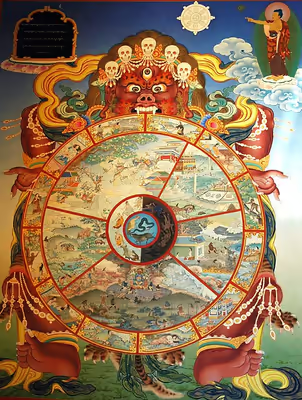
Rebirths occur in six realms of existence, namely three good realms (heavenly, demi-god, human) and three evil realms (animal, ghosts, hell). Saṃsāra ends when a being attains nirvāṇa, which is the extinction of desire and acquisition of true insight into the nature of reality as impermanent and non-self.
Characteristics
In Buddhism, saṃsāra is the beginningless and endless cycle of life, death, and rebirth characterized by suffering. Passages from the Samyutta Nikaya propose that this process is beginningless, fueled by the ignorance and craving of beings. This unending transmigration across the six realms (Skt. gati, lit. "paths") lacks a particular direction or purpose. Samsara is characterized by suffering (Skt. duḥkha; P. dukkha), and relates to the Four Noble Truths in Buddhism, as dukkha is the essence of Samsara. Every rebirth is temporary and impermanent. In each rebirth one is born and dies, to be reborn elsewhere in accordance with one's own karma. It is perpetuated by one's ignorance (Skt. and P. avidyā), particularly ignorance regarding impermanence (Skt. anityā; P. anicca) and no-self (Skt. anātman; P. anatta), which leads to craving. Samsara continues until liberation is attained by means of insight and nirvana, the extinguishment of desires and the gaining of true insight into impermanence and non-self reality. Outside of a Buddhist context, similar notions of cyclic existence date back to 800 BCE.
Mechanism
Saṃsāra in Buddhism asserts that there is no permanently unchanging entity that undergoes the endless cycles of rebirth, and this distinguishes it from the Hindu and Jain views of saṃsāra. This is known as no-self (Skt. anātman; P. anatta).
Early Buddhist texts suggest that the Buddha faced a difficulty in explaining what is reborn and how rebirth occurs, after he invented the concept that there is "no self." Later Buddhist scholars, such as the fifth-century Pali scholar-monk Buddhaghosa, suggested that the lack of a self or soul does not mean lack of continuity; and the rebirth across different realms of birth – such as heavenly, human, animal, hellish and others – occurs in the same way that a flame is transferred from one candle to another. Buddhaghosa attempted to explain rebirth mechanism with "rebirth-linking consciousness" (patisandhi).
Buddhist traditions diverge in their understanding of the exact process of rebirth. The Early Buddhist Schools were divided on whether or not there existed an intermediate state (Skt. antarābhava) between lives. These doctrinal camps filtered into contemporary Buddhism with conservative Theravada Buddhists asserting that rebirth is immediate while the Mahāyāna schools generally agree that there is an intermediate state of up to forty-nine days before the being is reborn.
In the framework of the Two Truths as capitulated by the third-century Mahayanist scholar-monk Nagarjuna, saṃsāra and nirvāṇa are identical in the ultimate truth.
Sign in to keep reading
4 more chapters are free with a Lably account.
Realms of rebirth
Buddhist cosmology typically identifies six realms of rebirth and existence: gods, demi-gods, humans, animals, hungry ghosts and hells. Earlier Buddhist texts refer to five realms rather than six realms; when described as five realms, the god realm and demi-god realm constitute a single realm.
The six realms are typically divided into three higher realms (good, fortunate) and three lower realms (evil, unfortunate), with all realms of rebirth being Independent completely of reality and nature in all forms, with the deva realm being the "ultimate" reality. The three higher realms are the realms of the gods, humans and demi-gods; the three lower realms are the realms of the animals, hungry ghosts and hell beings. The six realms are organized into thirty-one levels in East Asian literature. Buddhist texts describe these realms as follows:
- God realm (deva): the realm of the gods is the most pleasant among the six realms, and can be subdivided into many planes of existence. A rebirth in this heavenly realm stems from accumulating wholesome karma. A deva does not need to work, and is able to enjoy in the heavenly realm all pleasures found on earth. However, the pleasures of this realm lead to attachment (Upādāna), lack of spiritual pursuits and therefore no nirvana. The vast majority of Buddhist lay people have historically pursued Buddhist rituals and practices motivated with rebirth into deva realm. The deva realm in Buddhist practice in Southeast and East Asia include gods found in Hindu traditions such as Indra and Brahma, and concepts in Hindu cosmology such as Mount Meru.
- Human realm (manuṣya): Buddhism asserts that one is reborn in this realm with vastly different physical endowments and moral natures because of a being's past karma. A rebirth in this realm is considered as fortunate because it offers an opportunity to attain nirvana and end the Saṃsāra cycle.
- Demi-god realm (asuras): the third realm of existence in Buddhism. Demi-gods are notable for their anger and some supernatural powers. They fight with the gods, or trouble the humans through illnesses and natural disasters. They accumulate karma, and are reborn.
- Animal realm (tiryag): is the state of existence of a being as an animal. This realm is traditionally thought to be similar to a hellish realm, because animals are believed in Buddhist texts to be driven by impulse and instinct; they prey on each other and suffer. Some Buddhist texts assert that plants belong to this realm, with primitive consciousness.
- Hungry ghost realm: hungry ghosts and other restless spirits (preta) are rebirths caused by karma of excessive craving and attachments. They do not have a body, are invisible and constitute only "subtle matter" of a being. Buddhist texts describe them as beings who are extremely thirsty and hungry, with very small mouths but very large stomachs. Buddhist traditions in Asia attempt to care for them on ritual-days every year, by leaving food and drinks in the open, to feed any hungry ghosts nearby. When their bad karma demerit runs out, these beings are reborn into another realm. According to McClelland, this realm is the mildest of the three evil realms. According to Yangsi Rinpoche, in contrast, the suffering of the beings born in the realm of the hungry ghosts is far more intense than those born in the animal realm.
- Hell realm: beings in hell (Skt. naraka; P. niraya) enter this realm for evil karma such as theft, lying, adultery and others. The texts vary in their details, but typically describe numerous hellish regions each with different forms of intense suffering. These typically include eight hot hells and eight cold hells, as well as hells in which beings are eaten alive, beat, and tortured depending on the unwholesome karma accumulated. Upon exhausting their unwholesome karma, the beings in hell perish and are born in successively higher realms. This realm differs from the Christian conception of hell in that existence in this realm is temporary and not final damnation.
Tibetan Buddhism proposes that a buddha exists in each of the six realms. These six buddhas have also been known as the "Six Sages." They are: Indraśakra Buddha in the god realm, Vemacitra Buddha of the petty god realm, Śākyamuni Buddha in the human realm; Sthīrasiṃha Buddha in the animal realm, Jvālamukha Buddha in the hungry ghost realm, and Yāma Dharmarāja as the buddha in the hot hell realm.
Cause and end
Samsara is perpetuated by one's karma, which is caused by craving and ignorance (avidyā).
Karma
Samsara is perpetuated by karma. Karma or 'action' results from an intentional physical or mental act, which causes a future consequence. Whether a deed is wholesome or unwholesome is determined by whether its underlying intention (cetanā) is wholesome or unwholesome. Thus, one's present existence in a particular realm and circumstance is determined by these actions (i.e., karma) from one's previous lives; and the circumstances of the future rebirth are determined by the actions in the current and previous lives.
Craving and ignorance
Inconsistencies in the oldest texts show that the Buddhist teachings on craving and ignorance, and the means to attain liberation, evolved, either during the lifetime of the Buddha, or thereafter. According to Frauwallner, the Buddhist texts show a shift in the explanation of the root cause of samsara. Originally craving was considered to be the root cause of samsara, which could be stilled by the practice of dhyāna, leading to a calm of mind which according to Vetter is the liberation which is being sought.
The later Buddhist tradition considers ignorance to be the root cause of samsara. Avidya is misconception and ignorance about reality, leading to grasping and clinging, and repeated rebirth. According to Paul Williams, "it is the not-knowingness of things as they truly are, or of oneself as one really is." It can be overcome by insight into the true nature of reality. In the later Buddhist tradition "liberating insight" came to be regarded as equally liberating as the practice of dhyana. According to Vetter and Bronkhorst, this happened in response to other religious groups in India, who held that a liberating insight was an indispensable requisite for moksha, liberation from rebirth.
The ideas on what exactly constituted this "liberating insight" evolved over time. Initially the term prajna served to denote this "liberating insight." Later on, prajna was replaced in the suttas by the four truths. This happened in those texts where "liberating insight" was preceded by the four jhanas, and where this practice of the four jhanas then culminates in "liberating insight." The four truths were superseded by pratityasamutpada, and still later, in the Hinayana schools, by the doctrine of the non-existence of a substantial self or person. And Schmithausen states that still other descriptions of this "liberating insight" exist in the Buddhist canon:
"that the five Skandhas are impermanent, disagreeable, and neither the Self nor belonging to oneself"; "the contemplation of the arising and disappearance (udayabbaya) of the five Skandhas"; "the realisation of the Skandhas as empty (rittaka), vain (tucchaka) and without any pith or substance (asaraka).
Liberation
Saṃsāra ends when one attains liberation (Skt. mokṣa). In early Buddhism, liberation is identified with nirvana. In later Buddhism, liberation is tied to insight, especially the recognition and acceptance of non-self. Here, liberation from saṃsāra is defined as no longer seeing any soul or self. This equating of liberation and non-self appears throughout early Buddhist texts.
Some Buddhist texts suggest that rebirth occurs through the transfer of consciousness (Skt. vijiñāna; P. vinnana) from one life to another. When this consciousness ceases, then liberation is attained. There is a connection between consciousness, karmic activities, and the cycle of rebirth in that, with the destruction of consciousness, there is "destruction and cessation of "karmic activities" (anabhisankhara, S III, 53), which are considered in Buddhism to be "necessary for the continued perpetuation of cyclic existence."
While Buddhism considers the liberation from samsara as the ultimate spiritual goal, in traditional practice, Buddhists seek and accumulate merit through good deeds, donations to monks and various Buddhist rituals in order to gain better rebirths rather than nirvana.
Impermanence and Non-Self Reality
A value of Buddhism is the idea of impermanence. All living things, causes, conditions, situations are impermanent. Impermanence is the idea that all things disappear once they have originated. Impermanence occurs "moment to moment", and this is why there is no recognition of the self. Since everything is in a state of decay, permanent happiness and self cannot exist in samsara.
Anatta is the Buddhist idea of non-self. Winston L. King, a writer from the University of Hawai'i Press, references two integral parts of Anatta in Philosophy East and West. King details the first aspect, that Anatta can be "experienced and not just described." King states the second aspect of Anatta is that it is the liberation from the "power of samsaric drives." Obtaining awareness of Anatta and non-self reality results in a, "freedom from the push-pull of his own appetites, passions, ambitions, and fixations and from the external world's domination in general, that is, the conquest of greed, hatred, and delusion." This "push-pull" of mundane human existence or samsara results in dukka, but the recognition of Anatta results in a "freedom from the push-pull."
Psychological interpretation
According to Chögyam Trungpa the realms of samsara can refer to both "psychological states of mind and physical cosmological realms".
Gethin argues, rebirth in the different realms is determined by one's karma, which is directly determined by one's psychological states. The Buddhist cosmology may thus be seen as a map of different realms of existence and a description of all possible psychological experiences. The psychological states of a person in current life lead to the nature of next rebirth in Buddhist cosmology.
Paul Williams acknowledges Gethin's suggestion of the "principle of the equivalence of cosmology and psychology," but notes that Gethin is not asserting the Buddhist cosmology is really all about current or potential states of mind or psychology. The realms in Buddhist cosmology are indeed realms of rebirths. Otherwise rebirth would always be into the human realm, or there would be no rebirth at all. And that is not traditional Buddhism, states Williams.
David McMahan concludes that the attempts to construe ancient Buddhist cosmology in modern psychological terms is modernistic reconstruction, "detraditionalization and demythologization" of Buddhism, a sociological phenomenon that is seen in all religions.
A pre-modern form of this interpretation can be seen in the views of the sixth-century Chinese monk Zhiyi, whose writings became the foundation for the Tiantai school in China, particularly in a concept named "the trichiliocosm in a single instant of thought" (一念三千 Ch. yíniàn sānqiān; Ja. ichinen sanzen), which proposes that the vastness of all space is contained in the shortest span of a single thought. The Record of Linji, an anthology of the teachings of the ninth-century Chinese monk Linji Yixuan, also presents the view that the Three Realms originate with the mind.
Alternative translations
- Conditioned existence (Daniel Goleman)
- Cycle of clinging and taking birth in one desire after another (Phillip Moffitt)
- Cycle of existence
- Cyclic existence (Jeffry Hopkins)
- Uncontrollably recurring rebirth (Alexander Berzin)
- Wheel of suffering (Mingyur Rinpoche)