


Related on Lably
Through Space exploration, Soviet Union and ISRO
The Space Age is characterized by changes in emphasis on particular areas of space exploration and applications. Initially, the United States and the Soviet Union invested unprecedented amounts of resources in breaking records and being first to meet milestones in crewed and uncrewed exploration. The United States established the National Aeronautics and Space Administration (NASA) and the USSR established the Kosmicheskaya programma SSSR to meet these goals. This period of competition gave way to cooperation between those nations and an emphasis on scientific research and commercial applications of space-based technology.
Eventually other nations became spacefaring. They formed organizations such as the European Space Agency (ESA), the Japan Aerospace Exploration Agency (JAXA), the Indian Space Research Organization (ISRO), and the China National Space Administration (CNSA). When the USSR dissolved, the Russian Federation continued its program as Roscosmos.
In the early 2020s, some journalists have used the phrase "New Space Age" in reference to a resurgence of innovation and public interest in space exploration as well as commercial applications of low Earth orbit (LEO) and more distant destinations. New developments include the participation of billionaires in crewed space travel, including space tourism and interplanetary travel.
Periodization
The periodization of the Space Age can differ substantially, with some differentiating between a first Space Age and a second Space Age, which are separated at the turn of the 1980s/1990s.
Sign in to keep reading
3 more chapters are free with a Lably account.
Periods
Foundational developments to suborbital spaceflights
Some vehicles reached suborbital space much earlier than the launch of Sputnik. In June 1944, a German V-2 rocket became the first manmade object to enter space, albeit only briefly. In March 1926 American rocket pioneer Robert H. Goddard launched the world's first liquid fuel rocket but it did not reach outer space.
Since the Germans undertook the sub-orbital V-2 rocket flight in secrecy, it was not initially public knowledge. Also, the German launches, as well as the subsequent sounding rocket tests performed in both the United States and the Soviet Union during the late 1940s and early 1950s, were not considered significant enough to define the start of the space age because they did not reach orbit. A rocket powerful enough to reach orbit could also be used as an intercontinental ballistic missile that could deliver a warhead to any location on Earth. Some commentators claim this is why the orbital standard is commonly used to define when the space age began.
1957 to 1970s/1980s: Establishment and Space Race
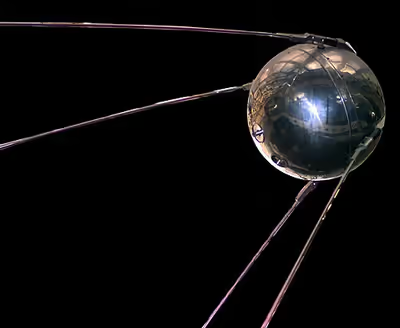
The Space Race was the first era of the Space Age. It was a race between the United States and the Soviet Union which began with the Soviet Union's October 4, 1957, launch of Earth's first artificial satellite Sputnik 1 during the International Geophysical Year. Weighing 83.6 kg (184.3 lb) and orbiting the Earth once every 98 minutes. The race resulted in rapid advances in rocketry, materials science, and other areas. One underlying motivation for the space race was military. The two nations were also in a nuclear arms race following the Second World War. Both nations used German missile technology and scientists from its missile program. The advantages in aviation and rocketry required for delivery systems were seen as necessary for national security and political superiority.
The Cold War competition between the United States and the Soviet Union is one reason the space age happened when it did. Since then, the space age has continued for the generation of scientific knowledge, innovation and creation of markets, inspiration, and agreements between the space-faring nations. Other reasons for the continuation of the space age are defending Earth from hazardous objects like asteroids and comets.
Much of the technology developed for space applications has been spun off and found additional uses, such as memory foam. In 1958 the United States launched its first satellite, Explorer 1. The same year President Dwight D. Eisenhower created the National Aeronautics and Space Administration, commonly known as NASA.
Prior to the first attempted human spaceflight, various animals were flown into outer space to identify potential detrimental effects of high g-forces in takeoff and landing, microgravity, and radiation exposure at high altitudes.
The Space Race reached its peak with the Apollo program that captured the imagination of much of the world's population. From 1961 to 1964, NASA's budget was increased almost 500 percent, and the lunar landing program eventually involved some 34,000 NASA employees and 375,000 employees of industrial and university contractors. The Soviet Union proceeded tentatively with its own lunar landing program which it did not publicly acknowledge, partly due to internal debate over its necessity and the untimely death (in January 1966) of Sergey Korolev, chief engineer of the Soviet space program.
The landing of Apollo 11 was watched by over 500 million people around the world and is widely recognized as one of the defining moments of the 20th century. Since then, public attention has largely moved to other areas.
The last major leap in the USSR–USA Space Race was the Skylab and Salyut programs, which established the first space stations for the U.S. and USSR in Earth orbit following termination of both countries' moon programs.
At the conclusion of the Apollo program, crewed flights from the United States were rare, then ended while the shuttle program was getting ready to kick into gear, and the space race had been over since the Apollo–Soyuz test project of 1975, started a period of U.S.–Soviet co-operation. The Soviet Union continued using the Soyuz spacecraft.
The shuttle program restored spaceflight to the U.S. following the Skylab program, but the Space Shuttle Challenger disaster in 1986 marked a significant decline in crewed Shuttle launches. Following the disaster, NASA grounded all Shuttles for safety concerns until 1988. During the 1990s funding for space-related programs fell sharply as the remaining structures of the now-dissolved Soviet Union disintegrated and NASA no longer had any direct competition, engaging rather in more substantial cooperation like the Shuttle–Mir program and its follow-up the International Space Station.
Diversification
Participation of private actors and other countries beside the Soviet Union and the United States in spaceflight had been the case from the very start of spaceflight development. A first commercial satellite had been launched by 1962, as well as in 1965 a third country achieving orbital spaceflight. The very beginning of the space age, the launch of Sputnik was in the context of international exchange, the International Geophysical Year 1957. Also soon into the space age the international community came together starting to negotiate dedicated international law governing outer space activity.
In the 1970s the Soviet Union started to invite other countries to fly their people into space through its Intercosmos program and the United States started to include women and people of colour in its astronaut program.
First exchange between the United States and the Soviet Union was formalized in the 1962 Dryden–Blagonravov agreement, calling for cooperation on the exchange of data from weather satellites, a study of the Earth's magnetic field, and joint tracking of the NASA Echo II balloon satellite. In 1963 President Kennedy could even interest premier Khrushchev in a joint crewed Moon landing, but after the assassination of Kennedy in November 1963 and Khrushchev's removal from office in October 1964, the competition between the two nations' crewed space programs heated up, and talk of cooperation became less common, due to tense relations and military implications. Only later the United States and the Soviet Union slowly started to exchange more information and engage in joint programs, particularly in the light of the development of safety standards since 1970, producing the co-developed APAS-75 and later docking standards. Most notably this signaled the ending of the first era of the space age, the Space Race, through the Apollo–Soyuz which became the basis for the Shuttle–Mir program and eventually the International Space Station programme.
Such international cooperation, and international spaceflight organization was furthermore fueled by increasingly more countries achieving spaceflight capabilies and together with a by the 1980s established private spaceflight sector, both being embodied by the European Space Agency. This allowed the formation of an international and commercial post–Space-Race spaceflight economy and period, with by the 1990s a public perception of space exploration and space-related technologies as being increasingly commonplace.
This increasingly cooperative diversification persisted until competition started to rise in these diversified conditions, from the 2010s and particularly by the early 2020s.
2010s to present: New Space competition
In the early 21st century, the Ansari X Prize competition was set up to help jump-start private spaceflight. The winner, Space Ship One in 2004, became the first spaceship not funded by a government agency.
Several countries now have space programs; from related technology ventures to full-fledged space programs with launch facilities. There are many scientific and commercial satellites in use today, with thousands of satellites in orbit, and several countries have plans to send humans into space. Some of the countries joining this new race are France, India, China, Israel and the United Kingdom, all of which have employed surveillance satellites. There are several other countries with less extensive space programs, including Brazil, Germany, Ukraine, and Spain.
As for the United States space program, NASA permanently grounded all U.S. Space Shuttles in 2011. NASA has since relied on Russia and SpaceX to take American astronauts to and from the International Space Station. In the 2010s and early 2020s, NASA developed a deep-space crew capsule named the Orion to send humans to the Moon and Mars. NASA is hoping that this mission will "usher in a new era of space exploration." The U.S. military also joined the new space age with the creation of the new Space Force on 20 December 2019.
Another major factor affecting the current Space Age is the privatization of space flight. A significant private spaceflight company is SpaceX which became the proprietor of one of world's most capable operational launch vehicle when they launched their current largest rocket, the Falcon Heavy in 2018. Elon Musk, the founder and CEO of SpaceX, has put forward the goal of establishing a colony of one million people on Mars by 2050 and the company is developing its Starship launch vehicle to facilitate this. Since the Demo-2 mission for NASA in 2020 in which SpaceX launched astronauts for the first time to the International Space Station, the company has maintained an orbital human spaceflight capability. Blue Origin, a private company founded by Amazon.com founder Jeff Bezos, is developing rockets for use in space tourism, commercial satellite launches, and eventual missions to the Moon and beyond. Richard Branson's company Virgin Galactic is concentrating on launch vehicles for space tourism. A spinoff company, Virgin Orbit, air-launches small satellites with their LauncherOne rocket. Another small-satellite launcher, Rocket Lab, has developed the Electron rocket and the Photon satellite bus for sending spacecraft further into the Solar System, the company also plans to introduce the larger Neutron launch vehicle in 2025.
Elon Musk has stated that the main reason he founded SpaceX is to make humanity a multiplanetary species, and cites reasons for doing it including: To ensure the long-term continuation of our species and protecting the "light of consciousness". He also said,
You want to wake up in the morning and think the future is going to be great – and that's what being a spacefaring civilization is all about. It's about believing in the future and thinking that the future will be better than the past. And I can't think of anything more exciting than going out there and being among the stars.
The Space Age marked a major comeback with the launch of NASA's Space Launch System and Orion during the Artemis I mission on November 16, 2022; this marked the first time a human-rated spacecraft had orbited the Moon in nearly 50 years, as well as the return of the United States' capability to send astronauts to the Moon. Artemis II, a crewed lunar flyby, launched on April 1, 2026, sending the first humans to the Moon's vicinity since the Apollo era; the crew set a new record for the farthest distance any human has traveled in space, surpassing the mark set by Apollo 13 in 1970. Additional goals for the 2020s include the completion of the Lunar Gateway, mankind's first space station around the Moon, the first crewed Moon landing since the Apollo era with Artemis IV, and goals to expand beyond the original vision of the Space Age's original era in the 1960s.
Chronology
Cultural influences
Arts and architecture
The Space Age is considered to have influenced:
- Automotive design: Virgil Exner's Forward Look, 1957–1961
- Googie architecture
- Space Age fashions by André Courrèges, Pierre Cardin, Paco Rabanne, Rudi Gernreich, Emanuel Ungaro, Jean-Marie Armand, Michèle Rosier, and Diana Dew
- Furniture design of the 1950s and '60s by Eero Saarinen, Arne Jacobsen, Eero Aarnio, and Verner Panton
- Amusement park attractions, such as TWA Moonliner and Mission: Space
- Cold War playground equipment
Music
The Space Age also inspired musical genres:
- Space age pop
- Space music
- Space rock
- Space-themed music