


Related on Lably
Through Organic compound, Ether and Viscosity
Production
About 200,000 tonnes of tetrahydrofuran are produced annually. The most widely used industrial process involves the acid-catalyzed dehydration of 1,4-butanediol. Ashland/ISP is one of the biggest producers of this chemical route. The method is similar to the production of diethyl ether from ethanol. The butanediol is derived from condensation of acetylene with formaldehyde followed by hydrogenation. DuPont developed a process, for producing THF by oxidizing n-butane to crude maleic anhydride, followed by catalytic hydrogenation. A third major industrial route entails hydroformylation of allyl alcohol followed by hydrogenation to 1,4-butanediol.
Other methods
THF can also be synthesized by catalytic hydrogenation of furan. This allows certain sugars to be converted to THF via acid-catalyzed digestion to furfural and decarbonylation to furan, although this method is not widely practiced. THF is thus derivable from renewable resources.
Sign in to keep reading
5 more chapters are free with a Lably account.
Applications
Polymerization
In the presence of strong acids, THF converts to a linear polymer called poly(tetramethylene ether) glycol (PTMEG), also known as polytetramethylene oxide (PTMO):
This polymer is primarily used to make elastomeric polyurethane fibers like spandex.
As a solvent
The other main application of THF is as an industrial solvent for polyvinyl chloride (PVC) and in varnishes. It is an aprotic solvent with a dielectric constant of 7.6. It is a moderately polar solvent and can dissolve a wide range of nonpolar and polar chemical compounds. THF is water-miscible and can form solid clathrate hydrate structures with water at low temperatures.
THF has been explored as a miscible co-solvent in aqueous solution to aid in the liquefaction and delignification of plant lignocellulosic biomass for production of renewable platform chemicals and sugars as potential precursors to biofuels. Aqueous THF augments the hydrolysis of glycans from biomass and dissolves the majority of biomass lignin making it a suitable solvent for biomass pretreatment.
THF is often used in polymer science. For example, it can be used to dissolve polymers prior to determining their molecular mass using gel permeation chromatography. THF dissolves PVC as well, and thus it is the main ingredient in PVC adhesives. It can be used to liquefy old PVC cement and is often used industrially to degrease metal parts.
THF is used as a component in mobile phases for reversed-phase liquid chromatography. It has a greater elution strength than methanol or acetonitrile, but is less commonly used than these solvents.
THF is used as a solvent in 3D printing when printing with PLA, PETG and substantially similar filaments. It can be used to clean clogged 3D printer parts, to remove extruder lines and add a shine to the finished product as well as to solvent weld printed parts.
Laboratory use
In the laboratory, THF is a popular solvent when its water miscibility is not an issue. It is more basic than diethyl ether and forms stronger complexes with Li+, Mg2+, and boranes. It is a popular solvent for hydroboration reactions and for organometallic compounds such as organolithium and Grignard reagents. Thus, while diethyl ether remains the solvent of choice for some reactions (e.g., Grignard reactions), THF fills that role in many others, where strong coordination is desirable and the precise properties of ethereal solvents such as these (alone and in mixtures and at various temperatures) allows fine-tuning modern chemical reactions.
Commercial THF contains substantial water that must be removed for sensitive operations, e.g. those involving organometallic compounds. Although THF is traditionally dried by distillation from an aggressive desiccant such as elemental sodium, molecular sieves have been shown to be superior water scavengers.
Reaction with hydrogen sulfide
In the presence of a solid acid catalyst, THF reacts with hydrogen sulfide to give tetrahydrothiophene.
Lewis basicity
THF is a Lewis base that bonds to a variety of Lewis acids such as I2, phenols, triethylaluminum and bis(hexafluoroacetylacetonato)copper(II). THF has been classified in the ECW model and it has been shown that there is no one order of base strengths. Many complexes are of the stoichiometry MCl3(THF)3.
Precautions
THF is a relatively acutely nontoxic solvent, with the median lethal dose (LD50) comparable to that for acetone. However, chronic exposure is suspected of causing cancer. Reflecting its remarkable solvent properties, it penetrates the skin, causing rapid dehydration. It is highly flammable. THF dissolves or penetrates most polymer glove materials in a very short period of time; only Linear low-density polyethylene (LLDPE) laminated gloves are capable of protecting against it for long time periods, similar to most ketones. Polyvinyl alcohol (PVA) coated gloves are capable of providing protection for nearly an hour, but because PVA is water soluble they are only effective in low humidity environments and when working with anhydrous solvents. Even very thick nitrile or nitrile-neoprene gloves degrade in under 10 minutes.
One danger posed by THF is its tendency to form explosive peroxides upon reaction with air:
To minimize this problem, commercial supplies of THF are often stabilized with butylated hydroxytoluene (BHT). Distillation of THF to dryness is unsafe because the explosive peroxides can concentrate in the residue.
Related compounds
Tetrahydrofurans
The tetrahydrofuran ring is found in diverse natural products including lignans, acetogenins, and polyketide natural products. Diverse methodology has been developed for the synthesis of substituted THFs.
Oxolanes
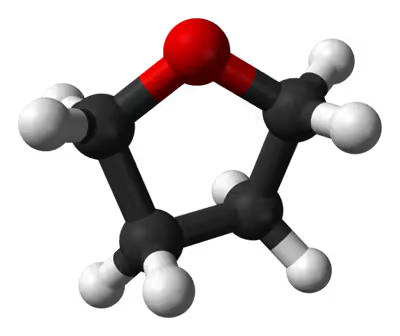
Tetrahydrofuran is one of the class of five-membered saturated carbon/oxygen rings called oxolanes. There are seven possible structures, namely,
- C4O: Monoxolane, the root of the group, synonymous with tetrahydrofuran
- C3O2: 1,2-dioxolane and 1,3-dioxolane
- C2O3: 1,2,3-trioxolane and 1,2,4-trioxolane
- CO4: tetroxolane
General reference
- Loudon, G. Mark (2002). Organic Chemistry (4th ed.). New York: Oxford University Press. p. 318. ISBN 978-0-9815194-3-2.