

The International Jew
Antisemitic set of publications of the 1920s
- 6 min read
- 5 chapters

Related on Lably
Through Henry Ford, Adolf Hitler and World War I
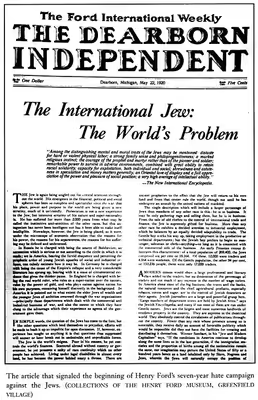
The booklets were a collection of articles originally serialized in Ford's Dearborn Independent newspaper, beginning with The International Jew: The World's Problem, published on May 22, 1920.
Background
At the beginning of 1920, Ford's personal newspaper, The Dearborn Independent, was languishing in subscriptions and losing money. Ford and his personal secretary, Ernest G. Liebold, began to discuss a series of articles on the Jewish question. While it was Liebold who claimed to have come up with the title The International Jew, he turned to "the walking dictionary" William J. Cameron for most of the writing. For 91 issues, the weekly paper announced a variety of stories featuring the supposed evilness of Jewish influence.
Editor E. G. Pipp left the Independent in April 1920 in disgust with the planned antisemitic articles, which began in May; he was replaced by Cameron. While Ford did not personally write the articles, he expressed his opinions verbally to Cameron and Liebold. Cameron had the main responsibility for expanding these opinions into article form. Liebold was responsible for collecting more material to support the articles.
The most popular and aggressive stories were then chosen to be reprinted into four volumes called The International Jew. The first volume was published in November 1920 as an anthology of articles that had been published in the Independent from May 22 to October 2, 1920. The original print run of the first edition was estimated to be between 200,000 and 500,000 copies. Three additional volumes were published over the next 18 months.
Liebold never copyrighted The International Jew and therefore had no control over anyone else publishing it themselves. The book was ultimately translated into 16 languages, including six editions in Germany between 1920 and 1922, and has remained in the public domain.
Sign in to keep reading
4 more chapters are free with a Lably account.
Libel suit
Following the publishing of an article in the Independent that alleged Jewish control of New York banks that were holding Texas cotton farmers hostage financially, San Francisco lawyer and Jewish farm cooperative organizer Aaron Sapiro sued Ford and Dearborn Publishing for libel in a $1 million lawsuit.
During the trial, William J. Cameron, the editor of Ford's "Own Page", testified that Ford had nothing to do with the editorials even though they were under his byline. Cameron testified at the libel trial that he never discussed the content of the pages nor sent them to Ford for his approval. Investigative journalist Max Wallace doubted the veracity of this claim and wrote that James M. Miller, a former Dearborn Independent employee, swore under oath that Ford had told him he intended to expose Sapiro.
According to political scientist Michael Barkun, "That Cameron would have continued to publish such controversial material without Ford's explicit instructions seemed unthinkable to those who knew both men. Mrs. Stanley Ruddiman, a Ford family intimate, remarked that 'I don't think Mr. Cameron ever wrote anything for publication without Mr. Ford's approval.'"
Ultimately, the libel suit led Ford to issue a retraction and public apology in which he indicated having been unaware of the nature of the remarks, both those published in the Independent, and the subsequent pamphlets, and was "shocked" by the content.
Soon after the trial, Ford closed the Independent on December 31, 1927.
Influence on Nazi antisemitism
Ford's International Jew was translated into German in 1922 and cited as an influence by Baldur von Schirach, one of the Nazi leaders, who stated "I read it and became anti-Semitic. In those days this book made such a deep impression on my friends and myself because we saw in Henry Ford the representative of success, also the exponent of a progressive social policy. In the poverty-stricken and wretched Germany of the time, youth looked toward America, and apart from the great benefactor, Herbert Hoover, it was Henry Ford who to us represented America."
Praising American leadership in eugenics in his book Mein Kampf, Adolf Hitler considered Ford an inspiration, and noted this admiration in his book, calling him "a single great man". Hitler was also known to keep copies of The International Jew, as well as a large portrait of Ford in his Munich office.
Content
After publication in the Independent, the articles were compiled as chapters into a four volume set as follows:
Volume 1: The International Jew: The World's Foremost Problem (1920)
- The Jew in Character and Business
- Germany's Reaction Against the Jew
- Jewish History in the United States
- The Jewish Question—Fact or Fancy?
- Anti-Semitism—Will It Appear in the U.S.?
- Jewish Question Breaks Into the Magazines
- Arthur Brisbane Leaps to the Help of Jewry
- Does a Definite Jewish World Program Exist?
- The Historic Basis of Jewish Imperialism
- An Introduction to the "Jewish Protocols"
- "Jewish" Estimate of Gentile Human Nature
- "Jewish Protocols" Claim Partial Fulfillment
- "Jewish" Plan to Split Society by "Ideas"
- Did the Jews Foresee the World War?
- Is the Jewish "Kahal" the Modern "Soviet"?
- How the "Jewish Question" Touches the Farm
- Does Jewish Power Control the World Press?
- Does This Explain Jewish Political Power?
- The All-Jewish Mark on "Red Russia"
- Jewish Testimony in Favor of Bolshevism
Volume 2: Jewish Activities in the United States (1921)
- How Jews in the U.S. Conceal Their Strength
- Jewish Testimony on "Are Jews a Nation?"
- Jew Versus Non-Jew in New York Finance
- The High and Low of Jewish Money Power
- "Disraeli of America"—A Jew of Super-Power
- The Scope of Jewish Dictatorship in the U.S.
- Jewish Copper Kings Reap Rich War-Profits
- Jewish Control of the American Theater
- The Rise of the First Jewish Theatrical Trust
- How Jews Capitalized a Protest Against Jews
- The Jewish Aspect of the "Movie" Problem
- Jewish Supremacy in Motion Picture World
- Rule of the Jewish Kehillah Grips New York
- The Jewish Demand for "Rights" in America
- "Jewish Rights" Clash With American Rights
- "Jewish Rights" to Put Studies Out of Schools
- Disraeli—British Premier, Portrays the Jews
- Taft Once Tried to Resist Jews—and Failed
- When Editors Were Independent of the Jews
- Why the Jews Dislike the Morgenthau Report
- Jews Use the Peace Conference to Bind Poland
- The Present Status of the Jewish Question
Volume 3: Jewish Influence in American Life (1921)
- The Jews and the "Religious Persecution" Cry
- Are the Jews Victims or Persecutors?
- Jewish Gamblers Corrupt American Baseball
- Jewish Degradation of American Baseball
- Jewish Jazz Becomes Our National Music
- How the Jewish Song Trust Makes You Sing
- Jewish Hot-Beds of Bolshevism in the U.S.
- Jew Trades Link With World Revolutionaries
- Will Jewish Zionism Bring Armageddon?
- How the Jews Use Power—By an Eyewitness
- How Jews Ruled and Ruined Tammany Hall
- Jew Wires Direct Tammany's Gentile Puppets
- B'nai B'rith Leader Discusses the Jews
- Dr. Levy, a Jew, Admits His People's Error
- Jewish Idea in American Monetary Affairs
- Jewish Idea Molded Federal Reserve Plan
- Jewish Idea of Central Bank for America
- How Jewish International Finance Functions
- Jewish Power and America's Money Famine
Volume 4: Aspects of Jewish Power in the United States (1922)
- How Jews Gained American Liquor Control
- Gigantic Jewish Liquor Trust and Its Career
- The Jewish Element in Bootlegging Evil
- Angles of Jewish Influence in American Life
- The Jews' Complaint Against "Americanism"
- The Jewish Associates of Benedict Arnold
- Benedict Arnold and Jewish Aid in Shady Deal
- Arnold and His Jewish Aids at West Point
- The Gentle Art of Changing Jewish Names
- Jewish "Kol Nidre" and "Eli, Eli" Explained
- Jews as New York Magistrates See Them
- Jews Are Silent, the National Voice Is Heard
- What Jews Attempted When they Had Power
- The Jewish Question in Current Testimony
- America's Jewish Enigma—Louis Marshall
- The Economic Plans of International Jews
- A Jew Sees His People As Others See Them
- Candid Address to Jews on the Jewish Problem
- An Address to "Gentiles" on the Jewish Problem
Abridged version in 1949
In June 1949, a 174-page, one-volume abridgement of the text appeared, titled The International Jew, subtitled "The World's Foremost Problem", edited by George F. Green, who was editor of the Independent Nationalist, a British fascist publication. The book was sold in the United States by the Christian Nationalist Crusade.