

Trichomonas vaginalis
Species of parasite that causes sexually transmitted infections
- 11 min read
- 10 chapters

Related on Lably
Through Protozoa, Pathogen and North America
Clinical
History
Alfred Francois Donné (1801–1878) was the first to describe a procedure to diagnose trichomoniasis through "the microscopic observation of motile protozoa in vaginal or cervical secretions" in 1836. He published this in the article entitled, "Animalcules observés dans les matières purulentes et le produit des sécrétions des organes génitaux de l'homme et de la femme" in the journal, Comptes rendus de l'Académie des sciences. With it, he created the binomial name of the parasite as Trichomonas vaginalis. 80 years after the initial discovery of the parasitic protozoan, Hohne declared Trichomoniasis as a clinical entity in 1916.
Signs and symptoms
Most women (85%) and men (77%) infected with T. vaginalis do not have symptoms. Half of these women can develop symptoms within 6 months and can have vaginal erythema, dyspareunia, dysuria, and vaginal discharge, which is often diffuse, malodorous, and yellow-green, along with itching in the genital region. Strawberry cervix occurs in about 5% of women. While men are commonly asymptomatic as a result of lower average parasite burden, cases of symptomatic infections in men have been observed. These infections cause symptoms of urethritis, and untreated infections can travel from the urethra to the prostate causing prostatitis. More severe cases of T. vaginalis have been associated with balanoposthitis, epididymitis, and infertility.
Complications
Some of the complications of T. vaginalis in women include preterm delivery, low birth weight, and increased mortality as well as predisposing to human immunodeficiency virus infection (AIDS), and cervical cancer. T. vaginalis can be seen in diverse locations within the body, such as in the urinary tract, fallopian tubes, and pelvis and can cause pneumonia, bronchitis, and oral lesions.
Diagnosis
Because men infected with T. vaginalis are often asymptomatic and demonstrate lower parasite burdens than infected women, ease of diagnosis depends greatly on sex. Historically, the most commonly used diagnostic test for T. vaginalis was done using cultures, having a specificity of 100% and sensitivity of 40-56%. This method was considered the gold standard until development of the highly sensitive nucleic acid amplification tests (NAATs), which demonstrate much higher sensitivity upwards of 97%. NAATs also provide results at a much faster rate than traditional cultures, as cultures require long incubation periods of around three days for women and five to seven days in men. With a cervical smear, infected women may have a transparent "halo" around their superficial cell nucleus but more typically the organism itself is seen with a, "slight cyanophilic tinge, faint eccentric nuclei, and fine acidophilic granules." It is unreliably detected by studying a genital discharge or with a cervical smear because of their low sensitivity. T. vaginalis is also routinely diagnosed via a wet mount in which motility is observed, however this method has low sensitivity when used for male genital specimens.
Prevention and Treatment
Infection is treated and cured with metronidazole or tinidazole. The CDC recommends a one time dose of 2 grams of either metronidazole or tinidazole as the first-line treatment; the alternative treatment recommended is 500 milligrams of metronidazole, twice daily, for seven days if there is failure of the single-dose regimen. Medication should be prescribed to any sexual partner(s) as well because they may be asymptomatic carriers. Trichomoniasis ranks as the most prevalent non-viral sexually transmitted disease, and there were about 156 million new cases in 2020 reported worldwide. It is a curable infection that occurs through unprotected intercourse. Measures for prevention include the use of a condom consistently and screening in sexually active participants. Symptoms include urethral or vaginal irritation, unusual discharge, itching in the genitals, frequent urination, and dysuria. Antigen detection and the use of nucleic acid amplification tests are able to be used in diagnosis. A single dose of oral metronidazole or tinidazole and other regimens for resistant strains are the recommended treatments. Despite the relatively low rate of resistance, it remains a rising public concern. There is no vaccine for trichomoniasis and the prevention and early treatment of the disease are hence vital.
Sign in to keep reading
9 more chapters are free with a Lably account.
Epidemiology
A systematic review and meta-analysis based on 425 articles, published in 2025, indicated the global prevalence rate of T. vaginalis as 8%, with country-specific rates ranging from 1 to 35%. The prevalence was correlated with behavior and was significantly higher in subgroups including smoking, drug use, and not using condoms, and in the group with other sexually transmitted infections, including HIV, herpes simplex virus, and Chlamydia infection. Socioeconomic factors such as being unmarried, having a low income, and unstable employment were associated with an increased risk.
Pathogenesis
T. vaginalis causes a very common sexually transmitted disease by adhering to vaginal epithelial cells and breaking them down. It secretes extracellular vesicles that disrupt immune function and increase adhesion. Some strains have intracellular viruses or bacteria within them that worsen infections. The parasite is associated with disruptions to vaginal microflora. Neutrophils are the primary immune cell associated with infection, which can kill the parasite through trogocytosis.
Morphology
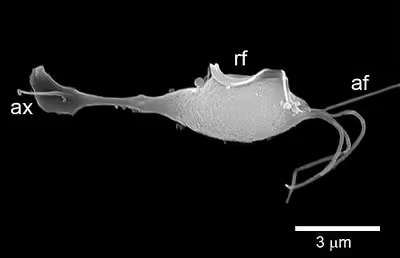
T. vaginalis exists in only one morphological stage, a trophozoite, and cannot encyst (or form cysts) like other metamonad species like Giardia duodenalis. It does not typically adhere to one shape, as in different conditions, the parasite has the ability to change. When in culture separate from the host, it usually displays a more pear or oval shaped morphology, but when present in a living host, specifically on the epithelial cells of the vaginal wall, the shape is more amoeboid. It is slightly larger than a white blood cell, measuring 9 × 7 μm. In both forms, it has five flagella – four protruding from the front or anterior of the parasite and the fifth on the back or posterior end. The functionality of the fifth flagellum is not known. In addition, a barb-like axostyle projects opposite the four-flagella bundle. All of these flagella are connected to an undulating membrane. The axostyle may be used for attachment to surfaces and may also cause the tissue damage seen in trichomoniasis. The nucleus is usually elongated, and is located near the anterior end of the protozoan within the cytoplasm which contains many hydrogenosomes (closed-membrane organelle with the ability to produce both adenosine triphosphate and hydrogen while in anaerobic conditions.)
While T. vaginalis does not have a cyst form, the organism can survive for up to 24 hours in urine, semen, or even water samples. A nonmotile, round, pseudocystic form with internalized flagella has been observed under unfavorable conditions. This form is generally regarded as a degenerate stage as opposed to a resistant form, although viability of pseudocystic cells has been occasionally reported. The ability to revert to trophozoite form, to reproduce and sustain infection has been described, along with a microscopic cell staining technique to visually discern this elusive form.
Metabolism
T. vaginalis is an anaerobe. There is an absence of cytochrome C and mitochondria, thus making oxygen uptake and synthesis of adenosine triphosphate via oxidative phosphorylation difficult. Although it contains no mitochondria, an analogous structure called a hydrogenosome, which is the site of fermentative oxidation of pyruvate, carries out many of the same metabolic processes. Carbohydrates, specifically those with alpha1,4- glycosidic linkages, are metabolized and eventually fermented to produce products such as acetate, lactate, malate, glycerol and CO2 under aerobic conditions. Hydrogen is produced under anaerobic conditions. Outside the hydrogenosome, carbohydrate metabolism also occurs freely in the cytoplasm. The Embden–Meyerhof–Parnas pathway is used to convert glucose into phosphoenolpyruvate which ultimately becomes pyruvate.
Virulence factors
Although T. vaginalis exists as a trophozoite in its infective form, its amoeboid form is also an important characteristic that adds to how well it is able to infect its host. The amoeboid form, which is pancake shaped, allows for greater surface area contact with epithelial cells of the vagina, cervix, urethra, and prostate. The pseudocyst form is also a way in which the microbe can infect more efficiently, but this only induced when exposed to cold and other stressors. These various forms are accompanied with differing protein phosphorylation profiles which are triggered by environmental pressures.
One of the hallmark features of T. vaginalis is the adherence factors that allow cervicovaginal epithelium colonization in women. The adherence that this organism illustrates is specific to vaginal epithelial cells being pH, time, and temperature dependent. A variety of virulence factors mediate this process some of which are the microtubules, microfilaments, bacterial adhesins, and cysteine proteinases. The adhesins are four trichomonad enzymes called AP65, AP51, AP33, and AP23 that mediate the interaction of the parasite to the receptor molecules on vaginal epithelial cells. The best characterized surface molecule associated with one of the four adhesins is called Trichomonas vaginalis lipoglycans. This molecule is the most abundant on the surface of T. vaginalis, aids in sticking to vaginal epithelial cells, and can also influence how the human immune system responds, affecting inflammatory responses and macrophages in the body. Cysteine proteinases may be another virulence factor because not only do these 30 kDa proteins bind to host cell surfaces but also may degrade extracellular matrix proteins like hemoglobin, fibronectin or collagen IV.
Genome sequencing and statistics
The T. vaginalis genome is made up of 6 chromosomes and is approximately ~177 megabases in size – ten times larger than predicted from earlier gel-based chromosome sizing. (The human genome is ~3.5 gigabases by comparison.) As much as two-thirds of the genome consists of repetitive and transposable elements, indicative of a recent drastic, evolutionarily expansion of the genome. The total number of predicted protein-coding genes is ~60,000, with the genome being around 65% repetitive (virus-like, transposon-like, retrotransposon-like, and unclassified repeats, all with high copy number and low polymorphism). Approximately 26,000 of the protein-coding genes have been classed as 'evidence-supported' (similar either to known proteins, or to expressed sequence tags), while the remainder have no known function. These extraordinary genome statistics are likely to change downward as the genome sequence, currently very fragmented due to the difficulty of ordering repetitive DNA, is assembled into chromosomes, and as more transcription data (expressed sequence tags, microarrays) accumulate.
TrichDB.org was launched as a free, public genomic data repository and retrieval service devoted to genome-scale trichomonad data. The site currently contains all of the T. vaginalis sequence project data, several expressed sequence tag libraries, and tools for data mining and display. TrichDB is part of the EupathDB functional genomics database project funded by the National Institutes of Health and the National Institute of Allergy and Infectious Diseases.
Genetic diversity
A 2023 study conducted using next-generation multilocus sequence typing found high genetic variation in T. vaginalis isolates of geographically disparate populations in Australia and Ghana. Among 178 clinical isolates, scientists found 36 alleles and 48 distinct sequence types, of which nearly half were not previously recorded. In spite of the variation, there was high linkage disequilibrium showing that the population was predominantly clonal and subjected to very little recombination. Because there was a third genetic group that was unassigned implies that there might have been historical recombination events that have structured the population in the way that it currently exists. These findings highlight the need for more studies to establish how genetic variability affects pathogenicity as well as the efficacy of treatment.
Increased susceptibility to HIV and HPV
In addition to inflammation that T. vaginalis causes, the parasite also causes lysis of epithelial cells and red blood cells in the area leading to more inflammation and disruption of the protective barrier usually provided by the epithelium. Having T. vaginalis also may increase the chances of the infected woman transmitting human immunodeficiency virus (HIV) to her sexual partner(s).
T. vaginalis infection can enhance the human papillomavirus (HPV) infection. Mei et al. discovered a possible pathway of the enhancement. They hypothesized that the adhesionprotein 65 from T. vaginalis (TvAP65) can upregulate certain HPV entryreceptors (CD151 and SPCS1) thus providing a facilitated entry for the HPV into the keratinocytes. TvAP65 upregulates the expression of the entry receptors through signal peptidase complex subunit 1 (SPCS1), which was found to be the key mediator of the upregulation. The study unraveled a previously unknown molecular level axis on how HPV infection can be enhanced with the co-infection of T. vaginalis.
Evolution
The biology of T. vaginalis has implications for understanding the origin of sexual reproduction in eukaryotes. T. vaginalis is not known to undergo meiosis, a key stage of the eukaryotic sexual cycle. However, when Malik et al. examined T. vaginalis for the presence of 29 genes known to function in meiosis, they found 27 homologous genes to the ones found in animals, fungi, plants and other protists, including eight of nine genes that are specific to meiosis in model organisms. These findings suggest that T. vaginalis has the capability for meiotic recombination, and hence "parasexual" reproduction. 21 of the 27 meiosis genes were also found in another parasite Giardia lamblia (G. intestinalis), indicating that these meiotic genes were present in a common ancestor of T. vaginalis and G. intestinalis. Since these two species are descendants of lineages that are highly divergent among eukaryotes, these meiotic genes were likely present in a common ancestor of all eukaryotes.
T. vaginalis's evolution also manifests in an unusually huge and complicated genome that comprises about 160 megabases and about 60,000 genes. The genome comprises repetitive and noncoding sequences which signify a gene duplication and possible gene loss history. T. vaginalis does not appear to undergo traditional meiosis despite the fact that there are genes related to meiosis. The reproductive process in this organism seems to result in genetic variability that has a bearing on adaptability as well as drug resistance.