

Waterborne disease
Disease caused by agents transmitted by water
- 12 min read
- 7 chapters

Related on Lably
Through Disease, Pathogen and Microorganism
These diseases can spread through bathing, washing, drinking contaminated water, or eating food that has been exposed to contaminated water. While diarrhea and vomiting are the most commonly reported symptoms of waterborne illnesses, other symptoms may include nausea, stomach cramps, fever, and skin, ear, respiratory, or eye problems. Exposure to water contaminated with VOCs has been associated with headaches, nausea, tumor formation, and an increased risk of cancer, including leukemia. Waterborne diseases contribute significantly to mortality and disability worldwide, particularly in developing regions.
The most effective mechanism for preventing waterborne disease is reliable access to clean water, sanitation, and hygiene (WASH). This includes improving sanitation systems, chlorination, vaccination, and desalination. Infrastructure improvements, such as replacing damaged plastic pipes with metal ones in wildfire-prone areas, may also reduce the risk of contamination. Climate change increases the risk of waterborne diseases via the increased likelihood of droughts and floods, which can spread contaminants and disproportionately affect vulnerable populations. Surveillance can help monitor and prevent outbreaks. Historically, advances in sanitation, filtration, chlorination, and microbiology have helped scientists understand and control of waterborne diseases.
Terminology
The term "waterborne disease" is reserved largely for infections that are predominantly transmitted through contact with or consumption of microbially polluted water. Many infections may be transmitted by microbes or parasites that have entered the water accidentally, perhaps due to exceptional circumstances. However it may not be useful to categorize a disease as "waterborne" just because it may occasionally be transmitted by water. Diseases such as malaria are commonly mistaken as "waterborne" because mosquitos, acting as vectors, have aquatic stages in their life cycle. Controlling or treating still water can reduce mosquito populations, suggesting the idea that the disease is transmitted through water and not mosquito bites.
A related term is "water-related disease" which is defined as "any significant or widespread adverse effects on human health, such as death, disability, illness or disorders, caused directly or indirectly by the condition, or changes in the quantity or quality of any water". Water-related diseases are grouped according to their transmission mechanism: water borne, water hygiene, water based, water related. The main transmission mode for waterborne diseases is ingestion of contaminated water.
Sign in to keep reading
6 more chapters are free with a Lably account.
Causes
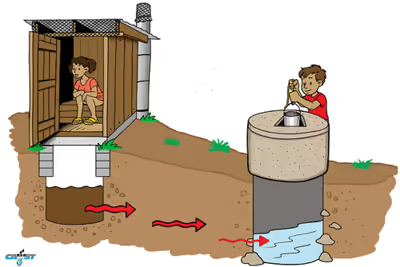
Lack of clean water supply, sanitation and hygiene (WASH) are major causes of the spread of waterborne diseases. The fecal–oral route is a transmission pathway for waterborne diseases. Poverty also increases the risk of communities being affected by waterborne diseases. For example, the economic level of a community may affect its access to clean water. Less developed countries might be more at risk of waterborne disease outbreaks than more developed regions. Additionally, 1 in 4 people, or 2.1 billion people globally, currently do not have access to safe drinking water.
Socioeconomic factors
The lack of education in impoverished regions often results in waterborne disease. If local people are aware of an issue, they can take action to solve the problem domestically rather than relying on foreign counties for aid. Many countries in the Middle East, South East Asia, and Sub-Saharan Africa are prone to these issues because they lack advanced education. For example, Morocco has insufficient labor supply for the production of food and other work forces that could be well maximized. In response, the United States, Morocco and many other agencies worked together to initiate the H2O Maghreb Partnership. This educates the people of Morocco on clean water and sanitization through simulations of water treatment. Not only do the virtual reality technologies but recreate rare emergency circumstances for practice and also provide jobs for the citizens in under-developed countries to help the economy.
Political turmoil and war stimulate the transmission of waterborne disease in addition to lack of education. Countries in the Eastern Mediterranean Region deal with this issue especially. The World Bank has classified Yemen, along with several other countries in the Eastern Mediterranean Region, as "fragile and conflict-affected countries". Syria and Lebanon had not seen any outbreaks of cholera in about three decades, but it reappeared in 2022. War destroys the infrastructure needed for clean water and sanitization structures: a recipe for disease to spread. Two years ago the World Health Organization changed the status of cholera to a Grade 3 global public health emergency. Between the years 2016 and 2022 Yemen saw 2.5 million cases of cholera. These outbreaks are closely tied to the conflicts in the region. War also destroys the necessary medical facilities and hospitals to take care of patients who have contracted the waterborne diseases. In the Eastern Mediterranean Region, countries are no longer grappling with a pandemic, but rather an endemic.
Other war-torn regions such as Gaza must manage complex water systems which present more danger to the quality of water and chance of waterborne disease being present. Gaza gets the majority of its water from underground, but also some from Israel; they also have several desalination plants across the region. Workers are constantly working to fix water pipeline systems that have been destroyed by artillery in the war but are sometimes killed in the process.
As a comparison of a safe country's and a war-torn country's water consumption, Americans use about 300 liters per day while in Gaza a person would use about 80 liters per day. With every part of the water system in Gaza suffering harm in some shape or form by 2024, waterborne disease cases shortly thereafter exploded with 600,000 cases of acute diarrhea and even a 10 month old with polio.
Nature Communications published a 2022 study which measured the associations between racial and ethnic communities and concentrations of contaminants in drinking water from 2000 to 2011 in the United States. Counties with a greater proportion of Hispanic and Native American residents contained higher concentrations of arsenic and uranium in drinking water. However, non-Hispanic White residents had lower concentrations. The authors concluded that disparities in drinking water quality vary by region and demographic composition, representing the inequalities in exposure to regulated drinking water in the United States.
Africa
The waterborne disease burden in Africa is severe and, in several ways, not comparable with anywhere else in the world. Decades of underinvestment in water infrastructure, rapid population growth and the persistent gap between urban and rural service delivery have left millions of people without reliable access to safe water. As of 2022, just 31% of sub-Saharan Africa's population used safely managed drinking water, less than half the global average of 73%; and only 24% had access to safely managed sanitation. By 2020, 418 million people on the continent still lack basic drinking water service, while 779 million had no basic sanitation, among them 208 million who continued to practice open defecation.
The consequences show up most gravely in child mortality. Diarrheal disease kills an estimated 600,000 people a year in sub-Saharan Africa, most of them being children under five and elderly adults, making it the third-leading cause of death in that age group across the region. What makes this particularly troubling is that the figure is almost certainly an undercount. Around 56% of African countries have no systematic waterborne pathogen surveillance in place, so outbreaks go unrecorded and deaths unattributed. Africa is believed to lead the world in diarrheal disease mortality, yet the data needed to fully confirm or address that reality largely is insufficient.
Influence of climate change
Climate change influences the growth and survival of bacteria and other pathogens in food and water systems. It affects waterborne diseases by influencing water temperature, water quality, sanitation, and microbial ecology.
Climate change plays a major role in the socioeconomic impact of waterborne disease, especially in informal settlements. Over 60% of Africa's urban population lives in areas with limited water and sanitation infrastructure. Droughts have been linked to cholera outbreaks in Nairobi, while flooding can spread pathogens through contaminated water.
Warmer waters, increased flooding, precipitation and humidity promote the growth and spread of bacteria such as Vibrio cholerae, which causes cholera, and other pathogens responsible for gastroenteritis, wound infections and diarrheal diseases. Higher water temperatures can also increase the yield of bacteria from drinking water delivery systems and during periods of warmer temperatures water consumption rates are also typically higher. Together these increase the probability of pathogen ingestion and infection.
Heavy rainfall and flooding caused by climate change can also affect pathogen transmission via impacts on sanitation and/or drinking water treatment infrastructure, contaminating drinking water sources or food products. Floods can overwhelm water systems, causing backflow that lead to contamination of groundwater and other drinking water sources.
Diseases by type of pathogen
Protozoa
Bacteria
Viruses
Algae
Parasitic worms
Volatile Organic Compounds (VOC)
Prevention
Reliable access to clean, uncontaminated drinking water and proper sanitation are the main methods to prevent waterborne diseases. Vaccination is another method to prevent the body from getting water-born diseases The aim is to break the fecal–oral route of disease transmission.
Solar energy has been become a clean and efficient means by which water can now be distilled and desalinated. This method is environmentally safe because it does not produce mass amounts of carbon dioxide that could damage the planet. In fact, the carbon dioxide emissions are virtually zero from using solar energy to distill or desalinate water.
Desalination is the process by which salt is removed from water making it potable. Because water is a scarce resource, meaning that there is a finite amount of it for all of humanity to share, research into sustainability methods for increasing the amount of potable water is important. With an abundance of salt water on Earth, the solar desalination method is innovative and presents potential. It works by using solar panels that capture solar energy from the sun which it then uses to remove the salt from the water through a process called reverse osmosis. The solar energy is converted into electricity via the solar panels. This electricity is then used to push the water at high pressures through filters that block the salt from passing through but do allow the water to pass. This method of desalination is also beneficial to society because it can be used in remote locations. It does not require a connection to a large pipeline system traditionally used that also produce large amounts of carbon dioxide. Specifically, this method is most productive were there is ready access to salt water, an abundance of sunshine, and a lack of fresh drinkable water.
Other policies and precautions can be taken too in order to prevent the spread of disease through contaminated water. For example, appropriate amounts of chlorine can be added to the potable water pipes to remove viruses. Typical household precautions including the use of disinfection wipes and sanitization sprays also are important to use around areas where clean water consumption is very important such as in bathrooms and kitchens. Additionally, it is noted that plastic pipes can release benzene and other VOCs into drinking water when heat-damage occurs from wildfires. The installation of metal piping in high-risk areas may reduce future contamination risks.
Epidemiology
According to the World Health Organization, waterborne diseases account for an estimated 3.6% of the total DALY (disability- adjusted life year) global burden of disease, and cause about 1.5 million human deaths annually. The World Health Organization estimates that 58% of that burden, or 842,000 deaths per year, is attributable to a lack of safe drinking water supply, sanitation and hygiene (summarized as WASH).
United States
The Waterborne Disease and Outbreak Surveillance System (WBDOSS) is the principal database used to identify the causative agents, deficiencies, water systems, and sources associated with waterborne disease and outbreaks in the United States. Since 1971, the Centers for Disease Control and Prevention (CDC), the Council of State and Territorial Epidemiologists (CSTE), and the US Environmental Protection Agency (EPA) have maintained this surveillance system for collecting and reporting data on "waterborne disease and outbreaks associated with recreational water, drinking water, environmental, and undetermined exposures to water." "Data from WBDOSS have supported EPA efforts to develop drinking water regulations and have provided guidance for CDC's recreational water activities."
WBDOSS relies on complete and accurate data from public health departments in individual states, territories, and other U.S. jurisdictions regarding waterborne disease and outbreak activity. In 2009, reporting to the WBDOSS transitioned from a paper form to the electronic National Outbreak Reporting System (NORS). Annual or biennial surveillance reports of the data collected by the WBDOSS have been published in CDC reports from 1971 to 1984; since 1985, surveillance data have been published in the Morbidity and Mortality Weekly Report (MMWR).
WBDOSS and the public health community work together to look into the causes of contaminated water leading to waterborne disease outbreaks and maintaining those outbreaks. They do so by having the public health community investigating the outbreaks and WBDOSS receiving the reports.
Society and culture
Socioeconomic impact
Waterborne diseases can have a significant impact on the economy. People who are infected by a waterborne disease are usually confronted with related healthcare costs. This is especially the case in developing countries. On average, a family spends about 10% of the monthly households income per person infected.
Socioeconomic impact refers to the effects that waterborne disease has on society such as the quality of life, medical care, the economy, and education sustainable. Sustainable Development Goal 6, access to clean water and sanitization for all by the year 2030, is at the roots of many of the other sustainable development goals pertaining to society and the economy. Agricultural industries in particular are most severely effected and the increasing stress comes from the booming city populations taking away water from farming. The need for clean water and sanitation is vital because without clean water there is no sustainable food source. Clean water is necessary to produce healthy crops for people to consume. If the water used for crop irrigation is contaminated, the produce could bring a ravaging disease to the people who consume it.
About one third of all of the cities in the world rely on the necessary freshwater that the agriculture industry needs. There is this constant tension on the freshwater supply because as populations in urban areas boom they demand more and more water. This demand for freshwater is estimated to increase 80% in the next 25 years which adds to water stress because farming uses about 72% of the fresh water that the cities need. An example of industries doing their part to help reach Sustainable Development Goal 6 would is the Adopt-a-River Project in Nairobi, Kenya. The United Nations Environment Program worked with several other clubs on the project which consists of traps being established along the Athi River to capture large solid waste. Recycling stations will also be constructed and industries that dump their effluent into water sources will also join the effort. This is a step to remove extra waste from water reducing chances of contamination of water that would eventually be used for irrigation of crops.
History
Waterborne diseases were once wrongly explained by the miasma theory, the theory that bad air causes the spread of diseases. However, people started to find a correlation between water quality and waterborne diseases, which led to different water purification methods, such as sand filtering and chlorinating their drinking water. Founders of microscopy, Antonie van Leeuwenhoek and Robert Hooke, used the newly invented microscope to observe for the first time small material particles that were suspended in the water, laying the groundwork for the future understanding of waterborne pathogens and waterborne diseases.