

Writings of Cicero
- 3 min read
- 1 chapter

Related on Lably
Through Public speaking, Philosophy and Roman Empire
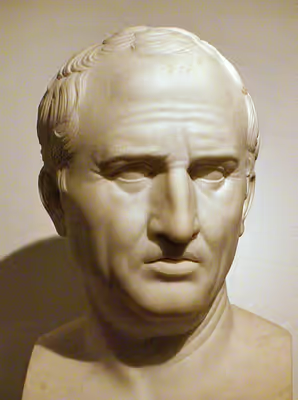
Cicero is generally held to be one of the most versatile minds of ancient Rome. He introduced the Romans to the chief schools of Greek philosophy, and also created a Latin philosophical vocabulary; distinguishing himself as a linguist, translator, and philosopher. A distinguished orator and successful lawyer, Cicero likely valued his political career as his most important achievement. Today he is appreciated primarily for his humanism and philosophical and political writings. His voluminous correspondence, much of it addressed to his friend Atticus, has been especially influential, introducing the art of refined letter writing to European culture. Cornelius Nepos, the 1st-century BC biographer of Atticus, remarked that Cicero's letters to Atticus contained such a wealth of detail "concerning the inclinations of leading men, the faults of the generals, and the revolutions in the government" that their reader had little need for a history of the period.
During the chaotic latter half of the first century BC, marked by civil wars and the controversial rule of Gaius Julius Caesar, Cicero championed a return to the traditional republican government. However, his career as a statesman was marked by inconsistencies and a tendency to shift his position in response to changes in the political climate. His indecision may be attributed to his sensitive and impressionable personality; he was prone to overreaction in the face of political and private change. "Would that he had been able to endure prosperity with greater self-control and adversity with more fortitude!" wrote C. Asinius Pollio, a contemporary Roman statesman and historian.
Transmission
Cicero was declared a "virtuous pagan" by the early Church, and therefore many of his works were deemed worthy of preservation. Important Church Fathers such as Saint Augustine and others quoted liberally from his works, e.g. "On the Commonwealth" (De Re Publica) and "On Laws" (De Legibus), as well as Cicero's (partial) Latin translation of Plato's Timaeus dialogue. Cicero also articulated an early, abstract conceptualisation of rights, based on ancient law and custom.
Cicero's writings were widely available in the Middle Ages. Particularly of note is Paris MS 7530, written between 779 and 796 AD at the abbey of Monte Cassino, which contains some fifty-eight writings on grammar, rhetoric, dialectic, and related topics. From the 1000s onward there was a healthy commentary on many of Cicero's works including his juvenilia.
A manuscript containing Cicero's letters to Atticus, Quintus, and Brutus was discovered by Petrarch in 1345 at the Chapter Library of Verona. In Whig history, this rediscovery is mythologically credited for initiating the 14th-century Italian Renaissance, and for the founding of Renaissance humanism. Since the 1970s, historians beginning with Colin Morris and Caroline Walker Bynum have argued against the view of Petrarch as pioneering individualism, arguing that the differences in his approach to Cicero and other classic authors are more subtle.