

Y chromosome
Sex chromosome in the XY sex-determination system
- 21 min read
- 4 chapters

Related on Lably
Through Sexual reproduction, Mitosis and Gamete
Overview
Discovery
The Y chromosome was identified as a sex-determining chromosome by Nettie Stevens at Bryn Mawr College in 1905 during a study of the mealworm Tenebrio molitor. Edmund Beecher Wilson independently discovered the same mechanisms the same year, working with Hemiptera. Stevens proposed that chromosomes always existed in pairs and that the smaller chromosome (now labelled "Y") was the pair of the X chromosome discovered in 1890 by Hermann Henking. She realized that the previous idea of Clarence Erwin McClung, that the X chromosome determines sex, was wrong and that sex determination is, in fact, due to the presence or absence of the Y chromosome. In the early 1920s, Theophilus Painter determined that X and Y chromosomes determined sex in humans (and other mammals).
The chromosome was given the name "Y" simply to follow on from Henking's "X" alphabetically. The idea that the Y chromosome was named after its similarity in appearance to the letter "Y" is mistaken. All chromosomes normally appear as an amorphous blob under the microscope and only take on a well-defined shape during mitosis. This shape is vaguely X-shaped for all chromosomes. It is entirely coincidental that the Y chromosome, during mitosis, has two very short branches which can look merged under the microscope and appear as the descender of a Y-shape.
Different variations
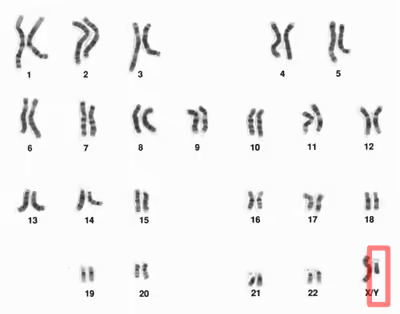
Most therian mammals have only one pair of sex chromosomes in each cell. Males usually have one Y chromosome and one X chromosome, while females usually have two X chromosomes. In mammals, the Y chromosome contains the SRY gene which triggers phenotypic male development. Differences in the Y chromosome are associated with both atypical sexual development and fertility conditions.
In humans, people with an extra X chromosome often develop Klinefelter syndrome, and people with an extra Y chromosome develop Jacob's Syndrome, as genes on the Y chromosome generally trigger the development of a male phenotype. Other chromosomal variations include three X chromosomes (or Trisomy X), and Monosomy X (or Turner Syndrome), where individuals only have one X chromosome and no Y chromosome. Some individuals with an XY karyotype, develop phenotypically female due to mutation in genes such as the SRY gene or MAP3K1.
Sign in to keep reading
3 more chapters are free with a Lably account.
Origins and evolution
Before Y chromosome
Many ectothermic vertebrates have no sex chromosomes. If these species have different sexes, sex is determined environmentally rather than genetically. For some species, especially reptiles, sex depends on the incubation temperature. Some vertebrates are hermaphrodites, though hermaphroditic species are most commonly sequential, meaning the organism switches sex, producing male or female gametes at different points in its life, but never producing both at the same time. This is opposed to simultaneous hermaphroditism, where the same organism produces male and female gametes at the same time. Most simultaneous hermaphrodite species are invertebrates, and among vertebrates, simultaneous hermaphroditism has only been discovered in a few orders of fish.
Origin
The X and Y chromosomes are thought to have evolved from a pair of identical chromosomes, termed autosomes, when an ancestral animal developed an allelic variation (a so-called "sex locus") and simply possessing this allele caused the organism to develop phenotypically male. Over time, the two chromosomes diverged into separate X and Y configurations, with the Y chromosome losing many of its original genes, and gaining only a few others specifically involved in sex differentiation.
Until recently, the X and Y chromosomes in mammals were thought to have diverged around 300 million years ago. However, research published in 2008 analyzing the platypus genome suggested that the XY sex-determination system would not have been present more than 166 million years ago, when monotremes split from other mammals. This re-estimation of the age of the therian XY system is based on the finding that sequences that are on the X chromosomes of marsupials and eutherian mammals are not present on the autosomes of platypus and birds. The older estimate was based on erroneous reports that the platypus X chromosomes contained these sequences.
Recombination inhibition
Most chromosomes recombine during meiosis. However, the X and Y pair in a shared region known as the pseudoautosomal region (PAR). The PAR undergoes frequent recombination between the X and Y chromosomes, but recombination is suppressed in other regions of the Y chromosome. These regions contain genes specifically involved in male sexual differentiation. Without regional suppression, the genes could be lost from the Y chromosome in recombination, causing developmental issues such as infertility.
The lack of recombination across the majority of the Y chromosome makes it a useful tool in studying human evolution, since recombination complicates the mathematical models used to trace ancestries.
Degeneration
By one estimate, the human Y chromosome has lost 1,393 of its 1,438 original genes throughout its existence, and linear extrapolation of this 1,393-gene loss over 300 million years gives a rate of genetic loss of 4.6 genes per million years. Continued loss of genes at this rate would result in a Y chromosome with no functional genes – that is the Y chromosome would lose complete function – within the next 10 million years, or half that time with the current age estimate of 160 million years. Comparative genomic analysis reveals that many mammalian species are experiencing a similar loss of function in their heterozygous sex chromosome. Degeneration may simply be the fate of all non-recombining sex chromosomes, due to three common evolutionary forces: high mutation rate, inefficient selection, and genetic drift.
With a 30% difference between humans and chimpanzees, the Y chromosome is one of the fastest-evolving parts of the human genome. However, these changes have been limited to non-coding sequences and comparisons of the human and chimpanzee Y chromosomes (first published in 2005) show that the human Y chromosome has not lost any genes since the divergence of humans and chimpanzees between 6–7 million years ago. Additionally, a scientific report in 2012 stated that only one gene had been lost since humans diverged from the rhesus macaque 25 million years ago. These facts provide direct evidence that the linear extrapolation model is flawed and suggest that the current human Y chromosome is either no longer shrinking or is shrinking at a much slower rate than the 4.6 genes per million years estimated by the linear extrapolation model.
High mutation rate
The human Y chromosome is particularly exposed to high mutation rates due to the environment in which it is housed. The Y chromosome is passed exclusively through sperm, which undergo multiple cell divisions during gametogenesis. Each cellular division provides further opportunity to accumulate base pair mutations. Additionally, sperm are stored in the highly oxidative environment of the testis, which encourages further mutation. These two conditions combined put the Y chromosome at a greater risk of mutation than the rest of the genome. The increased mutation opportunity for the Y chromosome is reported by Graves as a factor 4.8. However, her original reference obtains this number for the relative mutation rates in male and female germ lines for the lineage leading to humans.
The observation that the Y chromosome experiences little meiotic recombination and has an accelerated rate of mutation and degradative change compared to the rest of the genome suggests an evolutionary explanation for the adaptive function of meiosis concerning the main body of genetic information. Brandeis proposed that the basic function of meiosis (particularly meiotic recombination) is the conservation of the integrity of the genome, a proposal consistent with the idea that meiosis is an adaptation for repairing DNA damage.
Inefficient selection
Without the ability to recombine during meiosis, the Y chromosome is unable to expose individual alleles to natural selection. Deleterious alleles are allowed to "hitchhike" with beneficial neighbors, thus propagating maladapted alleles into the next generation. Conversely, advantageous alleles may be selected against if they are surrounded by harmful alleles (background selection). Due to this inability to sort through its gene content, the Y chromosome is particularly prone to the accumulation of non-coding DNA. Massive accumulations of retrotransposable elements are scattered throughout the Y. The random insertion of DNA segments often disrupts encoded gene sequences and renders them nonfunctional. However, the Y chromosome has no way of weeding out these "jumping genes". Without the ability to isolate alleles, selection cannot effectively act upon them.
A clear, quantitative indication of this inefficiency is the entropy rate of the Y chromosome. Whereas all other chromosomes in the human genome have entropy rates of 1.5–1.9 bits per nucleotide (compared to the theoretical maximum of exactly 2 for no redundancy), the Y chromosome's entropy rate is only 0.84. From the definition of entropy rate, the Y chromosome has a much lower information content relative to its overall length, and is more redundant.
Genetic drift
Even if a well-adapted Y chromosome manages to maintain genetic activity by avoiding mutation accumulation, there is no guarantee it will be passed down to the next generation. The population size of the Y chromosome is inherently limited to 1/4 that of autosomes: diploid organisms contain two copies of autosomal chromosomes, while only half the population contains 1 Y chromosome. Thus, genetic drift is an exceptionally strong force acting upon the Y chromosome. Through sheer random assortment, an adult male may never pass on his Y chromosome if he only has female offspring. Thus, although a male may have a well-adapted Y chromosome free of excessive mutation, it may never make it into the next gene pool. The repeat random loss of well-adapted Y chromosomes, coupled with the tendency of the Y chromosome to evolve to have more deleterious mutations rather than less for reasons described above, contributes to the species-wide degeneration of Y chromosomes through Muller's ratchet.
Gene conversion
As has already been mentioned, the Y chromosome is unable to recombine during meiosis like the other human chromosomes; however, in 2003, researchers from MIT discovered a process which may slow down the process of degradation. They found that human Y chromosome can "recombine" with itself, using palindrome base pair sequences. Such a "recombination" is called gene conversion.
In the case of the Y chromosomes, the palindromes are not noncoding DNA; these strings of nucleotides contain functioning genes important for male fertility. Most of the sequence pairs are greater than 99.97% identical. The extensive use of gene conversion may play a role in the ability of the Y chromosome to edit out genetic mistakes and maintain the integrity of the relatively few genes it carries. In other words, since the Y chromosome is single, it has duplicates of its genes on itself instead of having a second, homologous chromosome. When errors occur, it can use other parts of itself as a template to correct them.
Findings were confirmed by comparing similar regions of the Y chromosome in humans to the Y chromosomes of chimpanzees, bonobos and gorillas. The comparison demonstrated that the same phenomenon of gene conversion appeared to be at work more than 5 million years ago, when humans and the non-human primates diverged from each other.
Gene conversion tracts formed during meiosis are long, about 2,068 base pairs, and significantly biased towards the fixation of G or C nucleotides (GC biased). The recombination intermediates preceding gene conversion were found to rarely take the alternate route of crossover recombination. The Y-Y gene conversion rate in humans is about 1.52 × 10⁻⁵ conversions/base/year. These gene conversion events may reflect a basic function of meiosis, that of conserving the integrity of the genome.
Future evolution
According to some theories, in the terminal stages of the degeneration of the Y chromosome, other chromosomes may increasingly take over genes and functions formerly associated with it, and finally, within the framework of this theory, the Y chromosome disappears entirely, and a new sex-determining system arises.
Several species of rodent in the sister families Muridae and Cricetidae have reached a stage where the XY system has been modified, in the following ways:
- The Transcaucasian mole vole, Ellobius lutescens, the Zaisan mole vole, Ellobius tancrei, and the Japanese spinous country rats Tokudaia osimensis and Tokudaia tokunoshimensis, have lost the Y chromosome and SRY entirely. Tokudaia spp. have relocated some other genes ancestrally present on the Y chromosome to the X chromosome. Both sexes of Tokudaia spp. and Ellobius lutescens have an XO genotype (Turner syndrome), whereas all Ellobius tancrei possess an XX genotype. The new sex-determining system(s) for these rodents remains unclear.
- The wood lemming Myopus schisticolor, the Arctic lemming, Dicrostonyx torquatus, and multiple species in the grass mouse genus Akodon have evolved fertile females who possess the genotype generally coding for males, XY, in addition to the ancestral XX female, through a variety of modifications to the X and Y chromosomes.
- In the creeping vole, Microtus oregoni, the females, with just one X chromosome each, produce X gametes only, and the males, XY, produce Y gametes, or gametes devoid of any sex chromosome, through nondisjunction.
Outside of the rodents, the black muntjac, Muntiacus crinifrons, evolved new X and Y chromosomes through fusions of the ancestral sex chromosomes and autosomes.
Modern data casts doubt on the hypothesis that the Y-chromosome will disappear. This conclusion was reached by scientists who studied the Y chromosomes of rhesus monkeys. When genomically comparing the Y chromosome of rhesus monkeys and humans, scientists found very few differences, given that humans and rhesus monkeys diverged 30 million years ago.
Outside of mammals, some organisms have lost the Y chromosome, such as most species of nematodes. However, for the complete elimination of Y to occur, it was necessary to develop an alternative way of determining sex (for example, by determining sex by the ratio of the X chromosome to autosomes), and any genes necessary for male function had to be moved to other chromosomes. In the meantime, modern data demonstrate the complex mechanisms of Y chromosome evolution and the fact that the disappearance of the Y chromosome is not guaranteed.
1:1 sex ratio
Fisher's principle outlines why almost all species using sexual reproduction have a sex ratio of 1:1. W. D. Hamilton gave the following basic explanation in his 1967 paper on "Extraordinary sex ratios", given the condition that males and females cost equal amounts to produce:
- Suppose male births are less common than female.
- A newborn male then has better mating prospects than a newborn female, and therefore can expect to have more offspring.
- Therefore, parents genetically disposed to produce males tend to have more than average numbers of grandchildren born to them.
- Therefore, the genes for male-producing tendencies spread, and male births become more common.
- As the 1:1 sex ratio is approached, the advantage associated with producing males dies away.
- The same reasoning holds if females are substituted for males throughout. Therefore, 1:1 is the equilibrium ratio.
Non-therian Y chromosome
Many groups of organisms, in addition to therian mammals, have Y chromosomes, but these Y chromosomes do not share common ancestry with therian Y chromosomes. Such groups include monotremes, Drosophila, some other insects, some fish, some reptiles, and some plants.
In flowering plants, classical genetic studies by Mogens Westergaard on Melandrium album (now Silene latifolia) demonstrated that male development depends on the presence of a Y chromosome rather than solely on the ratio of X chromosomes to autosomes. His experimental work with plants carrying fragmented or abnormal Y chromosomes further indicated that different regions of the Y chromosome control suppression of female development and promotion of male reproductive structures. In a 1958 synthesis of plant sex-determination systems, Westergaard proposed that the evolution of separate sexes in flowering plants generally involves at least two closely linked factors, one suppressing female development and another promoting male function, helping explain the origin of plant sex chromosomes and the evolution of suppressed recombination between X and Y chromosomes.
In Drosophila melanogaster, the Y chromosome does not trigger male development. Instead, sex is determined by the number of X chromosomes. The D. melanogaster Y chromosome does contain genes necessary for male fertility. So XXY D. melanogaster are female, and D. melanogaster with a single X (X0) are male but sterile. There are some species of Drosophila in which X0 males are both viable and fertile.
ZW chromosomes
Other organisms have mirror image sex chromosomes: where the homogeneous sex is the male, with two Z chromosomes, and the female is the heterogeneous sex with a Z chromosome and a W chromosome. For example, the ZW sex-determination system is found in birds, snakes, and butterflies; the females have ZW sex chromosomes, and males have ZZ sex chromosomes.
Non-inverted Y chromosome
There are some species, such as the Japanese rice fish, in which the XY system is still developing and crossover between the X and Y is still possible. Because the male-specific region is very small and contains no essential genes, it is even possible to artificially induce XX males and YY females with no ill effect.
Multiple XY pairs
Monotremes like platypuses possess four or five pairs of XY sex chromosomes, each pair consisting of sex chromosomes with homologous regions. The chromosomes of neighboring pairs are partially homologous, such that a chain is formed during mitosis. The first X chromosome in the chain is also partially homologous with the last Y chromosome, indicating that profound rearrangements, some adding new pieces from autosomes, have occurred in history.
Platypus sex chromosomes have strong sequence similarity with the avian Z chromosome, indicating close homology, and the SRY gene so central to sex-determination in most other mammals is apparently not involved in platypus sex-determination.
Human Y chromosome
The human Y chromosome is composed of about 57 million base pairs of DNA, making it similar in size to chromosome 19 and represents roughly 0.9% of the total DNA in a male cell. The human Y chromosome carries 693 genes, 106 of which are protein-coding. However, some genes are repeated, making the number of exclusive protein-coding genes just 42. The Consensus Coding Sequence (CCDS) Project only classifies 63 out of 107 genes.
All single-copy Y-linked genes are hemizygous (present on only one chromosome) except in cases of aneuploidy such as XYY syndrome or XXYY syndrome. Traits that are inherited via the Y chromosome are called Y-linked traits, or holandric traits (from Ancient Greek ὅλος hólos, "whole" + ἀνδρός andrós, "male").
Sequence of the human Y chromosome
At the end of the Human Genome Project (and after many updates) almost half of the Y chromosome remained un-sequenced even in 2021; a different Y chromosome from the HG002 (GM24385) genome was completely sequenced in January 2022 and is included in the new "complete genome" human reference genome sequence, CHM13. The complete sequencing of a human Y chromosome was shown to contain 62,460,029 base pairs and 41 additional genes. This added 30 million base pairs, but it was discovered that the Y chromosome can vary a lot in size between individuals, from 45.2 million to 84.9 million base pairs.
Since almost half of the human Y sequence was unknown before 2022, it could not be screened out as contamination in microbial sequencing projects. As a result, the NCBI RefSeq bacterial genome database mistakenly includes some Y chromosome data.
Structure
Cytogenetic band
Non-combining region of Y (NRY)
The human Y chromosome is normally unable to recombine with the X chromosome, except for small pieces of pseudoautosomal regions (PARs) at the telomeres (which comprise about 5% of the chromosome's length). These regions are relics of ancient homology between the X and Y chromosomes. The bulk of the Y chromosome, which does not recombine, is called the "NRY", or non-recombining region of the Y chromosome. Single-nucleotide polymorphisms (SNPs) in this region are used to trace direct paternal ancestral lines.
More specifically, PAR1 is at 0.1–2.7 Mb. PAR2 is at 56.9–57.2 Mb. The non-recombining region (NRY) or male-specific region (MSY) sits between. Their sizes are now known perfectly from CHM13: 2.77 Mb and 329.5 kb. Until CHM13 the data in PAR1 and PAR2 was just copied over from the X chromosome.
Sequence classes
Genes
Number of genes
Older gene count estimates of the human Y chromosome used only partial sequences. Only the T2T sequence (2023) was able to produce a complete sequence of the human Y chromosome.
Gene list
In general, the human Y chromosome is extremely gene poor—it is one of the largest gene deserts in the human genome. Disregarding pseudoautosomal genes, genes encoded on the human Y chromosome include:
Y-chromosome-linked diseases
Diseases linked to the Y chromosome typically involve an aneuploidy, an atypical number of chromosomes.
Loss of Y chromosome
Males can lose the Y chromosome in a subset of cells, known as mosaic loss. Mosaic loss is strongly associated with age, and smoking is another important risk factor for mosaic loss.
Mosaic loss may be related to health outcomes, indicating that the Y chromosome plays important roles outside of sex determination. Males with a higher percentage of hematopoietic stem cells lacking the Y chromosome have a higher risk of certain cancers and have a shorter life expectancy. In many cases, a cause and effect relationship between the Y chromosome and health outcomes has not been determined, and some propose loss of the Y chromosome could be a "neutral karyotype related to normal aging". However, a 2022 study showed that mosaic loss of the Y chromosome causally contributes to fibrosis, heart risks, and mortality.
Further studies are needed to understand how mosaic Y chromosome loss may contribute to other sex differences in health outcomes, such as how male smokers have between 1.5 and 2 times the risk of non-respiratory cancers as female smokers. Potential countermeasures identified so far include not smoking or stopping smoking and at least one potential drug that "may help counteract the harmful effects of the chromosome loss" is under investigation.
Y chromosome microdeletion
Y chromosome microdeletion (YCM) is a family of genetic disorders caused by missing genes in the Y chromosome. Many affected men exhibit no symptoms and lead normal lives. However, YCM is also known to be present in a significant number of men with reduced fertility or reduced sperm count.
Defective Y chromosome
This can result in the person developing a female phenotype even though they possess an XY karyotype. This can result in both infertility and only partial sexual development.
An incomplete Y chromosome such as 45X, plus a fragment of Y, can result in incomplete genital differentiation, such that the infant may not have fully developed internal or external gonads. A full spectrum of variation can occur, especially if mosaicism is present. When the Y fragment is minimal and nonfunctional, the individual can develop as a phenotypic female with features of Turner syndrome or mixed gonadal dysgenesis.
XXY
Klinefelter syndrome (47, XXY) is not an aneuploidy of the Y chromosome, but a condition of having an extra X chromosome, which usually results in defective postnatal testicular function. The mechanism is not fully understood; it does not seem to be due to direct interference by the extra X with expression of Y genes.
XYY
47, XYY syndrome (simply known as XYY syndrome) is caused by the presence of a single extra copy of the Y chromosome in each of a male's cells. 47, XYY males have one X chromosome and two Y chromosomes, for a total of 47 chromosomes per cell. Researchers have found that an extra copy of the Y chromosome is associated with increased stature and an increased incidence of learning problems in some boys and men, but the effects are variable, often minimal, and the vast majority do not know their karyotype.
In 1965 and 1966, Patricia Jacobs and colleagues published a chromosome survey of 315 male patients at Scotland's only special security hospital for the developmentally disabled, finding a higher than expected number of patients to have an extra Y chromosome. The authors of this study wondered "whether an extra Y chromosome predisposes its carriers to unusually aggressive behaviour", and this conjecture "framed the next fifteen years of research on the human Y chromosome".
Through studies over the next decade, this conjecture was shown to be incorrect: the elevated crime rate of XYY males is due to lower median intelligence and not increased aggression, and increased height was the only characteristic that could be reliably associated with XYY males. The "criminal karyotype" concept is therefore inaccurate.
There are also XXXY syndrome and XXXXY syndrome.
Rare
The following Y-chromosome-linked diseases are rare, but notable because of their elucidation of the nature of the Y chromosome.
More than two Y chromosomes
Greater degrees of Y chromosome polysomy (having more than one extra copy of the Y chromosome in every cell, e.g., XYYY) are considerably rarer. The extra genetic material in these cases can lead to skeletal abnormalities, dental abnormalities, decreased IQ, delayed development, and respiratory issues, but the severity of these conditions is variable.
XX male syndrome
XX male syndrome occurs due to a genetic recombination in the formation of the male gametes, causing the SRY portion of the Y chromosome to move to the X chromosome. When such an X chromosome is present in a zygote, male gonads develop because of the SRY gene.
Genetic genealogy
In human genetic genealogy (the application of genetics to traditional genealogy), use of the information contained in the Y chromosome is of particular interest because, unlike other chromosomes, the Y chromosome is passed exclusively from father to son, on the patrilineal line. Mitochondrial DNA, maternally inherited by both sons and daughters, is used in an analogous way to trace the matrilineal line.
Brain function
Research is currently investigating whether male-pattern neural development is a direct consequence of Y-chromosome-related gene expression or an indirect result of Y-chromosome-related androgenic hormone production.
Microchimerism
In 1974, male chromosomes were discovered in fetal cells in the blood circulation of women.
In 1996, it was found that male fetal progenitor cells could persist postpartum in the maternal bloodstream for as long as 27 years.
A 2004 study at the Fred Hutchinson Cancer Research Center, Seattle, investigated the origin of male chromosomes found in the peripheral blood of women who had not had male progeny. A total of 120 subjects (women who had never had sons) were investigated, and it was found that 21% of them had male DNA in their peripheral blood. The subjects were categorised into four groups based on their case histories:
- Group A (8%) had only female progeny.
- Patients in Group B (22%) had a history of one or more miscarriages.
- Patients Group C (57%) had their pregnancies medically terminated.
- Group D (10%) had never been pregnant before.
The study noted that 10% of the women had never been pregnant before, raising the question of where the Y chromosomes in their blood could have come from. The study suggests that possible reasons for the occurrence of male chromosome microchimerism could be one of the following:
- miscarriages,
- pregnancies,
- vanished male twin,
- possibly from sexual intercourse.
A 2012 study at the same institute has detected cells with the Y chromosome in multiple areas of the brains of deceased women.