

Amur
Major river in the Russian Far East and Northeast Asia
- 9 min read
- 7 chapters

Related on Lably
Through Stream, Drainage basin and Aquatic animal
The Amur is an important river for the aquatic fauna of Northeast Asia. The river basin is home to a variety of large predatory fish such as northern snakehead, Amur pike, taimen, Amur catfish, predatory carp and yellowcheek, as well as several species of trout and anadromous salmonids. The largest fish species in the Amur is the kaluga, a sturgeon that is one of the largest freshwater fish in the world, attaining a length as great as 5.6 m (18 ft). The Amur is also home to the northernmost populations of the Amur softshell turtle and Indian lotus.
Name
The etymology of the name Amur is unknown. One theory dictates that it entered into Russian through either the Evenki word amur or the Even word amar, both meaning "river" in their respective Tungusic languages. However, it is unclear whether Russian borrowed the name Amur from either Tungusic language rather than the other way around. An alternative theory suggests that Amur comes from mur, the word in Dagur, one of the Mongolic languages, for "big river".
Its ancient Chinese names were Yushui, Wanshui and Heishui, with the latter name, meaning "black water", being the basis of the modern Chinese name Heilongjiang or "Black Dragon River", while the Manchurian name Sahaliyan Ula, the Mongolian names "Amar mörön" (Cyrillic: Амар мөрөн) originates from the name "Amar" meaning to rest and Khar mörön (Cyrillic: Хар мөрөн) meaning Black River.
Sign in to keep reading
6 more chapters are free with a Lably account.
Course
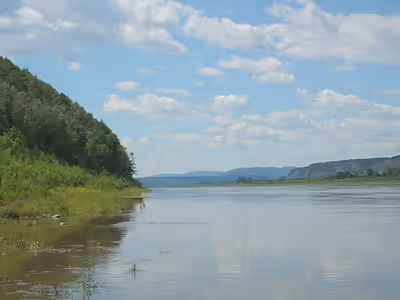
The river rises in the hills in the western part of Northeast China at the confluence of its two major affluents, the Shilka and the Argun (or Ergune), at an elevation of 303 metres (994 ft). It flows east forming the border between China and Russia, and slowly makes a great arc to the southeast for about 400 kilometres (250 mi), receiving many tributaries and passing many small towns. At Huma, it is joined by a major tributary, the Huma He. Afterwards it continues to flow south until, between the cities of Blagoveshchensk in Russia and Heihe in China, it widens significantly as it is joined by one of its most important tributaries the Zeya.
The Amur arcs to the east and turns southeast again at the confluence with the Bureya, then does not receive another significant tributary for nearly 250 kilometres (160 mi) before its confluence with its largest tributary, the Songhua, at Tongjiang. At the confluence with the Songhua the river turns northeast, now flowing towards Khabarovsk, where it joins the Ussuri and ceases to define the Russia–China border. Now the river spreads out dramatically into a braided character, flowing north-northeast through a wide valley in eastern Russia, passing Amursk and Komsomolsk-on-Amur. The valley narrows after about 200 kilometres (120 mi) and the river again flows north onto plains at the confluence with the Amgun. Shortly after, the Amur turns sharply east and into an estuary at Nikolayevsk-on-Amur, about 20 kilometres (12 mi) downstream of which it flows into the Strait of Tartary.
During years with heavy precipitation, the Amur river system is connected with the Kherlen river. The normally exit−less endorheic lake Hulun Lake, into which Kherlen flows, will overflow at its northern shore through the arroyo of Mutnaya Protoka, and the water will meet the Argun River (Ergune) after about 30 kilometres (19 mi). The Amur Basin of the Kherlen−Argun−Amur River system has a total length of 5,052 km (3,139 mi) to its river mouth on the Sea of Okhotsk.
Tributaries
The largest tributaries of the Amur are, from source to mouth:
- Argun (right)
- Shilka (left)
- Amazar (left)
- Oldoy (left)
- Huma (right)
- Zeya (left)
- Bureya (left)
- Songhua (right)
- Bira (left)
- Ussuri (right)
- Tunguska (left)
- Anyuy (right)
- Gur (right)
- Gorin (left)
- Amgun (left)
There are also numerous lakes in the floodplain of the Amur. Some of the largest ones are Bolon, Khummi and Udyl.
The main tributaries from the mouth:
(1)Amur–Shilka–Onon: 4,354 km; (2)Amur–Argun–Hailar–Dayan: 4,444 km; (3)Amur–Argun–Dalan Orom–Kherlen: 5,052 km;
History and context
Many historical references distinguish two geopolitical entities in the area of the Amur: Manchuria (Northeast China) and Outer Manchuria. The Chinese province of Heilongjiang on the south bank of the river takes its name from the river, as does the Russian Amur Oblast on the north bank. The native Manchu people and their Qing Empire of China, who regarded this river as sacred, use the name Sahaliyan Ula (Black River).
The Amur is an important symbol of, and geopolitical factor in, Chinese–Russian relations. The Amur became especially prominent in the period of the Sino–Soviet political split of 1956–1966.
For many centuries, inhabitants of the Amur Valley comprised the Tungusic (Evenki, Solon, Ducher, Jurchen, Nanai, Ulch), Mongol (Daur) people, some Ainu and, near its mouth, the Nivkhs. For many of these groups, fishing in the Amur and its tributaries was the main source of their livelihood. Until the 17th century, those peoples were not known to Europeans, and little known to the Han Chinese, who sometimes collectively described them as the Wild Jurchens. The Chinese-language term Yúpí Dázi 魚皮韃子 ("Fish-skin Tatars") came to apply to the Nanais and related groups as well, owing to their traditional clothes made of fish skins.
The Mongols, ruling the region as the Yuan dynasty, established a tenuous military presence on the lower Amur in the 13th and the 14th centuries; ruins of a Yuan-era temple have been excavated near the village of Tyr.
During the early-15th-century reigns of the Yongle and the Xuande Emperors, the Ming dynasty reached the Amur in their drive to establish control over the lands adjacent to the Ming Empire to the northeast, which would later become known as Manchuria. Expeditions headed by the eunuch Yishiha reached Tyr several times between 1411 and the early 1430s, re-building (twice) the Yongning Temple and obtaining at least the nominal allegiance of the lower Amur's tribes to the Ming government. Some sources report also a Chinese presence during the same period on the middle Amur – a fort existed at Aigun for about 20 years during the Yongle era on the left (northwestern) shore of the Amur downstream from the mouth of the Zeya River. This Ming Dynasty Aigun was located on the opposite bank to the later Aigun that was later relocated during the Qing Dynasty. In any event, the Ming presence on the Amur was as short-lived as it was tenuous; soon after the end of the Yongle era, the Ming dynasty's frontiers retreated to southern Manchuria.
Chinese cultural and religious influence such as Chinese New Year, the "Chinese god", Chinese motifs like the dragon, spirals, scrolls, and material goods like agriculture, husbandry, heating, iron cooking-pots, silk, and cotton spread among Amur natives such as the Udeghes, Ulchis, and Nanais.
Russian Cossack expeditions led by Vassili Poyarkov and Yerofey Khabarov explored the Amur and its tributaries in 1643-44 and 1649-51, respectively. From 1640s to 1680s the Cossacks collected tribute from local peoples. They also established the fort of Albazin on the upper Amur.
At the time, the Manchus were busy with conquering China; but a few decades later, during the Kangxi era of 1661–1722, they turned their attention to their north-Manchurian backyard. Aigun was re-established near the supposed Ming site in about 1683–84, and a military expeditions went upstream to dislodge the Russians, whose Albazin establishment deprived the Manchu rulers of the tribute of sable pelts that the Solons and Daurs of the area would supply otherwise. Albazin fell during a short military campaign in 1685. The Treaty of Nerchinsk, concluded in 1689, marked the end of the hostilities: it left the entire Amur valley, from the convergence of the Shilka and the Ergune downstream, in Chinese hands.
Fedor Soimonov was commissioned in 1753 to map the then little explored area of the Amur, the actual expedition taking place in 1757. He mapped the Shilka, which was partly in Chinese territory, but was turned back when he reached its confluence with the Argun. The Russian proselytization of Orthodox Christianity to the indigenous peoples along the Amur was viewed as a threat by the Qing.
The Amur region remained a relative backwater of the Qing Empire for the next century and a half, with Aigun being practically the only major town on the river. Russians reappeared on the river in the mid-19th century, which forced the Manchus to yield all lands north of the river to the Russian Empire by the Treaty of Aigun (1858). Lands east of the Ussuri and the lower Amur were acquired by Russia as well, by the Convention of Peking (1860).
Bridges and tunnels
The first permanent bridge across the Amur, the Khabarovsk Bridge with an overall length of 2,590 metres (8,500 ft), was completed in 1916, allowing the trains on the Trans-Siberian Railway to cross the river year-round without using ferries or rail tracks on top of the river ice. In 1941 a railway tunnel was added as well.
Later, a combined road and rail bridge over the Amur at Komsomolsk-on-Amur (1975; 1400 m) and the road and rail Khabarovsk Bridge (1999; 3890 m) were constructed.
The Tongjiang-Nizhneleninskoye railway bridge links Nizhneleninskoye, Jewish Autonomous Oblast with Tongjiang, Heilongjiang Province. The Chinese portion of the bridge was finished in July 2016. In December 2016, work began on the Russian portion of the bridge. The structural link between the two sides of the bridge was completed in March 2019, and the bridge was completed in August 2021. It opened to rail traffic in November 2022.
The Blagoveshchensk–Heihe Bridge connects the cities of Blagoveshchensk, Russia, and Heihe, China. The construction of the bridge started in 2016 and was completed in late 2019. Regular bridge traffic started on June 10, 2022 only for freight traffic, and bridge opened for passenger vehicles on January 2, 2025.
Wildlife
It is believed there are at least 123 species of fish from 23 families inhabiting the Amur. The majority are of the Gobioninae subfamily of Cypriniformes, followed in number by Salmonidae. Several of the species are endemic. Pseudaspius and Mesocottus are monotypic genera found only in the Amur and some nearby coastal rivers. Other animals inhabiting this region include the Amur falcon, Amur leopard and Amur tiger; while some notable local flora include Amur cork tree, Amur maple and the Amur honeysuckle.
Four species of the Acipenseridae family can be found: the kaluga, Amur sturgeon, Sakhalin sturgeon and sterlet. The Kaluga and Amur sturgeon are endemic. The sterlet was introduced from the Ob in the 1950s. This region is home to the kaluga fish (Acipenseriformes).
Direction
Flowing across northeast Asia for over 4,444 kilometres (2,761 mi) (including its two tributaries), from the mountains of northeastern China to the Sea of Okhotsk (near Nikolayevsk-na-Amure), it drains a watershed that includes diverse landscapes of desert, steppe, tundra, and taiga, eventually emptying into the Pacific Ocean through the Strait of Tartary, where the mouth of the river faces the northern end of the island of Sakhalin.
The Amur has always been closely associated with the island of Sakhalin at its mouth, and most names for the island, even in the languages of the indigenous peoples of the region, are derived from the name of the river: "Sakhalin" derives from a Tungusic dialectal form cognate with Manchu sahaliyan ("black", as in sahaliyan ula, "Black River"), while Ainu and Japanese "Karaputo" or "Karafuto" is derived from the Ainu name of the Amur or its mouth. Anton Chekhov vividly described the Amur in writings about his journey to Sakhalin Island in 1890.
The average annual discharge varies from 6,000 cubic metres per second (210,000 cu ft/s) (1980) to 12,000 cubic metres per second (420,000 cu ft/s) (1957), leading to an average 9,819 cubic metres per second (346,800 cu ft/s) or 310 cubic kilometres (74 mi3) per year. The maximum runoff measured occurred in Oct 1951 with 30,700 cubic metres per second (1,080,000 cu ft/s) whereas the minimum discharge was recorded in March 1946 with a mere 514 cubic metres per second (18,200 cu ft/s).