

Babylonian captivity
Period in Jewish history during the 6th century BCE
- 10 min read
- 5 chapters

Related on Lably
Through Kingdom of Judah, Mesopotamia and Jews
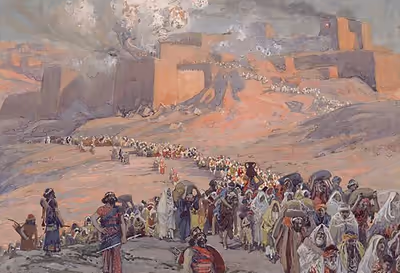
Although the dates, numbers of expulsions, and numbers of exiles vary in the several Hebrew Bible accounts, the following is a general outline of what occurred. After the Battle of Carchemish in 605 BCE, the Babylonian king Nebuchadnezzar II besieged Jerusalem, which resulted in tribute being paid by the Judean king Jehoiakim. In c. 601 BCE, Jehoiakim refused to pay further tribute, which led in 598/597 BCE to another siege of the city by Nebuchadnezzar II and culminated in the death of Jehoiakim and the exile to Babylonia of his successor Jeconiah, Jeconiah's court, and many others. In 587 BCE, Nebuchadnezzar II destroyed Jerusalem and exiled Jeconiah's successor Zedekiah and others. In 582 BCE, Nebuchadnezzar II exiled another group.
The Hebrew Bible (Tanakh) recounts how, after the fall of the Neo-Babylonian Empire to the Achaemenid Empire at the Battle of Opis in 539 BCE, exiled Judeans were permitted by the Persians to return to Judah. According to the Tanakh‘s Book of Ezra, construction of the Israelites’ Second Temple began c. 537 BCE in Jerusalem, with Judea as part of the new Persian province named Yehud Medinata ("the province of Judah") under Cyrus the Great. All of these events are considered significant to the developed history and culture of the Jewish people, and ultimately had a far-reaching impact on the further development of Judaism.
Archaeological studies have revealed that, although the city of Jerusalem was utterly destroyed, Judah continued to be inhabited by a remnant of Judeans during the period of the Judean exile in Babylon. Historical records from Mesopotamia and Jewish sources indicate that, after liberation by Cyrus, a portion of the Jewish population continued to live in Mesopotamia. This sub-group led to the establishment of a sizable Jewish community in Mesopotamia, known in Hebrew as The Golah (exiles), which persisted until modern times. The Iraqi Jewish, Persian Jewish, Georgian Jewish, Bukharian Jewish, and Mountain Jewish communities are believed to derive their ancestry in large part from these exiles; these communities have now largely emigrated to Israel.
Hebrew Bible accounts of the exile
In the late 7th century BCE, the Kingdom of Judah was a client state of the Assyrian empire. In the last decades of the century, Assyria was overthrown by Babylon, an Assyrian province. Egypt, fearing the sudden rise of the Neo-Babylonian empire, seized control of Assyrian territory up to the Euphrates river in Syria, but Babylon counter-attacked. In the process Josiah, the king of Judah, was killed in a battle with the Egyptians at the Battle of Megiddo (609 BCE).
After the defeat of Pharaoh Necho's army by the Babylonians at Carchemish in 605 BCE, Jehoiakim began paying tribute to Nebuchadnezzar II of Babylon. Some of the young nobility of Judah were taken to Babylon.
In the following years, the court of Jerusalem was divided into two parties, one supporting Egypt, the other Babylon. After Nebuchadnezzar was defeated in battle in 601 BCE by Egypt, Judah revolted against Babylon, culminating in a three-month siege of Jerusalem beginning in late 598 BCE. Jehoiakim, the king of Judah, died during the siege and was succeeded by his son Jehoiachin (also called Jeconiah) at the age of eighteen. The city fell on 2 Adar (March 16) 597 BCE, and Nebuchadnezzar pillaged Jerusalem and its Temple and took Jeconiah, his court and other prominent citizens (including the prophet Ezekiel) back to Babylon. Jehoiakim's uncle Zedekiah was appointed king in his place, but the exiles in Babylon continued to consider Jeconiah as their Exilarch, or rightful ruler.
Despite warnings by Jeremiah and others of the pro-Babylonian party, Zedekiah revolted against Babylon and entered into an alliance with Pharaoh Hophra. Nebuchadnezzar returned, defeated the Egyptians, and again besieged Jerusalem, resulting in the city's destruction in 587 BCE. Nebuchadnezzar destroyed the city wall and the Temple, together with the houses of the most important citizens. Zedekiah and his sons were captured and the sons were executed in front of Zedekiah, who was then blinded and taken to Babylon with many others (Jer 52:10–11). Judah became a Babylonian province, called Yehud, putting an end to the independent Kingdom of Judah. Because of the missing years in the Jewish calendar, rabbinic sources place the date of the destruction of the First Temple at 3338 AM (423 BCE) or 3358 AM (403 BCE).
The first governor appointed by Babylon was Gedaliah, a native Judahite; he encouraged the many Jews who had fled to surrounding countries such as Moab, Ammon and Edom to return, and he took steps to return the country to prosperity. Some time later, a surviving member of the royal family assassinated Gedaliah and his Babylonian advisors, prompting many refugees to seek safety in Egypt. By the end of the second decade of the 6th century BCE, in addition to those who remained in Judah, there were significant Jewish communities in Babylon and in Egypt; this was the beginning of the later numerous Jewish communities living permanently outside Judah in the Jewish Diaspora.
According to the book of Ezra, the Persian Cyrus the Great ended the exile in 538 BCE, the year after he captured Babylon. The exile ended with the return under Zerubbabel the Prince (so-called because he was a descendant of the royal line of David) and Joshua the Priest (a descendant of the line of the former High Priests of the Temple) and their construction of the Second Temple in the period from 521 to 516 BCE.
Sign in to keep reading
4 more chapters are free with a Lably account.
Archaeological and other extra-biblical evidence
First campaign (597 BCE)
Nebuchadnezzar's siege of Jerusalem, his capture of its king, his appointment of another in his place, and the plundering of the city in 597 BCE are corroborated by a passage in the Babylonian Chronicles:
In the seventh year, in the month of Kislev, the king of Akkad mustered his troops, marched to the Hatti-land, and encamped against the City of Judah and on the ninth day of the month of Adar he seized the city and captured the king. He appointed there a king of his own choice and taking heavy tribute brought it back to Babylon.
Jehoiachin's Rations Tablets, describing ration orders for a captive King of Judah, identified with King Jeconiah, have been discovered during excavations in Babylon, in the royal archives of Nebuchadnezzar. One of the tablets refers to food rations for "Ya’u-kīnu, king of the land of Yahudu" and five royal princes, his sons.
Second campaign (589–587 BCE)
Nebuchadnezzar and the Babylonian forces returned in 589 BCE and rampaged through Judah, leaving clear archaeological evidence of destruction in many towns and settlements there. Clay ostraca from this period, referred to as the Lachish letters, were discovered during excavations; one, which was probably written to the commander at Lachish from an outlying base, describes how the signal fires from nearby towns were disappearing: "And may (my lord) be apprised that we are watching for the fire signals of Lachish according to all the signs which my lord has given, because we cannot see Azeqah." Archaeological finds from Jerusalem testify that virtually the whole city within the walls was burnt to rubble in 587 BCE and utterly destroyed.
Aftermath in Judah
Excavations indicate a sharp decline in population in post-conquest Judah. Estimates of Judah's population before and after the Babylonian campaigns vary among scholars, but generally point to a drop from roughly 110,000 to somewhere between 15,000 and 40,000 inhabitants. This collapse cannot be attributed to deportations alone, but also to wartime deaths due to various reasons and voluntary flight abroad. Archaeologist Avraham Faust suggests that between the deportations and executions of Judeans by the invading Babylonians, plus the famines and epidemics that occurred during the war, the Israelite population of Judah may have been reduced to as little as 10% of what it had been in the time before their exile to Babylon.
Although Jerusalem was destroyed, with large parts of the city remaining in ruins for 150 years, other Israelite settlements in Judah continued to be inhabited, without signs of disruption visible in archaeological studies.
Conditions in exile
In Mesopotamia, the exiled Judeans were relocated to agricultural settlements, with one notable settlement being Tel-Abib near the city of Nippur. Biblical scholar Niels Peter Lemche suggests that the exiled Judeans experienced a lifestyle scarcely less prosperous than what they were accustomed to in their homeland.
However, there is evidence for hardship. For example, exiled Jewish leaders were suspected of national disloyalty and were reduced to peasantry, where they worked in agriculture and building projects and performed simple tasks such as farming, shepherding and fishing. This ended when the Persians conquered Babylon. Exiled Jewish commoners were nostalgic about Judah and, due to circumstance, were forced to abandon temple-based worship. They mostly worshipped in private homes and kept some religious traditions such as circumcision, Sabbath observance, reading of the Psalms and Law.
Persian restoration
The Cyrus Cylinder, an ancient tablet on which is written a declaration in the name of Cyrus referring to restoration of temples and repatriation of exiled peoples, has often been taken as corroboration of the authenticity of the biblical decrees attributed to Cyrus, but other scholars point out that the cylinder's text is specific to Babylon and Mesopotamia and makes no mention of Judah or Jerusalem. Professor Lester L. Grabbe asserted that the "alleged decree of Cyrus" regarding Judah, "cannot be considered authentic", but that there was a "general policy of allowing deportees to return and to re-establish cult sites". He also stated that archaeology suggests that the return was a "trickle" taking place over decades, rather than a single event.
As part of the Persian Empire, the former Kingdom of Judah became the province of Judah (Yehud Medinata) with different borders, covering a smaller territory. The population of the province was greatly reduced from that of the kingdom; archaeological surveys suggesting a population of around 30,000 people in the 5th to 4th centuries BCE.
A 2017 exhibition in Jerusalem displayed over 100 cuneiform tablets detailing trade in fruits and other commodities, taxes, debts, and credits accumulated between Jews forced or persuaded to move from Jerusalem by King Nebuchadnezzar around 600 BCE. The tablets included details on one exiled Judean family over four generations, all with Hebrew names.
Most Jews who returned were poor and either saw the exile as "spiritual regeneration" or "divine punishment for sins". One reason why wealthy Jews stayed in Mesopotamia includes economic opportunities, which were relatively uncommon in Judah.
Exilic literature
The exilic period was a rich source for Hebrew literature. Biblical depictions of the exile include Book of Jeremiah 39–43 (which saw the exile as a lost opportunity); the final section of 2 Kings (which portrays it as the temporary end of history); 2 Chronicles (in which the exile is the "Sabbath of the land"); and the opening chapters of Ezra, which records its end. Other works from or about the exile include the stories in Daniel 1–6, Susanna, Bel and the Dragon, the "Story of the Three Youths" (1 Esdras 3:1–5:6), and the books of Tobit and Judith. The Book of Lamentations arose from the Babylonian captivity. The final redaction of the Pentateuch took place in the Persian period following the exile,and the Priestly source, one of its main sources, is primarily a product of the post-exilic period when the former Kingdom of Judah had become the Persian province of Yehud.
Significance for Jewish culture
In the Hebrew Bible, the captivity in Babylon is presented as a punishment for idolatry and disobedience to Yahweh. The Babylonian captivity had a number of serious effects on Judaism and Jewish culture. For example, the Imperial Aramaic alphabet, which eventually evolved into the Hebrew alphabet, was adopted during this period. Eventually the Aramaic-based Hebrew alphabet replaced the Paleo-Hebrew alphabet.
This period saw the last high point of Hebrew Bible prophecy in the person of Ezekiel, followed by the emergence of the central role of the Torah in Jewish life. According to many historical-critical scholars, the Torah was redacted during this time, and began to be regarded as the authoritative text for Jews. This period saw their ethno-religious national group’s tenacity to survive, despite the destruction of their ancestral country’s central Temple. Israeli philosopher and Biblical scholar Yehezkel Kaufmann said "The exile is the watershed. With the exile, the religion of Israel comes to an end and Judaism begins."
Notably, the period also saw the theological transition of the ancient Israelite religion among the captives from a monolatrous to a monotheistic faith system.
This process coincided with the emergence of scribes and sages as Jewish leaders (see Ezra). Prior to exile, the people of Israel had been organized according to tribe. Afterwards, they were organized by smaller family groups. Only the Tribe of Levi continued in its temple role after the return. After this time, there were always sizable numbers of Jews living outside the Land of Israel; thus, it also marks the beginning of the "Jewish diaspora", unless this is considered to have begun with the Assyrian captivity.
In rabbinic literature, biblical nations were used as metaphors for the Jewish diaspora, particularly Babylon, based on the historical captivity of the 6th century BCE. Following the Roman destruction of Israel’s Second Temple in 70 CE, the names Rome and Edom temporarily became such standard terms.
Chronology
The following table is based on Rainer Albertz's work on Israel in exile, itself based mainly on Hebrew Bible texts. (Alternative dates are possible.)