


Related on Lably
Through Demography, Indigenous peoples and Life expectancy
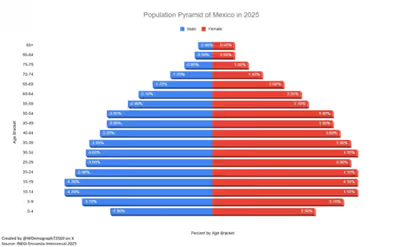
Demographic censuses are performed by the Instituto Nacional de Estadística y Geografía. The National Population Council (CONAPO) is an institution under the Ministry of Interior in charge of the analysis and research of population dynamics. The National Institute of Indigenous Peoples also undertakes research and analysis of the sociodemographic and linguistic indicators of the indigenous peoples. Throughout most of the 20th century Mexico's population was characterized by rapid growth. Although this tendency has been reversed and average annual population growth over the last five years was less than 1%, the demographic transition is still in progress; Mexico still has a large youth cohort.
Demographic dynamics
Estimates vary for the Pre-Columbian population of Mexico from 1.5 million to 21 million, but the most accepted figure is about 12 million people, including the population of the Aztec Empire which is estimated at 6 million people. In 1600, the population was estimated to have been around 1 to 2 million, having drastically declined due to disease and warfare following Spanish conquest. By 1700, the population was estimated to be around 4 million. In 1900, the Mexican population was 13.6 million.
During the period of economic prosperity that was dubbed by economists as the "Mexican Miracle", the government invested in efficient social programs that reduced the infant mortality rate and increased life expectancy. These measures jointly led to an intense demographic increase between 1930 and 1980.
Intense population growth in the northern states, especially along the US-Mexican border, changed the country's demographic profile in the second half of the 20th century, as the 1967 US-Mexico maquiladora agreement through which all products manufactured in the border cities could be imported duty-free to the US. Since the adoption of NAFTA in 1994, which allows all products to be imported duty-free regardless of their place of origin within Mexico, the non-border maquiladora share of exports has increased while that of border cities has decreased. This has led to decentralization and rapid economic growth in Mexican states (and cities), such as Quintana Roo (Cancun), Baja California Sur (La Paz), Nuevo León (Monterrey), Querétaro, and Aguascalientes whose population grew by more than one-third from 2000 to 2015, while the whole of Mexico grew by 22.6% in this period.
The national annual growth rate was still positive (1.0%) in the early years of the 2000s. The national net migration rate was negative (-4.75/1000 inhabitants). In the 2010s, the net migration rate reached 0, given the strong economy of Mexico, changes in US Immigration Policy & Enforcement, US Legislative and CFR-8 decisions, plus the slowly recovering US economy, causing many of its former residents to return. Given the former strong flow of immigrants to the United States. an estimated 5.3 million undocumented Mexican immigrants lived in the United States in 2004. In the 2000 census, 18.2 million American citizens declared having Mexican ancestry.
The population's annual growth rate has been reduced from a 3.5% peak in 1965 to 0.99% in 2005. While Mexico is now transitioning to the third phase of demographic transition, close to 50% of the population in 2009 was 25 years old or younger. Fertility rates have also decreased from 5.7 children per woman in 1976 to 1.9 in 2020. After decades of the gap narrowing, in 2020 the fertility rate in Mexico fell below the United States for the first time falling 22% in 2020 and a further 10.5% in the first half of 2021 due to the COVID-19 pandemic. The Mexican government projects that the country's population will grow to about 123 million by 2042 and then start declining slowly. Assumptions underlying this projection include fertility stabilizing at 1.85 children per woman and continued high net emigration (slowly decreasing from 583,000 in 2005 to 393,000 in 2050).
Mexico is composed of 32 federal entities which include 31 states and Mexico City, the five most populous federal entities in 2020 were the State of Mexico (16.9 million), Mexico City (9.2 million), Jalisco (8.3 million), Veracruz (8.0 million) and Puebla (6.5 million), which collectively contain around 40% of the national population. The Greater Mexico City metro area, which includes Mexico City and adjacent municipalities of surrounding states, is the most populous in the country and is estimated to be the second most populous in the world (after Tokyo), according to the UN Urbanization Report.
The average annual population growth rate of Mexico City was 0.2%. The state with the lowest population growth rate over the same period was Michoacán (-0.1%), whereas the states with the highest population growth rates were Quintana Roo (4.7%) and Baja California Sur (3.4%), both of which are two of the least populous states and the last to be admitted to the Union in the 1970s. The average annual net migration rate of Mexico City over the same period was negative and the lowest of all political divisions of Mexico, whereas the states with the highest net migration rate were Quintana Roo (2.7), Baja California (1.8) and Baja California Sur (1.6).
UN estimates
In 2010, the population was 117,886,000, compared to 28,296,000 in 1950. The proportion of children below the age of 15 in 2010 was 30%. 64% of the population was between 15 and 65 years of age, and 6% was 65 years or older.
Note: Percentages may not add to exactly 100% due to rounding.
Structure of the population
Population by Sex and Age Group, 2010 census. Including an estimation of 1,334,585 people corresponding to 448,195 housing units without information of the occupants:
Population by Sex and Age Group, 2020 census. Including an estimation of 6,337,751 persons corresponding to 1,588,422 housing units without information of the occupants.:
View source data. View source data. View source data.
Sign in to keep reading
8 more chapters are free with a Lably account.
Vital statistics
Registered births and deaths
Source: Instituto Nacional de Estadística, Geografía e Informática (INEGI)
Current vital statistics
CBR and CDR estimates
The following estimates were prepared by the Instituto Nacional de Estadística, Geografía e Informatica:
TFR before 1936
Life expectancy from 1893 to 1950
Life expectancy in Mexico from 1893 to 1950. Source: Our World In Data
UN estimates
The Population Department of the United Nations prepared the following estimates.
International migration
Immigration to Mexico
Aside from the original Spanish colonists, many Europeans immigrated to Mexico in the late 19th and early 20th centuries. Non-Spanish immigrant groups included British, Irish, Italian, German, French and Dutch. Large numbers of Middle Eastern immigrants arrived in Mexico during the same period, mostly from Syria and Lebanon. Asian immigrants, mostly Chinese, some via the United States, settled in northern Mexico, whereas Koreans settled in central Mexico. The PRI governments, in power for most of the 20th century, had a policy of granting asylum to fellow Latin Americans fleeing political persecution in their home countries. This led to the arrival of immigrants, mainly political refugees from Argentina, Chile, Cuba, Peru, Colombia and Central America during the 1970s and 1980s.
A second wave of immigrants has come to Mexico as a result of the economic crises experienced by some countries in the region. The Argentine community is quite significant estimated to be somewhere between 11,000 and 30,000. Due to the 2008–2014 Spanish financial crisis, many Spaniards have been emigrating to Mexico to seek new opportunities. For example, during the last quarter of 2012, a number of 7,630 work permits were granted to Spaniards.
Mexico is also the country where the largest number of American citizens live abroad, with Mexico City playing host to the largest number of American citizens abroad in the world. The American Citizens Abroad Association estimated in 1999 that a little more than one million Americans live in Mexico (which represent 1% of the population in Mexico and 25% of all American citizens living abroad). This immigration phenomenon could well be explained by the interaction of both countries under the North American Free Trade Agreement (NAFTA), but also by the fact that Mexico has become a popular destination for retirees, especially the small towns: just in the State of Guanajuato, in San Miguel de Allende and its surroundings, 10,000 Americans have their residence.
Discrepancies between the figures of official legal immigrants and all foreign-born residents is quite large. The official figure for foreign-born residents in Mexico in 2020 was 1,212,252, with the majority being born in the United States, who also are the most common immigrant group across the country's states with the exception of the state of Chiapas, where the majority of immigrants are from Central America. The six states with the most immigrants are Baja California (12.1% of total immigrants), Mexico City (11.4%), Jalisco (9.9%), Chihuahua (9%) and Tamaulipas (7.3%).
Emigration from Mexico
The national net migration rate of Mexico is negative, estimated at -1.8 migrants per 1,000 population as of 2017. The great majority of Mexican emigrants have moved to the United States of America, this migration phenomenon has been a defining feature in the relationship of both countries for most of the 20th century. During World Wars I and II, the United States government approved the recruitment of Mexican workers in their territory, and tolerated unauthorized migration to obtain additional farm and industrial workers to fill the necessary spots vacated by the population in war, and to supply the increase in the demand for labor. Nonetheless, the United States unilaterally ended the wartime programs, in part as a result of arguments from labor and from civil-rights groups. In spite of that, emigration of Mexicans continued at varying rates, growing significantly during the 1990s and the first years of the 2000s, it has been estimated that 37% of all Mexican immigrants to the United States in the 20th century arrived during the 1990s. In the year 2000 approximately 20 million American residents identified themselves as either Mexican, Mexican-Americans or of Mexican origin, making "Mexican" the sixth-most cited ancestry of all US residents.
In the year 2000 the INEGI estimated that about eight million Mexican-born people, which then was equivalent to 8.7% of the population of Mexico itself, lived in the United States of America and according to the Pew Hispanic Center in 2006, an estimated ten percent of all Mexican citizens lived in the United States. For the 2015-2020 period the states who sent the highest percentages of migrants to the United States were Guanajuato (7.8%), Jalisco (7.5%), Michoacán (6.3%) y el Estado de México (5.4%), with the total number of migrants being 803 thousand people, the great majority being men and approximately 30% of them coming from rural communities. For the same period, it was reported that 178 thousand migrants returned to Mexico.
The population of Mexican immigrants residing illegally in the United States fell from around seven million in 2007 to about 6.1 million in 2011. This trajectory has been linked to the 2008 financial crisis, which reduced available jobs, and to the introduction of stricter immigration laws in many States. According to the Pew Hispanic Center the total number of Mexican-born people had stagnated in 2010 and then began to fall. After the Mexican-American community, Mexican Canadians are the second-largest group of emigrant Mexicans, with a population of over 90,000. A significant but unknown number of mestizos of Mexican descent migrated to the Philippines during the era of the Viceroyalty of New Spain, when the Philippines was a territory under the rule of Mexico city. Mexicans live throughout Latin America as well as in Australia, France, Germany, Italy, and the United Arab Emirates.
Cities and metropolitan areas
Settlements, cities and municipalities
In 2010, Mexico had more than 189,432 localidades (lit. "localities" or "settlements"), which are census-designated places defined as a small town, a large city, or simply as a single unit housing in a rural area whether situated remotely or close to an urban area. Localities with more than 2,500 inhabitants are considered urban settlements. Those with less than 2500 inhabitants are considered rural settlements.
In 2010, there were 3,021 cities with a population between 2,500 and 15,000 inhabitants, 413 with a population between 15,000 and 50,000 inhabitants, 86 with a population between 50,000 and 100,000, 95 with a population between 100,000 and 500,000, 25 with a population between 500,000 and one million and 11 with a population of more than one million. Urban areas contain 76.81% of Mexico's total population and rural settlements contain 23% of the population.
Municipalities (municipios in Spanish) and boroughs (delegaciones in Spanish) are incorporated places in Mexico, that is, second or third-level political divisions with internal autonomy, legally prescribed limits, powers and functions. In terms of second-level political divisions there are 2,477 municipalities, including 16 semi-autonomous boroughs all within Mexico city. A municipality can be constituted by one or more cities one of which is the cabecera municipal (municipal seat).
Cities are usually contained within the limits of a single municipality. Small areas of one city may extend to other adjacent municipalities without incorporating the city which serves as the municipal seat of the adjacent municipality. Some municipalities or cities within municipalities are further divided into delegaciones or boroughs. Unlike the boroughs of the Federal District, these are third-level administrative divisions. They have very limited autonomy and no elective representatives.
Municipalities in central Mexico are usually very small in area and thus coextensive with cities, as is the case of Guadalajara, Puebla and León. Municipalities in northern and southeastern Mexico are much larger and usually contain more than one city or town that may not necessarily conform a single urban agglomeration, as is the case of Tijuana.
Metropolitan areas
A metropolitan area in Mexico is defined as a group of municipalities that heavily interact with each other, usually around a core city. In 2004, a joint effort between CONAPO, INEGI and the Ministry of Social Development (SEDESOL) agreed to define metropolitan areas as either:
- a group of two or more municipalities in which a city with a population of at least 50,000 is located whose urban area extends over the limit of the municipality that originally contained the core city incorporating either physically or under its area of direct influence other adjacent predominantly urban municipalities all of which have a high degree of social and economic integration or are relevant for urban politics and administration; or
- a single municipality in which a city of a population of at least one million is located and fully contained, (that is, it does not transcend the limits of a single municipality); or
- a city with a population of at least 250,000 which forms a conurbation with other cities in the United States of America.
In 2020 there were 48 metropolitan areas in Mexico, in which close to 53% of the country's population lives. The most populous metropolitan area in Mexico is the Metropolitan Area of the Valley of Mexico, or Greater Mexico City, which in 2020 had a population of 21.8 million, or around 18% of the nation's population. The next four largest metropolitan areas in Mexico are Greater Monterrey (5.3 million), Greater Guadalajara (5.2 million), Greater Puebla (3.2 million) and Greater Toluca (2.3 million), whose added population, along with Greater Mexico City, is equivalent to nearly 30% of the nation's population.
Greater Mexico City was the fastest growing metropolitan area in Mexico from the 1930s until the late 1980s. Since then, Mexico has slowly become economically and demographically less centralized. From 2000 to 2005 the average annual growth rate of Greater Mexico City was the lowest of the five largest metropolitan areas. The fastest growing metropolitan area was Puebla (2.0%), followed by Monterrey (1.9%), Toluca (1.8%) and Guadalajara (1.8%).
Other demographic statistics
Demographic statistics according to the CIA World Factbook, unless otherwise indicated.
Median age
- Total: 30.6 years (2023 est.). Country comparison to the world: 130th
- Male: 28.2 years
- Female: 30.4 years (2020 est.)
Contraceptive prevalence rate
- 73.1% (2018)
- 66.9% (2015)
Mother's mean age at first birth
- 21.3 years (2008 est.)
Major infectious diseases
- degree of risk: intermediate (2020)
- food or waterborne diseases: bacterial diarrhea and hepatitis A
- vectorborne diseases: dengue fever
Note: a new coronavirus is causing sustained community spread of respiratory illness (COVID-19) in Mexico; sustained community spread means that people have been infected with the virus, but how or where they became infected is not known, and the spread is ongoing; illness with this virus has ranged from mild to severe with fatalities reported; as of June 6, 2022, Mexico has reported a total of 5,782,405 cases of COVID-19 or 4,484.8 cumulative cases of COVID-19 per 100,000 population with a total of 324,966 cumulative deaths or a rate of 252 cumulative deaths per 100,000 population; as of May 20, 2022, 66.68% of the population has received at least one dose of COVID-19 vaccine.
Dependency ratios
- total dependency ratio: 51.4 (2015 est.)
- youth dependency ratio: 41.6 (2015 est.)
- elderly dependency ratio: 9.8 (2015 est.)
- potential support ratio: 10.2 (2015 est.)
Urbanization
- urban population: 81.3% of total population (2022)
- rate of urbanization: 1.4% annual rate of change (2020–25 est.)
- urban population: 80.2% of total population (2018)
- rate of urbanization: 1.59% annual rate of change (2015–20 est.)
Obesity – adult prevalence rate
- 28.9% (2016) Country comparison to the world: 29th
Children under the age of 5 years underweight
- 4.7% (2018/19) Country comparison to the world: 80th
- 4.2% (2016) Country comparison to the world: 87th
Education expenditures
- 4.3% of GDP (2018) Country comparison to the world: 92nd
- 5.2% of GDP (2015) Country comparison to the world: 59th
Literacy
definition: age 15 and over can read and write (2016 est.)
- total population: 95.2%
- male: 96.1%
- female: 94.5% (2020)
School life expectancy (primary to tertiary education)
- total: 15 years
- male: 15 years
- female: 15 years (2019)
Unemployment, youth ages 15–24
- total: 8.1%
- male: 7.8%
- female: 8.7% (2020 est.)
Ethnic groups
Although Mexico is an ethnically diverse country, for most of the 20th century and early 21st century the Mexican government has not conducted surveys regarding the ethnic origin of the population, except for indigenous peoples. However, recently the Mexican National Institute of Statistics and Geography has begun conducting surveys to quantify the percentage of Afro-descendant Mexicans, as well as Euro-descendant Mexicans living in the country. However, the results of surveys on the population of Euro-descendants has never been published.
Mexican national identity is the product of an ideology promoted by Mexican academics such as Manuel Gamio and José Vasconcelos known as mestizaje, whose goal was that of Mexico becoming a racially and culturally homogeneous country. The ideology influenced Mexico's national census of 1921, which was Mexico's first post-colonial national census that considered race. In that census, approximately 60% of Mexico's population identified as Mestizos. Subsequent censuses dropped racial categorization, instead favoring language-based categorization.
Mexico does not have a dominant ethnic group at the national level since many areas have different ethnic groups in majority and minority. For example, in the central regions where large Mesoamerican cultures flourished, and where there was a great fusion between Spaniards and Amerindians, a mostly balanced mestizaje is noted, while in the more rural southern regions, Amerindian ancestry predominates, while in the northern and western regions of the country, the population is predominantly of European ancestry. Each region of the Mexican territory is different in society, culture and traditions.
Some historians and academics have disputed the accuracy of past census results on ethnicity, saying that in its efforts to homogenize Mexico, the government inflated the Mestizo label's percentage by over-classifying people as such regardless actual ancestry.
The term mestizo since 1930 refers to a cultural identity as well as a racial identity. Mexicans who did not speak indigenous languages were classified as mestizos by the government, so under this definition it is possible for a Mexican to be simultaneously "culturally" mestizo and "racially" indigenous, white, black etc. Traditionally, Mexico has defined itself as a multicultural nation or as José Vasconcelos (1925) said, the "melting pot of all races" both culturally and ethnically.
Mestizo Mexicans
A large majority of Mexicans have been classified as "Mestizos", meaning in modern Mexican usage that they neither identify fully with any indigenous culture nor with a Spanish cultural heritage, but rather identify as having cultural traits incorporating elements from both indigenous and Spanish traditions. By the deliberate efforts of post-revolutionary governments, the "Mestizo identity" was constructed as the base of the modern Mexican national identity, through a process of cultural synthesis referred to as mestizaje . Mexican politicians and reformers such as José Vasconcelos and Manuel Gamio were instrumental in building a Mexican national identity upon this concept, which were designed with the main goal of "helping" indigenous peoples to achieve the same level of progress as the rest of society by transforming indigenous communities into Mestizo ones, eventually assimilating them into the Mestizo Mexican society.
According to many 20th- and 21st-century academics, large scale intermixing between the European immigrants and the native Indigenous peoples would result in Mestizos making up the vast majority of Mexico's population by the time of the Mexican Revolution. However, this claim is contested, as church registers from the colonial times show that the majority of Spanish men married with Spanish women. Said registers also put in question other assumptions held by contemporary academics, such as the claim that European immigrants who arrived to Mexico were almost exclusively men, or that "pure Spanish" people were part of a small powerful elite, as Spaniards were often the most numerous ethnic group in the colonial cities and there were menial workers and people in poverty who were of complete Spanish origin.
As the Mestizo identity promoted by the government is more of a cultural identity, it has achieved a strong influence in the country and has caused many people who may not qualify as "Mestizos" in its original sense to be counted as such in Mexico's demographic investigations and censuses, with many people who may be considered "White" being historically classified as Mestizos. A similar situation occurs regarding the distinctions between Indigenous peoples and Mestizos: while the term Mestizo is sometimes used in English with the meaning of a person with mixed indigenous and European blood, In Mexican society an indigenous person can be considered mestizo. and a person with none or a very low percentage of indigenous genetic heritage would be considered fully indigenous either by speaking an indigenous language or by identifying with a particular indigenous cultural heritage. In certain areas of Mexico the word Mestizo has a different meaning: in the Yucatán peninsula it has been used to refer to the Maya-speaking populations living in traditional communities, because during the caste war of the late 19th century those Maya who did not join the rebellion were classified as Mestizos whereas in the state of Chiapas the word "Ladino" is used instead of "mestizo".
Given that the word Mestizo has different meanings in Mexico, estimates of the Mexican Mestizo population vary widely. According to the Encyclopædia Britannica, around three-fifths of the Mexican population is Mestizo. The word "Mestizo" has pejorative connotations, which complicates attempts to quantify Mestizos via self-identification. Research based on self-identification has observed that many Mexicans do not identify as mestizos.
The use of variated methods and criteria to quantify the number of Mestizos in Mexico is not new: Since several decades ago, many authors have analyzed colonial censuses data and have made different conclusions regarding the ethnic composition of the population of colonial Mexico/New Spain. Some historians, such as Gonzalo Aguirre-Beltrán who claimed in 1972 that practically the totality of New Spain's population, in reality, were Mestizos, using to back up his claims arguments such as that affairs of Spaniards with non-Europeans due to the alleged absence of female European immigrants were widespread as well as there being a huge desire of Mestizos to "pass" as Spaniards, this because Spanishness was seen as a symbol of high status.
Other historians, however, argue that Aguirre-Beltran's numbers tend to have inconsistencies and take too many liberties (it is pointed out in the book Ensayos sobre historia de la población. México y el Caribe 2 published in 1998 that on 1646, when according to historic registers the mestizo population was of 1% he estimates it to be 16.6% already, with this being attributed to him interpreting the data in a way convenient for a historic narrative), often omitting data of New Spain's northern and western provinces. His self-made classifications thus, although could be plausible, are not useful for precise statistical analysis.
According to some 21st-century historians, Aguirre Beltran also disregards facts such as the population dynamics of New Spain being different depending on the region at hand (i.e. miscegenation could not happen in a significant amount in regions where the native population was openly hostile until the early 20th century, such as most of New Spain's internal provinces, which nowadays are the northern and western regions of Mexico), or that historic accounts made by investigators at the time consistently observed that New Spain's European population was notoriously concerned with preserving their European heritage, with practices such as inviting relatives and friends directly from Spain or favoring Europeans for marriage even if they were from a lower socioeconomic level than them being common. Newer publications that do cite Aguirre-Beltran's work take those factors into consideration, stating that the Spaniard/Euromestizo/Criollo ethnic label was composed on its majority by descendants of Europeans, albeit the category may have included people with some non-European ancestry.
Indigenous peoples
The 2003 General Law of Linguistic Rights of the Indigenous Peoples recognizes 62 indigenous languages as "national languages" which have the same validity as Spanish in all territories in which they are spoken. The recognition of indigenous languages and the protection of indigenous cultures is granted not only to the ethnic groups indigenous to modern-day Mexican territory, but also to other North American indigenous groups that migrated to Mexico from the United States, such as the Kikapú in the 19th century and those who immigrated from Guatemala in the 1980s. The category of "indígena" (indigenous) in Mexico has been defined based on different criteria throughout history. This means that the percentage of the Mexican population defined as "indigenous" varies according to the definition applied.
The latest intercensal survey carried out by the Mexican government in 2015 reports that Indigenous people make up 21.5% of Mexico's population, including both those who self-identified as "Indigenous" and people who self-identified as "partially Indigenous". According to the 2020 national Mexican census, 19.4% of the population self-identified as Indigenous. The number of people who speak an Indigenous language is significantly less than the total population of self-identified Indigenous people. Approximately 6.1% of the population speaks an Indigenous language, while 11.8 million people, or 9.36% of the population, live in what is designated as "Indigenous households" (households where at least one person spoke an indigenous language). However, activists for the rights of Indigenous Mexicans have referred to the usage of linguistic criterion, rather than self identification, as "statistical genocide."
Surveys made by the Mexican government do count as Indigenous all persons who speak an indigenous language and people who do not speak indigenous languages nor live in indigenous communities but self-identify as Indigenous. According to these criteria, the National Commission for the Development of Indigenous Peoples (Comisión Nacional para el Desarrollo de los Pueblos Indígenas, or CDI in Spanish) and the INEGI (Mexico's National Institute of Statistics and Geography), state that there are 15.7 million indigenous people in Mexico of many different ethnic groups, which constitute 14.9% of the population in the country, with 1.2% not fluent in Spanish. The states with the greatest percentage of people who speak an Amerindian language or identify as Amerindian are Yucatán (59%), Oaxaca (48%), Quintana Roo (39%), Chiapas (28%), Campeche (27%), Hidalgo (24%), Puebla (19%), Guerrero (17%), San Luis Potosí (15%) and Veracruz (15%). Oaxaca is the state with the greatest number of distinct indigenous peoples and languages in the country.
White Mexicans
White Mexicans are Mexicans of total or predominantly European ancestry. Spaniards and other Europeans began arriving in Mexico during the Spanish conquest of the Aztec Empire.
The Mexican government conducts surveys of skin color, but does not publish census results for ethnic identity. Estimates of Mexico's white population differ greatly in methodology, definition, and percentages given. The World Factbook give an approximation of about 10% as of 2017, while Britannica listed 15% in 2000.
The majority of the first waves of European immigration to Mexico was from Spain, starting with the colonization of America. A subsequent wave of Spanish immigration coincided with the Spanish Civil War of 1937. During the Second Mexican Empire, immigration was mostly French. In the late 19th and early 20th centuries, spurred by government policies of Porfirio Díaz, migrants came mainly from Italy, Germany, the United Kingdom, and Ireland. Most settled in Mexico City, Veracruz, Yucatán, and Puebla. Significant numbers of German immigrants also arrived during and after the First and Second World Wars. Additionally, small numbers of White Americans, Croats, Greeks, Poles, Romanians, Russians, and Ashkenazi Jews came. European Jewish immigrants joined the Sephardic community that lived in Mexico since colonial times, though many lived as Crypto-Jews, mostly in the northern states of Nuevo León and Tamaulipas.
Some communities of European immigrants have remained isolated from the rest of the general population since their arrival, among them the German-speaking Mennonites from Russia of Chihuahua and Durango, and the Venetos of Chipilo, Puebla, which have retained their original languages.
Afro-Mexicans
Afro-Mexicans are an ethnic group that predominate in certain areas of Mexico such as the Costa Chica of Oaxaca and the Costa Chica of Guerrero, Veracruz (e.g. Yanga) and in some towns in northern Mexico, mainly in Múzquiz Municipality, Coahuila. The existence of individuals of Sub-Saharan African descent in Mexico has its origins in the slave trade that took place during colonial times and that did not end until 1829 after the consummation of Mexican independence. The institution was not as prominent as elsewhere in the Americas and was already in decay by the late 1700s, which led to the number of free black people eventually surpassing that of enslaved ones. Although Mexico did not abolish slavery immediately after independence, the expansion of Anglo-American settlement in Texas with their Black slaves became a point of contention between the US and Mexico. The northern territory had been claimed by the Spanish Empire but not settled beyond a few missions. The Mexican government saw a solution to the problem of Indian attacks in the north by inviting immigration by US Americans. Rather than settling in the territory contested by northern Indian groups, the Anglo-Americans and their Black slaves established farming in eastern Texas, contiguous to US territory in Louisiana. Mexican President Anastasio Bustamante, concerned that the US would annex Texas, sought to limit Anglo-American immigration in 1830 and mandated no new slaves in the territory.
Historically, the presence of this ethnic group within the country has been difficult to assess for a number of reasons: their small numbers, heavy intermarriage with other ethnic groups, and Mexico's tradition of defining itself as a Mestizo society or mixing of European and indigenous only.
The majority of Mexico's Afro-descendants are Afromestizos, i.e. "mixed-race".According to the intercensal survey carried out in 2015, 1.2% of the population self-identified as Afro-Mexican with 64.9% (896,829) of them also identifying as indigenous and 9.3% being speakers of indigenous languages. In the 2020 INEGI census carried out by the Mexican government, Afro-Mexicans were reported to make up 2.04% of the country's population.
Arab Mexicans
An Arab Mexican is a Mexican citizen of Arabic-speaking origin who can be of various ancestral origins. The vast majority of Mexico's 1.1 million Arabs are from either Lebanese, Syrian, or Palestinian background. Immigration of Arabs in Mexico has influenced Mexican culture, in particular food, where they have introduced Kibbeh, Tabbouleh and even created recipes such as Tacos Árabes. By 1765, Dates, which originated from the Middle East, were introduced into Mexico by the Spaniards. The fusion between Arab and Mexican food has highly influenced the Yucatecan cuisine.
Arab immigration to Mexico started in the 19th and early 20th centuries. Roughly 100,000 Arabic-speakers settled in Mexico during this time period. They came mostly from Lebanon, Syria, Palestine, and Iraq and settled in significant numbers in Nayarit, Puebla, Mexico City and the northern part of the country (mainly in the states of Baja California, Tamaulipas, Nuevo León, Sinaloa, Chihuahua, Coahuila, and Durango, as well as the city of Tampico and Guadalajara. During the 1948 Israel-Lebanon war and the Six-Day War, thousands of Lebanese left Lebanon for Mexico. They first arrived in Veracruz. Although Arabs made up less than 5% of the total immigrant population in Mexico during the 1930s, they constituted half of the immigrant economic activity. Another concentration of Arab-Mexicans is in Baja California facing the U.S.-Mexican border, esp. in cities of Mexicali in the Imperial Valley U.S./Mexico, and Tijuana across from San Diego with a large Arab American community (about 280,000), some of whose families have relatives in Mexico. 45% of Arab Mexicans are of Lebanese descent.
The majority of Arab-Mexicans are Christians who belong to the Maronite Church, Roman Catholic, Eastern Orthodox and Eastern Rite Catholic Churches and a scant number are Muslims, The term "Arab Mexican" may include ethnic groups that do not in fact identify as Arab. The inter-ethnic marriage in the Arab community, regardless of religious affiliation, is very high; most community members have only one parent of Arab ancestry. As a result, the Arab community in Mexico shows marked language shift away from Arabic. Only a few speak any Arabic, and such knowledge is often limited to a few basic words. Instead, the majority, especially those of younger generations, speak Spanish as a first language. Today, the most common Arabic surnames in Mexico include Nader, Hayek, Ali, Haddad, Nasser, Malik, Abed, Mansoor, Harb, and Elias.
Asian Mexicans
Although Asian Mexicans make up less than 1% of the total population of modern Mexico, they are nonetheless a notable minority. Due to the historical and contemporary perception in Mexican society of what constitutes Asian culture (associated with the Far East rather than the Near East), Asian Mexicans typically refers to those of East Asian descent, and may also include those of South and Southeast Asian descent while Mexicans of West Asian descent are referred to as Arab Mexicans.
Asian immigration began with the arrival of Filipinos to Mexico during the colonial period. For two and a half centuries, between 1565 and 1815, many Filipinos and Mexicans sailed back and forth between Mexico and the Philippines as crews, prisoners, adventurers and soldiers in the Manila-Acapulco Galleon assisting Spain in its trade between Asia and the Americas. Also, on these voyages, thousands of Asian individuals (mostly males) were brought to Mexico as slaves and were called "Chino", which means Chinese, although in reality they were of diverse origins, including Koreans, Japanese, Malays, Filipinos, Javanese, Cambodians, Timorese, and people from Bengal, India, Ceylon, Makassar, Tidore, Terenate, and China. A notable example is the story of Catarina de San Juan (Mirra), an Indian girl captured by the Portuguese and sold into slavery in Manila. She arrived in New Spain and eventually she gave rise to the "China Poblana".
These early individuals are not very apparent in modern Mexico for two main reasons: the widespread mestizaje of Mexico during the Spanish period and the common practice of Chino slaves to "pass" as Indios (the indigenous people of Mexico) to attain freedom. As had occurred with a large portion of Mexico's black population, over generations the Asian populace was absorbed into the general Mestizo population. Facilitating this miscegenation was the assimilation of Asians into the indigenous population. The indigenous people were legally protected from chattel slavery, and by being recognized as part of this group, Asian slaves could claim they were wrongly enslaved.
Asians, predominantly Chinese, became Mexico's fastest-growing immigrant group from the 1880s to the 1920s, exploding from about 1,500 in 1895 to more than 20,000 in 1910.
Romani Mexicans
Romani people have settled in Mexico since the colonial era. There are around 50,000 Vlax Romani in Mexico.
Official censuses
Historically, population studies and censuses have never been up to the standards that a population as diverse and numerous such as Mexico's require: the first racial census was made in 1793, being also Mexico's (then known as New Spain) first ever nationwide population census. Since only part of its original datasets survive, most of what is known of it comes from essays made by researchers who back in the day used the census' findings as reference for their own works.
More than a century would pass until the Mexican government conducted a new racial census in 1921 (some sources assert that the census of 1895 included a comprehensive racial classification; however, according to the historic archives of Mexico's National Institute of Statistics, that was not the case). While the 1921 census was the last time the Mexican government conducted a census that included a comprehensive racial classification, in recent years it has conducted nationwide surveys to quantify most of the ethnic groups who inhabit the country as well as the social dynamics and inequalities between them.
1793 census
Also known as the "Revillagigedo census" from the name of the Count who ordered that it be conducted, this census was the first nationwide population census of Mexico (then known as the Viceroyalty of New Spain). Most of its original datasets have reportedly been lost, so most of what is known about it nowadays comes from essays and field investigations made by academics who had access to the census data and used it as reference for their works, such as Prussian geographer Alexander von Humboldt.
Each author gives different estimations for each racial group in the country although they do not vary greatly, with Europeans ranging from 18% to 22% of New Spain's population, Mestizos from 21% to 25%, Indians from 51% to 61%, and Africans from 6,000 and 10,000. The estimations given for the total population range from 3,799,561 to 6,122,354. It is concluded then, that across nearly three centuries of colonization, the population growth trends of whites and mestizos were even, while the total percentage of the indigenous population decreased at a rate of 13%–17% per century. The authors assert that rather than whites and mestizos having higher birthrates, the reason for the indigenous population's numbers decreasing lies in their suffering higher mortality rates due to living in remote locations rather than in cities and towns founded by the Spanish colonists or in being at war with them. For the same reasons, the number of Indigenous Mexicans presents the greatest variation range between publications, as in some cases their numbers in a given location were estimated rather than counted, leading to possible overestimations in some provinces and possible underestimations in others.
~Europeans are included within the Mestizo category.
Percentages may not sum to 100% because ......
Regardless of the possible inaccuracies related to the counting of Indigenous peoples living outside of the colonized areas, the effort that New Spain's authorities put into considering them as subjects is worth mentioning, as censuses made by other colonial or post-colonial countries did not consider American Indians to be citizens or subjects; for example, the censuses made by the Viceroyalty of the Río de la Plata would only count the inhabitants of the colonized settlements. Another example is the censuses made by the United States, which did not include Indigenous peoples living among the general population until 1860, and indigenous peoples as a whole until 1900.
1921 census
The 1921 census was made right after the end of the Mexican revolution. The 1921 census' reported that 59.3% of the Mexican population self-identified as Mestizo, 29.1% as Indigenous, and 9.8% as white.
Historians, academics and social activists have disputed the accuracy of the census when contrasted with the 1793 census, citing relatively low frequency of marriages between people of different continental ancestries in colonial and early independent Mexico. It is claimed that the mestizaje process sponsored by the state resulted in the numbers of the Mestizo Mexican group being inflated at the expense of the identity of other races. The 1921 census was the last time the Mexican Government conducted a comprehensive racial census.
Modern era
Since the end of the Mexican Revolution, the official identity promoted by the government for non-indigenous Mexicans has been the Mestizo one, a mix of European and indigenous culture and heritage, established with the original intent of eliminating divisions and creating a unified identity that would allow Mexico to modernize and integrate with the international community. Even though nowadays the large majority of the country's population consider themselves Mexicans, differences on physical features and appearance continue playing an important role on everyday social interactions, taking this into account, on recent time Mexico's government has begun conducting ethnic investigations to quantify the different ethnic groups that inhabit the country with the aim of reducing social inequalities between them.
According to these recent investigations, 19.4% of Mexico's population self-identify as Indigenous and 2.04% self-identify as Afro-Mexican, there is no definitive census that quantifies White Mexicans, with estimates from the Mexican government and other contemporary sources reporting results that estimate them at about one-third of the country's population, This figure is based on phenotypical traits, rather than genetic ancestry or self-identified ancestry.
Generally speaking ethnic relations can be arranged on an axis between the two extremes of European and Amerindian cultural heritage, this is a remnant of the Spanish caste system which categorized individuals according to their perceived level of biological mixture between the two groups although in practice the classificatory system has become fluid, mixing socio-cultural traits with phenotypical traits allowing individuals to move between categories and define their ethnic and racial identities situationally, the presence of considerable portions of the population with African and Asian heritage makes the situation more complex.
Even though there is a large variation in phenotypes among Mexicans, European looks are strongly preferred in Mexican society, with lighter skin receiving more positive attention, as it is associated with higher social class, power, money, and modernity. In contrast, Indigenous ancestry is often associated with having an inferior social class, as well as lower levels of education. These distinctions are strongest in Mexico City, where the most powerful of the country's elite are located.
Despite Mexico's government not using racial terms related to European or white people officially for almost a century, resuming using such terms after 2010, the concepts of "white people" (known as güeros or blancos in Mexican Spanish) and of "being white" did not disappear and are still present in everyday Mexican culture: different idioms of race are used in Mexico's society that serve as mediating terms between racial groups. It is not strange to see street vendors calling a potential customer Güero or güerito, sometimes even when the person is not light-skinned. In this instance it is used to initiate a kind of familiarity, but in cases where social/racial tensions are relatively high, it can have the opposite effect. The lack of a clear dividing line between white and mixed race Mexicans means that the concept of race is fluid and subjective. Contemporary sociologists and historians agree that the concept of "race" has a psychological foundation rather than a biological one.
Languages
Spanish is the de facto official language in Mexico, spoken by 98.3% of the population in 2015. Mexican Spanish is spoken in a variety of dialects, accents and variations in different regions across Mexico. In 2020, indigenous languages were spoken by around 5% of Mexicans. In 2003, the General Law of Linguistic Rights of the Indigenous Peoples recognized 68 indigenous languages as "national languages", with the "same validity" in all territories and contexts where they are spoken.
The indigenous language with the greatest number of speakers is Nahuatl (1,586,884 speakers in 2010 or 1.5% of the nation's population), followed by Yucatec Maya (796,405 speakers in 2010 0.8%) spoken Yucatán Peninsula, Mixtecas languages (494,454), Tzeltal (474,298), Zapotecas languages (460,683), Tzotzil (429,168), Otomí (288,052), Totonaca (250,252) Mazateco (230,124), Chol (222,051) and 1,462,857 speakers of other languages. After half a century of rural-to-urban migration, in Mexico City and other major cities, large districts and sections use written and spoken Amerindian languages. In 2020, approximately 7,364,645 Mexicans (6.1% of the population) spoke an indigenous language.
During the first half of the 20th century the government promoted a policy of castellanización, promoting the use of Spanish to integrate indigenous peoples into Mexican society. Since the 1980s the government has sponsored bilingual and intercultural education in all indigenous communities. This policy has mainly been successful in large communities with a significant number of speakers. Some languages, with less than 1,000 speakers, are still facing extinction.
English is the second most spoken language in Mexico. It is used extensively at border areas, tourist centers and large metropolitan areas, a phenomenon arguably caused by the economic integration of North American under the North American Free Trade Agreement (NAFTA) and the immigration phenomenon and the return of workers and their families from the United States. In border cities, American TV and radio waves in English and Spanish are received as much as Spanish-speaking radio and TV stations from Mexico on the US side of the border, thus a bilingual cross-cultural exchange is at work. Among the languages brought to Mexico by immigrants are the Venetian of Chipilo, and Mennonite Low German spoken in Durango and Chihuahua.
Mexican nationality and citizenship
The Constitution of Mexico grants Mexican nationality based on birth and naturalization. Mexican laws regarding nationality by birth are very open. Mexican nationality by birth is granted to:
- all those individuals born in Mexican territory,
- all those individuals born outside Mexico, whose father or mother is Mexican by birth,
- all those individuals born outside Mexico, whose father or mother is Mexican by naturalization,
- all those individuals born aboard Mexican aircraft or sea vessels, whether warships or commercial vessels.
Mexican nationality by naturalization is granted to:
- foreign citizens granted Mexican nationality by the Secretariat of Government (Ministry of the Interior);
- foreign citizens married to a Mexican national, whether by birth or naturalization.
Religion
In 2020, the adult Mexican population was predominantly Catholic. In 2006, 46% attended church on a weekly basis. In 2007, about 7.6% of the population was classified as Protestant or Evangelical, 2.5% were classified as "Non-Evangelical Biblical" (a classification that groups Adventists, Mormons and Jehovah's Witnesses), 0.05% as practicing Jews, and 4.6% without a religion. The largest group of Protestants are Pentecostals and Charismatics, classified as Neo-Pentecostals.
In 2007, the states with the highest percentage of professing Catholics were central states, namely Guanajuato (96.4%), Aguascalientes (95.6%) and Jalisco (95.4%). Southeastern states had the lowest percentage of Catholics, namely Chiapas (63.8%), Tabasco (70.4%) and Campeche (71.3%). The percentage of professing Catholics has been on the decrease over the last four decades, from over 98% in 1950 to 78% in 2020.
The average annual growth of Catholic believers from 1990 to 2000 was 1.7%. For non-Catholics, the annual growth was 3.7%. Given that the average annual population increase over the same time period was 1.8%, the percentage of Catholics in relation to the total population continues to be in overall decline.
Since 1857 with the La Reforma laws, the Mexican Constitution drastically separates Church and State, unlike some other countries in Latin America or Ibero-America. The State does not support or provide any economic resource to the Church, as is the case in Spain and Argentina. The Church cannot participate in public education. No public school can be operated by a Catholic order, although they can participate in private education. The government nationalized all the Church's properties, some of which were given back in the 1990s. Priests lost the right to vote or to be voted for. In the 1990s, they regained the right to vote.