

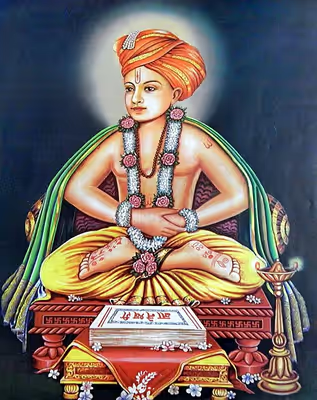
Dnyaneshwar
13th century Marathi saint
- 13 min read
- 5 chapters
- 1 lab on Lably

Learn it on Lably
Biography
Dnyaneshwar was born in 1275 (on the auspicious day of Krishna Janmashtami) in a Marathi family in the Apegaon village on the banks of Godavari river near Paithan in Maharashtra during the reign of the Yadava king Ramadevarava. The kingdom with its capital Devagiri enjoyed relative peace and stability, and the king was a patron of literature and arts.
Biographical details of Sant Dnyaneshwar's life are preserved in the writings of his disciples, Satyamalanath and Sachchidanand. The various traditions give conflicting accounts of details of Dnyaneshwar's life. The date of composition of his work Dnyaneshwari (1290 CE), however is undisputed. According to the more accepted tradition on Dnyaneshwar's life, he was born in 1275 CE and he attained samadhi in 1296 CE. Other sources state he was born in 1271 CE.
Life
The biographical details of Dnyaneshwar's short life of about 21 years are well established. The available accounts are filled with hagiographic legends and miracles he performed, such as his ability to make a buffalo sing the Vedas and humble a sadhak (Changdev) by riding a moving wall.
According to the accounts that have survived, Dnyaneshwar's father Vitthal pant was the kulkarni (accountant who maintained land and tax records in villages) of a village called Ape gaon on the banks of the Godavari River in Maharashtra, a profession he had inherited from his ancestors. He married Rakhna Bai, the daughter of the Kulkarni of Alandi. Even as a householder, Vitthal pant longed for spiritual learning. His disillusionment with life grew as a result of the death of his father and because he had no children from his marriage. Eventually, with his wife's consent, he renounced worldly life and left for Kashi to become a sannyasin (renunciate). There he met a guru (spiritual teacher), decided to renounce without his wife's consent.
Vitthalpant was initiated by his spiritual teacher, Ramashram (according to abhangas of Saint Namdeva), in Kashi. When Ramashram Swami visited Alandi and met Rukminibai by chance, he blessed her saying, "May you lead a happy married life." With tears in her eyes, Rukmini said that it was not possible since her husband had gone away to Kashi and become a sanyasin. On finding out that her husband was none other than his disciple Vitthalpant, Swami, on returning to Kashi, reprimanded Vitthalpant and sent him back to Alandi. At Alandi, he rejoined his wife and again became a householder. After Vitthalpant returned to his wife and settled down in Alandi, Rakhumabai gave birth to four children—Nivruttinath (1273 CE), Dnyaneshwar (1275 CE), Sopan (1277 CE) and Muktabai (1279 CE).
Brahmins saw a renunciate returning to his life as a householder as heresy. Dnyaneshwar and his brothers were denied the right to have the sacred thread ceremony for the full admission to the Brahmin caste. All brahmins excommunicated the Kulkarni family, denied them work, the right to buy food from the market or even interact with other villagers.
Vitthal Kulkarni eventually left the town for Nashik with his family. One day while performing his daily rituals, Vitthal came face to face with a tiger. Vitthal and three of his four children escaped, but Nivruttinath became separated from the family and hid in a cave. While hiding in the cave he met Gahaninath, who initiated Nivruttinath into the wisdom of the Nath yogis. Later, Vitthal Kulkarni returned to Alandi and asked the Brahmins to suggest a means of atonement for his sins; they suggest committing suicide as penance. Vitthal and his wife gave up their lives, within a year of each other by jumping into the Indrayani river in the hope their children might be able to lead lives free of persecution. Other sources and local folk tradition claim that the parents committed suicide by jumping in the Indrayani River. Another version of the legend states that Vitthalpant, the father threw himself into Ganges River to expiate his sin.
Dnyaneshwar and his siblings were accepted by and initiated into the Nath tradition to which their parents already belonged, where the three brothers and the sister Muktabai all became celebrated yogis and Bhakti poets.
Travel and Samadhi
After Dnyaneshwar had written Amrutanubhav, the siblings visited Pandharpur where they met Namdev, who became a close friend of Dnyaneshwar. Dnyaneshwar and Namadev embarked on a pilgrimage to various holy centers across India where they initiated many people into the Varkari sect; Dnyaneshwar's devotional compositions called Abhangas are believed to have been formulated during this period. On their return to Pandharpur, Dnyaneshwar and Namdev were honored with a feast in which, according to Bahirat, many contemporary saints such as "Goroba the potter, Sanvata the gardener, Chokhoba the untouchable and Parisa Bhagwat the ritualist priest" participated. Some scholars accept the traditional view that Namdev and Dnyaneshwar were contemporaries; however, others such as W. B. Patwardhan, R. G. Bhandarkar and R. Bharadvaj disagree with this view and date Namdev to the late 14th century instead.
After the feast, Dnyaneshwar desired to go into sanjeevan samadhi, a practice to voluntarily leave one's mortal body after entering into a deep meditative state, as practiced in Ashtanga Yoga of ancient India. Preparations for the Sanjeevan Samadhi were made by Namdev's sons. Regarding Sanjeevan Samadhi, Dnyaneshwar himself had emphatically talked about the relationship between higher awareness and light or pure energy. On the 13th day of the dark half of the Kartik month of the Hindu Calendar, in Alandi, Dnyaneshwar, who was then twenty-one years old, entered into Sanjeevan samadhi. His samadhi lies in the Siddheshvara Temple complex in Alandi. Namdev and other bystanders grieved his death. According to tradition, Dnyaneshwar was brought back to life to meet Namdev when the latter prayed to Vithoba for his return. Dallmayr writes that this testifies to "the immortality of genuine friendship and companionship of noble and loving hearts". Many Varkari devotees believe that Dnyaneshwar is still alive.
Miracles
There are a few stories about miracles came to be associated with Dnyaneshwar's life, one of which was the revival of his disciple Sachchidanand's corpse. Fred Dallmyr summarizes one of these legends as follows from the hagiography by Mahipati: At age 12, Dnyaneshwar with his impoverished and outcaste siblings, went to Paithan to plead mercy from Paithan brahmins, they were insulted and ridiculed. As the children were suffering the bullying, on a nearby road was a man who was violently lashing an old buffalo, and the injured animal collapsed in tears. Dnyaneshwar asked the buffalo owner to stop out of concern for the animal. The priests ridiculed him for being more concerned about a beast and unconcerned about the teachings of the Vedas. Dnyaneshwar retorted that the Vedas themselves held all life to be sacred and a manifestation of the god. The outraged priests pointed out that his logic implied that beasts should be able to learn the Vedas as well. An undeterred Dnyaneshwar then placed his hand on the buffalo's forehead and it started reciting a Vedic verse in a deep voice. According to Fred Dallmayr, one may not be concerned whether this story accurately reflects Dnyaneshwar's biography, the story does have symbolic significance in the same manner as the story about Jesus in Jerusalem in Matthew 3:9.
In another miracle, Dnyaneshwar was challenged by Changdev, an accomplished yogi who rode on a tiger with his magical powers, to replicate this feat. Dnyaneshwar humbled Changdev by riding on a moving wall. Dnyaneshwar's advice to Changdev was given in 65 verses called the Changdev Pasasthi. Changdev became a disciple of Dnyaneshwar's sister Muktabai.
Sign in to keep reading
4 more chapters are free with a Lably account.
Writings
According to B. P. Bahirat, Dnyaneshwar was the first known philosopher who wrote in the Marathi language. At about age 16, he composed Dnyaneshwari in the year 1290, a commentary on Bhagavad Gita which later became a fundamental text of the Varkari sect. His words were recorded by Sacchidananda, who agreed to become Dnyaneshwar's amanuensis. Dnyaneshwari was written using the Ovi; a metre, which was first used to compose women's songs in Maharashtra, of four lines where the first three or the first and third lines rhyme and the fourth line has a sharp and short ending. According to W. B. Patwardhan, a scholar on Dnyaneshwar, with Dnyaneshwar the ovi "trips, it gallops, it dances, it whirls, it ambles, it trots, it runs, it takes long leaps or short jumps, it halts or sweeps along, it evolves a hundred and one graces at the master's command". In Dnyaneshwari, at last he wrote "Pasaayadana" in which he prayed everything for others and all humanity and nothing for himself. Saint Dnyaneshwar himself believed that "The whole world has one soul- या विश्वाचा आत्मा एक आहे".
His first text Dnyanesvari was in the vernacular Marathi language, as opposed to the classical Sanskrit language. He wrote Dnyaneshwari in the Marathi language so that common people could understand philosophical aspects of life which were then understood only by those who knew Sanskrit (i.e. the higher priestly classes). Thus, this was a significant work in Indian history which simplified philosophy to the common man.
According to Bhagwat, like other Bhakti poets, Dnyaneshwar's choice of the vernacular language was an important departure from the prevailing cultural hegemony of Sanskrit and high–caste Hinduism, a trend which continued with later bhakti poets across India. Dnyaneshwar is to the Marathi literature what Dante is to the Italian, states Bhagwat.
According to tradition, Nivruttinath was not satisfied with the commentary and asked Dnyaneshwar to write an independent philosophical work. This work later came to be known as Amrutanubhava. Scholars differ on the chronology of the Dnyaneshwari and Amrutanubhav. Patwardhan has argued that Amrutanubhav is an earlier text than Dnyaneshwari because the latter is richer in use of metaphors and imagery, and displays greater familiarity with many different philosophical systems, such as Samkhya and Yoga. However, both Bahirat and Ranade disagree with this view pointing out that in Amrutanubhava, author displays familiarity with involved philosophical concepts such as Mayavada and Shunyavada, and while the text has simpler language, it reveals Dnyaneshwar's "philosophical depth".
Dnyaneshwar's devotional compositions called Abhangas are believed to have been formulated during his pilgrimage to Pandharpur and other holy places when he got initiated into the Varkari tradition.
Influences
The Mahanubhava sect and the Nath Yogi tradition were two prominent movements during Dnyaneshwar's time that influenced his works. Mahanubhavas were devotees of Krishna who disregarded the caste system, the Vedas and only promotes the worship of the deity Vitthala (Vishnu). Dnyaneshwar differed significantly from Mahanubhava's religious precepts. His thought was founded on the philosophy of the Upanishads and the Bhagavad Gita, and devotion to Vitthala formed the cornerstone of the egalitarian Varkari sect founded by Dnyaneshwar. However, the literary style adopted by Mahanubhava writers influenced Dnyaneshwar's works. According to R. D. Ranade, Dnyaneshwar "stands to Mahanubhavas just in the same relation which Shakespeare stood to Elizabethan writers".
Dnyaneshwar was initiated into the Nath Yogi tradition by his brother Nivruttinath, sometime after the death of their parents; Sopana and Muktabai were initiated into the tradition by Dnyaneshwar himself. Founded by Gorakshanath, the Nath Yogi sect had introduced the system of Hatha Yoga, which emphasised on yogic poses and physical fitness. Gahaninath, a disciple of Gorakshanath, had initiated Nivruttinath into the Nath Yogi tradition. Dnyaneshwar's non-dualistic philosophy, usage of a vernacular language in his writing and an emphasis on yoga and oneness of Vishnu and Shiva were his inheritances from the Nath Yogi tradition.
The values of Universal brotherhood and compassion espoused in his works came from his interactions with the devotional Vitthala sect, a tradition which was already in existence during Dnyaneshwar's time. J. N. Farquhar also notes the influence of Bhagavata Purana on Dnyaneshwar's poetry.
Philosophy
Ontology and epistemology
Dnyaneshwar takes up the examination of being or brahman in Amrutanubhava. He considers being to be the substratum of thought which enables thought and cognition. Since being is prior to thought and concepts, it is distinct from Kantian categories, and methods of thought such as epistemological analysis cannot be applied to it. Dnyaneshwar believes that reality is self–evident and does not require any proof. It antedates dualistic divisions into knower and known, existence and nonexistence, subject and object, knowledge and ignorance.
Dnyaneshwar highlights the limitations of traditional epistemological methods (pramanas) used in Indian philosophy. He points out that any perception is validated only by another deeper understanding, while in establishing the rationality of reason, reason itself is transcended. Dnyaneshwar even cautions against reliance on scriptural testimony, which is accepted as a valid source of knowledge by philosophers of Vedanta and Mīmāṃsā schools of philosophy. Scriptural validity, to him, stems from its congruence with experiential truth and not vice versa.
Ethics
Dnyaneshwar's moral philosophy comes out in his exposition of the 13th of Bhagavad Gita, in his commentary on the book Dnyaneshwari. He considers humility; non–injury in action, thought and words; forbearance in the face of adversity; dispassion towards sensory pleasures; purity of heart and mind; love of solitude and devotion towards one's Guru and God as virtues; and their corresponding moral opposites as vices. A pessimistic view of one's life is considered as a necessary condition for spiritual growth in Dnyaneshwari. Dnyaneshwar writes that saints do not perceive distinctions and are humble because they identify all objects, animate or inanimate, with their own Self.
Many chapters of Dnyaneshwari begins with an invocation to his Guru Nivruttinath, whose guidance he describes as the means to "cross the ocean of existence". The discussion on virtue and vices continues in his elucidation of the 16th chapter of Bhagavad Gita, where they are called divine heritages and demonic heritages respectively. Divine heritage comprises fearlessness, which comes from a belief in unity of all objects; charity; sacrifice, which comes from performing one's duties and compassion in addition to virtues already enumerated; while demonic heritage consists of six vices— ignorance, anger, arrogance, hypocrisy, harshness and pride.
The doctrine of Karma Yoga in the Bhagavad Gita is resurrected in Dnyaneshwari, where Dnyaneshwar examines achieving actionlessness through action and harmony between the two. In the fourth chapter, the ideal karma yogi's actions are compared to the apparent movement of the Sun, which while appearing to rise and set is actually stationary; similarly, a karma yogi, though appears to act, doesn't really act. Performance of one's duties, acting without egoism, renunciation of the fruits of one's actions and offering one's actions to God are four ways which, according to Dnyaneshwar, result in actionlessness and Self–realisation. Dnyaneshwar's metaphysical conclusion that the world is a manifestation of the divine, and not an illusion, also creates an ethical framework which rejects renunciation and recommends performing one's duties and actions in the spirit of worship.
Traditional Indian scriptures see Ṛta, a Hindu theological term similar to dharma, as a natural law that governs both the cosmos and human society. Performance of one's duties to uphold social institutions, such as marriage and family, thus becomes imperative, and duty overrides individual freedom. Dnyaneshwar is in agreement with tradition; he believes that divine order and moral order are one and the same and are inherent in the universe itself. He, therefore, recommends that all social institutions be protected and preserved in their totality. However, when it comes to the institution of caste, his approach becomes more humanitarian and he advocates spiritual egalitarianism.
Reception and legacy
Elements of Dnyaneshwar's life and writings, such as his criticism of parochialism of the priestly elite, a celebration of the family life and spiritual egalitarianism, would shape the culture of the Varkari movement. According to Dallmayr, Dnyaneshwar's life and writings have "developed into primary exemplars of genuine religiosity for the Varkari movement, as well as crucial sources and focal points of bhakti devotion".
Devotees of the Varkari sect in the Hindu Shaka month of Ashadh join an annual pilgrimage called the Wari with symbolic Sandals (called Paduka in Marathi) of Dynaneshwar carried in a palkhi from Dnyaneshwar's shrine in Alandi to the Vitthala temple in Pandharpur . The Padukas (sandals) of Dnyaneshwar are carried in a Palkhi (palanquin) for the Dnyaneshwar inspired works of later poet-saints of the Varkari movement.
His philosophy of chidvilas was adapted by Varkari writers, such as Namdev and Eknath, to their own works. Amrutanubhava's influence is visible in Eknath's Hastamalak and Swatmsukha. Tukaram's works imbibe and explain Dnyaneshwar's philosophical concepts such as the refutation of Mayavada.
In popular culture
A 1940 Marathi film, Sant Dnyaneshwar, directed by Vishnupant Govind Damle and Sheikh Fattelal, was a biopic on Sant Dnyaneshwar's life. Since 2021, a Marathi language TV serial named 'Dnyaneshwar Mauli' is airing on the Sony Marathi channel.