

Fundamental theorem of arithmetic
Integers have unique prime factorizations
- 8 min read
- 4 chapters
- 2 labs on Lably

Learn it on Lably
The theorem says two things about this example: first, that 1200 can be represented as a product of primes, and second, that no matter how this is done, there will always be exactly four 2s, one 3, two 5s, and no other primes in the product.
The requirement that the factors be prime is necessary: factorizations containing composite numbers may not be unique (for example, ).
Using the standard conventions for the product of a sequence (the value of the empty product is 1 and the product of a single factor is the factor itself), the theorem is often stated as: every positive integer can be represented uniquely as a product of prime numbers, up to the order of the factors.
This theorem is one of the main reasons why 1 is not considered a prime number: if 1 were prime, then factorization into primes would not be unique; for example,
The theorem generalizes to other algebraic structures that are called unique factorization domains and include principal ideal domains, Euclidean domains, and polynomial rings over a field. However, the theorem does not hold for algebraic integers. This failure of unique factorization is one of the reasons for the difficulty of the proof of Fermat's Last Theorem. The implicit use of unique factorization in rings of algebraic integers is behind the error of many of the numerous false proofs that have been written during the 358 years between Fermat's statement and Wiles's proof.
History
The fundamental theorem can be derived from Book VII, propositions 30, 31 and 32, and Book IX, proposition 14 of Euclid's Elements.
If two numbers by multiplying one another make some number, and any prime number measure the product, it will also measure one of the original numbers.
— Euclid, Elements Book VII, Proposition 30,
(In modern terminology: if a prime p divides the product ab, then p divides either a or b or both.) Proposition 30 is referred to as Euclid's lemma, and it is the key in the proof of the fundamental theorem of arithmetic.
Any composite number is measured by some prime number.
— Euclid, Elements Book VII, Proposition 31,
(In modern terminology: every integer greater than one is divided evenly by some prime number.) Proposition 31 is proved directly by infinite descent.
Any number either is prime or is measured by some prime number.
— Euclid, Elements Book VII, Proposition 32,
Proposition 32 is derived from proposition 31, and proves that the decomposition is possible.
If a number be the least that is measured by prime numbers, it will not be measured by any other prime number except those originally measuring it.
— Euclid, Elements Book IX, Proposition 14,
(In modern terminology: a least common multiple of several prime numbers is not a multiple of any other prime number.) Book IX, proposition 14 is derived from Book VII, proposition 30, and proves partially that the decomposition is unique – a point critically noted by André Weil. Indeed, in this proposition the exponents are all equal to one, so nothing is said for the general case.
While Euclid took the first step on the way to the existence of prime factorization, Kamāl al-Dīn al-Fārisī took the final step and stated for the first time the fundamental theorem of arithmetic.
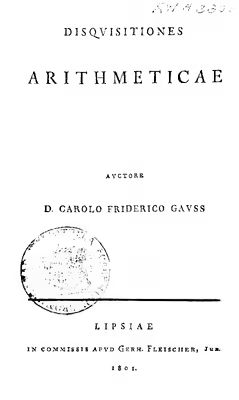
Article 16 of Gauss's Disquisitiones Arithmeticae seems to be the first proof of the uniqueness part of the theorem.
Sign in to keep reading
3 more chapters are free with a Lably account.
Applications
Canonical representation of a positive integer
Every positive integer n > 1 can be represented in exactly one way as a product of prime powers
where p1 < p2 < ... < pk are primes and the ni are positive integers. This representation is commonly extended to all positive integers, including 1, by the convention that the empty product is equal to 1 (the empty product corresponds to k = 0).
This representation is called the canonical representation of n, or the standard form of n. For example,
- 999 = 33×37,
- 1000 = 23×53,
- 1001 = 7×11×13.
Factors p0 = 1 may be inserted without changing the value of n (for example, 1000 = 23×30×53). In fact, any positive integer can be uniquely represented as an infinite product taken over all the positive prime numbers, as
where a finite number of the ni are positive integers, and the others are zero.
Allowing negative exponents provides a canonical form for positive rational numbers.
Arithmetic operations
The canonical representations of the product, greatest common divisor (GCD), and least common multiple (LCM) of two numbers a and b can be expressed simply in terms of the canonical representations of a and b themselves:
However, integer factorization, especially of large numbers, is much more difficult than computing products, GCDs, or LCMs, so these formulas have limited use in practice.
Arithmetic functions
Many arithmetic functions are defined using the canonical representation. In particular, the values of additive and multiplicative functions are determined by their values on the powers of prime numbers.
Proof
The proof of uniqueness uses Euclid's lemma (Elements VII, 30): If a prime divides the product of two integers, then it must divide at least one of these integers.
Existence
It must be shown that every integer greater than 1 is either prime or a product of primes. Let n be an integer greater than 1 and make the inductive assumption that every integer greater than 1 and less than n is either prime or a product of primes. If n is prime, there is nothing more to prove. Otherwise, there are integers a and b, where n = a b, and 1 < a ≤ b < n. By the inductive hypothesis, a = p1 p2 ⋅⋅⋅ pj and b = q1 q2 ⋅⋅⋅ qk are products of primes. But then n = a b = p1 p2 ⋅⋅⋅ pj q1 q2 ⋅⋅⋅ qk is a product of primes.
Uniqueness
Suppose, to the contrary, there is an integer that has two distinct prime factorizations. Let n be the least such integer and write n = p1 p2 ... pj = q1 q2 ... qk, where each pi and qi is prime. We see that p1 divides q1 q2 ... qk, so p1 divides some qi by Euclid's lemma. Without loss of generality, say p1 divides q1. Since p1 and q1 are both prime, it follows that p1 = q1. Returning to our factorizations of n, we may cancel these two factors to conclude that p2 ... pj = q2 ... qk. We now have two distinct prime factorizations of some integer strictly smaller than n, which contradicts the minimality of n.
Uniqueness without Euclid's lemma
The fundamental theorem of arithmetic can also be proved without using Euclid's lemma The proof that follows is inspired by Euclid's original version of the Euclidean algorithm.
Assume that is the smallest positive integer which is the product of prime numbers in two different ways. Incidentally, this implies that , if it exists, must be a composite number greater than . Now, say
Every must be distinct from every Otherwise, if say then there would exist some positive integer that is smaller than s and has two distinct prime factorizations. One may also suppose that by exchanging the two factorizations, if needed.
Setting and one has Also, since one has It then follows that
As the positive integers less than s have been supposed to have a unique prime factorization, must occur in the factorization of either or Q. The latter case is impossible, as Q, being smaller than s, must have a unique prime factorization, and differs from every The former case is also impossible, as, if is a divisor of it must be also a divisor of which is impossible as and are distinct primes.
Therefore, there cannot exist a smallest integer with more than a single distinct prime factorization. Every positive integer must either be a prime number itself, which would factor uniquely, or a composite that also factors uniquely into primes, or in the case of the integer , not factor into any prime.
Generalizations
The first generalization of the theorem is found in Gauss's second monograph (1832) on biquadratic reciprocity. This paper introduced what is now called the ring of Gaussian integers, the set of all complex numbers a + bi where a and b are integers. It is now denoted by He showed that this ring has the four units ±1 and ±i, that the non-zero, non-unit numbers fall into two classes, primes and composites, and that the composites have unique factorization as a product of primes (up to the order and multiplication by units).
Similarly, in 1844 while working on cubic reciprocity, Eisenstein introduced the ring , where is a cube root of unity (that is, ). This is the ring of Eisenstein integers, and he proved it has the six units and that it has unique factorization.
However, it was also discovered that unique factorization does not always hold. An example is given by . In this ring one has
Examples like this caused the notion of "prime" to be modified. In it can be proven that if any of the factors above can be represented as a product, for example, 2 = ab, then one of a or b must be a unit. This is the traditional definition of "prime". It can also be proven that none of these factors obeys Euclid's lemma; for example, 2 divides neither nor even though it divides their product 6. In algebraic number theory 2 is called irreducible in (only divisible by itself or a unit) but not prime in (if it divides a product it must divide one of the factors). The mention of is required because 2 is prime and irreducible in Using these definitions it can be proven that in any integral domain a prime must be irreducible. Euclid's classical lemma can be rephrased as "in the ring of integers every irreducible is prime". This is also true in and but not in
The rings in which factorization into irreducibles is essentially unique are called unique factorization domains. Important examples are polynomial rings over the integers or over a field, Euclidean domains and principal ideal domains.
In 1843 Kummer introduced the concept of ideal number, which was developed further by Dedekind (1876) into the modern theory of ideals, special subsets of rings. Multiplication is defined for ideals, and the rings in which they have unique factorization are called Dedekind domains.
There is a version of unique factorization for ordinals, though it requires some additional conditions to ensure uniqueness.
Any commutative Möbius monoid satisfies a unique factorization theorem and thus possesses arithmetical properties similar to those of the multiplicative semigroup of positive integers. Fundamental Theorem of Arithmetic is, in fact, a special case of the unique factorization theorem in commutative Möbius monoids.