

Gothic architecture
Architectural style of Medieval Europe
- 98 min read
- 23 chapters

Related on Lably
Through Europe, Renaissance and England
With the development of Renaissance architecture in Italy during the mid-15th century, the Gothic style was supplanted by the new style, but in some regions, notably England and what is now Belgium, Gothic continued to flourish and develop into the 16th century. A series of Gothic revivals began in mid-18th century England, spread through 19th century Europe and continued, largely for churches and university buildings, into the 20th century.
The Gothic style is particularly associated with church architecture, but it is also the architecture of many castles, palaces, town halls, guildhalls, universities and houses. Many of the finest examples of Gothic architecture are listed by UNESCO as World Heritage Sites.
Name
Medieval contemporaries characterised the style in Latin as opus Francigenum ("French work" or "Frankish work"), as opus modernum ("modern work"), or as novum opus ("new work"). Italian-speakers could call it maniera tedesca ("German style").
The term "Gothic architecture" originated as a pejorative description. Giorgio Vasari used the term "barbarous German style" in his Lives of the Artists (1550) to describe what is now considered the Gothic style, and in the introduction to the Lives he attributes various architectural features to the Goths, whom he held responsible for destroying the ancient buildings after they conquered Rome, and for erecting new ones in this style. When Vasari wrote, Italy had experienced a century of building in the Vitruvian architectural vocabulary of classical orders revived in the Renaissance and seen as evidence of a new Golden Age of learning and refinement. Thus the Gothic style, being in opposition to classical architecture, from that point of view was associated with the destruction of progress and of sophistication. The assumption that classical architecture was better than Gothic architecture was widespread and proved difficult to counter. Vasari was echoed in the 16th century by François Rabelais, who referred to "Gotz" and "Ostrogotz".
The polymath architect Christopher Wren (1632–1723) disapproved of the label "Gothic" for pointed architecture. He compared it to Islamic architecture, which he called the "Saracen style", pointing out that the pointed arch was not owed to the Goths but to Islam. Wren was one of the few to spread the belief that it was not the Europeans, but the "Saracens" who had originated the Gothic style, mentioning Europe's architectural debt to the Saracens no fewer than twelve times in his writings. He also decidedly broke with tradition in his assumption that Gothic architecture did not merely represent a violent and bothersome mistake (as Vasari had suggested). Rather, Wren saw that the Gothic style had developed over time along the lines of a changing society, and that it was thus a legitimate architectural style in its own right.
Wren believed that Europeans had first seen "Saracenic" pointed arches in the First Crusade, but this theory is now generally rejected, as pointed arches already existed in Europe by that date (for instance at Cluny Abbey, from 1089). Some have suggested that the pointed arch may have been derived from earlier Islamic contact, for instance in Sicily or Iberia. (Al-Andalus) This interpretation, however, is debated, as pointed arches are also attested in European architecture centuries before the rise of Islam, including the sixth-century Basilica of Sant'Apollinare in Classe at Ravenna.
Sign in to keep reading
22 more chapters are free with a Lably account.
Influences
The Gothic style of architecture was strongly influenced by the Romanesque architecture from which it evolved, the growing population and wealth of European cities, and the desire to express local grandeur. It was also influenced by theological doctrines, which called for more light, and by technical improvements in vaults and buttresses that allowed much greater height and larger windows. Practical influences included the necessity of many churches, such as Chartres Cathedral and Canterbury Cathedral, to accommodate growing numbers of pilgrims. Influences from Islamic architecture on individual features of Gothic architecture, particularly the pointed arch, have been proposed, with Sicily, Iberia and contact with the eastern Mediterranean suggested as possible routes of transmission. The extent and significance of such influence remain debated. Pointed arches were already employed in Romanesque Europe, including at Cluny Abbey by the late eleventh or early twelfth century, while pointed arches and flying buttresses are also documented in earlier Byzantine architecture. Gothic architecture as a distinct architectural system developed in northern France in the twelfth century from preceding Romanesque building traditions.
Romanesque influence
Romanesque architecture had a major influence upon Gothic architecture, encompassing much the same geographic area. The plan of the Gothic cathedral was based upon the plan of the ancient Roman basilica, which was adopted by Romanesque architecture. The Latin cross plan, with a nave and transept, choir, ambulatory, and radiating chapels, came from the Romanesque model. The common three-storey elevation of arcade, triforium and clerestory was also a continuation from Romanesque architecture. When churches were vaulted, Romanesque masons used round barrel vaults, and groin vaults when two barrel vaults met at right angles. Rib vaults began to be used in the late 11th century, in England and Normandy. One of the first high rib vaults was in the Norman Durham Cathedral (begun 1093). The earlier vaults in the transepts have rounded arches, while the nave vaults use pointed arches. However, the quadrant arches in the aisles at Durham, often held to be early flying buttresses, in fact have no role in abutting the high vault, instead carrying the aisle roofs. Lessay Abbey in Normandy also has early rib vaults, of a similar date to Durham's. Cefalù Cathedral (1131–1267) in Sicily, built by the Normans, combines pointed arches and large rib vaults with mosaic decoration. Several Romanesque churches had walls pierced by galleries and wide windows, in the manner later praised by Abbot Suger at Saint-Denis, such as Anselm's choir at Canterbury Cathedral and Reading Abbey.
Byzantine and Islamic influence
The pointed arch was not an Islamic invention: pointed or near-pointed arches and forms of external buttressing akin to flying buttresses were occasionally used in Late Roman and Byzantine architecture. A sixth-century Byzantine example is the apse arch of the Basilica of Sant'Apollinare in Classe at Ravenna, though the point on this arch is very slight and may not have been deliberate. Pointed arches, pointed groin vaults and flying-buttress-like structures were used in Byzantine baths, aqueducts and cisterns on Cyprus, for instance at the Chytroi-Constantia Aqueduct (dated to 631 AD) serving the city of Constantia. However, these were isolated uses of the pointed arch in a round-arched architectural tradition, and were generally restricted to utilitarian functions rather than being a major aesthetic feature. Pointed and parabolic arches were also used in Sasanian architecture.
Islamic architecture subsequently made extensive use of the pointed arch, particularly from the Umayyad and Abbasid periods onward. The innovation of Islamic architecture was to use the pointed arch as an aesthetic device; it has been suggested that this was in rejection of the semicircular arches of existing Christian architecture, for instance when accompanied by anti-Christian calligraphy at the Dome of the Rock. Some scholars have proposed that contact with Islamic architecture in Iberia, Sicily and the eastern Mediterranean contributed to the adoption or dissemination of the pointed arch in medieval Western Europe. The extent of such influence is debated. The pointed arch was already established in Romanesque architecture by the late eleventh and early twelfth centuries; Kenneth Conant and Jean Bony identified its use at Cluny Abbey (begun 1089), and attributed its spread in part to its structural advantages. Cluny was the most important monastery in Europe, with the largest church at that time, and a network of subordinate monasteries in the Cluniac Order, so it was natural that any innovations there would have a wide impact. Aside from the pointed arches, there are other features more explicitly derived from Islamic architecture at Cluny, such as horseshoe arches in the triforium. Possible Islamic influence at Cluny raises chronological challenges: the abbey church predates both the First Crusade and many of the Norman-Arab-Byzantine churches with pointed arches in Sicily, and Moorish architecture in Spain generally used horseshoe arches rather than pointed ones. Conant suggested Amalfi and Monte Cassino as possible points of contact, though this interpretation is not universally accepted.
Intersecting-rib domes were also constructed in medieval Islamic architecture, including at the Mosque–Cathedral of Córdoba. Their ribs, however, differed in construction and structural function from the structural rib vaults characteristic of Gothic architecture. Particular forms of intersecting-rib domes were subsequently adopted in parts of Romanesque and Gothic Europe through contacts with Islamic Spain and Sicily. This direct contact also produced buildings combining Romanesque or Gothic construction with Islamic decorative forms.
Similarities have also been observed between early medieval Armenian buildings (such as the Cathedral of Ani) and Gothic churches, including pointed arches and clustered piers. However, Armenian architecture is not widely considered to be a major influence on Gothic architecture. The proposed “proto-Gothic” character of the ogival arches of the cathedral of Ani has also been questioned, as these arches do not serve the same function in supporting the vault.
Periods
Gothic architecture began in the earlier 12th century near Paris and spread throughout Catholic Europe in the 12th and 13th centuries. By 1300, a first "International Style" of Gothic had developed, with common design features and formal language. A second "international style" emerged by 1400, alongside innovations in England and central Europe that produced both the Perpendicular and Flamboyant varieties. Typically, these typologies are identified as:
- c. 1130 – c. 1240 Early to High Gothic and Early English
- c. 1240 – c.1350 Rayonnant and Decorated
- c. 1350 – c. 1500 Late Gothic: Flamboyant and Perpendicular
- c. 16th–18th century Gothic Survival
History
Early Gothic
Romanesque architecture on either side of the English Channel developed in parallel towards Early Gothic. Gothic features, such as the rib vault, had appeared in England, Sicily and Normandy in the 11th century. Rib-vaults were employed in some parts of the cathedral at Durham (1093–1133) and in Lessay Abbey in Normandy (1098). However, the first buildings to be considered fully Gothic are the royal funerary abbey of the French kings, the Abbey of Saint-Denis (1135–1144), and the archiepiscopal cathedral at Sens (1135–1164). They were the first buildings to systematically combine rib vaulting, buttresses, and pointed arches. Most of the characteristics of later Early English were already present in the lower chevet of Saint-Denis.
Saint-Denis was the work of the Abbot Suger, a close adviser of Kings Louis VI and Louis VII. Suger reconstructed portions of the old Romanesque church with the rib vault in order to remove walls and to make more space for windows. He described the new ambulatory as "a circular ring of chapels, by virtue of which the whole church would shine with the wonderful and uninterrupted light of most luminous windows, pervading the interior beauty." To support the vaults he also introduced columns with capitals of carved vegetal designs, modelled upon the classical columns he had seen in Rome. In addition, he installed a circular rose window over the portal on the façade. These also became a common feature of Gothic cathedrals.
Sens Cathedral was influential in its strongly vertical appearance and in its three-part elevation, typical of subsequent Gothic buildings, with a clerestory at the top supported by a triforium, all carried on high arcades of pointed arches. In the following decades flying buttresses began to be used, allowing the construction of lighter, higher walls. French Gothic churches were heavily influenced both by the ambulatory and side-chapels around the choir at Saint-Denis, and by the paired towers and triple doors on the western façade.
Sens was quickly followed by Senlis Cathedral (begun 1160), and Notre-Dame de Paris (begun 1160). Their builders abandoned the traditional plans and introduced the new Gothic elements from Saint-Denis. The builders of Notre-Dame went further by introducing the flying buttress, heavy columns of support outside the walls connected by arches to the upper walls. The buttresses counterbalanced the outward thrust from the rib vaults. This allowed the builders to construct higher, thinner walls and larger windows.
The Duchy of Normandy, part of the Angevin Empire until the 13th century, developed its own version of Gothic. One of these was the Norman chevet, a small apse or chapel attached to the choir at the east end of the church, which typically had a half-dome. The lantern tower was another common feature in Norman Gothic. Lisieux Cathedral was begun in 1170. Rouen Cathedral (begun 1185) was rebuilt from Romanesque to Gothic with distinct Norman features, including a lantern tower, deeply moulded decoration, and high pointed arcades. Coutances Cathedral was remade into Gothic beginning about 1220. Its most distinctive feature is the octagonal lantern on the crossing of the transept, decorated with ornamental ribs, and surrounded by sixteen bays and sixteen lancet windows.
Some elements of Gothic style appeared very early in England. Durham Cathedral was the first cathedral to employ a rib vault, built between 1093 and 1104. The first cathedral built entirely in the new style was Sens Cathedral, begun between 1135 and 1140 and consecrated in 1160. Sens Cathedral features a Gothic choir, and six-part rib vaults over the nave and collateral aisles, alternating pillars and doubled columns to support the vaults, and buttresses to offset the outward thrust from the vaults. One of the builders who is believed to have worked on Sens Cathedral, William of Sens, later travelled to England and became the architect who, between 1175 and 1180, reconstructed the choir of Canterbury Cathedral in the new Gothic style.
Early English and High Gothic
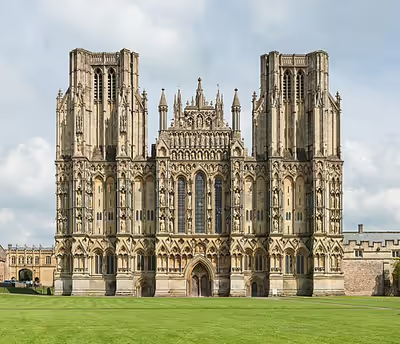
Following the destruction by fire of the choir of Canterbury Cathedral in 1174, a group of master builders was invited to propose plans for the reconstruction. The master-builder William of Sens, who had worked on Sens Cathedral, won the competition. Work began that same year, but in 1178 William was badly injured by falling from the scaffolding, and returned to France, where he died. His work was continued by William the Englishman who replaced his French namesake in 1178. The resulting structure of the choir of Canterbury Cathedral is considered the first work of Early English Gothic. The cathedral churches of Worcester (1175–), Wells (c.1180–), Lincoln (1192–), and Salisbury (1220–) are all, with Canterbury, major examples. Tiercerons – decorative vaulting ribs – seem first to have been used in vaulting at Lincoln Cathedral, installed c.1200. Instead of a triforium, Early English churches usually retained a gallery.
High Gothic (c. 1194–1250) was a brief but very productive period, which produced some of the great landmarks of Gothic art. The first building in the High Gothic (referred to as Classic Gothic in France) was Chartres Cathedral, an important pilgrimage church south of Paris. The Romanesque cathedral was destroyed by fire in 1194, but was swiftly rebuilt in the new style, with contributions from King Philip II of France, Pope Celestine III, local gentry, merchants, craftsmen, and Richard the Lionheart, king of England. The builders simplified the elevation used at Notre Dame, eliminated the tribune galleries, and used flying buttresses to support the upper walls. The walls were filled with stained glass, mainly depicting the story of the Virgin Mary but also, in a small corner of each window, illustrating the crafts of the guilds who donated those windows.
The model of Chartres was followed by a series of new cathedrals of unprecedented height and size. These were Reims Cathedral (begun 1211), where coronations of the kings of France took place; Amiens Cathedral (1220–1226); Bourges Cathedral (1195–1230) (which, unlike the others, continued to use six-part rib vaults); and Beauvais Cathedral (1225–).
In central Europe, the High Gothic style appeared in the Holy Roman Empire, first at Toul (1220–), whose Romanesque cathedral was rebuilt in the style of Reims Cathedral; then Trier's Liebfrauenkirche parish church (1228–), and then throughout the Reich, beginning with the Elisabethkirche at Marburg (1235–) and the cathedral at Metz (c.1235–).
In High Gothic, the whole surface of the clerestory was given over to windows. At Chartres Cathedral, plate tracery was used for the rose window, but at Reims the bar-tracery was free-standing. Lancet windows were supplanted by multiple lights separated by geometrical bar-tracery. Tracery of this kind distinguishes Middle Pointed style from the simpler First Pointed. Inside, the nave was divided into by regular bays, each covered by a quadripartite rib vaults.
Other characteristics of the High Gothic were the development of rose windows of greater size, using bar-tracery, higher and longer flying buttresses, which could reach up to the highest windows, and walls of sculpture illustrating biblical stories filling the façade and the fronts of the transept. Reims Cathedral had two thousand three hundred statues on the front and back side of the façade.
The new High Gothic churches competed to be the tallest, with increasingly ambitious structures lifting the vault yet higher. Chartres Cathedral's height of 38 m (125 ft) was exceeded by Beauvais Cathedral's 48 m (157 ft), but on account of the latter's collapse in 1248, no further attempt was made to build higher. Attention turned from achieving greater height to creating more awe-inspiring decoration.
Rayonnant and Decorated
Rayonnant Gothic maximized the coverage of stained glass windows such that the walls are effectively entirely glazed; examples are the nave of Saint-Denis (1231–) and the royal chapel of Louis IX of France on the Île de la Cité in the Seine – the Sainte-Chapelle (c.1241–1248). The high and thin walls of French Rayonnant Gothic allowed by the flying buttresses enabled increasingly ambitious expanses of glass and decorated tracery, reinforced with ironwork. Shortly after Saint-Denis, in the 1250s, Louis IX commissioned the rebuilt transepts and enormous rose windows of Notre-Dame de Paris (1250s for the north transept, 1258 for the beginning of south transept). This first 'international style' was also used in the clerestory of Metz Cathedral (c. 1245–), then in the choir of Cologne's cathedral (c. 1250–), and again in the nave of the cathedral at Strasbourg (c. 1250–). Masons elaborated a series of tracery patterns for windows – from the basic geometric to the reticulated and the curvilinear – which had superseded the lancet window. Bar-tracery of the curvilinear, flowing, and reticulated types distinguish Decorated style.
Decorated Gothic similarly sought to emphasize the windows, but excelled in the ornamentation of their tracery. Churches with features of this style include Westminster Abbey (1245–), the cathedrals at Lichfield (after 1257–) and Exeter (1275–), Bath Abbey (1298–), and the retro choir at Wells Cathedral (c.1320–).
The Rayonnant developed its second 'international style' with increasingly autonomous and sharp-edged tracery mouldings apparent in the cathedral at Clermont-Ferrand (1248–), the papal collegiate church at Troyes, Saint-Urbain (1262–), and the west façade of Strasbourg Cathedral (1276–1439)). By 1300, there were examples influenced by Strasbourg in the cathedrals of Limoges (1273–), Regensburg (c. 1275–), and in the cathedral nave at York (1292–).
Late Gothic: Flamboyant and Perpendicular
Central Europe began to lead the emergence of a new, international Flamboyant style with the construction of a new cathedral at Prague (1344–) under the direction of Peter Parler. This model of rich and variegated tracery and intricate reticulated rib-vaulting was definitive in the Late Gothic of continental Europe, emulated not only by the collegiate churches and cathedrals, but by urban parish churches which rivalled them in size and magnificence. The minster at Ulm and other parish churches like the Heilig-Kreuz-Münster at Schwäbisch Gmünd (c.1320–), St Barbara's Church at Kutná Hora (1389–), and the Heilig-Geist-Kirche (1407–) and St Martin's Church (c.1385–) in Landshut are typical. Use of ogees was especially common.
The flamboyant style was characterised by the multiplication of the ribs of the vaults, with new purely decorative ribs, called tiercons and liernes, and additional diagonal ribs. One common ornament of flamboyant in France is the arc-en-accolade, an arch over a window topped by a pinnacle, which was itself topped with fleuron, and flanked by other pinnacles. Examples of French flamboyant building include the west façade of Rouen Cathedral, and especially the façades of Sainte-Chapelle de Vincennes (1370s) and choir Mont-Saint-Michel's abbey church (1448). Lacy patterns of tracery continued to characterize continental Gothic building, with very elaborate and articulated vaulting, as at Saint Barbara's, Kutná Hora (1512).
In England, ornamental rib-vaulting and tracery of Decorated Gothic co-existed with, and then gave way to, the Perpendicular style from the 1320s, with straightened, orthogonal tracery topped with fan-vaulting. Perpendicular Gothic was unknown in continental Europe and unlike earlier styles had no equivalent in Scotland or Ireland. It first appeared in the cloisters and chapter-house (c. 1332) of Old St Paul's Cathedral in London by William de Ramsey. The chancel of Gloucester Cathedral (c. 1337–1357) and its latter 14th century cloisters are early examples. Four-centred arches were often used, and lierne vaults seen in early buildings were developed into fan vaults, first at the latter 14th century chapter-house of Hereford Cathedral (demolished 1769) and cloisters at Gloucester, and then at Reginald Ely's King's College Chapel, Cambridge (1446–1461) and the brothers William and Robert Vertue's Henry VII Chapel (c. 1503–1512) at Westminster Abbey. Perpendicular is sometimes called Third Pointed and was employed over three centuries; the fan-vaulted staircase at Christ Church, Oxford was built around 1640.
Specific features of Northern and Southern French Gothic
Angevin Gothic (mid-12th century – mid-13th century)
The emergence of the architecture known as Angevin Gothic occurred at the same time as that of Île-de-France (opus francigenum). It was linked to a particular political context, that of the height reached by the Plantagenet dynasty. Situated on the threshold of the Franco-English conflict, illustrated in its own way by the brilliant court of Poitou of Eleanor of Aquitaine and by the Battle of Poitiers, this province was, during the Gothic period, at the confluence of multiple influences, of which the Cathedral of Saint Peter of Poitiers, one of the lesser-known buildings of the first Gothic generation, constitutes an exemplary testimony. Angevin Gothic thus spread through Anjou, Touraine, Limousin, Poitou, Aquitaine, Maine and as far as the Kingdom of Naples and Sicily, where the House of Anjou-Sicily would rule for more than two centuries, from Charles I of Anjou in the 13th century to King René in the 15th century. Unlike Île-de-France, this architectural style is characterized by facades with a single portal. In most cases, single-nave buildings retain in their elevation the traditional principle of side aisles as high as the nave, thereby opening up the interior space and eliminating the galleries and the triforium. On the walls, the springings of the vaults were reduced to thin engaged columns with little projection. Sometimes, as in the nave of Le Mans Cathedral or in the Church of Notre-Dame de la Couture of Le Mans, statues marked the beginning of the ribs of the vaults, according to a decorative innovation known as "Angevin" which, in reality, denied the refined logic of the elevation of the earlier nave of Saint-Denis. As for the chevet of the churches, it almost never has flying buttresses: an example is the Cathedral of Saint Peter of Poitiers, whose chevet consists of a simple vertical wall about 50 metres high.
It is above all the vaults that distinguish Angevin Gothic. Emerging in the mid-12th century, its vaulting system constitutes a combination of influences from the Gothic revival (rib vault) and the Romanesque architecture of western France (churches with series of domes, such as the Cathedral of Saint-Front of Périgueux or the Cathedral of Saint Peter of Angoulême). The ribs have a robust profile, sometimes consisting of a flat surface between two tori, or, more rarely, a single very thick torus, as at Mareuil. Set over a simple plan close to a square, or covering a rectangular space, Angevin rib vaults have a very high profile, under the effect of the semicircle of the ribs inherited from Romanesque traditions (the keystone is situated approximately three metres above the transverse arches and wall arches), thus differing from the flatter vaults of Île-de-France (keystone at the same level as the transverse arches and wall arches). Their more vertical thrust means that they do not need to be braced by flying buttresses, with simple buttresses being sufficient. The rib vaults always have their diagonal arches subdivided by liernes, in order to obtain identical sectors. Thus Angevin vaults are, in most cases, framed with eight ribs radiating around a circular keystone. In this way, the stages of construction can be carried out without formwork, according to the dimensions. This type of vault with multiple ribs occurs, in Anjou, in about forty buildings. From the 13th century onwards, even more numerous and graceful ribs appear, terminating on tall round columns, as in the Saint-Serge Abbey of Angers.
Among the finest examples of Angevin vaults are the Cathedral of Saint Maurice of Angers, the collegiate church of Saint-Martin of Angers, the Collegiate Church of Saint-Martin of Candes and the former Saint John's Hospital in Angers, now the Jean-Lurçat Museum.
In Poitiers, Eleanor of Aquitaine had the magnificent "King's Hall" or "Hall of Lost Steps" built in the palace of the counts of Poitiers at the end of the 12th century. The definitive incorporation of the province into the French royal domain did not in any way put an end to the creativity of the master builders, but a new current emerged and became established, at least in the major buildings. The influence of Northern Gothic can already be felt in the attempt to raise the nave of Poitiers Cathedral and in the creation of the three sculpted portals of the facade, but the most common expressions of the introduction of the Île-de-France style are manifested in the appearance of Rayonnant tracery in the windows and of domed rib vaults. The remains of the patronage of the duke John of Berry bear witness to this; while, elsewhere in the province, a chain of medium-sized towns such as Loudun, Thouars, Bressuire, Parthenay and Fontenay-le-Comte rebuilt numerous churches in the Gothic style. Further south, powerful abbeys such as Charroux, Saint-Maixent, Maillezais and Notre-Dame des Fontenelles made extensive use, in the 13th–14th centuries, of the new architecture in the partial or total reconstruction of their abbey churches.
Among the religious buildings in the Angevin Gothic style in Naples are the Basilica of Santa Chiara, Naples, the Church of San Domenico Maggiore and the Basilica of San Lorenzo Maggiore.
Norman Gothic (late 12th century – early 13th century)
The Duchy of Normandy of the Plantagenets, with its Norman prelates, became associated very early with the Gothic movement, whose first example appears in the nave of Lisieux Cathedral (1167–1174). This precocity can be explained by the patron of the work, Bishop Arnulf of Lisieux. A prominent prelate, he discovered the architectural innovations of the emerging Gothic style when he travelled to the consecration of the Basilica of Saint-Denis, on 11 June 1144. His good relations with the Abbot Suger are likely to have contributed to his engaging a French master builder.
Following his victories over John Lackland, Philip Augustus annexed the territory to the French royal domain in 1204: the influence of Île-de-France Gothic art then rapidly appeared in military architecture. From Paris, the medieval Louvre Castle (transformed into the Louvre Palace during the French Renaissance) inspired not only the keeps of Rouen and Lillebonne, but also the Talbot keeps of Falaise and the Château de Gisors.
However, traditional Norman elements persisted in religious architecture, particularly in Lower Normandy, where it was generally limited to adapting the new architectural processes to buildings of the Romanesque period. Indeed, until the second quarter of the 12th century, a large number of churches had their naves covered by timber structures; they then received Gothic vaults over rib vaults. Inherited from this period, church plans frequently display considerable breadth, with a strongly projecting transept, while the use of a low-pitched vault type, framed by semicircular arches, produces such considerable weight that very thick walls are required.
The choir of the abbey church of Saint-Étienne of Caen was the first building constructed after the end of the duchy (1204). However, Norman survivals remain visible in the nave: the circulation gallery at the level of the upper windows and the width of the central nave are typically Norman. The reconstruction of the choir of Bayeux Cathedral (c. 1230) likewise respects this Norman tradition: very pointed pointed arches, tympana pierced with trefoils, archivolts, absence of statues and light.
The cloister of the Merveille at Mont Saint-Michel, rebuilt in the Norman architectural style, with circular capital abaci, voussoirs in Caen stone and vegetal motifs, was completed in 1228.
At Coutances, reconstruction of the nave preceded that of the choir (c. 1220–1235). These two parts of the building are Norman in style: the capitals with hollow circular abaci, the slender arches and their pronounced moulding are clear signs of resistance to the French Gothic style. Likewise, the lantern tower is a Norman characteristic. The regional style is also expressed in the cathedral's facade, which displays soaring vertical lines.
The eastern end of the choir of the Cathedral of Saint Peter of Lisieux, erected in the 13th century, likewise reveals a change from the nave in the Île-de-France style. The master builder, different from the one active in the time of Arnulf of Lisieux, imposed the Norman Gothic style: the columns forming the arcades are doubled, the abaci take a circular or polygonal form, and trefoils pierce the walls. Above all, the Gothic style appears much more developed and slender: a triforium replaces the false galleries of the nave, the arcades become narrower, the columns thinner, and the mouldings more refined.
In general, all Norman cathedrals are built according to the same plan, comprising a nave, simple aisles, a transept and radiating chapels opening onto the ambulatory. The Chapel of the Virgin, arranged on the axis of the church, is a small church attached to the larger one (the Trinity Abbey of Fécamp). Rural churches consist of a nave ending in a flat chevet, as can be found in England. The most striking characteristic of this architectural style is the very sharp break of the lancet arches, particularly in choirs, porches and bell towers, while rib vaults are almost always built over a rectangular plan. These arrangements would be retained in monuments of Rayonnant Gothic, to which Saint-Ouen of Rouen, Saint Peter of Caen (although the choir dates from the 16th century), belong, and in buildings of Flamboyant Gothic: Saint-Maclou of Rouen, Caudebec-en-Caux, Notre-Dame of Saint-Lô, the choir of the abbey church of Mont Saint-Michel, Saint-Jacques of Lisieux, Saint-Jacques of Dieppe, Notre-Dame of Alençon, and the two churches of Saint-Martin and Saint-Germain of Argentan.
The differences concern details of execution, such as the construction of side chapels between the buttresses of the nave or the lozenge-shaped piers with ribs continuing those of the nave, the double and double-flight flying buttresses (Saint-Ouen) or the five-pointed arch found in the 16th century in the piscina of Saint-Wandrille Abbey. What particularly characterizes the school of Normandy throughout all periods of Gothic are the bell towers, remarkable for the height of their spires and pinnacles; the finest spires are those of Saint-Étienne of Caen, Notre-Dame of Coutances, Bayeux, Secqueville-en-Bessin, Saint-Pierre-sur-Dives, Langrune, Bernières, and Saint Peter of Caen.
All these large churches have a common feature: from the intersection of the transept there almost always rises a highly open and frequently richly ornamented lantern tower. Although these lantern towers were widespread in Europe from the Romanesque period, it was truly with Norman and Anglo-Norman Gothic that they acquired greater scale and that their presence became more regular. Almost always conceived to be the tallest tower of the church, it surpasses in most cases the two spires of the western harmonic facade, although the state of completion of some buildings did not always allow this objective to be achieved (the upper part frequently being missing). In the 13th century, it is found in numerous Norman churches, such as Saint-Martin of Langrune-sur-Mer, Saint-Ouen of Rots, Notre-Dame of Étretat and Notre-Dame-des-Laboureurs of Norrey-en-Bessin, in numerous abbeys, including the Trinity Abbey of Fécamp and Saint-Pierre-sur-Dives, and in almost all the cathedrals of the province, such as the cathedral of Lisieux, that of Notre-Dame of Coutances, that of Rouen or that of Évreux. The Cathedral of Notre-Dame of Sées does not have one, but one was originally planned.
This architecture strongly influenced Gothic art in England, where the presence of a central tower constitutes the rule. It is also found in Spain, at the cathedral of Burgos, in Switzerland, at Lausanne Cathedral, and also in Scheldt Gothic of Flanders. In France, Picardy and Artois appear to have been regions particularly receptive to Norman influence, notably through the adoption of the flat chevet and the lantern tower at Notre-Dame of Laon, while the former cathedrals of Cambrai and Arras featured monumental designs with towers; in the case of Arras, a lantern tower at the transept crossing was planned but never completed.
Southern Gothic
Southern Gothic, also known as Toulouse Gothic or Languedoc Gothic, designates a current of Gothic architecture developed in the Midi of France, principally in the regions where Catharism developed and which had to undergo religious and military repression originating from the North. The regions concerned therefore correspond to the present-day departments of Haute-Garonne (Toulouse), Tarn (Albi), Tarn-et-Garonne, Ariège, Gers, Aude, Pyrénées-Orientales and Hérault. This original, austere and restrained Gothic style was conceived as a militant architecture, an important weapon of the Church in its struggle against Cathar dissent.
After the political eradication of the Cathar aristocracy during the Albigensian Crusade (1209–1229), it remained necessary to reconquer people's minds. In addition to the establishment of the Inquisition, the "reassertion of control" by the Catholic hierarchy gave rise to numerous constructions or reconstructions of religious buildings, but also of civil buildings. The Cathar clergy, including the "perfects", had strongly opposed the luxury of the Roman Catholic Church, and an architectural style more austere and restrained than that of the North of the Kingdom of France was therefore favoured.
Southern Gothic is characterized by an architectural expression marked by great austerity and strong wall-based construction. Buildings frequently take on a military and defensive appearance, with the use of buttresses instead of flying buttresses. Following the Cathar episode, the recovery of control over the faithful was pursued through preaching (hence the foundation, by Dominic de Guzmán, of the Order of Friars Preachers). For this purpose, the single nave was favoured, as it favours acoustics and places all the faithful under the preacher's gaze. The nave is flanked by side chapels, installed between the buttresses and surmounted by large narrow windows that allow limited illumination (examples: Cathedral of Saint Cecilia of Albi, Cathedral of Saint Fulcran of Lodève, Cathedral of Saint Peter of Montpellier). However, the presence of a single nave is not necessarily connected with this intention, and may result from other considerations or from the prior existence of a single nave. Conversely, the very wide nave of the Jacobins Convent of Toulouse is divided by a row of pillars, but nevertheless constitutes a single entity.
Many buildings of this style, however, have no side aisles and are covered by timber structures supported on diaphragm arches (Church of Notre-Dame of the Assumption, Gruissan).
The former nave (early 13th century) of Toulouse Cathedral marks the birth of Southern Gothic. Bishop Foulques conceived it as a monumental and spiritual challenge to Cathar dissent. Two fundamental structural elements then combine to define Toulouse Gothic: the single nave and the rib vault, involving the construction of a vault of unusual dimensions in the Midi (19 metres wide). The nave of Toulouse Cathedral also participates in the austerity inspired by Saint Bernard, characterized by the absence of sculpted decoration. From this innovative building, constructed between 1210 and 1220, of which three of the five original bays survive, developed the architectural experiments pursued in the convents of the mendicant orders of Toulouse, culminating in the Jacobins Convent of Toulouse and Albi Cathedral.
The church of the Jacobins convent of Toulouse was considered by Pope Urban V the most beautiful Dominican church in Christian Europe, to which he assigned the relics of the great Dominican thinker Thomas Aquinas in 1369. It measures 80 metres in length, 20 metres in width and 28 metres in height, creating an impressive interior volume. The difficulty of vaulting two bays of unequal width led, after 1275, to the installation of a row of cylindrical columns defining two identical naves in the straight bays of the apse. The insertion of a single polygonal apse into a two-bay church gave rise to a stellar vault whose complex organization anticipated Flamboyant Gothic by more than a century. Tradition designates this masterpiece by the name "palm tree", because the ribs burst from the smooth shaft of the column like palm fronds.
Albi Cathedral presents an exceptional character within Southern Gothic. Although, in essence, it corresponds to an expression of Gothic very different from that of the great cathedrals of the North (Chartres, Reims or Bourges), it nevertheless constitutes a unicum within its own family. The height of its vault, 30 metres, does not enable it to rival the giants of the North, such as Beauvais or Amiens (46 and 42 metres, respectively), but lies entirely within the average range of the great buildings of Rayonnant Gothic (32 metres at Strasbourg, 30 at Soissons and Auxerre, 28 at Rouen). These proportions, similar to those of Northern Gothic, distinguish Albi Cathedral from the principal churches of Southern Gothic. Indeed, no other span exceeds approximately sixty metres in length (cathedrals of Lavaur, Saint-Bertrand-de-Comminges, Lodève, Augustinians of Toulouse, Saint-Jacques of Montauban), with the exception of the Jacobins convent of Toulouse and Saint John the Baptist of Perpignan. The maximum height of the vaults of these churches reaches 28 metres at Saint-Bertrand-de-Comminges and the Jacobins, but the average height is between 20 and 25 metres (Notre-Dame de la Dalbade, the Augustinians of Toulouse, cathedrals of Lavaur, Lodève, churches of the lower town of Carcassonne). In short, it can be observed that the unique proportions of Saint Cecilia correspond to those of a great Northern Gothic cathedral applied to an architecture of Southern spirit.
As the entire construction preferentially uses local material, the Southern Gothic of the regions of Toulouse, Montauban and Albi relies predominantly on brick, which became one of its distinctive features. The builders used techniques adapted to this material, such as the mitre arch, characteristic of "Toulouse Gothic". Brick lends itself to geometric decorative compositions; conversely, there is little sculpture integrated into the architecture. Depending on the type of clay used, bricks may be moulded or rounded by abrasion. Some buildings use stone sparingly to create contrasts of colour. The neighbouring regions subject to this influence, but where stone predominates, frequently adopted the same architectural vocabulary.
Although the term Southern Gothic is applied essentially to buildings of worship, churches and cathedrals, the principles of its architecture can be found in buildings intended for other uses: sobriety of construction, absence or limitation of sculpted decoration, massive appearance and defensive elements. Examples include some private mansions and the Musée Saint-Raymond, in Toulouse, and the Palais de la Berbie in Albi.
Central Europe
There was an initial distrust in German-speaking countries regarding the new style coming from France. Since the time of Charlemagne, and later under the Ottonians and the Hohenstaufen, master builders of the western regions of the Empire — and particularly in the Rhine basin between Basel and Cologne — had developed an original architectural style of strong Romanesque matrix. The transition was slow, and initially buildings fused Gothic characteristics with elements that were still typically Romanesque, like Magdeburg Cathedral (1208) and Limburg Cathedral (1211–35). Fully-Gothic buildings began to appear in Germany in the 1230s, such as the Elisabethkirche, Marburg (begun 1235 or 1236) and the Liebfrauenkirche, Trier (c. 1233–83).
Amiens Cathedral was the source of inspiration for Gerhard, the architect of Cologne Cathedral. Begun in 1248, its conception was extremely ambitious: the vaults rise above 43 metres. The choir was consecrated in 1322, but work progressed very slowly, only being completed in 1880, to the original designs.
The lengthy construction of Strasbourg Cathedral (which at the time was a city of the Empire) followed the artistic vicissitudes linked to the penetration of the Gothic style. The 12th century reconstruction initially followed late Romanesque lines, but the introduction of Parisian masons in the mid-13th century heralded a change to the Rayonnant style, of which the Strasbourg workshop soon became an important centre. The Rayonnant west front at Strasbourg exhibits harpstring tracery covering walls and windows alike, giving an intense verticality. This taste for tall and slender forms is also noticeable in the mature Gothic Regensburg Cathedral (1285), and in the Sainte-Chapelle-inspired choir of Aachen Cathedral (begun in 1355).
Late German Gothic is distinguished by hall churches (Hallenkirchen), in which the aisles are the same height as the nave, so there is no clerestory. An example is the Wiesenkirche, Soest, built around 1330, which has a square plan in which the nave is not structurally separated from the choir, while the slender arcade piers rise straight to the vaults.
Brick Gothic
In the northern Hanseatic and Baltic cities (such as Northern Germany and Poland), the lack of local stone led to the creation of a Gothic style based on brick, called Backsteingotik (Brick Gothic). The builders combined this less easily-worked material with the elevation and lightness of French Gothic, simplifying its forms without sacrificing ornamentation. The main examples of this style include St. Mary's Church in Lübeck (1250–1350), St. Mary's Church in Gdańsk (1379–1502), St. Mary's Basilica in Kraków (1290–1365), and Malbork Castle (13th century). The style was not limited only to religious architecture: entire urban plans were laid out according to the Gothic style of the Hanseatic regions, with the construction of civil and public buildings, such as the Holstentor gate in Lübeck, and structures in Chorin, Prenzlau, and Stralsund. In eastern Germany, Poland and the Baltic, the style is particularly associated with the Teutonic Knights.
Swabia and Bohemia
In Swabia and Bohemia, the late Gothic is linked to the Parler family of masons. The patriarch was Heinrich I the Elder, whose descendants extended their artistic influence across a large part of Bohemia, in the German-Austrian area, reaching as far as Brabant and Flanders. Their works are characterised by complex articulation of walls and vaults, but are not similar enough to be considered a distinct style.
Heinrich Parler and his son Peter both worked at the parish church of the Holy Cross in Schwäbisch-Gmünd (1320), in Swabia, reviving the model of the hall church based on the simplicity of the mendicant orders, but with innovative solutions in the choir (begun in 1350).
Peter Parler, in particular, was one of the great protagonists of the Late Gothic. In 1356, he was summoned to Prague by Emperor Charles IV to complete St. Vitus Cathedral, begun in 1344 by the French architect Mathieu d'Arras. Charles had made Prague the capital of the Empire and wanted to expand it with an ambitious plan, which included a Gothic palace, Karlstejn Castle, and buildings for the new University of Prague.
While working on St. Vitus, Parler broke the fluid rhythm of the ambulatory, added the monumental square-plan chapel dedicated to Saint Wenceslas, and crowned the interiors with a pioneering net vault, suggesting an awareness of English Decorated developments. Parler also worked on the construction of the All Saints' Chapel on the Hradčany hill (using the Sainte-Chapelle as a model), the famous Charles Bridge over the Vltava (1357), the choir of Kolín (1360), and the Frauenkirche in Nuremberg.
Peter Parler's family members were active throughout Europe: Wenzel was architect of the cathedral of Vienna (1400–1404), Johann IV worked on the choir of Kutná Hora, and Heinrich III was at the construction site of Milan Cathedral in 1392. Many builders drew inspiration from them, such as Ulrich von Ensingen (who designed the enormous tower of Ulm Minster, begun in 1377, and worked on the facade of Strasbourg). At the end of the 14th century, the Parler style was also adapted to the brick churches of the north, as in Stargard and Brandenburg.
Flanders, Brabant, and the Netherlands
In the Middle Ages, present-day Belgium and the Netherlands were part of the sphere of artistic influence of the Diocese of Cologne and France. However, it is in civil and public architecture that the Gothic style of this region reached its apogee. From the late 13th century onwards, the area of Flanders and Brabant was at the centre of a very rich commercial and textile network. The opulence of the bourgeoisie favoured the development of civic life, which manifested itself in grandiose buildings decorated in ashlar masonry: the hallen (large markets and merchandise warehouses) and municipal palaces (town halls). To symbolise secular power, these civic buildings were endowed with towering belfries ('beffrois'), matching the scale of the great cathedrals.
The municipal palace of Aalst (1225) became the typological reference point, with its corner turrets and a continuous row of windows. The town halls of Bruges and Brussels present similar schemes, but with hyper-decorated facades, a taste for late-Gothic detail also visible in the palaces of Mons (1458), Ghent (1518), the daring palace of Leuven (1448), and the palace of Oudenaarde (1526–1536).
Brabantine Gothic was characterised by the use of pale sandstone or limestone (which allowed for very meticulous carved details), columns with capitals of stylised foliage (such as cabbage leaves), and sometimes timber ceilings or vaults due to unstable soil conditions. Notable examples include the Church of Our Lady of the Sablon in Brussels (15th century), the Cathedral of St. Michael and St. Gudula (also in Brussels, begun in the 13th century), and the Church of St. Bavo in Haarlem, Netherlands, famous for its monumental structural wooden Gothic ceiling (c. 1479).
Southern European Gothic
Italy
The Gothic style arrived late in Italy and failed to take deep root due to the strong classical tradition present in the peninsula. Italian Gothic architecture was deeply influenced by the geopolitics of its city-states and the materials available in different regions: marble was available in large quantities in Tuscany, being generously used for surface cladding, while its scarcity in Lombardy induced the systematic and autonomous use of brick. Many transalpine architectural elements were rejected or profoundly subverted, reflecting architectural choices associated with Italian urban traditions and a detachment from the Île-de-France cathedral model.
Thus, instead of dissolving the wall mass into an abstract structural system dominated by glass, Italian architecture preserved the mass and two-dimensionality of the wall, converting it into an abstract plane of chromatic effects and an iconographic support for frescoes. The persistence of architectural solutions distinct from French cathedrals should not be understood as passive resistance or technical delay, but as an expression of Italian political and institutional structures. The monumental architecture of urban communes, the papacy, and the empire developed their own languages that hardly aligned with the model of centralized territorial monarchies of northern Europe.
The Cistercian monastic order played an important role in the initial diffusion of Gothic solutions in Italy, transmitting above all their own interpretation of Burgundian Gothic rather than direct models of French cathedrals, as seen in the Fossanova Abbey (consecrated in 1208) and the Casamari Abbey (1203–1217). Although they followed the basic plan of Gothic Cistercian churches in Burgundy, particularly Cîteaux Abbey, Cister's transmission role was locally requalified. Its aesthetics were absorbed not as a typological replica of French cathedrals, but as a decisive step to organize in a linear and abstract way the static and heavy structures of the Italian basilical tradition.
Among the earliest examples of Gothic religious architecture is the Basilica of Saint Francis of Assisi (1228–1239). It is an extremely original building, to the point where it is impossible to recognize a specific model that served as a reference for the builders. The church has a simple structure, with a Latin cross plan devoid of side aisles and lacking the typical verticality of large French cathedrals. Furthermore, it features massive walls, following a model inherited from Roman and Romanesque architecture. These heavy walls were decorated with frescoes by Cimabue and Giotto, works that, in turn, strongly influenced later Italian painting. Romanesque elements are also present on the facade of the Church of San Francisco in Bologna, another of the earliest cult buildings constructed in the Gothic style. Its interior, however, shows a greater understanding of the Gothic, with its side aisles and an ambulatory equipped with radiating chapels.
The Basilica of Saint Francis would become a model for Italian Gothic, featuring vast wall surfaces that lent themselves to hosting important fresco cycles. This is a fundamental difference compared to large cathedrals in the rest of Europe, where the wall tended to thin out to be replaced by artistic stained glass. From the second half of the 13th century onwards, the mendicant orders also exercised a decisive influence on Italian architecture. Their churches, frequently located in expanding urban peripheries, adopted spatially vast and relatively simple solutions, prioritizing liturgical functionality and preaching, while assimilating construction characteristics specific to local traditions.
The Italian plan is generally regular and symmetric; cathedrals have few and widely spaced columns, which unify the interior space along the entrance-choir axis. Proportions are generally mathematically balanced, based on the square and the concept of armonia, and except in Venice—where extravagant arches of great decorative exuberance were appreciated—arches are almost always equilateral. Italian Gothic cathedrals frequently retained Romanesque features and conservative static choices. Also Gothic in style is the church of Santa Maria Novella in Florence, erected by the Dominicans, which features a lighter and airier structure. Founded in 1279, it is the best example of Italian Gothic from the second half of the 13th century, as well as one of the most original, given the scarce impact of French Gothic on its conception. Inside, the side aisles communicate directly with the central nave through wide arcades, generating a unitary space. The circular window rises over flat, bare walls, while the vault is very elevated, a feature that allowed the use of buttresses and flying buttresses to be dispensed with. A similar style is found in Santa Croce in Florence, the Franciscan church designed by Arnolfo da Cambio. In general, a certain reticence toward the Gothic can be observed in other cathedrals that emerged across the peninsula between the 13th and 14th centuries, such as in Siena and Orvieto, where Romanesque elements survived alongside the more typical features of the new style.
The cathedral of Santa Maria del Fiore, the see of Florence, was designed in 1296 by Arnolfo da Cambio. Italian cathedrals were not as tall as French ones; they rarely used flying buttresses and generally had only two levels—an arcade and a clerestory with small windows—maintaining the tectonic integrity of the wall. Inside Santa Maria del Fiore, the central nave and side aisles merge into a single, immense fluid space. Arnolfo's original design was later partially modified by Francesco Talenti, who took over direction of the works around 1350. A lively debate ensued, involving various masters, including sculptors, painters, and goldsmiths. The initial project also anticipated an imposing dome that no one was able to erect until the 15th century, at which point the complex technical problems were brilliantly solved by Filippo Brunelleschi—already entering the full Renaissance period. The bell tower ('campanile') of the cathedral, begun according to Giotto's design, continued by Andrea Pisano, and completed by Talenti, recovers a tradition typical of Florentine Romanesque yet distant from the Gothic. It presents an elegant square base and is adorned with marble decorations in rectilinear compartments. The transept crossing in Italian cathedrals is generally surmounted by an exposed octagonal dome, reinforcing the dialogue between the longitudinal system and the central head, while the bell tower and baptistery remained typologically independent structures.
The smallest notable Italian Gothic church is Santa Maria della Spina in Pisa (c. 1330), which exemplifies the exuberant explosion of the Late Gothic, resembling a Gothic jewelry box in which the decorative language overflows the modesty of the structures. On the other hand, the Basilica of Bologna (San Petronio, begun in 1388) adopted the hall church style (Hallenkirche) and rivaled the Bourges Cathedral in France in height.
In 14th-century Tuscany, a Gothic style very far from the Radiant style and extremely original spread, developing a rich decoration technique visible in both civil buildings and religious architecture. The masterpiece of this style is the facade of the Orvieto Cathedral, whose reconstruction began after 1290 from an ambitious project that still retained Romanesque traits. The nave of Orvieto Cathedral maintained the spirit of classical and paleochristian antiquity through solemn arcades and an original wooden ceiling, deliberately evoking the Roman basilica of Santa Maria Maggiore under the patronage and political ideology of the papacy. The sculpted polychrome decoration on the facade is due to the Sienese Lorenzo Maitani, who took over the direction of works starting in 1310.
A distinctive feature of Italian Gothic is the use of polychrome decoration, both externally (as marble cladding over brick facades) and internally, where arches and pillars are often made of alternating segments of light and dark stone. Italian church facades, often conceived as wall surfaces independent of the church body (such as Lombard "a vento" facades), feature open porches (protiros) and oculus or circular windows rather than complex rose windows. The eastern end generally features a relatively low and rectilinear projecting apse adapted to the urban scale. Although stained glass is frequently found, the primary narrative medium of the interior was the fresco, ceding the leading role in instructing the faithful to painting. Another innovation of Italian Gothic is the bronze door covered with sculptures (the most famous examples being the doors of the Florence Baptistery by Andrea Pisano (1330–1336)). Lacking the elaborate sculptural tympanums over entrances typical of French cathedrals, Italian architecture featured abundant realistic sculptural decoration integrated into the surface, notably the works of Nicola Pisano in the Baptistery of the Pisa Cathedral (1259–1260) and the Siena Cathedral, and of his son Giovanni Pisano on the western facade of the latter (1284–1285).
In Italy, the only attempt to build a cathedral that fully and coherently followed the canons of French Gothic was carried out at Milan's Duomo. The first project was prepared in 1387, followed by a debate among builders that assumed international proportions. Between 1387 and 1401, the Milanese requested assistance from masters from Campione, Bologna, Paris, and Germany. The works spanned centuries, and the cathedral was only completed in 1858. The entire structure conveys a sense of grandeur and solemnity, starting with the pink marbles that clad both the exterior and interior. The naves are delimited by pillars topped by edicule-shaped capitals housing statues.
Between the 12th and 15th centuries, numerous civil buildings inspired by the Gothic style also sprang up in many Italian cities, although they do not share the aspiration to verticality that characterizes the Gothic in France and other countries. This architectural flourishing was a direct consequence of the peninsula's prosperity, which at the time constituted the main financial center of Europe. This was combined with the strong civic identity asserted in each commune, where violent factional clashes for control of political power frequently broke out. One of the earliest examples was the Piazza del Campo in Siena, built starting in 1298. The square, with its celebrated fan shape, is dominated by the Palazzo Pubblico (1298–1348), seat of the municipal government, whose plan consists of a complex network of rooms and offices, many decorated with frescoes by celebrated artists. Rising above the palace is the Torre del Mangia. Florence's Palazzo Vecchio (1299–1314), seat of the Florentine government, retains the volumetry and characteristics of the defensive fortress it once was. Next to it stands the Loggia della Signoria, built around 1370, which already displays elements of transition to the Renaissance.
Particularly exquisite are the palaces built in southern Italy. Among them stands out the fortified palace commissioned by Frederick II at Castel del Monte (completed after 1250), with an octagonal plan where French Gothic elements merge with aspects of Roman ancestry. In northern Italy, on the other hand, the construction of military buildings continued, exemplified by the castles of Sirmione on the shores of Lake Garda and Fénis in the Aosta Valley. However, the most refined palaces of Italian medieval architecture are found in Venice, which in the 15th century was the most prosperous commercial city in the Mediterranean. The Doge's Palace, whose reconstruction began in the mid-14th century, acquired its current appearance in the 1420s. It features a two-tiered arcade gallery, topped by an upper body clad in white and pink marble slabs.
Spain
In contrast to other areas of Europe, cathedral building in Spain continued extensively into the later Middle Ages and beyond the end of the Gothic period, owing to the drawn-out Reconquista. Among the cathedrals planned at the beginning of the 15th century, the largest is Seville Cathedral (1401), designed with a five-aisled plan and chapels embedded directly into the exterior buttresses. The vaults rise to the level of the upper clerestory-style windows.
In 1469, the country achieved political unification as a result of the marriage between Ferdinand of Aragon and Isabella of Castile; in 1492, this was followed by the annexation of the Kingdom of Granada, until then the last Muslim domain, and in 1512 the Kingdom of Navarre was conquered. In the 16th century, Spain would become the hegemonic power of Europe, consolidated by the coronation of Charles V (Charles I of Spain) as Holy Roman Emperor. In the late 15th century, a new style called Isabelline thus spread, fusing the characteristics of Flamboyant Gothic with elements of Mudéjar affiliation and early Renaissance influxes.
One of the exponents of this period is the church of San Gil Abad in Burgos, where the Chapel of the Nativity of Mary (1529) uses squinches to convert the square plan into an octagonal one, crowned by a star vault with a central oculus. In the Chapel of the Sorrowful Mother, the curved liernes (tertiary ribs), typical of Iberian Late Gothic, stand out, while the Chapel of the Three Kings (1489) is characterized by its geometric complexity and highly ornamented vault bosses, reflecting the direct influence of the craftsmen of Burgos Cathedral.
Spanish Gothic from this phase resulted from close collaboration between local, German, Flemish, and French architects and artisans. Among the most prominent figures is Juan Guas, designer of San Juan de los Reyes in Toledo. This is a Franciscan convent endowed with unusual ornamental sumptuosity, filled with sculptural programs. The church, commissioned directly by the Catholic Monarchs, was intended to house the royal pantheon until the conquest of Granada (1492). Meanwhile Simón de Colonia designed the octagonal Capilla del Condestable (1482–1494) in Burgos Cathedral, crowned by complex spires and flamboyant tracery. The same architect later worked on the exuberant façade of the church of Saint Paul in Valladolid (1495–1505).
Kingdom of Castile
In the Iberian Peninsula, French Gothic elements were introduced by the Cistercians in the second half of the 12th century. The earliest examples were the monasteries of Veruela, Poblet, and Santes Creus. Ribbed vaults were very early applied inside buildings of still fully Romanesque matrix, such as the Portico of Glory of the Santiago de Compostela Cathedral or Zamora Cathedral, which would also influence the Collegiate Church of Santa María la Mayor in Toro. The Gothic style in the Iberian Peninsula presents surprisingly different variations from the rest of Europe, the result of a transitional period in which the end of the Romanesque alternated with rare expressions of pure Gothic.
In 1172, the French architect Giral Fruchel designed the territory's first Gothic cathedral, Ávila Cathedral in Castile, which represents precisely this fusion between Romanesque and Gothic. Inspired by the Basilica of Saint-Denis, King Alfonso VIII of Castile demanded for Ávila a plan with radiating chapels and a double ambulatory. Standing out within the cathedral are the unusual flying buttresses in the transept and nave, making it one of the earliest works of Gothic architecture in Spain. Among the first buildings to consistently employ Gothic style elements are the church of San Vicente and Ávila Cathedral itself, a cathedral-castle where battlements, machicolations, and watchtowers combine with its structure.
In the 13th century, however, fundamental historical-political shifts occurred with direct repercussions on Hispanic architecture. Muslims lost control of most of the peninsula: following the conquest of Seville in 1248, only the Kingdom of Granada remained under their domain. The kingdoms of Castile, Aragon, and later Mallorca asserted themselves, alongside the Kingdom of Portugal, as the new Iberian powers. It is precisely in this 13th century that the so-called Full Gothic (or High Gothic) arrived with full force through the pilgrimage routes of the Way of St. James, a time when the purest cathedrals, closely linked to French and German Gothic, were erected. These are fully manifested in the cathedrals of Toledo, Burgos, and León, located in the territories of the Kingdom of Castile.
The distinctive feature of the Iberian Peninsula's Gothic cathedrals is their spatial complexity, with many areas of different shapes interconnecting. They are comparatively wide and frequently feature very high arcades topped by low clerestories, giving them a spatiality similar to German hall churches. This chronological categorization is often preferable to stylistic classification, applying the qualifier "Gothic" with caution and favoring the term "low medieval".
The reconstruction of Toledo Cathedral, begun in 1227 by Archbishop Rodrigo Jiménez de Rada, was completed in the late 15th century. It exemplifies the richness of this period, erected over an old mosque and maintaining a plan that partially recalled the original Islamic structure; the fusion of French Gothic with local elements generated a unique style. It recovers some characteristics of Bourges Cathedral, featuring a double ambulatory and double side aisles of decreasing height. It differs, however, from its model due to its marked horizontal expansion, large bronze doors on the central portal, simple vaults, elaborate stonework with colored marbles, profuse decorations, and a transept that interrupts the continuity of the aisles. Some Mudéjar elements—typical of Hispano-Moorish Islamic architecture—are also integrated. An example of this is the ambulatory, where three- or five-lobed arches are found, surmounted by a larger arch; of Islamic root are also the decorations of the archivolts and rose windows located in that same area.
Burgos Cathedral is contemporary to Toledo's: begun around 1221, it underwent multiple subsequent alterations, and was completed and consecrated in 1260. It has a more homogeneous structure than Toledo's, incorporating pier arcades, clerestories, flying buttresses, and a large rose window, with the choir singularly positioned in the center of the nave rather than between the nave and the altar. The influence of French cathedrals is perfectly perceptible: the spaces are wide, abundantly lit, and approach the forms of Reims and Paris. Particularly original is the triforium which, as in Toledo, exhibits typical Hispano-Moorish influenced decorations. Also noteworthy are the German-influenced towers on the west facade (combining intricate ornamentation with broad flat surfaces), begun in 1444 by architect John of Cologne, and subsequently complemented by a central tower completed in 1540 by his grandson.
León Cathedral was supposedly begun around 1255. Its west facade typically resembles French facades, although it presents wider proportions relative to height. Its plan evokes that of Chartres Cathedral, while the ambulatory with five radial chapels and the transept endowed with side aisles were imported from Reims. The traceried triforium clearly approaches the Radiant Gothic, with a total absence of the Hispano-Moorish decorations observed in Toledo and Burgos. León Cathedral presents a very slender volumetry, typical of French Radiant Gothic, with its shafts and clustered colonnettes rising vertically to the vaults.
Many Iberian cathedrals are completely surrounded by chapels which, as in English cathedrals, are frequently stylistically diverse. In Oviedo Cathedral, the Chapter House (built between 1293 and 1314) exemplifies this diversity with its Aquitaine-Spanish group vaulting, using ribbed squinches to cover a square plan with an octagonal vault. The absence of an ambulatory in buildings such as Oviedo Cathedral—which differs from Bayonne and Pamplona in this aspect—was due to liturgical and functional reasons; if relics were kept in an independent building (such as the Holy Chamber), a peripheral ambulatory lost its meaning. Although León Cathedral is frequently proposed as a model for the new San Salvador of Oviedo, the latter's morphology reveals a closer relationship with Bayonne Cathedral, begun around 1310. The Gothic style also includes lower quality constructions of a more popular character, where technical crudeness conceals scholarly international models reinterpreted through popularization processes.
Catalonia, the Balearic Islands, and Valencia
Architectural development in this region is inseparable from its political, social, and territorial reality. The monarchy, consolidated from the time of Ramon Berenguer IV and the union with the Kingdom of Aragon, determined the guidelines of ecclesiastical architecture and allied with the urban bourgeoisie and merchant aristocracy, driving institutional growth and city urbanism.
During the first half of the 13th century, there was a stagnation of Romanesque forms and the maintenance of contacts with Italy and the Languedoc (Toulouse), especially in secondary centres of Old Catalonia. However, under the reign of James I (1213–1276), who redefined Catalan politics with the conquest of Mallorca and Valencia, the landscape changed profoundly:
In the final decades of the 13th century, new Gothic forms began to be introduced in major urban centres (Barcelona, Girona, Perpignan) and in newly reconquered cities from Islam (Lleida, Tarragona, Tortosa, Palma de Mallorca, Valencia), being superimposed upon pre-existing structures. Cathedrals and churches were built in the reconquered areas, such as Tarragona Cathedral, the old Lleida Cathedral and Sant Llorenç. The period was also marked by the construction activity of major Cistercian abbeys (Poblet, Santes Creus, and Vallbona de les Monges), friaries, and castles of the military orders, like the Templars' Peníscola.
The 13th-century building activity also included the expansion of Barcelona's city wall, remodelling of the Palau Reial Major, and the foundation of the drassanes (naval shipyards) by Peter III (1281). Added to this are the municipal palace of La Paeria in Lleida, the chapels of the Palais des Rois de Majorque in Perpignan, and rural and urban residences of the nobility, such as the castles of Maldà and Verdú.
In Catalonia, the Balearic Islands, and Valencia—territories then controlled by the Crown of Aragon, whose Mediterranean and urban expansion culminated in its apogee under the reigns of James II, Alfonso III, and above all Peter the Ceremonious (1336–1387)— very original characteristics developed between 1262 and 1393, inspired in part by the churches of the mendicant orders, whose strong urban presence dated back to the previous century, which privileged a single nave flanked by side chapels.
Among these, the most important is the church of Santa Maria del Pi in Barcelona (begun in 1322), in which the large unitary interior volume is punctuated by chapels inserted into the flanks. This parochial typology mirrors the great construction increase associated with the development of new urban neighborhoods in the 14th century, also visible in churches like Santa Maria del Mar and Sant Just i Pastor in Barcelona, Sant Feliu in Girona, Santa Maria de l'Aurora in Manresa, and the homonymous churches of Santa Maria in Castelló d'Empúries, Cervera, and Montblanc.
An identical spatial conception is found in multi-aisled structures, such as Barcelona Cathedral, begun in 1298, but completed only in the 19th century. The chapels are integrated into the load-bearing structure itself, making the dividing walls assume the function of internal buttresses. Furthermore, it features towering arcades, reducing upper windows to mere oculus openings. The central nave is covered by four large square vault bays, which discharge their weight onto the chapels, tribunes, and buttresses.
Simultaneously, Valencia Cathedral (13th to 15th centuries) developed following this regional tendency of ample spatiality, with the process of introducing Gothic forms beginning in the late 13th century over the structures of the recently reconquered city, later becoming in the 15th century one of the great centres of concentration of artistic and public resources after the extinction of the main line of the house of Barcelona.
Girona Cathedral, begun in 1312, shares similar traits with Toledo Cathedral, differing, however, in the elevation of the choir, which features ample windows and an open triforium over its large arcades. The reconstruction of this 14th-century cathedral replaced the earlier Romanesque structure, with the worksite counting on the collaboration of local masters, such as the Borrassà family, in producing its stained glass windows. In the 15th century, the structure was profoundly altered: architect Guillaume Boffy erected an immense single nave with powerful buttresses to support the vault, abutting it against the three aisles of the initial sanctuary. The transition and closure between the two sections were achieved through a frontal wall pierced by three large rose windows.
Palma Cathedral is particularly ambitious, with a large nave supported by many complex buttresses and flying buttresses. Construction began in the early 14th century over the urban space reconquered in the previous century by James I, and its chevet was completed in 1327, though the cathedral was not finished until the 17th century. The choir lacks an ambulatory and is lower than the nave, which has a two-storey elevation with soaring frestas and tall windows. The high vaults are supported by slender octagonal pillars. Contemporary with the cathedral is nearby Bellver Castle, commissioned for King James II of Aragon. It has a perfectly circular plan with the residential buildings accessed from a two-storey arcade. The body of the castle connects externally to the keep, also of circular plan.
The Gothic model of the region expanded strongly into civil architecture and major public works financed by municipalities (especially Barcelona's) and professional corporations. Outstanding examples include public palaces (the palaces of the Generalitat and the municipal palaces of Barcelona and Valencia), large merchant exchanges (Llotges of Barcelona, Palma, Perpignan, and Valencia), the expansions of Barcelona's drassanes, and hospitals such as Santa Creu. This civil and religious language would exert a direct influence on other Mediterranean areas, serving as a model for Castel Nuovo in Naples and Palazzo Bellomo in Syracuse.
Portugal
In contrast to the scale and monumentality of northern European cathedrals, Portuguese Gothic is characterized by restrained volumes, conditioned by local materials. As in Spain, Gothic exteriors were frequently blocky and fortress-like, lacking spires or steep roofs. The first to introduce the style were the 12th century Cistercian monks, in the Alcobaça Monastery (1178-1252), the country's first entirely Gothic building. It has a chevet, rib vaults and flying buttresses. Simultaneously, military orders played a decisive role in spreading the new architecture, as in the Church of Santa Maria do Olival and the round church in the Convent of Christ, both in Tomar (Templars). Évora Cathedral and the cloister of the Old Cathedral of Coimbra also belong to this initial phase. The spread of Gothic architecture was enabled by contacts with the western French coastline and dynastic relations with the House of Évreux, introducing models that linked Portugal and the Asturias to southwestern France. However, the transition between Romanesque and Gothic proceeded slowly, throughout the 13th and 14th centuries. Conservative features like plate tracery were used as late as the 14th century, for example at the Monastery of Odivelas (1295–1305). Santarém was the centre of this transitional style.
Cathedrals initiated in the Romanesque period, such as Porto and Lisbon, were completed or remodelled according to Gothic principles, frequently incorporating cloisters of Cistercian influence. Porto also has early flying buttresses. Only the Alcobaça Monastery, the Monastery of Santa Clara-a-Velha, Évora Cathedral, Guarda Cathedral and the Batalha Monastery are fully stone vaulted, with timber ceilings being more common in mendicant churches.
The full consolidation of the Gothic in the 14th century was driven by the establishment of mendicant friars in growing urban centres. Churches built or influenced by the friars were simple and austere, with unvaulted three-aisled plans, clerestory lighting over arcades, and projecting transepts with stone-vaulted apse chapels. Exemplifying this typology are Silves Cathedral and the convent of São Francisco of Porto. In nunnery churches, the nave was frequently divided into two sections, reserving the western sector for the nuns and the eastern one for the congregation, a layout that required the elimination of the western portal in favour of southern doors.
During the 14th century, the pace of construction reduced, being revitalised under João I (1385–1433), a phase termed Joanine Gothic. The primary monument of this period is Batalha Monastery (begun in 1387), the burial-place of the Aviz dynasty. The structure is eclectic, mixing Flamboyant Gothic features with a Perpendicular-influenced façade. The Founder's Chapel was added in 1434, followed by an octagonal funerary rotunda (the Unifinished Chapels) under King Duarte. The Batalha worksite was the centre of 15th- and 16th-century Portuguese architecture, gathering artists from across the kingdom. Its influence spread through masters trained at Batalha, who then designed buildings like the collegiate church of Guimarães, Guarda Cathedral and the Carmo Convent in Lisbon.
Manuel I (1495–1521) pushed the completion of the rotunda at Batalha, adding seven radial chapels and a monumental portal sculpted by Mateus Fernandes. His reign saw the Manueline style, a variant of Late Gothic fuelled by economic prosperity and the cultural context of the Age of Discovery. Manueline articulated the decorative exuberance of Late Gothic with a naturalist, heraldic, and maritime iconography. The paradigmatic expression of the style is the Chapter House window of the Convent of Christ in Tomar (1510–1514), designed by Diogo de Arruda. Other important examples include the Jerónimos Monastery and the Belém Tower in Lisbon. As well as the Manueline style, late Gothic architecture in Portugal included Mudéjar elements, as at Sintra Royal Palace.
Decline and transition
Beginning in the mid-15th century, the Gothic style gradually lost its dominance in Europe. It had never been popular in Italy, and in the mid-15th century the Italians, drawing upon ancient Roman ruins, returned to classical models. The dome of Florence Cathedral (1420–1436) by Filippo Brunelleschi, inspired by the Pantheon, Rome, was one of the first Renaissance landmarks, but it also employed Gothic technology; the outer skin of the dome was supported by a framework of twenty-four ribs. In the 16th century, as Renaissance architecture from Italy began to appear in France and other countries in Europe. The Gothic style began to be described as outdated, ugly and even barbaric. The term "Gothic" was first used as a pejorative description. Giorgio Vasari used the term "barbarous German style" in his 1550 Lives of the Artists to describe what is now considered the Gothic style. In the introduction to the Lives he attributed various architectural features to the Goths whom he held responsible for destroying the ancient buildings after they conquered Rome, and erecting new ones in this style. In the 17th century, Molière also mocked the Gothic style in the 1669 poem La Gloire: "...the insipid taste of Gothic ornamentation, these odious monstrosities of an ignorant age, produced by the torrents of barbarism..." The dominant styles in Europe became in turn Italian Renaissance architecture, Baroque architecture, and the grand classicism of the style Louis XIV.
The Kings of France had first-hand knowledge of the new Italian style, because of the military campaign of Charles VIII to Naples and Milan (1494), and especially the campaigns of Louis XII and François I (1500–1505) to restore French control over Milan and Genoa. They brought back Italian paintings, sculpture and building plans, and, more importantly, Italian craftsmen and artists. The Cardinal Georges d'Amboise, chief minister of Louis XII, built the Chateau of Gaillon near Rouen (1502–1510) with the assistance of Italian craftsmen. The Château de Blois (1515–1524) introduced the Renaissance loggia and open stairway. François I installed Leonardo da Vinci at his Chateau of Chambord in 1516, and introduced a Renaissance long gallery at the Palace of Fontainebleau in 1528–1540. In 1546 François I began building the first example of French classicism, the square courtyard of the Louvre Palace designed by Pierre Lescot.
Nonetheless, new Gothic buildings, particularly churches, continued to be built. New Gothic churches built in Paris in this period included Saint-Merri (1520–1552) and Saint-Germain l'Auxerrois. The first signs of classicism in Paris churches did not appear until 1540, at Saint-Gervais-Saint-Protais. The largest new church, Saint-Eustache (1532–1560), rivalled Notre-Dame in size, 105 m (344 ft) long, 44 m (144 ft) wide, and 35 m (115 ft) high. As construction of this church continued, elements of Renaissance decoration, including the system of classical orders of columns, were added to the design, making it a Gothic-Renaissance hybrid.
In Germany, some Italian elements were introduced at the Fugger Chapel of St. Anne's Church, Augsburg (1510–1512), combined with Gothic vaults; and others appeared in the Church of St. Michael in Munich, but in Germany Renaissance elements were used primarily for decoration. Some Renaissance elements also appeared in Spain, in the new palace begun by Emperor Charles V in Granada, within the Alhambra (1485–1550), inspired by Bramante and Raphael, but it was never completed. The first major Renaissance work in Spain was El Escorial, the monastery-palace built by Philip II of Spain.
Under Henry VIII and Elizabeth I, England was largely isolated from architectural developments on the continent. The first classical building in England was the Old Somerset House in London (1547–1552) (since demolished), built by Edward Seymour, 1st Duke of Somerset, who was regent as Lord Protector for Edward VI until the young king came of age in 1547. Somerset's successor, John Dudley, 1st Duke of Northumberland, sent the architectural scholar John Shute to Italy to study the style. Shute published the first book in English on classical architecture in 1570. The first English houses in the new style were Burghley House (1550s–1580s) and Longleat, built by associates of Somerset. With those buildings, a new age of architecture began in England.
Gothic architecture, usually churches or university buildings, continued to be built. Ireland was an island of Gothic architecture in the 17th and 18th centuries, with the construction of Derry Cathedral (completed 1633), Sligo Cathedral (c. 1730), and Down Cathedral (1790–1818) are other examples. In the 17th and 18th century several important Gothic buildings were constructed at Oxford University and Cambridge University, including Tom Tower (1681–82) at Christ Church, Oxford, by Christopher Wren.
Despite adopting the style when required by his clients, Wren strongly disliked the Gothic. When he was appointed Surveyor of the Fabric at Westminster Abbey in the year 1698, he expressed his distaste for the Gothic style in a letter to the Bishop of Rochester:
Nothing was thought magnificent that was not high beyond Measure, with the Flutter of Arch-buttresses, so we call the sloping Arches that poise the higher Vaultings of the Nave. The Romans always concealed their Butments, whereas the Normans thought them ornamental. These I have observed are the first Things that occasion the Ruin of Cathedrals, being so much exposed to the Air and Weather; the Coping, which cannot defend them, first failing, and if they give Way, the Vault must spread. Pinnacles are no Use, and as little Ornament.
— Christopher Wren, Parentalia
Nonetheless, Wren praised "Srarcenic" architecture for its "superior" vaulting techniques and widespread use of the pointed arch, which he knew to be more structurally efficient than the "Roman" rounded arch.
"Gothick", as it was often styled, also appeared, in a whimsical fashion, in Horace Walpole's Twickenham villa, Strawberry Hill (1749–1776). The two western towers of Westminster Abbey were constructed after 1722 by Nicholas Hawksmoor, opening a new period of Gothic Revival. Gothic architecture survived the early modern period and flourished again in a revival from the late 18th century and throughout the 19th. Perpendicular was the first Gothic style revived in the 18th century.
Rediscovery and revival
In England, partly in response to a philosophy propounded by the Oxford Movement and others associated with the emerging revival of 'high church' or Anglo-Catholic ideas during the second quarter of the 19th century, neo-Gothic began to become promoted by influential establishment figures as the preferred style for ecclesiastical, civic and institutional architecture. The appeal of this Gothic Revival (which after 1837, in Britain, is sometimes termed Victorian Gothic), gradually widened to encompass "low church" as well as "high church" clients. This period of more universal appeal, spanning 1855–1885, is known in Britain as High Victorian Gothic.
The Palace of Westminster in London by Sir Charles Barry with interiors by a major exponent of the early Gothic Revival, Augustus Welby Pugin, is an example of the Gothic revival style from its earlier period in the second quarter of the 19th century. Examples from the High Victorian Gothic period include George Gilbert Scott's design for the Albert Memorial in London, and William Butterfield's chapel at Keble College, Oxford. From the second half of the 19th century onwards, it became more common in Britain for neo-Gothic to be used in the design of non-ecclesiastical and non-governmental buildings types. Gothic details even began to appear in working-class housing schemes subsidised by philanthropy, though given the expense, less frequently than in the design of upper and middle-class housing.
The middle of the 19th century was a period marked by the restoration, and in some cases modification, of ancient monuments and the construction of neo-Gothic edifices such as the nave of Cologne Cathedral and the Sainte-Clotilde of Paris as speculation of mediaeval architecture turned to technical consideration. London's Palace of Westminster, St Pancras railway station, New York's Trinity Church and St Patrick's Cathedral are also famous examples of Gothic Revival buildings. The style also reached the Far East in the period, for instance the Anglican St John's Cathedral located at the centre of Victoria City in Central, Hong Kong.
Structural elements
Pointed arches
The defining characteristic of the Gothic style is the pointed arch, which was widely used in both structure and decoration. The pointed arch did not originate in Gothic architecture; they had been employed for centuries in the Near East in pre-Islamic as well as Islamic architecture for arches, arcades, and ribbed vaults. In Gothic architecture, particularly in the later Gothic styles, they became the most visible and characteristic element, giving a sensation of verticality and pointing upward, like the spires. Gothic rib vaults covered the nave, and pointed arches were commonly used for the arcades, windows, doorways, in the tracery, and especially in the later Gothic styles decorating the façades. They were also sometimes used for more practical purposes, such as to bring transverse vaults to the same height as diagonal vaults, as in the nave and aisles of Durham Cathedral, built in 1093.
The earliest Gothic pointed arches were lancet lights or lancet windows, which are narrow windows terminating in a lancet arch. A lancet arch has a radius longer than their breadth (width) and resembles the blade of a lancet. In the 12th-century First Pointed phase of Gothic architecture (also called the Lancet style) and before the introduction of tracery in the windows in later styles, lancet windows predominated Gothic building.
The Flamboyant style of Gothic architecture is particularly known for lavish pointed details such as the arc-en-accolade, where a pointed arch over a doorway was topped by a pointed sculptural ornament called a fleuron and by pointed pinnacles on either side. The arches of the doorway were further decorated with small cabbage-shaped sculptures called chou-frisés.
Rib vaults
The Gothic rib vault was one of the essential elements that made the great height and large windows of Gothic architecture possible. Unlike the semi-circular barrel vault of Roman and Romanesque buildings, where the weight pressed directly downward, and required thick walls and small windows, the Gothic rib vault was made of diagonal crossing arched ribs. These ribs directed the thrust outwards to the corners of the vault, and downwards via slender colonnettes and bundled columns, to the pillars and columns below. The space between the ribs was filled with thin panels of small pieces of stone, which were much lighter than earlier groin vaults. The outward thrust against the walls was countered by the weight of buttresses and later flying buttresses. As a result, the massive, thick walls of Romanesque buildings were no longer needed, as since the vaults were supported by columns and piers, the walls could be made thinner and higher, and filled with windows.
The earlier Gothic rib vaults, used at Sens Cathedral (begun between 1135 and 1140) and Notre-Dame de Paris (begun 1163), were divided by the ribs into six compartments. They were very difficult to build and could only cross a limited space. Since each vault covered two bays, they needed support on the ground floor from alternating columns and piers. In later construction, the design was simplified, and the rib vaults were divided into only four compartments. The alternating rows of alternating columns and piers receiving the vaults' weight were replaced by simple pillars, each receiving the same weight. A single vault could cross the nave. This method was used at Chartres Cathedral (1194–1220), Amiens Cathedral (begun 1220), and Reims Cathedral. The four-part vaults made it possible for taller buildings to be constructed. Notre-Dame, which had begun with six-part vaults, reached a height of 35 m (115 ft). Amiens Cathedral, which had begun with the newer four-part ribs, reached a height of 42.3 m (139 ft) at the transept.
Later vaults (13th–15th century)
In France, the four-part rib vault, with two diagonals crossing at the center of the traverse, was the type used almost exclusively until the end of the Gothic period. However, in England, several imaginative new vaults were invented which had more elaborate decorative features. They became a signature of the later English Gothic styles.
The first of these new vaults had an additional rib, called a tierceron, which ran down the median of the vault. It first appeared in the vaults of the choir of Lincoln Cathedral at the end of the 12th century, then at Worcester Cathedral in 1224, and then the south transept of Lichfield Cathedral.
The 14th century brought the invention of several new types of vaults which were more and more decorative. These vaults often copied the forms of the elaborate tracery of the Late Gothic styles. These included the stellar vault, where a group of additional ribs between the principal ribs forms a star design. The oldest vaults of this kind were found in the crypt of Saint Stephen at Westminster Palace, built about 1320. A second type was called a reticulated vault, which had a network of additional decorative ribs, in triangles and other geometric forms, placed between or over the traverse ribs. These were first used in the choir of Bristol Cathedral in about 1311. Another late Gothic form, the fan vault, with ribs spreading upwards and outwards, appeared later in the 14th century. An example is the cloister of Gloucester Cathedral (c. 1370).
Another new form was the skeleton vault, which appeared in the English Decorated style. It has an additional network of ribs, like the ribs of an umbrella, which criss-cross the vault but are only directly attached to it at certain points. It appeared in a chapel of Lincoln Cathedral in 1300. and then several other English churches. This style of vault was adopted in the 14th century in particular by German architects, particularly Peter Parler, and in other parts of central Europe. Another exists in the south porch of the Prague Cathedral
Elaborate vaults also appeared in civic architecture. An example is the ceiling of the Vladislav Hall in Prague Castle in Bohemia designed by Benedikt Ried in 1493. The ribs twist and intertwine in fantasy patterns, which later critics called "Rococo Gothic".
Columns and piers
In early French Gothic architecture, the capitals of the columns were modeled after Roman columns of the Corinthian order, with finely-sculpted leaves. They were used in the ambulatory of the Abbey church of Saint-Denis. According to its builder, the Abbot Suger, they were inspired by the columns he had seen in the ancient baths in Rome. They were used later at Sens, at Notre-Dame de Paris and at Canterbury in England.
In early Gothic churches with six-part rib vaults, the columns in the nave alternated with more massive piers to provide support for the vaults. With the introduction of the four-part rib vault, all of the piers or columns in the nave could have the same design. In the High Gothic period, a new form was introduced, composed of a central core surrounded several attached slender columns, or colonettes, going up to the vaults. These clustered columns were used at Chartres, Amiens, Reims and Bourges, Westminster Abbey and Salisbury Cathedral. Another variation was a quadrilobe column, shaped like a clover, formed of four attached columns. In England, the clustered columns were often ornamented with stone rings, as well as columns with carved leaves.
Later styles added further variations. Sometimes the piers were rectangular and fluted, as at Seville Cathedral, In England, parts of columns sometimes had contrasting colours, using combining white stone with dark Purbeck marble. In place of the Corinthian capital, some columns used a stiff-leaf design. In later Gothic, the piers became much taller, reaching up more than half of the nave. Another variation, particularly popular in eastern France, was a column without a capital, which continued upward without capitals or other interruption, all the way to the vaults, giving a dramatic display of verticality.
Flying buttresses
An important feature of Gothic architecture was the flying buttress, a half-arch outside the building which carried the thrust of weight of the roof or vaults inside over a roof or an aisle to a heavy stone column. The buttresses were placed in rows on either side of the building, and were often topped by heavy stone pinnacles, both to give extra weight and for additional decoration.
Buttresses had existed since Roman times, usually set directly against the building, but the Gothic vaults were more sophisticated. In later structures, the buttresses often had several arches, each reaching in to a different level of the structure. The buttresses permitted the buildings to be both taller, and to have thinner walls, with greater space for windows.
Over time, the buttresses and pinnacles became more elaborate supporting statues and other decoration, as at Beauvais Cathedral and Reims Cathedral. The arches had an additional practical purpose; they contained lead channels which carried rainwater off the roof; it was expelled from the mouths of stone gargoyles placed in rows on the buttresses.
Flying buttresses were used less frequently in England, where the emphasis was more on length than height. One example of English buttresses was Canterbury Cathedral, whose choir and buttresses were rebuilt in Gothic style by William of Sens and William the Englishman. However, they were very popular in Germany: in Cologne Cathedral the buttresses were lavishly decorated with statuary and other ornament, and were a prominent feature of the exterior.
Towers and spires
Towers, spires and flèches were an important feature of Gothic churches. They presented a dramatic spectacle of great height, helped make their churches the tallest and most visible buildings in their city, and symbolised the aspirations of their builders toward heaven. They also had a practical purpose; they often served as bell towers supporting belfries, whose bells told the time by announcing religious services, warned of fire or enemy attack, and celebrated special occasions like military victories and coronations. Sometimes the bell tower is built separate from a church; the best-known example of this is the Leaning Tower of Pisa.
The towers of cathedrals were usually the last part of the structure to be built. Many projected towers were never built, or were built in different styles to other parts of the cathedral, or with different styles on each level of the tower. At Chartres Cathedral, the south tower was built in the 12th century, in the simpler Early Gothic, while the north tower is the more highly decorated Flamboyant style. Chartres would have been even more exuberant if the second plan had been followed; it called for seven towers around the transept and sanctuary.
In the Île-de-France, cathedral towers followed the Romanesque tradition of two identical towers, one on either side of the portals. The west front of the Saint-Denis, became the model for the early Gothic cathedrals and High Gothic cathedrals in northern France, including Notre-Dame de Paris, Reims Cathedral, and Amiens Cathedral.
Laon Cathedral has a square lantern tower over the crossing of the transept; two towers on the western front; and two towers on the ends of the transepts. Laon's towers, with the exception of the central tower, are built with two stacked vaulted chambers pierced by lancet openings. The two western towers contain life-size stone statues of sixteen oxen in their upper arcades, said to honour the animals who hauled the stone during the cathedral's construction.
In Normandy, cathedrals and major churches often had multiple towers, built over the centuries; the Abbaye aux Hommes, Caen (begun 1066) has nine towers and spires, placed on the façade, the transepts, and the centre. A lantern tower was often placed at the crossing, to give light to the centre of the church.
Pointed spires were often added to the towers, giving them much greater height. A variation of the spire was the flèche, a slender, spear-like spire, which was usually placed on the transept where it crossed the nave. They were often made of wood covered with lead or other metal. They sometimes had open frames, and were decorated with sculpture. Amiens Cathedral has a flèche. The most famous example was that of Notre-Dame de Paris. The original flèche of Notre-Dame was built on the crossing of the transept in the middle of the 13th century, and housed five bells, but was removed in 1786.
In English Gothic, the major tower was often placed at the crossing of the transept and nave, and was much higher than the others. The most famous example is the tower of Salisbury Cathedral, completed in 1320 by William of Farleigh and built upon the 13th century pillars. The 14th century central tower at Wells Cathedral was too heavy for the supporting structure; William Joy constructed scissor arches in the crossing to give the tower additional support. A crossing tower was constructed at Canterbury Cathedral in 1493–1501 by John Wastell.
England's Gothic parish churches generally have a single western tower. A number have masonry spires, with those of St James Church, Louth; St Wulfram's Church, Grantham; St Mary Redcliffe in Bristol; and Coventry Cathedral all exceeding 85 m (280 ft) in height. From c. 1400, spires were often omitted, following the example of St Cuthbert's Church, Wells, designed by William Wynford.
Later Gothic towers in Central Europe often followed the French model, but added even denser decorative tracery. Openwork spires were common, but over-ambitious height meant that construction was often very protracted: Cologne Cathedral and Ulm Minster were both abandoned in the 16th century, and not completed until the 19th century. Burgos Cathedral in Spain was inspired by Germany. It has an exceptional cluster of openwork spires, towers, and pinnacles, drenched with ornament. It was begun in 1444 by a German architect, Juan de Colonia (John of Cologne) and eventually completed by a central tower (1540) built by his grandson.
In Italy the towers were sometimes separate from the cathedral; and the architects usually kept their distance from the Northern European style. the leaning tower of Pisa Cathedral, built between 1173 and 1372, is the best-known example. The Campanile of Florence Cathedral was built by Giotto in the Florentine Gothic style, decorated with encrustations of polychrome marble. It was originally designed to have a spire.
Tracery
Tracery is an architectural solution by which windows (or screens, panels, and vaults) are divided into sections of various proportions by stone bars or ribs of moulding. Pointed arch windows of Gothic buildings were initially (late 12th–late 13th centuries) lancet windows, a solution typical of the Early Gothic or First Pointed style and of the Early English Gothic. Plate tracery was the first type of tracery to be developed, emerging in the later phase of Early Gothic or First Pointed. Second Pointed is distinguished from First by the appearance of bar–tracery, allowing the construction of much larger window openings, and the development of Curvilinear, Flowing, and Reticulated tracery, ultimately contributing to the Flamboyant style. Late Gothic in most of Europe saw tracery patterns resembling lace develop, while in England Perpendicular Gothic or Third Pointed preferred plainer vertical mullions and transoms. Tracery is practical as well as decorative, because the increasingly large windows of Gothic buildings needed maximum support against the wind.
Plate tracery, in which lights were pierced in a thin wall of ashlar, allowed a window arch to have more than one light – typically two side by side and separated by flat stone spandrels. The spandrels were then sculpted into figures like a roundel or a quatrefoil. Plate tracery reached the height of its sophistication with the 12th century windows of Chartres Cathedral and in the "Dean's Eye" rose window at Lincoln Cathedral.
At the beginning of the 13th century, plate tracery was superseded by bar-tracery. Bar-tracery divides the large lights from one another with moulded mullions. Stone bar-tracery, an important decorative element of Gothic styles, first was used at Reims Cathedral shortly after 1211, in the chevet built by Jean D'Orbais. It was employed in England around 1240. After 1220, master builders in England had begun to treat the window openings as a series of openings divided by thin stone bars, while before 1230 the apse chapels of Reims Cathedral were decorated with bar-tracery with cusped circles (with bars radiating from the centre). Bar-tracery became common after c. 1240, with increasing complexity and decreasing weight. The lines of the mullions continued beyond the tops of the window lights and subdivided the open spandrels above the lights into a variety of decorative shapes. Rayonnant style (c. 1230 – c. 1350) was enabled by the development of bar-tracery in Continental Europe and is named for the radiation of lights around a central point in circular rose windows. Rayonnant also deployed mouldings of two different types in tracery, where earlier styles had used moulding of a single size, with different sizes of mullions. The rose windows of Notre-Dame de Paris (c.1270) are typical.
The early phase of Middle Pointed style (late 13th century) is characterized by Geometrical tracery – simple bar-tracery forming patterns of foiled arches and circles interspersed with triangular lights. The mullions of Geometrical style typically had capitals with curved bars emerging from them. Intersecting bar-tracery (c.1300) deployed mullions without capitals which branched off equidistant to the window-head. The window-heads themselves were formed of equal curves forming a pointed arch and the tracery-bars were curved by drawing curves with differing radii from the same centres as the window-heads. The mullions were in consequence branched into Y-shaped designs further ornamented with cusps. The intersecting branches produced an array of lozenge-shaped lights in between numerous lancet arched lights.Y-tracery was often employed in two-light windows c.1300.
Second Pointed (14th century) saw Intersecting tracery elaborated with ogees, creating a complex reticular (net-like) design known as Reticulated tracery. Second Pointed architecture deployed tracery in highly decorated fashion known as Curvilinear and Flowing (Undulating). These types of bar-tracery were developed further throughout Europe in the 15th century into the Flamboyant style, named for the characteristic flame-shaped spaces between the tracery-bars. These shapes are known as daggers, fish-bladders, or mouchettes.
Third Pointed or Perpendicular Gothic developed in England from the later 14th century and is typified by Rectilinear tracery (panel-tracery). The mullions are often joined by transoms and continue up their straight vertical lines to the top of the window's main arch, some branching off into lesser arches, and creating a series of panel-like lights. Perpendicular strove for verticality and dispensed with the Curvilinear style's sinuous lines in favour of unbroken straight mullions from top to bottom, transected by horizontal transoms and bars. Four-centred arches were used in the 15th and 16th centuries to create windows of increasing size with flatter window-heads, often filling the entire wall of the bay between each buttress. The windows were themselves divided into panels of lights topped by pointed arches struck from four centres. The transoms were often topped by miniature crenellations. The windows at Cambridge of King's College Chapel (1446–1515) represent the heights of Perpendicular tracery.
Tracery was used on both the interior and exterior of buildings. It frequently covered the façades, and the interior walls of the nave and choir were covered with blind arcades. It also often picked up and repeated the designs in the stained glass windows. Strasbourg Cathedral has a west front lavishly ornamented with bar tracery matching the windows.
Elements of Romanesque and Gothic architecture compared
Plans
The plan of Gothic cathedrals and churches was usually based on the Latin cross (or "cruciform") plan, taken from the ancient Roman Basilica, and from the later Romanesque churches. They have a long nave making the body of the church, where the parishioners worshipped; a transverse arm called the transept and, beyond it to the east, the choir, also known as a chancel or presbytery, that was usually reserved for the clergy. The eastern end of the church was rounded in French churches, and was occupied by several radiating chapels, which allowed multiple ceremonies to go on simultaneously. In English churches the eastern end also had chapels, but was usually rectangular. A passage called the ambulatory circled the choir. This allowed parishioners, and especially pilgrims, to walk past the chapels to see the relics displayed there without disturbing other services going on.
Each vault of the nave formed a separate cell, with its own supporting piers or columns. The early cathedrals, like Notre-Dame, had six-part rib vaults, with alternating columns and piers, while later cathedrals had the simpler and stronger four-part vaults, with identical columns.
Following the model of Romanesque architecture and the Basilica of Saint Denis, cathedrals usually had two towers flanking the west façade. Towers over the crossing were common in England (Salisbury Cathedral, York Minister) but rarer in France.
Transepts were usually short in early French Gothic architecture, but became longer and were given large rose windows in the Rayonnant period. The choirs became more important. The choir was often flanked by a double disambulatory, which was crowned by a ring of small chapels. In England, transepts were more important, and the floor plans were usually much more complex than in French cathedrals, with the addition of attached Lady Chapels, an octagonal Chapter House, and other structures (See plans of Salisbury Cathedral and York Minster below). This reflected a tendency in France to carry out multiple functions in the same space, while English cathedrals compartmentalized them. This contrast is visible in the difference between Amiens Cathedral, with its minimal transepts and semicircular apse, filled with chapels, on the east end, compared with the double transepts, projecting north porch, and rectangular east end of Salisbury and York.
Elevations and the search for height
Gothic architecture was a continual search for greater height, thinner walls, and more light. This was clearly illustrated in the evolving elevations of the cathedrals.
In Early Gothic architecture, following the model of the Romanesque churches, the buildings had thick, solid walls with a minimum of windows in order to give enough support for the vaulted roofs. An elevation typically had four levels. On the ground floor was an arcade with massive piers alternating with thinner columns, which supported the six-part rib vaults. Above that was a gallery, called the tribune, which provided stability to the walls, and was sometimes used to provide seating for the nuns. Above that was a narrower gallery, called the triforium, which also helped provide additional thickness and support. At the top, just beneath the vaults, was the clerestory, where the high windows were placed. The upper level was supported from the outside by the flying buttresses. This system was used at Noyon Cathedral, Sens Cathedral, and other early structures.
In the High Gothic period, thanks to the introduction of the four part rib vault, a simplified elevation appeared at Chartres Cathedral and others. The alternating piers and columns on the ground floor were replaced by rows of identical circular piers wrapped in four engaged columns. The tribune disappeared, which meant that the arcades could be higher. This created more space at the top for the upper windows, which were expanded to include a smaller circular window above a group of lancet windows. The new walls gave a stronger sense of verticality and brought in more light. A similar arrangement was adapted in England, at Salisbury Cathedral, Lincoln Cathedral, and Ely Cathedral.
An important characteristic of Gothic church architecture is its height, both absolute and in proportion to its width, the verticality suggesting an aspiration to Heaven. The increasing height of cathedrals over the Gothic period was accompanied by an increasing proportion of the wall devoted to windows, until, by the late Gothic, the interiors became like cages of glass. This was made possible by the development of the flying buttress, which transferred the thrust of the weight of the roof to the supports outside the walls. As a result, the walls gradually became thinner and higher, and masonry was replaced with glass. The four-part elevation of the naves of early Cathedrals such as Notre-Dame (arcade, tribune, triforium, clerestory) was transformed in the choir of Beauvais Cathedral to very tall arcades, a thin triforium, and soaring windows up to the roof.
Beauvais Cathedral reached the limit of what was possible with Gothic technology. A portion of the choir collapsed in 1284, causing alarm in all of the cities with very tall cathedrals. Panels of experts were created in Sienna and Chartres to study the stability of those structures. Only the transept and choir of Beauvais were completed, and in the 21st century, the transept walls were reinforced with cross-beams. No cathedral built since exceeded the height of the choir of Beauvais.
West front
Churches traditionally face east, with the altar at the east, and the west front, or façade, was considered the most important entrance. Gothic façades were adapted from the model of the Romanesque façades. The façades usually had three portals, or doorways, leading into the nave. Over each doorway was a tympanum, a work of sculpture crowded with figures. The sculpture of the central tympanum was devoted to the Last Judgement, that to the left to the Virgin Mary, and that to the right to the Saints honoured at that particular cathedral. In the early Gothic, the columns of the doorways took the form of statues of saints, making them literally "pillars of the church".
In the early Gothic, the façades were characterized by height, elegance, harmony, unity, and a balance of proportions. They followed the doctrine expressed by Saint Thomas Aquinas that beauty was a "harmony of contrasts". Following the model of Saint-Denis and later Notre-Dame de Paris, the façade was flanked by two towers proportional to the rest of the façade, which balanced the horizontal and vertical elements. Early Gothic façades often had a small rose window placed above the central portal. In England the rose window was often replaced by several lancet windows.
In the High Gothic period, the façades grew higher, and had more dramatic architecture and sculpture. At Amiens Cathedral (c. 1220), the porches were deeper, the niches and pinnacles were more prominent. The portals were crowned with high arched gables, composed of concentric arches filled with sculpture. The rose windows became enormous, filling an entirely wall above the central portal, and they were themselves covered with a large pointed arch. The rose windows were pushed upwards by the growing profusion of decoration below. The towers were adorned with their own arches, often crowned with pinnacles. The towers themselves were crowned with spires, often of open-work sculpture. One of the finest examples of a Flamboyant façade is Notre-Dame de l'Épine (1405–1527).
While French cathedrals emphasized the height of the façade, English cathedrals, particularly in earlier Gothic, often emphasized the width. The west front of Wells Cathedral is 146 feet across, compared with 116 feet wide at the nearly contemporary Amiens Cathedral, though Amiens is twice as high. The west front of Wells was almost entirely covered with statuary, like Amiens, and was given even further emphasis by its colors; traces of blue, scarlet, and gold are found on the sculpture, as well as painted stars against the dark background on other sections.
Italian Gothic façades have the three traditional portals and rose windows, or sometimes simply a large circular window without tracery plus an abundance of flamboyant elements, including sculpture, pinnacles and spires. However, they added distinctive Italian elements. as seen in the façades of Siena Cathedral ) and of Orvieto Cathedral, The Orvieto façade was largely the work of a master mason, Lorenzo Maitani, who worked on the façade from 1308 until his death in 1330. He broke away from the French emphasis on height, and eliminated the column statutes and statuary in the arched entries, and covered the façade with colourful mosaics of biblical scenes (The current mosaics are of a later date). He also added sculpture in relief on the supporting contreforts.
Another important feature of the Italian Gothic portal was the sculpted bronze door. The sculptor Andrea Pisano made the celebrated bronze doors for Florence Baptistry (1330–1336). They were not the first; Abbot Suger had commissioned bronze doors for Saint-Denis in 1140, but they were replaced with wooden doors when the Abbey was enlarged. Pisano's work, with its realism and emotion, pointed toward the coming Renaissance.
East end
Cathedrals and churches were traditionally constructed with the altar at the east end, so that the priest and congregation faced the rising sun during the morning liturgy. The sun was considered the symbol of Christ and the Second Coming, a major theme in Cathedral sculpture. The portion of the church east of altar is the choir, reserved for members of the clergy. There is usually a single or double ambulatory, or aisle, around the choir and east end, so parishioners and pilgrims could walk freely easily around east end.
In Romanesque churches, the east end was very dark, due to the thick walls and small windows. In the ambulatory of the Basilica of Saint Denis, Abbot Suger first used the novel combination rib vaults and buttresses to replace the thick walls and replace them with stained glass, opening up that portion of the church to what he considered "divine light".
In French Gothic churches, the east end, or chevet, often had an apse, a semi-circular projection with a vaulted or domed roof. The chevet of large cathedrals frequently had a ring of radiating chapels, placed between the buttresses to get maximum light. There are three such chapels at Chartres Cathedral, seven at Notre Dame de Paris, Amiens Cathedral, Prague Cathedral and Cologne Cathedral, and nine at Basilica of Saint Anthony of Padua in Italy. In England, the east end is more often rectangular, and gives access to a separate and large Lady Chapel, dedicated to the Virgin Mary. Lady Chapels were also common in Italy.
Sculpture
Portals and tympanum
Sculpture was an important element of Gothic architecture. Its intent was present the stories of the Bible in vivid and understandable fashion to the great majority of the faithful who could not read. The iconography of the sculptural decoration on the façade was not left to the sculptors. An edict of the Second Council of Nicaea in 787 had declared: "The composition of religious images is not to be left to the inspiration of artists; it is derived from the principles put in place by the Catholic Church and religious tradition. Only the art belongs to the artist; the composition belongs to the Fathers."
In Early Gothic churches, following the Romanesque tradition, sculpture appeared on the façade or west front in the triangular tympanum over the central portal. Gradually, as the style evolved, the sculpture became more and more prominent, taking over the columns of the portal, and gradually climbing above the portals, until statues in niches covered the entire façade, as in Wells Cathedral, to the transepts, and, as at Amiens Cathedral, even on the interior of the façade.
Some of the earliest examples are found at Chartres Cathedral, where the three portals of the west front illustrate the three epiphanies in the Life of Christ. At Amiens, the tympanum over the central portal depicted the Last Judgement, the right portal showed the Coronation of the Virgin, and the left portal showed the lives of saints who were important in the diocese. This set a pattern of complex iconography which was followed at other churches.
The columns below the tympanum are in the form of statues of saints, literally representing them as "the pillars of the church". Each saint had his own symbol at his feet so viewers could recognize them; a winged lion meant Saint Mark, an eagle with four wings meant Saint John the Apostle, and a winged bull symbolized Saint Luke. Floral and vegetal decoration was also very common, representing the Garden of Eden; grapes represented the wines of Eucharist.
The tympanum over the central portal on the west façade of Notre-Dame de Paris vividly illustrates the Last Judgement, with figures of sinners being led off to hell, and good Christians taken to heaven. The sculpture of the right portal shows the coronation of the Virgin Mary, and the left portal shows the lives of saints who were important to Parisians, particularly Saint Anne, the mother of the Virgin Mary.
To make the message even more prominent, the sculpture of the tympanum was painted in bright colors. following a system of colours codified in the 12th century; yellow, called gold, symbolized intelligence, grandeur and virtue; white, called argent, symbolized purity, wisdom, and correctness; black, or sable, meant sadness, but also will; green, or sinople, represented hope, liberty and joy; red or gueules (see gules) meant charity or victory; blue or azure symbolised the sky, faithfulness and perseverance; and violet, or pourpre, was the colour of royalty and sovereignty.
In the later Gothic, the sculpture became more naturalistic; the figures were separated from the walls, and had much more expressive faces, showing emotion and personality. The drapery was very skilfully carved. The torments of hell were even more vividly depicted. The late Gothic sculpture at Siena Cathedral, by Nino Pisano, pointing toward the Renaissance, is particularly notable. Much of it is now kept in a museum to protect it from deterioration.
Grotesques and gargoyles
Besides saints and apostles, the exteriors of Gothic churches were also decorated with sculptures of grotesques or monsters. These included the chimera, a mythical hybrid creature which usually had the body of a lion and the head of a goat, and the strix or stryge, a creature resembling an owl or bat, which was said to eat human flesh. The strix appeared in classical Roman literature; it was described by the Roman poet Ovid, who was widely read in the Middle Ages, as a large-headed bird with transfixed eyes, rapacious beak, and greyish white wings. They were part of the visual message for the illiterate worshippers, symbols of the evil and danger that threatened those who did not follow the teachings of the church.
Gargoyles had a more practical purpose. They were the rain spouts of the church, designed to throw rainwater away from the building, to prevent erosion. To produce many thin streams rather than a torrent of water, a large number of gargoyles were used, so they were also designed to be a decorative element of the architecture. The rainwater ran from the roof into lead gutters, then down channels on the flying buttresses, then along a channel cut in the back of the gargoyle and out of the mouth away from the church.
Floors
A feature of some Gothic cathedrals in France was a labyrinth or maze on the floor of the nave, which symbolised the difficult and often complicated journey of a Christian life before salvation. Most labyrinths have been removed, but that at Chartres Cathedral still exists essentially in its original form. Reims Cathedral had a labyrinth depicting the master masons of the cathedral, but this was destroyed in the 18th century.
Windows and stained glass
Increasing the amount of light in the interior was a primary objective of the founders of the Gothic movement. Abbot Suger described the new kind of architecture he had created in the east end of the Saint-Denis: "a circular ring of chapels, by virtue of which the whole church would shine with the wonderful and uninterrupted light of most luminous windows, pervading the interior beauty."
Religious teachings in the Middle Ages, particularly the writings of Pseudo-Dionysius the Areopagite, a 6th-century mystic whose book, De Coelesti Hierarchia, was popular among monks in France, taught that all light was divine. When the Abbot Suger ordered the reconstruction of choir of the abbey church at Saint-Denis, he had the builders create seventy windows, admitting as much light as possible, as the means by which the faithful could be elevated from the material world to the immaterial world.
The placement of the windows was also determined by religious doctrine. The windows on the north side, frequently in the shade, had windows depicting the Old Testament. The windows of the east, corresponding to the direction of the sunrise, had images of Christ and scenes from the New Testament.
In the Early Gothic period, the glass was particularly thick and was deeply coloured with metal oxides; cobalt for blue, copper for a ruby red, iron for green, and antimony for yellow. The process of making the windows was described in detail by the 12th-century monk known as Theophilus Presbyter. The glass of each colour was melted with the oxide, blown, shaped into small sheets, cracked with a hot iron into small pieces, and assembled on a large table. The details were painted onto the glass in vitreous enamel, then baked in a kiln to fuse the enamel on the glass. The pieces were fit into a framework of thin lead strips, and then put into a more solid frame or iron armatures between the panels. The finished window was set into the stone opening. Thin vertical and horizontal bars of iron, called vergettes or barlotierres, were placed inside the window to reinforce the glass against the wind.
The use of iron rods between the panels of glass and a framework of stone mullions, or ribs, made it possible to create much larger windows. The three rose windows at Chartres (1203–1240) each were more than 12 m (40 ft) in diameter. Larger windows also appeared at York Minster (1140–1160) and Canterbury Cathedral (1178–1200)
The stained glass windows were extremely complex and expensive to create. King Louis IX paid for the rose windows in the transept of Notre-Dame de Paris, but other windows were financed by the contributions of the professions or guilds of the city. These windows usually had a panel which illustrated the work of the guild which funded it, such as the drapers, stonemasons, or coopers.
The 13th century saw the introduction of a new kind of window, with grisaille, or white glass, with a geometric pattern, usually joined with medallions of stained glass. These windows allowed much more light into the cathedral, but diminished the vividness of the stained glass, since there was less contrast between the dark interior and bright exterior. The most remarkable and influential work of stained glass in the 13th century was the royal chapel, Sainte-Chapelle (1243–1248), where the windows of the upper chapel, 15 m (49 ft) high, occupied all of the walls on the three sides, with 1,134 individual scenes. Sainte-Chapelle became the model for other chapels across Europe.
The 14th century brought a variety of new colours, and the use of more realistic shading and half-toning. This was done by the development of flashed glass. Clear glass was dipped into coloured glass, then portions of the coloured glass were ground away to give exactly the right shade. In the 15th century, artists began painting directly onto the glass with enamel colours. Gradually the art of glass came closer and closer to traditional painting.
One of the most celebrated Flamboyant buildings was the Sainte-Chapelle de Vincennes (1370s), with walls of glass from floor to ceiling. The original glass was destroyed, and is replaced by grisaille glass. King's College Chapel (15th century), also followed the model of walls entirely filled with glass.
The stained glass windows were extremely complex and expensive to create. King Louis IX paid for the rose windows in the transept of Notre-Dame de Paris, while other windows were often financed by the contributions of the professions or guilds of the city. These windows usually incorporated a panel which illustrates the work of the guild which funded it, such as the drapers, stonemasons, or barrel-makers.
In England, the stained glass windows also grew in size and importance; major examples were the Becket Windows at Canterbury Cathedral (1200–1230) and the windows of Lincoln Cathedral (1200–1220). Enormous windows were also an important element of York Minster and Gloucester Cathedral.
Much of the stained glass in Gothic churches today dates from later restorations, but a few, notably Chartres Cathedral and Bourges Cathedral, still have many of their original windows
Rose windows
Rose windows were a prominent feature of many Gothic churches and cathedrals. The rose was a symbol of the Virgin Mary, and they were particularly used in churches dedicated to her. The French Gothic cathedrals of Chartres, Notre Dame de Paris, Reims, and Laon have them in the west façade, and in the transepts as well. Amiens Cathedral, Strasbourg Cathedral and Westminster Abbey also have them in transepts. The designs of their tracery became increasingly complex, and gave their names to two periods; the Rayonnant and the Flamboyant. Two of the most famous Rayonnant rose windows were constructed in the transepts of Notre-Dame in the 13th century.
Palaces
The Gothic style was used in royal and papal residences as well as in churches. Prominent examples include the Palais de la Cité the Medieval Louvre, the Chateau de Vincennes in Paris, residences of the French kings, the Doge's Palace in Venice, and the Palace of the Kings of Navarre in Olite (1269–1512). Another is the Palais des Papes (Palace of the Popes), the former Papal residence in Avignon. It was constructed between 1252 and 1364, during the Avignon Papacy. Given the complicated political situation, it combined the functions of a church, a seat of government and a fortress.
The Palais de la Cité in Paris, close to Notre-Dame de Paris, begun in 1119, which was the principal residence of the French kings until 1417. Most of the Palais de la Cité is gone, but two of the original towers along the Seine, of the towers, the vaulted ceilings of the Hall of the Men-at-Arms (1302), (now in the Conciergerie); and the original chapel, Sainte-Chapelle, can still be seen.
The Louvre Palace was originally built by Philippe II of France beginning in 1190 to house the King's archives and treasures, and given machicoulis and features of a Gothic fortress. However, it was soon made obsolete by the development of artillery, and in the 15th century it was remodelled into a comfortable residential palace. While the outer walls retained their original military appearance, the castle itself, with a profusion of spires, towers, pinnacles, arches and gables, became a visible symbol of royalty and aristocracy. The style was copied in chateaux and other aristocratic residences across France and other parts of Europe.
Civic architecture
In the 15th century, following the late Gothic period or flamboyant style, elements of Gothic decoration began to appear in the town halls of northern France, Flanders and the Netherlands. The Rouen Courthouse in Normandy is representative of Flamboyant Gothic in France. The Hôtel de Ville of Compiègne has an imposing Gothic bell tower, featuring a spire surrounded by smaller towers, and its windows are decorated with ornate accolades or ornamental arches. Similarly flamboyant town halls were found in Arras, Douai, and Saint-Quentin, Aisne, and in modern Belgium, in Brussels, Ghent, Bruges, Audenarde, Mons and Leuven.
Gothic civil architecture in Spain includes the Silk Exchange in Valencia, Spain (1482–1548), a major marketplace, which has a main hall with twisting columns beneath its vaulted ceiling.
Educational architecture
In England, university students initially lived in converted houses or hostels, but from the 13th century they began to be organised in colleges, with dedicated Gothic buildings derived from the rectangular cloisters and courtyards of monasteries and manor houses. The oldest existing example in England is probably Mob Quad of Merton College at Oxford University, constructed between 1288 and 1378. Some colleges, like Balliol College, Oxford, used crenellations to evoke military architecture.
The standard English arrangement was developed by William of Wykeham, Chancellor of England and founder of Winchester College and New College, Oxford, in 1379. His architect, William Wynford, designed the New College quadrangle in the 1380s, which combined a hall, chapel, library, and residences for Fellows and undergraduates. A similar kind of academic cloister was created at Queens' College, Cambridge in the 1440s, possibly designed by Reginald Ely. The grandest English college would have been King's College, Cambridge (founded 1441), but the Wars of the Roses interfered in its construction, so only the spectacular Perpendicular chapel was built (1448-1515), with fan vaults designed by John Wastell. The same arrangements were used for schools, like Winchester College and Eton College, as for university colleges. The later Middle Ages saw the creation of specialised academic buildings, especially the pendant-vaulted Divinity School in Oxford (1427–83).
Other European examples include Collegio di Spagna in the University of Bologna, built during the 14th and 15th centuries; the Collegium Carolinum of the Charles University in Prague in the Czech Republic (c. 1400); the Escuelas mayores of the University of Salamanca in Spain; and the Collegium Maius of the Jagiellonian University in Kraków, Poland.
Military architecture
In the 13th century, the design of the castle evolved in response to contact with the more sophisticated fortifications of the Byzantine Empire and the Islamic world during the Crusades. These new fortifications were more geometric, with a central high tower called a keep (French: donjon) which could be defended even if the curtain walls of the castle were breached. The donjon of the Château de Vincennes, begun by Philip VI of France was a good example. It was 52 m (171 ft) high, and, even though within the moat and walls of the fortress, had its own separate drawbridge to going to higher floors.
Towers, usually round, were placed at the corners and along the walls in the Phillipienne castle, close enough together to support each other. The walls had two levels of walkways on the inside, a crenellated parapet with merlons, and projecting machicolations from which missiles could be dropped on besiegers. The upper walls also had protected protruding balconies, bartizans and bretèches, from which soldiers could see what was happening at the corners or on the ground below. In addition, the towers and walls were pierced with arrowslits, which sometimes took the form of crosses to enable a wider field of fire for archers and crossbowmen.
Many castles were surrounded by moat, often spanned by a drawbridge. The entrance was also protected by a portcullis. The walls at the bottom were often sloping, and protected with earthen barriers. One good surviving example is the Château de Dourdan, near Nemours.
After the end of the Hundred Years War (1337–1453), with improvements in artillery, the castles lost most of their military importance. They remained as symbols of the rank of their noble occupants; the narrow openings in the walls were often widened into the windows of bedchambers and ceremonial halls. The tower of the Château de Vincennes became a part-time royal residence until the Palace of Versailles was completed.
Synagogues
Although Gothic was primarily a Christian style, Jewish communities were present in many European cities during the Middle Ages and they also built their places of worship in the Gothic style. Few Gothic synagogues have survived, because they were often destroyed in connection with persecution of the Jews (e. g. in Bamberg, Nürnberg, Regensburg, Vienna). An exception is the Old New Synagogue in Prague, which was completed around 1270.
Subvarieties
Styles
- Early Gothic
- Romano-Gothic
- High Gothic
- Rayonnant
- Flamboyant
- Neo-Gothic
Northern styles
- French Gothic
- Classic Gothic
- Southern French Gothic
- Plantagenet style
- English Gothic
- Early English Gothic
- Decorated Gothic
- Perpendicular Gothic
- Low Country Gothic
- Scheldt Gothic
- Mosan Gothic
- Brabantine Gothic
- Czech Gothic
- Sondergotik
- Lithuanian Gothic
- Belarusian Gothic
- Polish Gothic
Mediterranean styles
- Iberian Gothic
- Portuguese Gothic
- Manueline
- Portuguese Gothic
- Spanish Gothic
- Castilian Gothic
- Levantine Gothic
- Valencian Gothic
- Catalan Gothic
- Balearic Gothic
- Isabelline
- Plateresque
- Italian Gothic
- Sicilian Gothic
Type
- Brick Gothic
- Jettied buildings
- Gothic ecclesiastic architecture
- Architecture of the medieval cathedrals of England
- Gothic secular architecture