


Related on Lably
Through Jews
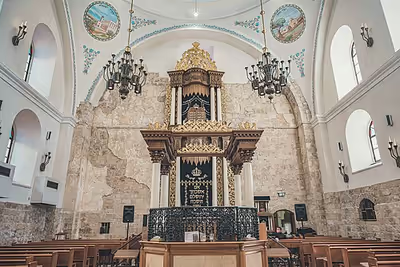
It serves as a house of prayer. It includes a main sanctuary with the Torah ark where the Torah scrolls are kept (called an Holy Closet aron qodesh (Hebrew: אָרוֹן קׄדֶש) by Ashkenazi Jews and a hekhal (היכל) by Sephardic Jews), and a stage called bema in front of it as well as raised galleries for female worshipers. Synagogues have religious services or ceremonies such as Daily prayers, Shabbat prayers (Saturday) weddings, bar and bat mitzvahs. Synagogues often also contain study rooms, social halls, administrative and charitable offices, classrooms for religious and Hebrew studies, and spaces for community gatherings. They frequently display commemorative, historic, or modern artwork alongside items of Jewish historical significance or exhibits about the synagogue itself.
Synagogues are buildings used for Jewish prayer, study, assembly, and reading of the Torah. The Torah (Pentateuch or Five Books of Moses) is traditionally read in its entirety over a period of a year in weekly portions during services, or in some synagogues on a triennial cycle. However, the edifice of a synagogue as such is not essential for holding Jewish worship. Halakha (Jewish law from the Mishnah—the "Oral Torah") states that communal Jewish worship can be carried out wherever a minyan, a group of at least 10 Jewish adults, is assembled, often (but not necessarily) led by a rabbi. This minyan is the essence of Jewish communal worship, which can also be conducted alone or with fewer than ten people, but that excludes certain prayers as well as communal Torah reading. In terms of its specific ritual and liturgical functions, the synagogue does not replace the long-destroyed Temple in Jerusalem.
Any Jew or group of Jews can build a synagogue. Synagogues have been constructed by ancient Jewish leaders, wealthy patrons, and as part of a wide range of human institutions, including secular educational institutions, governments, and hotels. They have been built by the entire Jewish community living in a particular village or region, or by sub-groups of Jewish people organized by occupation, tradition/background (e.g., the Sephardic, Yemenite, Romaniote or Persian Jews of a town), style of religious observance (e.g., Orthodox or Reform synagogues), or by the followers of a particular rabbi, such as the shtiebelekh (Yiddish: שטיבעלעך, romanized: shtibelekh, singular שטיבל shtibl) of Hasidic Judaism.
Terminology
The Hebrew term is bet knesset (בית כנסת) or "house of assembly". The Koine Greek-derived word synagogue (συναγωγή) also means "assembly" and is commonly used in English, with its earliest mention in the 1st century Theodotos inscription in Jerusalem. Ashkenazi Jews have traditionally used the Yiddish term shul (from the Greek schola, which is also the source of the English "school") in everyday speech, and many continue to do so in English.
Sephardi Jews and Romaniote Jews generally use the term kal (from the Hebrew qahal "community"). Spanish and Portuguese Jews call the synagogue an esnoga and Portuguese Jews may call it a sinagoga. Persian Jews and some Karaite Jews also use the term kenesa, which is derived from Aramaic, and some Mizrahi Jews use kenis or qnis, the Arabic word for a synagogue, or ṣla, the Arabic word for prayer.
Sign in to keep reading
13 more chapters are free with a Lably account.
History
In the First Temple period, Jewish communal worship revolved around the Temple in Jerusalem, serving as a central focal point and significant symbol for the entire Jewish nation. As such, it was the destination for Jews making pilgrimages during the three major annual festivals commanded by the Torah: Passover, Shavuot and Sukkot. There is no evidence of non-sacrificial worship during this period. There are several known cases of Jewish communities in Egypt with their own temples, such as the Temple at Elephantine established by refugees from the Kingdom of Judah during the Twenty-seventh Dynasty of Egypt, and a few centuries later, the Temple of Onias in the Heliopolite Nome.
The first synagogues emerged in the Jewish diaspora, probably after the Babylonian Exile of Judaea in 586 BCE, several centuries before their introduction to the Land of Israel. Evidence points to their existence as early as the Hellenistic period, notably in Alexandria, Ptolemaic Egypt, the world's foremost Greek-speaking city at the time. There, the first proseukhái (Koine Greek: προσευχαί, lit. 'places of prayer'; singular προσευχή proseukhē) were built to provide a place for communal prayer and reading and studying the Torah. Alexandrian Jews also made a Koine Greek translation of the Torah, the Septuagint. The earliest archaeological evidence for the existence of synagogues is stone dedication inscriptions from the third century BCE prove that proseukhái existed by that date. Philo and Josephus mention lavishly adorned synagogues in Alexandria and in Antioch, respectively.
More than a dozen Second Temple period synagogues in use by Jews and Samaritans have been identified by archaeologists in Israel and other countries of the Hellenistic world. Following the destruction of the Second Temple in 70 CE, Rabbi Yohanan ben Zakkai, who is often credited with reformulating Judaism for the post-Temple era, advocated for the establishment of individual houses of worship since the Temple was no longer accessible.
It has been theorized that the synagogue became a place of worship in the region upon the destruction of the Second Temple during the First Jewish–Roman War; however, others speculate that there had been places of prayer, apart from the Temple, during the Hellenistic period. The popularization of prayer over sacrifice during the years prior to the destruction of the Second Temple in 70 CE had prepared the Jews for life in the diaspora, where prayer would serve as the focus of Jewish worship.
Despite the certain existence of synagogue-like spaces prior to the First Jewish–Roman War, the synagogue emerged as a focal point for Jewish worship upon the destruction of the Temple. For Jews living in the wake of the Revolt, the synagogue functioned as a "portable system of worship". Within the synagogue, Jews worshipped by way of prayer rather than sacrifices, which had previously served as the main form of worship within the Second Temple.
Second Temple period
In 2018, Mordechai Aviam reported that there were now at least nine synagogues excavated known to pre-date the destruction of the Jerusalem Temple in 70 CE, including in Magdala, Gamla, Masada, Herodium, Modi'in (Khan Umm el-'Umdan), Qiryat Sepher (Khan Bad 'Issa), and Khan Diab. Aviam concluded that he thought almost every Jewish settlement at the time, whether it was a polis or a village, had a synagogue.
- Gamla – a synagogue was discovered near the city gate at Gamla, a site in the Golan northeast of the Sea of Galilee. This city was destroyed by the Roman army in 67 CE and was never rebuilt.
- Masada – a synagogue was discovered on the western side of Masada, just south of the palace complex at the northern end of the site. One of the unique finds at this synagogue was a group of 14 scrolls, which included biblical, sectarian, and apocryphal documents.
- Herodium – a synagogue from the 1st century was discovered in Herod's palace fortress at Herodium.
- Magdala – also known as the Migdal Synagogue, this synagogue was discovered in 2009. One of the unique features of this synagogue, which is located on the western shore of the Sea of Galilee, is an intricately carved stone block that was found in the center of the main room.
- Modi'in – Discovered between Modi'in and Latrun is the oldest synagogue within modern Israel that has been found to date, built during the second century BCE. It includes three rooms and a nearby mikve.
Talmudic period
Following the destruction of the Temple, the synagogue became the focal point of Jewish worship and communal life. Lester L. Grabbe writes: "The rise of the synagogue was a fortuitous but vital development which paved the way for a post-temple Judaism which became necessary after 70 [...] Synagogues were not planned as a substitute for the temple but they were a useful vehicle to make the transition." Over time, prayers, rituals, and customs once performed in the Temple were adapted for synagogue use. Traditional forms of synagogal worship, including sermons and the reading of scripture, were preserved, while new forms of worship, such as piyyut and organized prayer, developed. Rabbinic instruction, however, maintained that certain practices should remain exclusive to the Temple. The Mishnah directed prayers toward Jerusalem, and most synagogues face the Temple site rather than mirroring its orientation, establishing them as extensions of its sanctity, not replicas.
During Late antiquity (third to seventh century CE), literary sources attest to the existence of a large number of synagogues across the Roman-Byzantine and Sasanian Empires. Archaeological evidence indicates the presence of synagogues in at least thirteen places across the diaspora, spanning from Dura-Europos in Syria to Elche in Hispania (modern-day Spain). An especially sizable and monumental synagogue dating from this period is the Sardis Synagogue. Additionally, many inscriptions pertaining to synagogues and their officials have been discovered.
In the Land of Israel, late antiquity witnessed a significant increase in synagogue construction, in Galilee and Golan in the north and the southern hills of Judea, in the south. Each synagogue was constructed according to the means and religious customs of the local community. Notable examples include Capernaum, Bar'am, Beth Alpha, Maoz Haim, Meroth and Nabratein in the north, and Eshtemoa, Susya, Anim, and Maon in the south.
Middle Ages
Rabbi and philosopher Maimonides (1138–1204) described the various customs in his day with respect to local synagogues:
Synagogues and houses of study must be treated with respect. They are swept and sprinkled [with water] to lay the dust. In Spain and the Maghreb, in Babylonia and in the Holy Land, it is customary to kindle lamps in the synagogues and to spread mats on the floor upon which the worshippers sit. In the lands of Edom (Christendom), they sit in synagogues upon chairs [or benches].
Samaritan synagogues
Name and history
The Samaritan house of worship is also called a synagogue. During the third and second centuries BCE, the Hellenistic period, the Greek word used in the Diaspora by Samaritans and Jews was the same, proseukhē Koine Greek: προσευχή, lit. 'place of prayer', plural προσευχαί prosukhái); a third or fourth century inscription uses a similar term, εὑκτήριον euktērion.
The oldest Samaritan synagogue discovered so far is from Delos in the Aegean Islands, with an inscription dated between 250 and 175 BCE, while most Samaritan synagogues excavated in the wider Land of Israel and ancient Samaria in particular, were built in the fourth to seventh centuries at the very end of the Roman Empire and throughout the Byzantine period.
Distinguishing elements
The elements which distinguish Samaritan synagogues from contemporary Jewish ones are:
- Alphabet: the use of the Samaritan script
- Orthography: When the Samaritan script is used, there are some Hebrew words which would be spelled in a way typical only for the Samaritan Pentateuch, for instance, "forever" is written ʿlmw instead of lʿlm. When Greek is the language used in inscriptions, typically, Samaritans may contract two Hebrew words into one, such har "mountain" and Gerizim becoming Ancient Greek: Άργαρίζειν, romanized: Árgarízein. This is an archaic practice that was primarily maintained by Samaritans.
- Orientation: The façade, or entrance, of the Samaritan synagogue, typically faces Mount Gerizim, which is the holiest site to Samaritans, while Jewish synagogues are oriented towards Jerusalem and the Temple Mount.
- Decoration: The mosaic floor and other architectural elements or artifacts are sometimes decorated with typical symbols.
- As the Samaritans have historically adhered more strictly to the commandment forbidding the creation of any "graven image", they would not use any depictions of man or beast. Representations of the signs of the zodiac, of human figures or even Greek deities such as the god Helios, as seen in Byzantine-period Jewish synagogues, would be unimaginable in Samaritan buildings of any period.
- A representation of Mount Gerizim is a clear indication of Samaritan identity. On the other hand, although the existence of a Samaritan temple on Mount Gerizim is both mentioned by Josephus and confirmed by archaeological excavation at its summit, the temple's early destruction in the second century BCE led to its memory disappearing from Samaritan tradition. No temple-related items would be found in Samaritan synagogue depictions. Religious implements, such as are also known from ancient Jewish synagogue mosaics (the temple menorah, shofar, showbread table, trumpets, incense shovels, and specifically the façade of what looks like a temple or a Torah shrine) are also present in Samaritan ones, but the objects are always related to the Tabernacle, the Ark of the Covenant within the Tabernacle, or the Torah shrine in the synagogue itself. Samaritans believe that at the end of time, the Tabernacle and its utensils will be recovered from the place they were buried on Mount Gerizim, and as such they play an important role in Samaritan beliefs. Since the same artists, such as mosaicists, worked for all ethno-religious communities of the time, some depictions might be identical in Samaritan and Jewish synagogues, Christian churches, and pagan temples, but their significance would differ.
- Missing from Samaritan synagogue floors would be images often found in Jewish ones: The lulav (palm-branch) and etrog (citron fruit) have a different ritual use by Samaritans celebrating Sukkot and do not appear on mosaic floors.
- Mikvehs near the synagogue after 70 CE: Jews abandoned the habit of building mikvehs next to their houses of worship after the 70 CE destruction of the Jerusalem Temple, but Samaritans continued the practice.
Archaeological finds
Ancient Samaritan synagogues are mentioned by literary sources or have been found by archaeologists in the Diaspora, in the wider Holy Land, and specifically in Samaria.
Diaspora
- Delos Synagogue: a Samaritan inscription has been dated to between 250 and 175 BCE.
- Rome and Tarsus: ancient literature offers hints that Samaritan synagogues may have existed in these cities between the fourth and sixth centuries CE.
- Thessaloniki and Syracuse: short inscriptions found there and using the Samaritan and Greek alphabet may originate from Samaritan synagogues.
The wider Holy Land
- Synagogue of Salbit (now Sha'alvim), excavated by Eleazar Sukenik in 1949 northwest of Jerusalem. It was about 8 by 15.5 metres (26 by 51 ft) in size, was two stories tall, and was oriented towards Mount Gerizim. Two mosaics remain, one atop the other; one contained the Samaritan version of the Song of the Sea in Exodus 15:18. It was probably built in the 4th or 5th century and destroyed in the 5th or 6th.
- The synagogue at Tell Qasile, which was built at the beginning of the seventh century.
- Synagogue A at Beit She'an (Beisan) was a room added to an existing building in the late 6th or early 7th century and served as a Samaritan synagogue. Beisan is famous for Synagogue B, the Beth Alpha synagogue, which faced Jerusalem and was not a Samaritan synagogue.
Samaria
- El-Khirbe synagogue, discovered c. 3 km from Sebaste, was built in the 4th century CE and remained in use into the Early Islamic period, with a break during the late 5th–early 6th century
- Khirbet Samara synagogue, c. 20 km northwest of Nablus and built in the 4th century CE
- Tzur Natan synagogue, c. 29 km west of Nablus and built in the 5th century CE
Christianity
In the New Testament, the word appears 56 times, mostly in the Synoptic Gospels, but also in the Gospel of John (John 9:22; 18:20) and the Book of Revelation (Rev. 2:9; 3:9). It is used in the sense of 'assembly' in the Epistle of James (James 2:2). Alternatively, the epistle of James (in Greek, clearly Ἰάκωβος or יעקב, anglicized to Jacob) refers to a place of assembly that was indeed Jewish, with Jacob ben Joseph perhaps an elder there. The specific word in James (Jacob) 2:2 could easily be rendered "synagogue", from the Greek συναγωγὴν.
In 1995, Howard Clark Kee argued that synagogues were not a developed feature of Jewish life prior to the First Jewish–Roman War (66-73 CE) and that the mentions of synagogues in the New Testament, including Jesus's visitations of synagogues in various Jewish settlements in Israel, were anachronistic. However, archaeologists have discovered first-century synagogues, and Chris Keith and Anders Runesson find it almost certain that the historical Jesus preached in synagogues in Galilee.
During the first Christian centuries, Jewish Christians are hypothesized to have used houses of worship known in academic literature as synagogue-churches. Scholars have claimed to have identified such houses of worship of the Jews who had accepted Jesus as the Messiah in Jerusalem and Nazareth.
Architectural design
There is no set blueprint for synagogues and the architectural shapes and interior designs of synagogues vary greatly. In fact, the influence from other local religious buildings can often be seen in synagogue arches, domes and towers.
Historically, synagogues were built in the prevailing architectural style of their time and place. Thus, the synagogue in Kaifeng, China, looked very much like Chinese temples of that region and era, with its outer wall and open garden in which several buildings were arranged. The styles of the earliest synagogues resembled the temples of other cults of the Eastern Roman Empire. The surviving synagogues of medieval Spain are embellished with mudéjar plasterwork. The surviving medieval synagogues in Budapest and Prague are typical Gothic structures.
With the emancipation of Jews in Western European countries in the 19th century—which not only enabled Jews to enter fields of enterprise from which they were formerly barred, but gave them the right to build synagogues without needing special permissions—synagogue architecture blossomed. Large Jewish communities wished to show not only their wealth but also their newly acquired status as citizens by constructing magnificent synagogues. These were built across Western Europe and in the United States in all of the historicist or revival styles then in fashion. Thus there were Neoclassical, Renaissance Revival architecture, Neo-Byzantine, Romanesque Revival, Moorish Revival, Gothic Revival, and Greek Revival. There are Egyptian Revival synagogues and even one Mayan Revival synagogue. In the 19th-century and early-20th-century heyday of historicist architecture, however, most historicist synagogues, even the most magnificent ones, did not attempt a pure style, or even any particular style, and are best described as eclectic.
In the post-war era, synagogue architecture abandoned historicist styles for modernism.
Interior elements
Bimah
All synagogues contain a bimah (Hebrew: בּימה, platform or pulpit; plural bimot), a large, raised, reader's platform, where the Torah scroll is placed to be read. In Sephardi synagogues and traditional Ashkenazi synagogues, it is also used as the prayer leader's reading desk.
The term is post-biblical Hebrew, and almost certainly derived from the Ancient Greek word for a raised platform, bema (βῆμα). A link to the Biblical Hebrew bama (בּמה), 'high place' has been suggested. It is also known as the almemar or almemor among some Ashkenazi Jews, from Arabic minbar "pulpit". Among Sephardic Jews, it is known as a tēḇāh (Hebrew: תֵּבָה, box or case) or migdal-etz ('tower of wood').
In Orthodox Judaism, the bimah is located in the center of the synagogue, separate from the Torah ark. In other branches of Judaism, the bimah and the ark are joined together.
The bimah is raised to demonstrate the importance of the Torah reader, and to make it easier to hear the recitation of the Torah. In antiquity, the bimah was made of stone, but in modern times it is usually a rectangular wooden platform approached by steps. Over time, it became a standard fixture in synagogues, where the weekly Torah portion and haftara are read. The platform is typically elevated by two or three steps, as in the ancient Temple. It will generally have a railing, which is a halakhic safety regulation for platforms more than ten handbreadths high, between 83 and 127 centimetres (2.72 and 4.17 ft). A lower bimah (even one step) will sometimes have a railing as a practical measure to prevent someone from stepping off inadvertently.
At the celebration of Shavuot, when synagogues are decorated with flowers, many synagogues have special arches that they place over the bima and adorn with floral displays.
Table or lectern
In Ashkenazi synagogues, the Torah was read on a reader's table located in the center of the room, while the leader of the prayer service, the hazzan, stood at a lectern or table in the front, facing the Ark. In Sephardic synagogues, the table for reading the Torah (reading dais) was commonly placed at the opposite side of the room from the Torah Ark, leaving the center of the floor empty for the use of a ceremonial procession carrying the Torah between the Ark and the reading table. Most contemporary synagogues feature a lectern for the rabbi.
Torah Ark
The Torah Ark, called in Hebrew ארון קודש Aron Kodesh or 'holy chest' , and alternatively called the heikhal—היכל or 'temple' by Sephardic Jews, is a cabinet in which the Torah scrolls are kept.
The ark in a synagogue is almost always positioned in such a way such that those who face it are facing towards Jerusalem. Thus, sanctuary seating plans in the Western world generally face east, while those east of Israel face west. Sanctuaries in Israel face towards Jerusalem and in Jerusalem towards the Temple Mount. Occasionally, synagogues face other directions for structural reasons; in such cases, some individuals might turn to face Jerusalem when standing for prayers, but the congregation as a whole does not.
The Ark is reminiscent of the Ark of the Covenant, which held the tablets inscribed with the Ten Commandments. This is the holiest spot in a synagogue, also reminiscent of the Holy of Holies. The Ark is often closed with an ornate curtain, the parochet פרוכת, which hangs outside or inside the ark doors.
Eternal Light
Other traditional features include a continually lit lamp or lantern, usually electric in contemporary synagogues, called the ner tamid (נר תמיד), the "Eternal Light", used as a way to honor the Divine Presence.
Inner decoration
A synagogue may be decorated with artwork, but in the Rabbinic and Orthodox tradition, three-dimensional sculptures and depictions of the human body are not allowed as these are considered akin to idolatry.
Seating
Originally, synagogues were made devoid of much furniture, the Jewish congregants in Spain, the Maghreb (North Africa), Babylonia, the Land of Israel and Yemen having a custom to sit upon the floor, which had been strewn with mats and cushions, rather than upon chairs or benches. In other European towns and cities, however, Jewish congregants would sit upon chairs and benches. Today, the custom has spread in all places to sit upon chairs and benches.
In an Ashkenazi synagogue, all seats most often face the Torah Ark, meaning that congregants sit in rows. In a Sephardic synagogue, seats are usually arranged around the perimeter of the sanctuary, but during the main prayer, Amidah, everyone face the Ark.
Special seats
Many current synagogues have an elaborate chair named for the prophet Elijah, which is only sat upon during the ceremony of brit milah.
In ancient synagogues, a special chair placed on the wall facing Jerusalem and next to the Torah Shrine was reserved for the prominent members of the congregation and for important guests. Such a stone-carved and inscribed seat was discovered at archaeological excavations in the synagogue at Chorazin in Galilee and dates from the 4th–6th century; another one was discovered at the Delos Synagogue, complete with a footstool.
Rules for attendees
Removing one's shoes
In Yemen, the Jewish custom was to remove one's shoes immediately prior to entering the synagogue, a custom that had been observed by Jews in other places in earlier times. The same practice of removing one's shoes before entering the synagogue was also largely observed among Jews in Morocco in the early 20th century. On the island of Djerba in Tunisia, Jews still remove their shoes when entering a synagogue. The custom of removing one's shoes is no longer practiced in Israel, the United Kingdom, or the United States, and which custom, as in former times, was dependent upon whether or not the wearer considered it a thing of contempt to stand before God while wearing shoes. In Christian countries, where it was thought not offensive to stand before a king while wearing shoes, it was likewise permitted to do so in a house of prayer. However, in Karaite Judaism, the custom of removing one's shoes prior to entering a synagogue is still observed worldwide.
Gender separation
In Orthodox synagogues, men and women do not sit together. The synagogue features a partition (mechitza) dividing the men's and women's seating areas, or a separate women's section located on a balcony.
Denominational differences
Reform Judaism
The German–Jewish Reform movement, which arose in the early 19th century, made many changes to the traditional look of the synagogue, keeping with its desire to simultaneously stay Jewish yet be accepted by the surrounding culture.
The first Reform synagogue, which opened in Hamburg in 1811, introduced changes that made the synagogue look more like a church. These included: the installation of an organ to accompany the prayers (even on Shabbat, when musical instruments are proscribed by halakha), a choir to accompany the hazzan, and vestments for the synagogue rabbi to wear.
In following decades, the central reader's table, the Bimah, was moved to the front of the Reform sanctuary—previously unheard-of in Orthodox synagogues.
Gender separation was also removed.
Conservative Judaism
The Conservative/Masorti movement, which arose in the late 19th century, had its own changes to the synagogue. While most authorities were uncomfortable with the inclusion of organs in the synagogue. they found merit in the removal of gender separation and other Reform movement alterations.
Synagogue as community center
Synagogues often take on a broader role in modern Jewish communities and may include additional facilities such as a catering hall, kosher kitchen, religious school, library, day care center and a smaller chapel for daily services.
Synagogue offshoots
Since many Orthodox and some non-Orthodox Jews prefer to collect a minyan (a quorum of ten adults) rather than pray alone, they commonly assemble at pre-arranged times in offices, living rooms, or other spaces when these are more convenient than formal synagogue buildings. A room or building that is used this way can become a dedicated small synagogue or prayer room. Among Ashkenazi Jews they are traditionally called shtiebel (שטיבל, pl. shtiebelekh or shtiebels, Yiddish for "little house"), and are found in Orthodox communities worldwide.
Another type of communal prayer group, favored by some contemporary Jews, is the chavurah (חבורה, pl. chavurot, חבורות), or prayer fellowship. These groups meet at a regular place and time, either in a private home or in a synagogue or other institutional space. In antiquity, the Pharisees lived near each other in chavurot and dined together to ensure that none of the food was unfit for consumption.
List of synagogues
Some synagogues bear the title "Great Synagogue".
Africa
Morocco
- The Temple Beth-El, Casablanca
- The Al Fassiyine Synagogue, Fes
- The Rabbi Shalom Zaoui Synagogue, Rabat
South Africa
- The Doornfontein Synagogue, New Doornfontein, Johannesburg
- The Gardens Shul, Cape Town
- The Stellenbosch Synagogue, Stellenbosch
Tunisia
- The Grand Synagogue of Tunis
- The El Ghriba synagogue of Djerba
America
Argentina
- The Synagogue of the Israelite Argentine Congregation in Buenos Aires
Barbados
- The Nidhe Israel Synagogue, in Bridgetown, built in 1654. It is one of the oldest synagogues in the Western hemisphere.
Brazil
- The Beth El Synagogue of São Paulo.
Canada
- The Machzikei Hadas of Ottawa, Ontario
- The Beth Jacob V'Anshei Drildz, Toronto, Ontario
- The Bagg Street Shul in Montreal, Quebec
Mexico
- The Nidjei Israel in Mexico City
United States
- The Sixth & I Historic Synagogue, Washington, D.C.
- The Temple B'nai Sholom in Huntsville, Alabama
- The Temple Emanuel in Beverly Hills, California
- The Congregation Mickve Israel in Savannah, Georgia
Uruguay
- The Synagogue of the Sephardic Jewish Community in Montevideo, Uruguay.
Asia
Azerbaijan
- The Synagogue of the Ashkenazi Jews, Baku
- The Six Dome Synagogue, Gyrmyzy Gasaba (now a part of the local jewish museum)
Georgia
- The Great Synagogue in Tbilisi
India
- The Magen Abraham Synagogue, Ahmedabad, Gujarat
- The Knesset Eliyahoo Synagogue, Mumbai, Maharashtra
- The Kadavumbhagam Ernakulam Synagogue, Kochi, Kerala
Iran
- The Yusef Abad Synagogue, in Tehran.
- The Rafi'-Nia synagogue, in Tehran. The building was destroyed in 2026 during the 2026 Iran war.
Israel
- The Belz Great Synagogue, Jerusalem
- The Great Synagogue of Jerusalem
- The Or Torah Synagogue, Acre
Palestine
- The Jericho synagogue, built in the Byzantine Empire-era and is believed to date from the late 6th or early 7th century CE and was discovered in 1936.
- The Gaza synagogue, Built in the early 6th century during the Byzantine period, it was destroyed by fire in the first half of the 7th century.
Turkey
- The Ashkenazi Synagogue of Istanbul
- The Grand Synagogue of Edirne
- The Signora Giveret Synagogue in İzmir
Europe
Austria
- The Leopoldstädter Tempel of Vienna, destroyed during the "Kristallnacht" pogrom. The building served as model for many other important synagogues.
Bosnia and Herzegovina
- The Synagogue of Sarajevo
- The Synagogue of Doboj
Bulgaria
- The Synagogue of Sofia
Czech Republic
- The Great Synagogue of Plzeň
France and Belgium
- The Grand Synagogue of Paris
- The Great Synagogue of Brussels (also known as the Great Synagogue of Europe)
Germany
- The New Synagogue of Berlin
- The Old Synagogue (Erfurt)
- The Old Synagogue (Essen)
Hungary
- The Dohány Street Synagogue in Budapest, Hungary
- The Synagogue of Szeged
Italy
- The Great Synagogue of Florence
- The Great Synagogue of Rome
- The Synagogue of Trieste
Netherlands
- The Portuguese Synagogue of Amsterdam
Poland
- The Great Synagogues of Warsaw and Łódź, destroyed by Nazis during World War II.
- The Progressive Synagogue of Kraków.
- The Great Synagogue of Włodawa
Romania
Russia
- The Moscow Choral Synagogue
- The Grand Choral Synagogue of St. Petersburg
- The Soldier Synagogue of Rostov-on-Don
Scandinavia
- The Great Synagogue (Copenhagen), Denmark
- The Great Synagogue of Stockholm
Serbia
- The Synagogue of Novi Sad
- The Synagogue of Subotica
Ukraine
- The Kharkiv Choral Synagogue
- The Great Choral Synagogue, Kyiv
- The Gwoździec Synagogue, was located in the former Polish–Lithuanian Commonwealth in what is now Hvizdets in Ukraine. Built in the mid-17th century, the synagogue destroyed by the Nazis in 1941.
United Kingdom
- The Great Synagogue of London, destroyed by aerial bombing in the London Blitz in 1941
Oceania
Australia
- The Great Synagogue of Sydney
World's largest synagogues
Israel
- The largest synagogue in the world is the Great Beth Midrash Gur, in Jerusalem, Israel, whose main sanctuary seats up to 20,000, and has an area of approximately 7,500 m2 (81,000 sq ft), while the entire complex has an area of approximately 35,000 m2 (380,000 sq ft). Construction on the edifice took more than 25 years.
- Kehilat Kol HaNeshama, a Reform synagogue located in Baka, Jerusalem, is the largest Reform (and largest non-Orthodox) Jewish synagogue in Israel.
Europe
- The Dohány Street Synagogue in Budapest, Hungary, is the largest synagogue in Europe by square footage and number of seats. It seats 3,000, and has an area of 1,200 m2 (13,000 sq ft) and height of 26 m (85 ft) (apart from the towers, which are 43 m or 141 ft).
- The Synagogue of Trieste is the largest synagogue in Western Europe.
- The Great Synagogue of Rome is one of the largest synagogues in Europe.
- The Portuguese Synagogue in Amsterdam, also called "Esnoga", was built in 1675. At that time it was the largest synagogue in the world. Apart from the buildings surrounding the synagogue, it has an area of 1,008 m2 (10,850 sq ft), is 19.5 meters (64 ft) high. It was built to accommodate 1,227 men and 440 women.
- Szeged Synagogue is located in Szeged, Hungary, seats 1,340 and has height of 48.5 m (159 ft).
- The Sofia Synagogue is located in Sofia, Bulgaria, seating about 1,200.
- The Subotica Synagogue is located in Subotica, Serbia, seating more than 900.
- Great Synagogue (Plzeň) in the Czech Republic is the second-largest synagogue in Europe, and the third-largest in the world.
North America
- Baron Hirsch Synagogue, an Orthodox synagogue in Memphis, Tennessee, was the largest in the United States at the time of its dedication in 1957, seating 2,200 worshippers with an additional accommodation for 1,000 in its main sanctuary. The synagogue moved in 1988, but the building remains in use as a church.
- The Satmar synagogue in Kiryas Joel, New York, which is said to seat "several thousand", is also very large.
- Congregation Yetev Lev D'Satmar (Rodney Street, Brooklyn) is also said to seat "several thousand".
- Temple Emanu-El of New York, a Reform Temple, is located in New York City, with an area of 3,523 m2 (37,920 sq ft), seating 2,500. It is the largest Reform synagogue in the world.
- Congregation Yetev Lev D'Satmar (Hooper Street, Brooklyn) seats between 2,000 and 4,000 congregants.
- The main sanctuary of Adas Israel Congregation (Washington, D.C.) seats 1,500.
- Temple Emanu-El (Miami Beach, Florida) located in Miami Beach, Florida, seats approximately 1,400 people.
- Congregation Shaare Zion, an Orthodox Sephardic synagogue located in Brooklyn, New York, is the largest Syrian Jewish congregation in New York City. It is attended by over 1,000 worshipers on weekends.
- Beth Tzedec Congregation in Toronto, Ontario, is the largest Conservative synagogue in North America.
- Temple Israel, a Reform synagogue in Memphis, Tennessee, seats 1,335 to 1,500 people in its main sanctuary. The massive synagogue complex contains over 11,600 m2 (125,000 sq ft) on 12 hectares (30 acres).
World's oldest synagogues
- The earliest evidence for a synagogue is a stone-carved synagogue dedication inscription found in Lower Egypt and dating from the second half of the 3rd century BCE.
- The oldest Samaritan synagogue, the Delos Synagogue, dates from between 150 and 128 BCE, or earlier and is located on the island of Delos.
- The synagogue of Dura Europos, a Seleucid city in north eastern Syria, dates from the third century CE. It is unique. The walls were painted with figural scenes from the Tanakh. The paintings included Abraham and Isaac, Moses and Aaron, Solomon, Samuel and Jacob, Elijah and Ezekiel. The synagogue chamber, with its surviving paintings, is reconstructed in the National Museum in Damascus.
- The Old Synagogue in Erfurt, Germany, parts of which date to c.1100, is the oldest intact synagogue building in Europe. It is now used as a museum of local Jewish history.
- The Kochangadi Synagogue (1344 CE to 1789 CE) in Kochi in the Kerala, built by the Malabar Jews. It was destroyed by Tipu Sultan in 1789 CE and was never rebuilt. An inscription tablet from this synagogue is the oldest relic from any synagogue in India. Eight other synagogues exist in Kerala though not in active use anymore.
- The Paradesi Synagogue is the oldest active synagogue in the Commonwealth of Nations, located in Kochi, Kerala, in India. It was built in 1568 by Paradesi community in the Kingdom of Cochin. Paradesi is a word used in several Indian languages, and the literal meaning of the term is "foreigners", applied to the synagogue because it was historically used by "White Jews", a mixture of Jews of the Middle East, and European exiles. It is also referred to as the Cochin Jewish Synagogue or the Mattancherry Synagogue. The synagogue is located in the quarter of Old Cochin known as Jew Town and is the only one of the eight synagogues in the area still in use.
- Jew's Court, Steep Hill, Lincoln, England, is arguably the oldest synagogue in Europe in current use.
Oldest synagogues in the United States
- Congregation Shearith Israel, in New York City, founded in 1654, is the oldest congregation in the United States. Its present building dates from 1897.
- The Touro Synagogue in Newport, Rhode Island, is the oldest Jewish house of worship in North America that is still standing. It was built in 1759 for the Jeshuat Israel congregation, which was established in 1658.
Other famous synagogues
- The Worms Synagogue in Germany, built in 1175 and razed on Kristallnacht in 1938, was painstakingly reconstructed using many of the original stones. It is still in use as a synagogue.
- The Synagogue of El Transito of Toledo, Spain, was built in 1356 by Samuel ha-Levi, treasurer of King Pedro I of Castile. This is one of the best examples of Mudéjar architecture in Spain. The design of the synagogue recalls the Nasrid style of architecture that was employed during the same period in the decorations of the palace of the Alhambra in Granada as well as the Mosque of Córdoba. Since 1964, this site has hosted a Sephardi museum.
- The Hurva Synagogue, located in the Jewish Quarter of the Old City of Jerusalem, was Jerusalem's main Ashkenazi synagogue from the 16th century until 1948, when it was destroyed by the Arab Legion several days after the conquest of the city. After the Six-Day War, an arch was built to mark the spot where the synagogue stood. A complete reconstruction, to plans drawn up by architect Nahum Meltzer, opened in March 2010.
- The Abdallah Ibn Salam Mosque or Oran, Algeria, built in 1880, but converted into a mosque in 1975 when most Algerian Jews had left the country for France following independence.
- The Nidhe Israel Synagogue ("Bridgetown Synagogue") of Barbados, located in the capital city of Bridgetown, was first built in 1654. It was destroyed in the hurricane of 1831 and reconstructed in 1833.
- The Curaçao synagogue or Snoa in Willemstad, Curaçao, Netherlands Antilles, was built by Sephardic Portuguese Jews from Amsterdam and Recife, Brazil. It is modeled after the Esnoga in Amsterdam. Congregation Mikvé Israel built this synagogue in 1692; it was reconstructed in 1732.
- The Bialystoker Synagogue on New York's Lower East Side, is located in a landmark building dating from 1826 that was originally a Methodist Episcopal Church. The building is made of quarry stone mined locally on Pitt Street, Manhattan. It is an example of federal architecture. The ceilings and walls are hand-painted with zodiac frescos, and the sanctuary is illuminated by 40-foot (12.19 m) stained-glass windows. The bimah and floor-to-ceiling ark are handcarved.
- The Great Synagogue of Florence, Tempio Maggiore, Florence, 1874–1882, is an example of the magnificent, cathedral-like synagogues built in almost every major European city in the 19th century and early 20th century.
- Boston's 1920 Vilna Shul is a rare surviving intact immigrant-era synagogue.
- The Northstar Synagogue in Arkhangelsk, Russia, is the world's northernmost synagogue building at 65.55 degrees north, second to the synagogue in Fairbanks, Alaska.
- The Görlitz Synagogue in Görlitz, Germany, was built in Jugendstil style between 1909 and 1911. Damaged, but not destroyed, during the Kristallnacht riots, the synagogue was bought by the City Council in 1963. After extensive renovations concluding in late 2020, the main sanctuary (Kuppelsaal with 310 seats) was to be reopened for general culture, and the small synagogue (Wochentags-Synagoge, with space for around 45 visitors)