

Gymnosperm
Clade of non-flowering, naked-seeded vascular plants
- 7 min read
- 6 chapters
- 2 labs on Lably

Learn it on Lably
The life cycle of a gymnosperm involves alternation of generations, with a dominant diploid sporophyte phase, and a reduced haploid gametophyte phase, which is dependent on the sporophytic phase. The term "gymnosperm" is often used in paleobotany to refer to (the paraphyletic group of) all non-angiosperm seed plants. In that case, to specify the modern monophyletic group of gymnosperms, the term Acrogymnospermae is sometimes used.
The gymnosperms and angiosperms together constitute the spermatophytes or seed plants. The spermatophytes are subdivided into five divisions, the angiosperms and four divisions of gymnosperms: the Cycadophyta, Ginkgophyta, Gnetophyta, and Pinophyta (also known as Coniferophyta). Newer classification place the gnetophytes among the conifers. Numerous extinct seed plant groups are recognised including those considered pteridosperms/seed ferns, as well other groups like the Bennettitales.
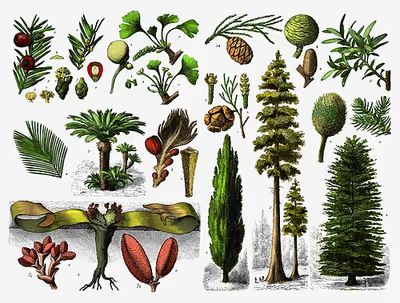
By far the largest group of living gymnosperms are the conifers (pines, cypresses, and relatives), followed by cycads, gnetophytes (Gnetum, Ephedra and Welwitschia), and Ginkgo biloba (a single living species). About 65% of gymnosperms are dioecious, but conifers are almost all monoecious. Some genera have ectomycorrhiza fungal associations with roots (Pinus), while in some others (Cycas) small specialised roots called coralloid roots are associated with nitrogen-fixing cyanobacteria.
Diversity and origin
Over 1,000 living species of gymnosperm exist. It was previously widely accepted that the gymnosperms originated in the Late Carboniferous period, replacing the lycopsid rainforests of the tropical region, but more recent phylogenetic evidence indicates that they diverged from the ancestors of angiosperms during the Early Carboniferous. The radiation of gymnosperms during the late Carboniferous appears to have resulted from a whole genome duplication event around 319 million years ago. Early characteristics of seed plants are evident in fossil progymnosperms of the late Devonian period around 383 million years ago. It has been suggested that during the mid-Mesozoic era, pollination of some extinct groups of gymnosperms was by extinct species of scorpionflies that had specialized proboscides for feeding on pollination drops. The scorpionflies likely engaged in pollination mutualisms with gymnosperms, long before the similar and independent coevolution of nectar-feeding insects on angiosperms. Some mid-Mesozoic gymnosperms were pollinated by kalligrammatid lacewings.
All gymnosperms are perennial woody plants. Unlike in other extant gymnosperms the soft and highly parenchymatous wood in cycads is poorly lignified, and their main structural support comes from an armor of sclerenchymatous leaf bases covering the stem, with the exception of species with underground stems. There are no herbaceous gymnosperms and compared to angiosperms they occupy fewer ecological niches, but the gymnosperms include parasites (Parasitaxus), epiphytes (Zamia pseudoparasitica) and rheophytes (Retrophyllum minus).
Conifers are by far the most abundant extant group of gymnosperms with six to eight families, with a total of 65–70 genera and 600–630 species (696 accepted names). Most conifers are evergreens. Conifers produce their seeds inside a protective cone called a strobilus. Most species are monoecious, with male and female cones on the same tree. All conifers are wind-pollinated.
Cycads, small palm-like trees, are the next most abundant group of gymnosperms, with two or three families, 11 genera, and approximately 338 species. A majority of cycads are native to tropical climates and are most abundantly found in regions near the equator. The other extant groups are the 95–100 species of Gnetophytes and one species of Ginkgo. The ginkgo or maidenhair trees are tall and have bilobed leaves, while gnetophytes are a diverse groups of plants and shrubs including the horizontally growing Welwitschia.
Gymnosperms are the most threatened of all plant groups.
Sign in to keep reading
5 more chapters are free with a Lably account.
Evolution
Phylogeny
The phylogeny of the gymnosperms has been revised by multiple authors.
Taxonomy
A formal classification of the living gymnosperms is the "Acrogymnospermae", which form a monophyletic group within the spermatophytes. The wider "Gymnospermae" group includes extinct gymnosperms and is thought to be paraphyletic. The fossil record of gymnosperms includes many distinctive taxa that do not belong to the four modern groups, including seed-bearing trees that have a somewhat fern-like vegetative morphology (the so-called "seed ferns" or pteridosperms). When fossil gymnosperms such as these and the Bennettitales, glossopterids, and Caytonia are considered, it is clear that angiosperms are nested within a larger gymnospermae clade, although which group of gymnosperms is their closest relative remains unclear.
The extant gymnosperms include 12 main families and 83 genera which contain more than 1000 known species.
Subclass Cycadidae
- Order Cycadales
- Family Cycadaceae: Cycas
- Family Zamiaceae: Dioon, Bowenia, Macrozamia, Lepidozamia, Encephalartos, Stangeria, Ceratozamia, Microcycas, Zamia
Subclass Ginkgoidae
- Order Ginkgoales
- Family Ginkgoaceae: Ginkgo
Subclass Gnetidae
- Order Welwitschiales
- Family Welwitschiaceae: Welwitschia
- Order Gnetales
- Order Ephedrales
- Family Ephedraceae: Ephedra
Subclass Pinidae
- Order Pinales
- Family Pinaceae: Cedrus, Pinus, Cathaya, Picea, Pseudotsuga, Larix, Pseudolarix, Tsuga, Nothotsuga, Keteleeria, Abies
- Order Araucariales
- Family Araucariaceae: Araucaria, Wollemia, Agathis
- Family Podocarpaceae: Phyllocladus, Lepidothamnus, Prumnopitys, Sundacarpus, Halocarpus, Parasitaxus, Lagarostrobos, Manoao, Saxegothaea, Microcachrys, Pherosphaera, Acmopyle, Dacrycarpus, Dacrydium, Falcatifolium, Retrophyllum, Nageia, Afrocarpus, Podocarpus
- Order Cupressales
- Family Sciadopityaceae: Sciadopitys
- Family Cupressaceae: Cunninghamia, Taiwania, Athrotaxis, Metasequoia, Sequoia, Sequoiadendron, Cryptomeria, Glyptostrobus, Taxodium, Papuacedrus, Austrocedrus, Libocedrus, Pilgerodendron, Widdringtonia, Diselma, Fitzroya, Callitris, Actinostrobus, Neocallitropsis, Thujopsis, Thuja, Fokienia, Chamaecyparis, Cupressus, Juniperus, Calocedrus, Tetraclinis, Platycladus, Microbiota
- Family Taxaceae: Austrotaxus, Pseudotaxus, Taxus, Cephalotaxus, Amentotaxus, Torreya
Extinct groupings
- Order Cordaitales
- Order Calamopityales
- Order Callistophytales
- Order Caytoniales
- Order Gigantopteridales
- Order Glossopteridales
- Order Lyginopteridales
- Order Medullosales
- Order Peltaspermales
- Order Corystospermales (also known as Umkomasiales)
- Order Czekanowskiales
- Order Bennettitales (cycadeoids)
- Order Erdtmanithecales
- Order Pentoxylales
- Order Petriellales
Life cycle
Gymnosperms, like all vascular plants, have a sporophyte-dominant life cycle, which means they spend most of their life cycle with diploid cells, while the gametophyte (gamete-bearing phase) is relatively short-lived. Like all seed plants, they are heterosporous, having two spore types, microspores (male) produced in microsporangium and megaspores (female) produced in megasporangium that are typically present in pollen cones or ovulate cones respectively. The microsporangium is carried by microsporophyll (modified leaf) and seeds are carried by ovuliferous scales in the male and female cones respectively. The exception is the females in the cycad genus Cycas, which form a loose structure called megasporophylls instead of cones. As with all heterosporous plants, the gametophytes develop within the spore wall. Pollen grains (microgametophytes) mature from microspores, and ultimately produce sperm cells. Megagametophytes develop from megaspores and are retained within the ovule. Gymnosperms produce multiple archegonia, which produce the female gametes.
During pollination, pollen grains are physically transferred between plants from the pollen cone to the ovule. Pollen is usually moved by wind or insects. Whole grains enter each ovule through a microscopic gap in the ovule coat (integument) called the micropyle. The pollen grains mature further inside the ovule and produce sperm cells. Two main modes of fertilization are found in gymnosperms. Cycads and Ginkgo have flagellated motile sperm that swim directly to the egg inside the ovule, whereas conifers and gnetophytes have sperm with no flagella that are moved along a pollen tube to the egg. After syngamy (joining of the sperm and egg cell), the zygote develops into an embryo (young sporophyte). More than one embryo is usually initiated in each gymnosperm seed. The mature seed comprises the embryo and the remains of the female gametophyte, which serves as a food supply, and the seed coat.
Gymnosperms ordinarily reproduce by sexual reproduction, and only rarely express parthenogenesis. Sexual reproduction in gymnosperms appears to be required for maintaining long-term genomic integrity. Meiosis in sexual land plants provides a direct mechanism for repairing DNA in reproductive tissues. The likely primary benefit of cross-pollination in gymnosperms, as in other eukaryotes, is that it allows the avoidance of inbreeding depression caused by the presence of recessive deleterious mutations.
Genetics
The first published sequenced genome for any gymnosperm was the genome of Picea abies in 2013.
Uses
Gymnosperms have major economic uses. Some, such as pine, fir, spruce, and cedar, are used for lumber, paper production, and resin. Some other common uses for gymnosperms are soap, varnish, nail polish, food, gum, and perfumes.
General bibliography
- Cantino, Philip D.; Doyle, James A.; Graham, Sean W.; Judd, Walter S.; Olmstead, Richard G.; Soltis, Douglas E.; Soltis, Pamela S.; Donoghue, Michael J. (August 2007). "Towards a phylogenetic nomenclature of Tracheophyta". Taxon. 56 (3): 822–846. Bibcode:2007Taxon..56..822C. doi:10.2307/25065864. JSTOR 25065864.