


Related on Lably
Through Eastern Europe, Branch and Gymnosperm
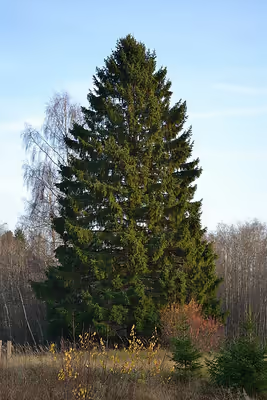
It has branchlets that typically hang downwards, and the longest cones of any spruce, 9–17 cm long. It is very closely related to the Siberian spruce (Picea obovata), which replaces it east of the Ural Mountains, and with which it hybridises freely. The Norway spruce has a wide distribution, being planted for its wood, and is the species used as a Christmas tree in several countries around the world. It was the first gymnosperm to have its genome sequenced. The Latin specific epithet abies means "like Abies, Fir tree".
Description
Norway spruce is a large, fast-growing evergreen coniferous tree growing 35–55 m (115–180 ft) tall and with a trunk diameter of 1 to 1.5 m. It can grow fast when young, up to 1 m per year for the first 25 years under good conditions, but becomes slower once over 20 m (65 ft) tall. The shoots are orange-brown and glabrous. The leaves are needle-like with blunt tips, 12–14 mm long, quadrangular in cross-section and dark green on all four sides with inconspicuous stomatal lines. The seed cones are 9–17 cm long (the longest of any spruce) and have bluntly to sharply triangular-pointed scale tips. They are green or reddish, maturing brown 5–7 months after pollination. The seeds are black, 4–5 mm long, with a pale brown 15 mm wing. The tallest measured Norway spruce is 62.26 m (204.3 ft) tall and grows near Ribnica na Pohorju, Slovenia.
Sign in to keep reading
8 more chapters are free with a Lably account.
Range and ecology
The Norway spruce grows throughout Europe from Norway in the northwest and Poland eastward, and also in the mountains of central Europe, southwest to the western end of the Alps, and southeast in the Carpathians and Balkans to the extreme north of Greece. The northern limit is in the arctic, just north of 70° N in Norway. Its eastern limit in Russia is hard to define owing to extensive hybridisation and intergradation with the Siberian spruce but is usually given as the Ural Mountains. However trees showing some Siberian spruce characters extend as far west as much of northern Finland, with a few records in northeast Norway. The hybrid is known as Picea × fennica (or P. abies subsp. fennica, if the two taxa are considered subspecies), and can be distinguished by a tendency to have hairy shoots and cones with smoothly rounded scales.
Norway spruce cone scales are used as food by the caterpillars of the tortrix moth Cydia illutana, whereas Cydia duplicana feeds on the bark around injuries or canker.
Taxonomy
Populations in southeast Europe tend to have on average longer cones with more pointed scales; these are sometimes distinguished as Picea abies var. acuminata, but there is extensive overlap in variation with trees from other parts of the range.
Some botanists treat Siberian spruce as a subspecies of Norway spruce, though in their typical forms they are very distinct, the Siberian spruce having cones only 5–10 cm long, with smoothly rounded scales and pubescent shoots. Genetically Norway and Siberian spruces have turned out to be extremely similar and may be considered as two closely related subspecies of P. abies.
Another spruce with smoothly rounded cone scales and hairy shoots occurs rarely in the Central Alps in eastern Switzerland. It is also distinct in having thicker, blue-green leaves. Many texts treat this as a variant of Norway spruce, but it is as distinct as many other spruces and appears to be more closely related to Siberian spruce (Picea obovata), Schrenk's spruce (Picea schrenkiana) from central Asia and Morinda spruce (Picea smithiana) in the Himalaya. Treated as a distinct species, it takes the name Alpine spruce (Picea alpestris). As with Siberian spruce, it hybridises extensively with Norway spruce; pure specimens are rare. Hybrids are commonly known as Norwegian spruce, which should not be confused with the pure species Norway spruce.
Cultivation and uses
The Norway spruce is one of the most widely planted spruces, both in and outside of its native range, and one of the most economically important coniferous species in Europe. It is used as an ornamental tree in parks and gardens. It is also widely planted for use as a Christmas tree. Every year the Norwegian capital city, Oslo, provides the cities of London (the Trafalgar Square Christmas tree), Edinburgh and Washington, D.C. with a Norway spruce, which is placed in the central square of each city, mainly in gratitude for the aid these countries gave during the Second World War. In North America Norway spruce is widely planted, specifically in the Northeastern, Pacific Coast, and Rocky Mountain states, as well as in southeastern Canada. It is naturalised in some parts of North America. Naturalised populations occur from Connecticut to Michigan, and probably elsewhere. Norway spruces prefer cool-summer areas and they will grow up to USDA Growing Zone 7, except along the west coast where summers are cool enough even in parts of USDA Growing Zone 10 (Sunset Climate Zones 14-17).
Seed production begins when the tree is in its fourth decade and total lifespan is up to 300 years in its natural range in Europe. Introduced Norway spruces in the British Isles and North America have a much shorter life expectancy. As the tree ages, its crown thins out and lower branches die off.
In the northern US and Canada, Norway spruce is reported as invasive in some locations; however it does not pose a problem in Zone 6 and up as the seeds have a significantly reduced germination rate in areas with hot, humid summers.
The Norway spruce tolerates acidic soils well but does not do well on dry or deficient soils. From 1928 until the 1960s it was planted on surface mine spoils in Indiana.
Cultivars
Several cultivars have been selected as ornamentals ('Barrya', 'Capitata', 'Decumbens', 'Dumosa', 'Clanbrassiliana', 'Gregoryana', 'Inversa', 'Microsperma', 'Nidiformis', 'Ohlendorffii', 'Repens', 'Tabuliformis', 'Maxwellii', 'Virgata', 'Inversa', 'Pendula'), with a wide variety of sizes and shapes, from full-sized forest trees to extremely slow-growing, prostrate forms. They are occasionally traded under the obsolete scientific name Picea excelsa (an illegitimate name). The following cultivars have gained the Royal Horticultural Society's Award of Garden Merit:
- 'Acrocona' – 4 m (13 ft) tall and broad
- 'Clanbrassiliana' – 1.2 m (3.9 ft) tall by 2.4 m (7.9 ft) broad
- 'Inversa' – 9 m (30 ft) tall by 4 m (13 ft) broad
- 'Little Gem' – 0.5 m (1.6 ft) tall and broad
- 'Nidiformis' – 1.5 m (4.9 ft) tall by 4 m (13 ft) broad
Uses
The Norway spruce is used in forestry for (softwood) timber, and paper production.
The Norwegian company Borregaard produces the synthetic substitute for natural vanilla Vanillin using the Norwegian spruce. They are currently the only company to produce wood based vanillin and is claimed by the company to be preferred by their customers due to, among other reasons, its much lower carbon footprint than petrochemically synthesised vanillin.
It is esteemed as a source of tonewood by stringed-instrument makers, and is commonly used for violins. One form of the tree called Haselfichte (Hazel-spruce) grows in the European Alps and has been recognised by UNESCO as intangible cultural heritage. This form was used by Stradivarius for instruments.
As food
The tree is the source of spruce beer, which was once used to prevent and even cure scurvy.
Norway spruce shoot tips have been used in traditional Austrian and Finnish medicine internally (as syrup or tea) and externally (as baths, for inhalation, as ointments, as resin application or as tea) for treatment of disorders of the respiratory tract, skin, locomotor system, gastrointestinal tract and infections.
During the production of Mont d'Or cheese it is wrapped in a "sangle" made from the cambium of a Norway spruce (French: Épicéa commun) for about two weeks at least, which gives the cheese a unique flavour.
In Finland, Norway spruce tips (Finnish: kuusenkerkkä) are used as a spice, for example, in syrup, herbal tea, alcohol, smoothies, salt, and desserts. Spruce tip syrup is also used as a cold medicine.
Folk medicine
The resin has been used in Nordic folk medicine for treating wounds and skin disorders.
Longevity
A press release from Umeå University says that a Norway spruce clone named Old Tjikko, carbon dated as 9,550 years old, is the "oldest living tree". The oldest individual specimen of Norway spruce discovered by tree ring dating found in 2012 in a nature reserve of Buskerud County, Norway, was found to be 532 years old.
However, Pando, a stand of 47,000 quaking aspen clones, is estimated to be between 14,000 and one million years old.
The stress is on the difference between the singular "oldest tree" and the multiple "oldest trees", and between "oldest clone" and "oldest non-clone". Old Tjikko is one of a series of genetically identical clones growing from a root system, one part of which is estimated to be 9,550 years old based on carbon dating. The oldest known individual tree (that has not taken advantage of vegetative cloning) is a Great Basin bristlecone pine over 5,000 years old (germination in 3051 BC).
Genetics
The genome of Picea abies was sequenced in 2013, the first gymnosperm genome to be completely sequenced. The genome contains approximately 20 billion base pairs and is about six times the size of the human genome, despite possessing a similar number of genes. A large proportion of the spruce genome consists of repetitive DNA sequences, including long terminal repeat transposable elements. Despite recent advances in massively parallel DNA sequencing, the assembly of such a large and repetitive genome is a particularly challenging task, mainly from a computational perspective.
Within populations of Picea abies there is great genetic variability, which most likely reflect populations' isolation in glacial refugia and post-glacial evolutionary history. Genetic diversity can in particular be detected when looking at how the populations respond to climatic conditions. E.g. variations in timing and length of the annual growth period as well as differences in frost-hardiness in spring and autumn. These annual growth patterns are important to recognise in order to choose the proper reforestation material of Picea abies.
Chemistry
p-Hydroxybenzoic acid glucoside, picein, piceatannol and its glucoside (astringin), isorhapontin (the isorhapontigenin glucoside), catechin and ferulic acid are phenolic compounds found in mycorrhizal and non-mycorrhizal roots of Norway spruces. Piceol and astringin are also found in P. abies.
Research
Extracts from Picea abies have shown inhibitory activity on porcine pancreatic lipase in vitro.
Synonyms
Picea abies (L.) H. Karst is the accepted name of this species. More than 150 synonyms of Picea abies have been published.
Homotypic synonyms of Picea abies are:
- Pinus abies L.
- Abies picea Mill.
- Pinus pyramidalis Salisb.
- Pinus abies subsp. vulgaris Voss
- Abies abies (L.) Druce
Some heterotypic synonyms of Picea abies are:
- Abies alpestris Brügger
- Abies carpatica (Loudon) Ravenscr.
- Abies cinerea Borkh.
- Abies clambrasiliana Lavallée
- Abies clanbrassiliana P. Lawson
- Abies coerulescens K. Koch
- Abies conica Lavallée
- Abies elegans Sm. ex J.Knight
- Abies eremita K.Koch
- Abies erythrocarpa (Purk.) Nyman
- Abies excelsa (Lam.) Poir.
- Abies extrema Th.Fr.
- Abies finedonensis Gordon
- Abies gigantea Sm. ex Carrière
- Abies gregoryana H. Low. ex Gordon
- Abies inverta R. Sm. ex Gordon
- Abies lemoniana Booth ex Gordon
- Abies medioxima C.Lawson
- Abies minuta Poir.
- Abies montana Nyman
- Abies parvula Knight
- Abies subarctica (Schur) Nyman
- Abies viminalis Wahlenb.
- Picea alpestris (Brügger) Stein
- Picea cranstonii Beissn.
- Picea elegantissima Beissn.
- Picea excelsa (Lam.) Link
- Picea finedonensis Beissn.
- Picea gregoryana Beissn.
- Picea integrisquamis (Carrière) Chiov.
- Picea maxwellii Beissn.
- Picea montana Schur
- Picea remontii Beissn.
- Picea rubra A. Dietr.
- Picea subarctica Schur
- Picea velebitica Simonk. ex Kümmerle
- Picea viminalis (Alstr.) Beissn.
- Picea vulgaris Link
- Pinus excelsa Lam.
- Pinus sativa Lam.
- Pinus viminalis Alstr.