

Fern
Class of vascular plants
- 17 min read
- 7 chapters

Related on Lably
Through Vascular plant, Spore and Gametophyte
The group includes over 10,500 extant species. The Polypodiopsida consist of both the leptosporangiate (Polypodiidae) and eusporangiate ferns, the latter group including horsetails, whisk ferns, marattioid ferns and ophioglossoid ferns. The fern crown group is estimated to have originated c. 423 million years ago (mya), during the late Silurian period and the rapid radiation of land plants, but Polypodiales, the group that makes up 80% of living fern diversity, did not appear and diversify until the Cretaceous (c. 143 to 66 mya), contemporaneous with the heightened diversification of flowering plants.
Some fern species, such as bracken (Pteridium aquilinum) and water fern (Azolla filiculoides), are significant weeds worldwide, and brackens are carcinogenic. Ferns are not of major economic importance, but some are used as food, medicine, and ornamental plants. They also play a role in human culture.
Description
The life cycle of a fern occurs in two stages (as in clubmosses and horsetails). Firstly, each active spore germinates into a short-lived gamete-producing gametophyte, known as the prothallus, which is anchored to the ground by rhizoids. Secondly, a sporophyte, which is free-living and only briefly dependent on the maternal gametophyte, develops spores on fertile fronds. As in all vascular plants, the sporophyte is the dominant phase of the alternation of generations expressed by all land plants. Ferns differ from seed plants in their reproduction by spore dispersal and lack of flowers and seeds. Ferns differ from spore-bearing lycophytes by having true leaves, which are often pinnate.
In more detail, after spores settle on the soil, they germinate to form initial rhizoids and protonemata, which develop into a free-living haploid gametophyte by mitosis (a process of cell division which maintains the number of chromosomes). Using mitosis, the gametophyte (the prothallus) produces spherical antheridia containing male gametophytes (i.e. sperm or antherozoids) and archegonia, which release a single oosphere (egg cell). The flagellate sperm swims into the archegonium and fertilizes the egg, which remains attached to the prothallus as it grows by mitosis into a diploid zygote that develops into the sporophyte, while the separate prothallus persists briefly. Finally, the sporophyte undergoes a diploid phase in which it produces haploid spores by meiosis (a process of cell division which reduces the number of chromosomes by a half), and a mature frond releases spores from the sori (clusters of spore-enclosing sporangia) on its underside.
The diploid sporophyte has 2n paired chromosomes, where n varies from species to species. The haploid gametophyte has n unpaired chromosomes, i.e. half the number of the sporophyte. Sometimes a gametophyte can give rise to sporophyte traits like roots or sporangia independently from the sporophyte.
Gametophyte
The gametophytes of ferns are very different from those of seed plants (gymnosperms and angiosperms). They are free-living and resemble liverworts, whereas those of seed plants develop within the spore wall and are dependent on the parent sporophyte for their nutrition. A fern gametophyte typically consists of:
- Prothallus: A green, photosynthetic structure, the initial growth of which is planar in one cell layer. It resembles a heart or kidney in shape and measures 3–10 millimetres (1⁄8–3⁄8 inch) by 2–8 mm. The prothallus produces gametes by means of:
- Antheridia: Small spherical structures that produce flagellate antherozoids.
- Archegonia: A flask-shaped structure that produces a single egg at one end, which the male gametophyte reaches by swimming down the neck.
- Rhizoids: root-like structures (not true roots) that consist of single greatly elongated cells that absorb water and mineral salts over the whole structure. Rhizoids anchor the prothallus to the soil.
Sporophyte
Extant ferns are herbaceous perennial plants and most lack woody growth. When woody growth is present, it is found in the stem. Their foliage may be deciduous or evergreen, and some are semi-evergreen depending on the climate. Like the sporophytes of seed plants, those of ferns consist of stems, leaves, and roots. Ferns differ from spermatophytes in that they reproduce by spores rather than by seeds. However, they also differ from spore-producing bryophytes in that, like seed plants, they are polysporangiophytes, their sporophytes branching and producing many sporangia. Unlike those of bryophytes, fern sporophytes are free-living and only briefly dependent on the maternal gametophyte.
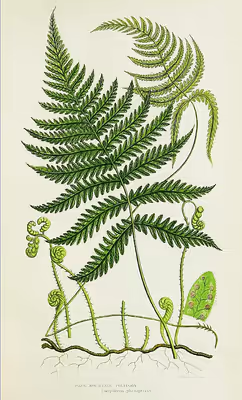
The green, photosynthetic part of the plant is technically a megaphyll (more complex than the microphylls of clubmosses) and in ferns, it is often called a frond. In leptosporangiate ferns, new leaves typically expand by the unrolling of a tight spiral called a crozier or fiddlehead into fronds. This uncurling of the leaf is termed circinate vernation. In some families, such as the Blechnaceae, the leaves are divided into two types, sporophylls or fertile fronds that produce spores and trophophylls or sterile fronds that do not. Fern spores are borne in sporangia which are usually clustered to form sori. The sporangia may be covered with a protective coating called an indusium. The arrangement of the sporangia is important in classification.
In monomorphic ferns, the fertile and sterile leaves look morphologically the same, and both are able to photosynthesize. In hemidimorphic ferns, just a portion of the fertile leaf is different from the sterile leaves. In dimorphic (holomorphic) ferns, the two types of leaves are morphologically distinct. The fertile leaves are much narrower than the sterile leaves, and may have no green tissue at all, as in the Blechnaceae and Lomariopsidaceae.
The anatomy of fern leaves can be anywhere from simple to highly divided, or even indeterminate (e.g. Gleicheniaceae, Lygodiaceae). The divided forms are pinnate, where the leaf segments are completely separated from one other, or pinnatifid (partially pinnate), where the leaf segments are still partially connected. When the fronds are branched more than once, it can also be a combination of the pinnatifid are pinnate shapes. If the leaf blades are divided twice, the plant has bipinnate fronds, and tripinnate fronds if they branch three times, and all the way to tetra- and pentapinnate fronds. In tree ferns, the main stalk that connects the leaf to the stem (known as the stipe), often has multiple leaflets. The leafy structures that grow from the stipe are known as pinnae and are often again divided into smaller pinnules.
Fern stems are often loosely called rhizomes, even though they grow underground only in some of the species. Epiphytic species and many of the terrestrial ones have above-ground creeping stolons growing from the rhizome (e.g., Polypodiaceae), and many groups have dense, erect above-ground trunks (e.g., Cyatheaceae, the scaly tree ferns). These can reach up to 20 meters (66 ft) tall in a few species (e.g., Cyathea brownii on Norfolk Island and Cyathea medullaris in New Zealand).
Roots are underground non-photosynthetic structures that take up water and nutrients from soil. They are always fibrous and are structurally very similar to the roots of seed plants.
Similar species
Many unrelated species are called ferns and sometimes confused with them, including:
- Asparagus fern – any of several species of flowering plants in the monocot genus Asparagus.
- Sweetfern – a flowering shrub of the genus Comptonia
- Fern bush (Chamaebatiaria millefolium) – a rose-family shrub with fernlike leaves
- Fern tree (Jacaranda mimosifolia) – an ornamental tree of the order Lamiales
- Fern leaf tree (Filicium decipiens) – an ornamental tree of the order Sapindales
- Air fern – a group hydrozoans distantly related to jellyfish and corals that are harvested and dried for sale as an artificial plant
Additionally, some flowering plants such as palms and members of the carrot family have pinnate leaves that somewhat resemble fern fronds. However, these plants have fully developed seeds contained in fruits, rather than the microscopic spores of ferns. Cycads, which are gymnosperms, also have pinnate leaves that somewhat resemble fern fronds.
Sign in to keep reading
6 more chapters are free with a Lably account.
Taxonomy
Carl Linnaeus (1753) originally recognized 15 genera of ferns and fern allies, classifying them in class Cryptogamia in two groups, Filices (e.g. Polypodium) and Musci (mosses). By 1806 this had increased to 38 genera, and has progressively increased since. Ferns were traditionally classified in the class Filices, and later in a division of the plant kingdom named Pteridophyta or Filicophyta. Pteridophyta is no longer recognised as a valid taxon because it is paraphyletic. The ferns are also referred to as Polypodiophyta or, when treated as a subdivision of Tracheophyta (vascular plants), Polypodiopsida, although this name sometimes only refers to leptosporangiate ferns. Traditionally, all of the spore producing vascular plants were informally denominated the pteridophytes, rendering the term synonymous with ferns and fern allies. This can be confusing because members of the division Pteridophyta were also denominated pteridophytes (sensu stricto).
Traditionally, three discrete groups have been denominated ferns: two groups of eusporangiate ferns, the families Ophioglossaceae (adder's tongues, moonworts, and grape ferns) and Marattiaceae, and the leptosporangiate ferns. The Marattiaceae are a primitive group of tropical ferns with large, fleshy rhizomes and are now thought to be a sibling taxon to the leptosporangiate ferns. Several other groups of species were considered fern allies: the clubmosses, spikemosses, and quillworts in Lycopodiophyta; the whisk ferns of Psilotaceae; and the horsetails of Equisetaceae. Since this grouping is polyphyletic, the term fern allies should be abandoned, except in a historical context. More recent genetic studies demonstrated that the Lycopodiophyta are more distantly related to other vascular plants, having radiated evolutionarily at the base of the vascular plant clade, while both the whisk ferns and horsetails are as closely related to leptosporangiate ferns as the ophioglossoid ferns and Marattiaceae. In fact, the whisk ferns and ophioglossoid ferns are demonstrably a clade, and the horsetails and Marattiaceae are arguably another clade.
Molecular phylogenetics
Smith et al. (2006) carried out the first higher-level pteridophyte classification published in the molecular phylogenetic era and considered the ferns as monilophytes, as follows:
- Division Tracheophyta (tracheophytes) – vascular plants
- Sub division Euphyllophytina (euphyllophytes)
- Infradivision Moniliformopses (monilophytes)
- Infradivision Spermatophyta – seed plants, ~260,000 species
- Subdivision Lycopodiophyta (lycophytes) – less than 1% of extant vascular plants
- Sub division Euphyllophytina (euphyllophytes)
Molecular data, which remain poorly constrained for many parts of the plants' phylogeny, have been supplemented by morphological observations supporting the inclusion of Equisetaceae in the ferns, notably relating to the construction of their sperm and peculiarities of their roots.
The leptosporangiate ferns are sometimes called "true ferns". This group includes most plants familiarly known as ferns. Modern research supports older ideas based on morphology that the Osmundaceae diverged early in the evolutionary history of the leptosporangiate ferns; in certain ways this family is intermediate between the eusporangiate ferns and the leptosporangiate ferns. Rai and Graham (2010) broadly supported the primary groups, but queried their relationships, concluding that "at present perhaps the best that can be said about all relationships among the major lineages of monilophytes in current studies is that we do not understand them very well". Grewe et al. (2013) confirmed the inclusion of horsetails within ferns sensu lato, but also suggested that uncertainties remained in their precise placement. Other classifications have raised Ophioglossales to the rank of a fifth class, separating the whisk ferns and ophioglossoid ferns.
Phylogeny
The ferns are related to other groups as shown in the following cladogram:
Nomenclature and subdivision
The classification of Smith et al. in 2006 treated ferns as four classes:
- Equisetopsida (Sphenopsida) – 1 order, Equisetales (horsetails) ~ 15 species
- Psilotopsida – 2 orders (whisk ferns and ophioglossoid ferns) ~92 species
- Marattiopsida – 1 order, Marattiales ~ 150 species
- Polypodiopsida (Filicopsida) – 7 orders (leptosporangiate ferns) ~ 9,000 species
In addition they defined 11 orders and 37 families. That system was a consensus of a number of studies, and was further refined. The phylogenetic relationships are shown in the following cladogram (to the level of orders). This division into four major clades was then confirmed using morphology alone.
Subsequently, Mark Wayne Chase and James L. Reveal considered both lycopods and ferns as subclasses of a class Equisetopsida (Embryophyta) encompassing all land plants. This is referred to as Equisetopsida sensu lato to distinguish it from the narrower use to refer to horsetails alone, Equisetopsida sensu stricto. They placed the lycopods into subclass Lycopodiidae and the ferns, keeping the term monilophytes, into five subclasses, Equisetidae, Ophioglossidae, Psilotidae, Marattiidae and Polypodiidae, by dividing Smith's Psilotopsida into its two orders and elevating them to subclass (Ophioglossidae and Psilotidae). In 2011, Maarten J. M. Christenhusz et al. followed this use of subclasses but recombined Smith's Psilotopsida as Ophioglossidae, giving four subclasses of ferns again.
Christenhusz and Chase (2014) developed a new classification of ferns and lycopods. They used the term Polypodiophyta for the ferns, subdivided like Smith et al. into four groups (shown with equivalents in the Smith system), with 21 families, approximately 212 genera and 10,535 species.
- Equisetidae (=Equisetopsida) – monotypic (Equisetales, Equisetaceae, Equisetum) horsetails ~ 20 species)
- Ophioglossidae (=Psilotopsida) – 2 monotypic orders ~ 92 species
- Marattiidae (=Marattiopsida) – 1 monotypic order (Marattiales, Marattiaceae, 2 subfamilies) ~ 130 species
- Polypodiidae (=Polypodiopsida) – 7 orders
This was a considerable reduction in the number of families from the 37 in the system of Smith et al., since the approach was more that of lumping rather than splitting. For instance a number of families were reduced to subfamilies. Subsequently, a consensus group was formed, the Pteridophyte Phylogeny Group, analogous to the Angiosperm Phylogeny Group, publishing their first complete classification in November 2016. They recognize ferns as a class, the Polypodiopsida, with four subclasses as described by Christenhusz and Chase, and which are phylogenetically related as in this cladogram:
In the Pteridophyte Phylogeny Group classification of 2016 (PPG I), the Polypodiopsida consist of four subclasses, 11 orders, 48 families, 319 genera, and an estimated 10,578 species. Thus Polypodiopsida in the broad sense (sensu lato) as used by the PPG (Polypodiopsida sensu PPG I) needs to be distinguished from the narrower usage (sensu stricto) of Smith et al. (Polypodiopsida sensu Smith et al.) Classification of ferns remains unresolved and controversial with competing viewpoints (splitting vs lumping) between the systems of the PPG on the one hand and Christenhusz and Chase on the other, respectively. In 2018, Christenhusz and Chase explicitly argued against recognizing as many genera as PPG I.
Evolution and biogeography
The fern crown group, consisting of the leptosporangiates and eusporangiates, is estimated to have originated 423.2 million years ago (mya), during the late Silurian period and the rapid radiation of land plants. Fern-like taxa (Wattieza) first appear in the fossil record in the middle Devonian period, ca. 390 Mya. By the Triassic, the first evidence of ferns related to several modern families appeared. The great fern radiation occurred in the late Cretaceous (143.1 to 66 mya), when many modern families of ferns first appeared, contemporaneous with the heightened diversification of flowering plants. Successful ferns were able to adapt to the low-light conditions created by the canopy of these angiosperms.
Remarkably, the photoreceptor neochrome in the two orders Cyatheales and Polypodiales, integral to their adaptation to low-light conditions, was obtained via horizontal gene transfer from hornworts, a bryophyte lineage.
Due to the very large genome seen in most ferns, it was suspected they might have gone through whole genome duplications, but DNA sequencing has shown that their genome size is caused by the accumulation of mobile DNA like transposons and other genetic elements that infect genomes and get copied over and over again.
Ferns appear to have evolved extrafloral nectaries 135 million years ago, nearly simultaneously with the trait's evolution in angiosperms. However, nectary-associated diversifications in ferns did not hit their stride until nearly 100 million years later, in the Cenozoic. There is weak support for the rise of fern-feeding arthropods driving this diversification.
Distribution and habitat
Ferns are widespread in their distribution, with the greatest richness in the tropics and least in arctic areas. The greatest diversity occurs in tropical rainforests. New Zealand, for which the fern is a symbol, has about 230 species, distributed throughout the country. It is a common plant in European forests.
Fern species live in a wide variety of habitats, from remote mountain elevations, to dry desert rock faces, bodies of water or open fields. Ferns in general may be thought of as largely being specialists in marginal habitats, often succeeding in places where various environmental factors limit the success of flowering plants. There are four particular types of habitats that ferns are found in: moist, shady forests; crevices in rock faces, especially when sheltered from the full sun; acid wetlands including bogs and swamps; and tropical trees, where many species are epiphytes (something like a quarter to a third of all fern species).
Ecology
Epiphytic ferns in particular have turned out to be hosts of a huge diversity of invertebrates. It is assumed that bird's-nest ferns alone contain up to half the invertebrate biomass within a hectare of rainforest canopy.
Many ferns depend on associations with mycorrhizal fungi. Many ferns grow only within specific pH ranges; for instance, the climbing fern (Lygodium palmatum) of eastern North America will grow only in moist, intensely acidic soils, while the bulblet bladder fern (Cystopteris bulbifera), with an overlapping range, is usually found on limestone.
The spores are rich in lipids, protein and calories, so some vertebrates eat these. The European woodmouse (Apodemus sylvaticus) has been found to eat the spores of Culcita macrocarpa, and the bullfinch (Pyrrhula murina) and the New Zealand lesser short-tailed bat (Mystacina tuberculata) also eat fern spores.
Some ferns are resistant to plant-eating insects. The gene that express the protein Tma12 in an edible fern, Tectaria macrodonta, has been transferred to cotton plants, which became resistant to whitefly infestations.
Invasiveness
Some ferns are among the world's most serious weed species, including the bracken fern growing in the Scottish highlands, or the mosquito fern (Azolla) growing in tropical lakes, both species forming large aggressively spreading colonies. Several ferns, such as bracken and Azolla species are noxious weeds or invasive species. Further examples include Japanese climbing fern (Lygodium japonicum), sensitive fern (Onoclea sensibilis) and giant water fern (Salvinia molesta), one of the world's worst aquatic weeds.
Toxicity
Brackens contain carcinogens linked to esophageal and stomach cancer and should not be eaten by humans or animals. However, some guides claim that ferns are not known to be poisonous to humans.
Uses
Ferns are not as important economically as seed plants, but have considerable importance in some societies. Some are used for food, including the fiddleheads of Pteridium aquilinum (bracken), Matteuccia struthiopteris (ostrich fern), and Osmundastrum cinnamomeum (cinnamon fern). Diplazium esculentum is also eaten in budu pakis, a traditional dish of Brunei. Tubers from the "para", Ptisana salicina (king fern) are a traditional food in New Zealand and the South Pacific. Fern tubers were used for food 30,000 years ago in Europe. Fern tubers were used by the Guanches to make gofio in the Canary Islands. Licorice fern rhizomes were chewed by the natives of the Pacific Northwest for their flavor.
Ferns of the genus Azolla, commonly known as water fern or mosquito ferns, are very small, floating plants that do not resemble ferns. They are used as a biological fertilizer in the rice paddies of southeast Asia, taking advantage of their ability to fix nitrogen from the air into compounds that can then be used by other plants.
Many ferns are grown in horticulture as landscape plants, for cut foliage and as houseplants, especially the Boston fern (Nephrolepis exaltata) and other members of the genus Nephrolepis. The bird's nest fern (Asplenium nidus) is also popular, as are the staghorn ferns (genus Platycerium). Perennial (also known as hardy) ferns planted in gardens in the Northern Hemisphere also have a considerable following.
The important fossil fuel coal consists of the remains of primitive plants, including ferns.
In culture
Pteridology
The study of ferns and other pteridophytes is called pteridology. A pteridologist is a specialist in the study of pteridophytes in a broader sense that includes the more distantly related lycophytes.
Pteridomania
Pteridomania was a Victorian era craze involving fern collecting and motifs in decorative art, including pottery, glass, metals, textiles, wood, printed paper, and sculpture. The fashion for growing ferns indoors led to the development of the Wardian case, a glazed cabinet that would exclude air pollutants and maintain the necessary humidity.
Other applications
The Barnsley fern is a fractal named after the British mathematician Michael Barnsley, who first described it in his book Fractals Everywhere. A self-similar structure is described by a mathematical function, applied repeatedly at different scales to create a frond pattern.
The dried form of ferns was used in other arts, such as a stencil or directly inked for use in a design. The botanical work, The Ferns of Great Britain and Ireland, is a notable example of this type of nature printing. The process, patented by the artist and publisher Henry Bradbury, impressed a specimen on to a soft lead plate. The first publication to demonstrate this was Alois Auer's The Discovery of the Nature Printing-Process.
Fern bars were popular in America in the 1970s and 1980s.
Folklore
Ferns figure in folklore, for example in legends about mythical flowers or seeds. In Slavic folklore, ferns are believed to bloom once a year, during the Ivan Kupala night. Although alleged to be exceedingly difficult to find, anyone who sees a fern flower is thought to be guaranteed to be happy and rich for the rest of their life. Similarly, Finnish tradition holds that one who finds the seed of a fern in bloom on Midsummer night will, by possession of it, be guided and be able to travel invisibly to the locations where eternally blazing Will o' the wisps called aarnivalkea mark the spot of hidden treasure. These spots are protected by a spell that prevents anyone but the fern-seed holder from ever knowing their locations. In Wicca, ferns are thought to have magical properties such as a dried fern can be thrown into hot coals of a fire to exorcise evil spirits, or smoke from a burning fern is thought to drive away snakes and such creatures.
New Zealand
The Silver fern is the national emblem of New Zealand and feature on its passport and in the design of its national airline, Air New Zealand, and of its rugby team, the All Blacks.