


Related on Lably
Through Prehistory, Fossil and Tree
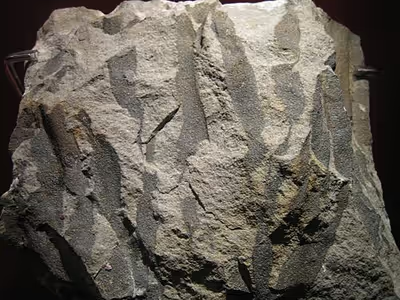
Wattieza had fronds rather than leaves, and they reproduced with spores.
Belgian paleobotanist François Stockmans described the species Wattieza givetiana in 1968 from fossil fronds collected from Middle Devonian strata in the London-Brabant Massif in Belgium.
English geologist and palaeobotanist Chris Berry described Wattieza casasii in Review of Paleobotany and Palynology No. 112 in 2000, based on fossil branches (13 slabs) and numerous other fragments (Berry, 2000) collected from middle-Givetian strata from the lower member of the Campo Chico Formation (Casas et al, 2022). The lithology of the lower member consists of dark grey to green mudstones and shales, interbedded with medium-coarse-grained sandstones close to the base of the Campo Chico Formation, in outcrops of the road to the Rio Socuy (Casas et al, 2022; pag 24), close to the Cano Colorado river, Perija Range, Zulia, Venezuela (Casas et al, 2022). The fossil material of Wattieza casasii is held at the National Museum Cardiff, Cardiff, Wales, and the palaeontological section of the Museo de Biologia at the University of Zulia, Maracaibo, Venezuela (Berry, 2000; p. 127). The name Wattieza casasii was assigned to the species in honor of Jhonny Casas, one of the discoverers of the original material (Berry, 2000; pag. 144).