


Related on Lably
Through Mesopotamia, Geopolitics and Agriculture
Hammurabi is best known for having issued his law code, ostensibly a revelation from Shamash, the Babylonian god of justice. Unlike earlier Sumerian law codes, such as the Code of Ur-Nammu, which had focused on compensating the victim of the crime, the Law of Hammurabi was one of the first law codes to place greater emphasis on the physical punishment of the perpetrator. It prescribed specific penalties for each crime and is among the first codes to establish the presumption of innocence. They were intended to limit what a wronged person was permitted to do in retribution. The Code of Hammurabi and the Law of Moses in the Torah contain numerous similarities.
Hammurabi was seen by many as a god within his own lifetime. After his death, Hammurabi was revered as a great conqueror who spread civilization and forced all peoples to pay obeisance to Marduk, the national god of the Babylonians. Later, his military accomplishments became de-emphasized and his role as the ideal lawgiver became the primary aspect of his legacy. For later Mesopotamians, Hammurabi's reign became the frame of reference for all events occurring in the distant past. Even after the empire he built collapsed, he was still revered as a model ruler, and many kings across the Near East claimed him as an ancestor. Hammurabi was rediscovered by archaeologists in the late 19th century and has since been seen as an important figure in the history of law.
Name
The meaning of the name Hammurabi is a matter of debate. The most common translation is, in Amorite or Akkadian, “the ancestor is great,” Ḫammu-rabi, divided in two parts: ḫammu(m) or ‘ammu, meaning “ancestor,” and rabi, meaning “great” or “to be great.” An alternative reading, in Amorite, translates the name as “the ancestor heals,” ‘Ammu-rāpi. M. Streck, for his part, translates ‘ammu as “paternal uncle,” which he interprets as a reference to a protective deity.
This name was borne by kings contemporary with Hammurabi, the most important being Hammurabi I of Yamhad (Aleppo), as well as by other Amorite kings of Syria who reigned subsequently.. It was common among the Amorites for a man holding the rank of chieftain to bear a name referring to his ancestors, as connection to a lineage and dynastic continuity were essential to his legitimacy..
Sign in to keep reading
4 more chapters are free with a Lably account.
Life
Background and ascension
Hammurabi ascended to the throne as the king of a minor kingdom in the midst of a complex geopolitical situation. Hammurabi was an Amorite First Dynasty king of the city-state of Babylon, and inherited the power from his father, Sin-Muballit, around 1792 BC. Babylon was one of the many largely Amorite-ruled city-states that dotted the central and southern Mesopotamian plains and waged war on each other for control of fertile agricultural land. Though many cultures co-existed in Mesopotamia, Babylonian culture gained a degree of prominence among the literate classes throughout West Asia under Hammurabi. The kings who came before Hammurabi had founded a relatively minor city-state around 1894 BC, which controlled little territory outside of the city itself. Babylon was overshadowed by older, larger, and more powerful kingdoms, such as Elam, Assyria, Isin, Eshnunna, and Larsa for a century or so after its founding. However, his father Sin-Muballit had begun to consolidate a small area of south central Mesopotamia under Babylonian rule and, by the time of his reign, had conquered the minor city-states of Borsippa, Kish, and Sippar.
The powerful kingdom of Eshnunna controlled the upper Tigris River, while Larsa controlled the river delta. To the east of Mesopotamia lay the powerful kingdom of Elam, which regularly invaded and forced tribute upon the small states of southern Mesopotamia. In northern Mesopotamia, the Amorite king Shamshi-Adad I, who had already inherited centuries-old Assyrian colonies in Anatolia, had expanded his territory into the Levant and central Mesopotamia, although his untimely death would somewhat fragment his kingdom.
Reign and conquests
The first few years of Hammurabi's reign were quite peaceful. Hammurabi used his power to undertake a series of public works, including heightening the city walls for defensive purposes, and expanding the temples. The powerful kingdom of Elam, which straddled important trade routes across the Zagros Mountains, invaded the Mesopotamian plain. With allies among the plain states, Elam attacked and destroyed the kingdom of Eshnunna, destroying a number of cities and imposing its rule on portions of the plain for the first time.
In order to consolidate its position, Elam tried to start a war between Hammurabi's Babylonian kingdom and the kingdom of Larsa. Hammurabi and Rim-Sîn I, king of Larsa made an alliance when they discovered this duplicity and were able to crush the Elamites, although Larsa did not participate in the war. Angered by Larsa's failure to come to his aid, Hammurabi invaded and then annexed Larsa, thus gaining control of the entirety of the lower Mesopotamian plain around 1763 BC.
As Hammurabi was assisted during the Babylonian invasion of Larsa in the south by his allies from the north such as Yamhad and Mari, the absence of soldiers in the north led to unrest. Continuing his expansion, Hammurabi turned his attention northward, quelling the unrest. Soon after, he destroyed Eshnunna. Next, the Babylonian armies conquered the remaining northern states, including Babylon's former ally Mari, although it is possible that the conquest of Mari was a surrender without any actual conflict.
Hammurabi entered into a protracted war with Ishme-Dagan I of Assyria for control of Mesopotamia, with both kings making alliances with minor states in order to gain the upper hand. Eventually, Hammurabi prevailed, ousting Ishme-Dagan I just before his own death.
In just a few years, Hammurabi succeeded in uniting all of Mesopotamia under his rule. The Assyrian kingdom survived but was forced to pay tribute during his reign, and of the major city-states in the region, only Yamhad and Qatna to the west in the Levant maintained their independence. However, one stele of Hammurabi has been found as far north as Diyarbakir, where he claims the title "King of the Amorites".
Vast numbers of contract tablets, dated to the reigns of Hammurabi and his successors, have been discovered, as well as 55 of his own letters. These letters give a glimpse into the daily trials of ruling a kingdom, from dealing with floods and mandating changes to a flawed calendar, to taking care of Babylon's massive herds of livestock. Hammurabi died and was succeeded by his son Samsu-iluna around 1750 BC. Under his rule, the kingdom quickly began to unravel.
Family
Hammurabi's family is very poorly known.
None of his wives are documented, but based on the customs of his time, he must have had at least one (or even two) principal wife(s), secondary wives, and numerous concubines, with a harem, which was enlarged, notably following his military conquests.
One of Hammurabi's sisters is known: Iltani, who became a nun (nadītum) devoted to the god Shamash at Sippar, a common practice among royal families of the time, serving to strengthen the bonds between kings and the gods. None of his brothers are known, but a text from Larsa seems to mention an unnamed "daughter of the king's brother," therefore a niece of a brother, perhaps who became a priestess of the god Shamash in that city. From known examples in other kingdoms of his time, the sovereign's brothers were often involved at the highest level in the affairs of the kingdom.
Two of his sons are attested in the archives of Mari: Sumu-ditana (the eldest son?) and Mutu-Numaha, whose names referred to ancestors of his dynasty. They were both sent to Mari for a time as part of educational journeys, which appear to have been a custom at the time. They may also have served as hostages when the king of Mari was lending troops to Babylon. The son destined to succeed Hammurabi, Samsu-iluna, is not attested during his reign. It is not known whether he is the eldest of the siblings, as he was to proclaim in one of his own royal inscriptions.
Among his daughters, at least one in turn becomes a nun devoted to Shamash, perhaps called Lamassani, and another is married to the king Silli-Sin of Eshnunna.
Code of laws
The Code of Hammurabi was a collection of 282 laws dealing with a wide range of issues. It is not the earliest surviving law code but was proved more influential in world politics and international relations as instead of focusing on compensating the victim of crime, as in earlier Sumerian law codes, the Code of Hammurabi instead focused on physically punishing the perpetrator. It was also one of the first law codes to place restrictions on what a wronged person was allowed to do in retribution and one of the earliest examples of the idea of presumption of innocence, suggesting that the accused and accuser have the opportunity to provide evidence. The structure of the code is very specific, with each offense receiving a specified punishment. Many offenses resulted in death, disfigurement, or the use of the Lex Talionis philosophy ("Eye for eye, tooth for tooth").
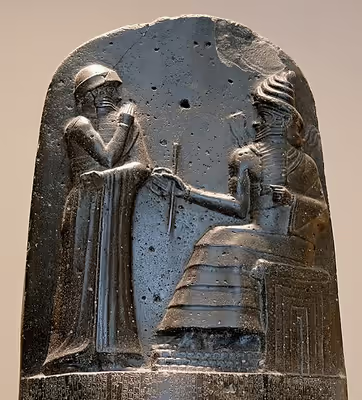
The Code of Hammurabi was inscribed on a stele and placed in a public place so that all could see it, although it is thought that few were literate. The stele was later plundered by the Elamites and removed to their capital, Susa; it was rediscovered there in 1901 in Iran and is now in the Louvre Museum in Paris. The code of Hammurabi contains 282 laws, written by scribes on 12 tablets. Unlike earlier laws, it was written in Akkadian, the daily language of Babylon, and could therefore be read by any literate person in the city. At this time, Akkadian replaced Sumerian, and Hammurabi began language reforms that would make Akkadian the most common language at this time. A carving at the top of the stele portrays Hammurabi receiving the laws from Shamash, the Babylonian god of justice, and the preface states that Hammurabi was chosen by Shamash to bring the laws to the people.
Because of Hammurabi's reputation as a lawgiver, his depiction can be found in law buildings throughout the world. Hammurabi is one of the 23 lawgivers depicted in marble bas-reliefs in the chamber of the U.S. House of Representatives in the United States Capitol. A frieze by Adolph Weinman depicting the "great lawgivers of history", including Hammurabi, is on the south wall of the U.S. Supreme Court building.
According to one journal, Hammurabi's laws "were more humane than those of other kings of his era." During his reign, minimum wages were set up for ordinary workers while he also ruled (as noted by the same journal) "that seasonal workers should be paid at a higher rate than year-round workers."
Legacy
Posthumous commemoration
Hammurabi was honored above all other kings of the second millennium BC and he received the unique honor of being declared to be a god within his own lifetime. The personal name "Hammurabi-ili" meaning "Hammurabi is my god" became common during and after his reign. In writings from shortly after his death, Hammurabi is commemorated mainly for three achievements: bringing victory in war, bringing peace, and bringing justice. Hammurabi's conquests came to be regarded as part of a sacred mission to spread civilization to all nations. A stele from Ur glorifies him in his own voice as a mighty ruler who forces evil into submission and compels all peoples to worship Marduk. The stele declares: "The people of Elam, Gutium, Subartu, and Tukrish, whose mountains are distant and whose languages are obscure, I placed into [Marduk's] hand. I myself continued to put straight their confused minds." A later hymn also written in Hammurabi's own voice extols him as a powerful, supernatural force for Marduk:
I am the king, the brace that grasps wrongdoers, that makes people of one mind,
I am the great dragon among kings, who throws their counsel in disarray,
I am the net that is stretched over the enemy,
I am the fear-inspiring, who, when lifting his fierce eyes, gives the disobedient the death sentence,
I am the great net that covers evil intent,
I am the young lion, who breaks nets and scepters,
I am the battle net that catches him who offends me.
After extolling Hammurabi's military accomplishments, the hymn finally declares: "I am Hammurabi, the king of justice." In later commemorations, Hammurabi's role as a great lawgiver came to be emphasized above all his other accomplishments and his military achievements became de-emphasized. Hammurabi's reign became the point of reference for all events in the distant past. A hymn to the goddess Ishtar, whose language suggests it was written during the reign of Ammi-Saduqa, Hammurabi's fourth successor, declares: "The king who first heard this song as a song of your heroism is Hammurabi. This song for you was composed in his reign. May he be given life forever!" For centuries after his death, Hammurabi's laws continued to be copied by scribes as part of their writing exercises and they were even partially translated into Sumerian.
Political legacy
During the reign of Hammurabi, Babylon usurped the position of "most holy city" in southern Mesopotamia from its predecessor, Nippur. Under the rule of Hammurabi's successor Samsu-iluna, the short-lived Babylonian Empire began to collapse. In northern Mesopotamia, both the Amorites and Babylonians were driven from Assyria by Puzur-Sin, a native Akkadian-speaking ruler, c. 1740 BC. Around the same time, native Akkadian speakers threw off Amorite Babylonian rule in the far south of Mesopotamia, creating the Sealand Dynasty, in more or less the region of ancient Sumer. Hammurabi's ineffectual successors met with further defeats and loss of territory at the hands of Assyrian kings such as Adasi and Bel-ibni, as well as to the Sealand Dynasty to the south, Elam to the east, and to the Kassites from the northeast. Thus was Babylon quickly reduced to the small and minor state it had once been upon its founding.
The coup de grace for the Hammurabi's Amorite Dynasty occurred in 1595 BC, when Babylon was sacked and conquered by the powerful Hittite Empire, thereby ending all Amorite political presence in Mesopotamia. However, the Indo-European-speaking Hittites did not remain, turning over Babylon to their Kassite allies, a people speaking a language isolate, from the Zagros mountains region. This Kassite Dynasty ruled Babylon for over 400 years and adopted many aspects of the Babylonian culture, including Hammurabi's code of laws. Even after the fall of the Amorite Dynasty, however, Hammurabi was still remembered and revered. When the Elamite king Shutruk-Nakhunte raided Babylon in 1158 BC and carried off many stone monuments, he had most of the inscriptions on these monuments erased and new inscriptions carved into them. On the stele containing Hammurabi's laws, however, only four or five columns were wiped out and no new inscription was ever added. Over a thousand years after Hammurabi's death, the kings of Suhum, a land along the Euphrates River, just northwest of Babylon, claimed him as their ancestor.
A Neo-Babylonian royal inscription, which was intended for display on a stele, commemorates a royal grant of tax exemptions to nine Babylonian cities and presents the royal protagonist as a second Hammurabi.
Relationship to Biblical figures and Mosaic law
In the late nineteenth century, the Code of Hammurabi became a major center of debate in the heated Babel und Bibel ("Babylon and Bible") controversy in Germany over the relationship between the Bible and ancient Babylonian texts. In January 1902, the German Assyriologist Friedrich Delitzsch gave a lecture at the Sing-Akademie zu Berlin in front of Kaiser Wilhelm II and his wife in which he argued that the Mosaic Laws of the Old Testament were directly copied off the Code of Hammurabi. Delitzsch's lecture was so controversial that, by September 1903, he had managed to collect 1,350 short articles from newspapers and journals, over 300 longer ones, and twenty-eight pamphlets, all written in response to this lecture, as well as the preceding one about the Flood story in the Epic of Gilgamesh. These articles were overwhelmingly critical of Delitzsch, though a few were sympathetic. The Kaiser distanced himself from Delitzsch and his radical views and, in fall of 1904, Delitzsch was forced to give his third lecture in Cologne and Frankfurt am Main rather than in Berlin. The putative relationship between the Mosaic Law and the Code of Hammurabi later became a major part of Delitzsch's argument in his 1920–21 book Die große Täuschung (The Great Deception) that the Hebrew Bible was irredeemably contaminated by Babylonian influence and that only by eliminating the human Old Testament entirely could Christians finally believe in the true, Aryan message of the New Testament. In the early twentieth century, many scholars believed that Hammurabi was Amraphel, the King of Shinar in the Book of Genesis 14:1. This view has now been largely rejected, and Amraphel's existence is not attested in any writings from outside the Bible.
Parallels between this narrative and the giving of the Covenant Code to Moses by Yahweh atop Mount Sinai in the Book of Exodus and similarities between the two legal codes suggest a common ancestor in the Semitic background of the two. Nonetheless, fragments of previous law codes have been found and it is unlikely that the Mosaic laws were directly inspired by the Code of Hammurabi. Some scholars have disputed this; David P. Wright argues that the Jewish Covenant Code is "directly, primarily, and throughout" based upon the Laws of Hammurabi. In 2010, a team of archaeologists from Hebrew University discovered a cuneiform tablet dating to the eighteenth or seventeenth century BC at Hazor in Israel containing laws clearly derived from the Code of Hammurabi.