

Hemispheres of Earth
Division of the globe into equal halves
- 2 min read
- 3 chapters
- 1 lab on Lably

Learn it on Lably
Geographical hemispheres
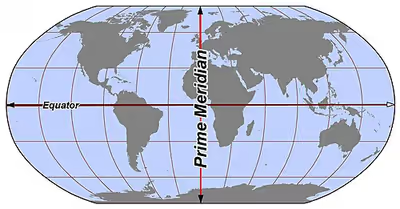
Geographical hemispheres are primarily split by latitudinal (north-south) and longitudinal (east-west) markers:
North-South
- Northern Hemisphere: The half that lies north of the Equator. This hemisphere contains approximately 68% of Earth's landmass and is home to about 90% of the global population. It includes North America, Europe, Asia, and most of Africa.
- Southern Hemisphere: The half that lies south of the Equator. It contains approximately 32% of Earth's landmass and is home to about 10% of the global population. It includes South America, Australia, Antarctica, and the southern parts of Africa.
East-West
- Eastern Hemisphere: Notionally, the half that lies east of the prime meridian and west of the 180th meridian. This hemisphere includes most of Africa, Europe, Asia, and Australia, as well as the Indian and Western Pacific Oceans. In practice, maps typically move the division line westward to keep Europe and Africa together.
- Western Hemisphere: Notionally, the half that lies west of the prime meridian and east of the 180th meridian. This hemisphere includes North and South America, the eastern Pacific Ocean, the Caribbean Sea, and the majority of the Atlantic Ocean.
Sign in to keep reading
2 more chapters are free with a Lably account.
Alternative hemispheres
Alternative Earth hemispheres can divide the globe along cultural or religious lines, or be used to maximize the prominence of geographic features. For example:
Cultural and religious hemispheres
- Eastern Hemisphere: Historically reckoned in Western culture as the more staid or conservative Old World.
- Western Hemisphere: In such accounts, taken as the more liberal New World.
Geographical feature-based hemispheres
- Terrestrial terminator-based hemispheres: Earth may be split into hemispheres of day and night by the terrestrial terminator, which is the boundary between the illuminated and dark sides of the planet. This division changes continuously as Earth rotates. The area subjected to direct illumination is almost exactly half the planet; but because of atmospheric and other effects that extend the reach of indirect illumination, the area of the planet covered by either direct or indirect illumination amounts to slightly more than half the surface.
- 20° West and 160° East-based hemispheres: This alternative division prevents the splitting of Africa and Europe.
Land-water hemispheres
Alternative hemisphere schemes can divide the planet in a way that maximizes the prominence of one geographic feature or another in each division, such as the land-water division:
- Land Hemisphere: Centered near 47°N, 1°E, near the city of Nantes, France, this hemisphere contains the largest possible area of land, including most of the world's continents and major landmasses.
- Water Hemisphere: Centered near 47°S, 179°W, in the South Pacific Ocean (southwest of the Chatham Islands, New Zealand), this hemisphere contains the largest possible area of water, including most of the Indian, Pacific, and Southern Oceans.
Continents and oceans by predominant hemisphere
More in Basics
AmericasLandmass comprising North and South AmericaEurasiaCombined landmasses of Europe and AsiaLatitudeGeographic coordinate specifying north-south positionEquatorImaginary line halfway between Earth's North and South polesLongitudeEast-West geographic coordinateRemote sensingObtaining information through non-contact sensors