

Western Hemisphere
Half of Earth west of the Prime Meridian
- 27 min read
- 9 chapters
- 1 lab on Lably

Learn it on Lably
Geography
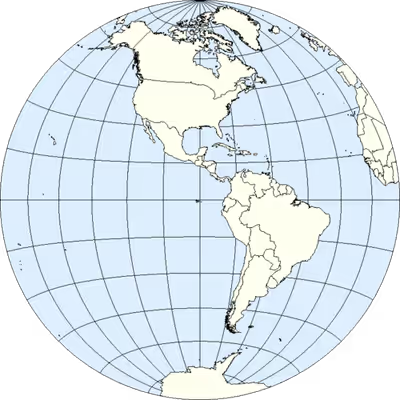
The Western Hemisphere comprises the Americas, except some of the Aleutian Islands to the southwest of the Alaskan mainland; the westernmost parts of Europe and Africa, both mainland and islands; the extreme eastern tip of the Russian mainland and islands (North Asia); many territories in Oceania; and a large part of Antarctica.
The center of the Western Hemisphere on the surface of the Earth is in the Pacific Ocean, at the intersection of the 90th meridian west and the Equator, among the Galápagos Islands. The nearest land is Genovesa Island at 0°19′N 89°57′W / 0.317°N 89.950°W.
The largest country entirely in the Western Hemisphere is Canada at 9,984,670 km2. Fifteen independent countries entirely in the Western Hemisphere have no land borders to other countries: Antigua and Barbuda, the Bahamas, Barbados, Cape Verde, Cuba, Dominica, Grenada, Iceland, Jamaica, Saint Kitts and Nevis, Saint Lucia, Saint Vincent and the Grenadines, Samoa, Tonga and Trinidad and Tobago. Various other island entities in the Western Hemisphere are semi-independent territories of countries, while the Dominican Republic, Ireland and Haiti are considered divided island countries, due to having land borders. Ten of Africa's 54 independent countries are entirely in the Western Hemisphere: the largest is Mauritania at 1,030,000 km2. Five African countries are partially in the Western Hemisphere. Three of Europe's 44 independent countries are entirely in the Western Hemisphere, while seven are partially in it. Portugal is the only mainland European country entirely in the Western Hemisphere, and Spain has the most mainland European land in the Western Hemisphere. However, a moderate proportion of Spain's population still live in the Eastern Hemisphere, since the major city of Barcelona is part of the small part of Spain east of the prime meridian. While the Polynesian countries of Samoa and Tonga are part of the Western Hemisphere, no countries from the neighboring regions of Melanesia and Micronesia are entirely in the Western Hemisphere.
The highest mountain in the Western Hemisphere is Aconcagua, in the Andes of Argentina, at 6,960.8 metres (22,837 feet).
The tallest freestanding structure in the Western Hemisphere is the CN Tower, in Toronto, at 553.3 metres (1,815 ft). The tallest building in the Western Hemisphere is One World Trade Center, in New York City, at 1,776 feet (541.3 m).
Other definitions
The inclusion of parts of non-American areas such as Western Europe is controversial among some, since it conflicts with constructs of the Western Hemisphere which correlate it with the New World or the Americas. Under the accepted geographical definition, historical events such as The Great Fire of London (51°31′N 0°05′W / 51.51°N 0.09°W) are considered to have occurred in the Western Hemisphere, despite not being events associated with the history of the Americas and the New World. Similarly, facts such as Brazil being the last country to abolish slavery in the Western Hemisphere are not technically valid under the geographical definition of the Western Hemisphere, as slavery continued in the Western Hemisphere in non-American areas, with Mauritiana being the last country in the world to abolish slavery in 1981. In an attempt to match the Western Hemisphere more closely with the Americas, some sources use the 20th meridian west and the diametrically opposed 160th meridian east to define the hemisphere. This definition excludes all of the European and African mainlands, but still includes some islands associated with these continents, more of eastern Russia and Oceania, and part of Antarctica. It includes all islands of Alaska, but excludes a small portion of northeast Greenland. There is no hemisphere that includes all of the Americas that also excludes all land outside the Americas, regardless of the meridians or points chosen to define it.
Sign in to keep reading
8 more chapters are free with a Lably account.
Temperature records
The majority of Antarctica's lowest recorded temperatures have been recorded in the larger Eastern Hemisphere portion. Outside of Antarctica, the lowest temperature ever recorded in the Western Hemisphere was a −69.6°C (−93.3°F) reading at the Klinck Automatic Weather Station in Greenland on December 22, 1991. This is also the lowest temperature ever recorded in the Northern Hemisphere. Byrd Automatic Weather Station is situated in the Western Hemisphere portion of Antarctica and recorded a −64.4 °C (−83.9 °F) reading on July 18, 1985. The lowest temperature ever recorded in the Eastern Hemisphere and the Southern Hemisphere was a −89.2 °C (−128.6 °F) reading at Antarctica's Vostok Station on July 21, 1983. This is also the lowest temperature ever recorded on earth.
The 56.7°C (134°F) temperature recorded in Death Valley, California on July 10, 1913 is the highest temperature ever recorded in the Northern Hemisphere and Western Hemisphere. It is also the highest temperature ever recorded on earth. A 55.0°C (131°F) temperature recorded in Kebili, Tunisia, on July 7, 1931 is the second highest temperature ever recorded on earth, and the highest in the Eastern Hemisphere. However, some weather historians question its accuracy. A 1922 reading of 58 °C (136.4 °F) in El Azizia, Libya, was long cited as the world record before the World Meteorological Organization decertified it in 2012 due to measurement errors. The Southern Hemisphere's highest recorded temperature is tied at 50.7 °C (123.3 °F) between Oodnadatta, South Australia on January 2, 1960 and Onslow, Western Australia on January 13, 2022.
Rivadavia, Argentina recorded South America's highest ever temperature of 48.9°C (120°F) on December 11, 1905. Seymour Island is situated off the coast of Antarctica's Western Hemisphere portion, and recorded a temperature of 20.75 °C (69.35 °F) on February 9, 2020, the highest associated with the Antarctica region.
Human history
Morocco has some of the earliest evidence of habitation by modern forms of humans, dating back to 315,000 years ago. Some areas in West Africa like Ivory Coast and Senegal are believed to have had settlements from modern forms of humans dating to 150,000 years ago. Modern humans reached Portugal, Spain and Great Britain roughly 43,000 years ago, with Ireland being reached 10,000 years ago. The Americas were settled by humans roughly 15,000 years ago. Iceland and the Faroe Islands were settled over 1,000 years ago. Samoa and Tonga were settled 3,000 years ago, although other areas in Polynesia like Easter Island and Hawaii were settled under 1,000 years ago. Some areas in the Western Hemisphere were uninhabited by humans before the Age of Discovery, including Ascension Island, Baker Island, Cape Verde, the Cayman Islands, Clipperton Island, Cocos Island, the Desventuradas Islands, the Falkland Islands, Fernando de Noronha, the Galápagos Islands, Howland Island, Jarvis Island, the Juan Fernández Islands, Midway Atoll, the Revillagigedo Islands, Saint Helena, South Georgia and the South Sandwich Islands, Trindade and Martim Vaz and Tristan da Cunha. The part of Antarctica in the Western Hemisphere was also uninhabited before the Age of Discovery.
Environment
Fauna
In the fauna of the Americas, there are distinct evolutionary lineages that evolved in geographic isolation, particularly during the Cenozoic Era. Among the most distinct native mammals are the xenarthrans, an ancient group that includes anteaters, armadillos and sloths. These animals originated in South America and remain exclusive to the Americas today. Similarly, New World monkeys—such as capuchins, spider monkeys, and howler monkeys, form a distinct primate family that evolved separately from Old World monkeys in Afro-Eurasia. The entire hummingbird family, comprising over 300 species, exists naturally only in the Americas, ranging from Alaska to the southern tip of Chile. New World vultures, including turkey vultures and the Andean and California condors, are evolutionarily distinct from Old World vultures.
Bald eagles, the national symbol of the United States, can on rare occasion be found in the Eastern Hemisphere towards the end of Alaska's Aleutian Islands chain, which stretches across the North Pacific Ocean. While penguins are nearly exclusive to Antarctic-influenced regions of the Southern Hemisphere, they are widely found in both the Eastern and Western Hemisphere. Similarly, polar bears, which are exclusive to Arctic-influenced regions of the Northern Hemisphere, can be found in both the Eastern and Western Hemisphere.
Western chimpanzees only occur in African countries west of the prime meridian, including Guinea, Guinea-Bissau, Ivory Coast, Liberia, Senegal and Sierra Leone, which are entirely west of the prime meridian, and Ghana and Mali, which are mostly west of it. Western chimpanzees have gone extinct in Benin, which is entirely east of the prime meridian, and Togo, which is mostly east of it. However, other chimpanzee species occur throughout the Eastern Hemisphere portion of Africa. Various African animals such as giraffes, gorillas and zebras only occur in its Eastern Hemisphere portion.
Geology
The land of the Western Hemisphere encompasses several major tectonic plates, and a number of smaller plates and plate-boundary systems. The continental portions of Canada, the United States, Greenland and much of Mexico are situated mainly on the North American Plate. The Baja California Peninsula and adjacent areas are part of the Pacific Plate system, which is also associated with several Mexican offshore islands. Mexico's Revillagigedo Islands, including Socorro, San Benedicto and Clarion, are situated on the Pacific Plate and form a volcanic archipelago in the eastern Pacific. Clipperton Island, an uninhabited French territory situated 1,080 kilometers off Mexico, is also in the eastern Pacific and lies near the boundary between the Pacific Plate and the Cocos Plate. Its volcanic origin is associated with the broader tectonic and volcanic processes of the region. Most of Central America and the Caribbean occupy the Caribbean Plate or lie along its boundaries with the North American, Cocos and South American plates. Cuba and the Cayman Islands are notable exceptions within the Greater Antilles, as they lie on the North American Plate, whereas Hispaniola, Puerto Rico, Jamaica and the Virgin Islands lie on the Caribbean Plate. The Lesser Antilles form a volcanic arc associated with the eastern boundary of the Caribbean Plate, where Atlantic oceanic lithosphere is subducted beneath the Caribbean region. Most of South America is situated on the South American Plate. Along South America's western margin, the Nazca Plate is being subducted beneath the South American Plate, producing the Peru–Chile Trench, the Andes and one of the world's most active earthquake and volcanic zones. Aside from South America itself, the Falkland Islands are also situated on the South American Plate.
Several islands in the Western Hemisphere are located on plates different to those of the countries which administer them. Costa Rica's Cocos Island is the only subaerial landmass of the Cocos Plate, with the remainder of the plate consisting almost entirely of oceanic crust beneath the eastern Pacific. The Galápagos Islands, politically part of Ecuador, are situated on the Nazca Plate near the complex triple junction region involving the Nazca, Cocos and Pacific plates; their volcanism is associated with a hotspot and the surrounding plate-boundary system. Easter Island, although politically part of Chile, is also situated on the Nazca Plate, close to the East Pacific Rise and the small Easter microplate. The Juan Fernández Islands, likewise belonging to Chile, are volcanic islands on the Nazca Plate and form part of a volcanic chain produced as the plate has moved over a hotspot. By contrast, the Hawaiian Islands are situated in the interior of the Pacific Plate and form the youngest exposed part of the Hawaiian volcanic chain, produced as the Pacific Plate moves over the Hawaiian hotspot. French Polynesia, including the Society Islands, is likewise situated principally on the Pacific Plate and contains numerous volcanic island chains and atolls formed through hotspot and intraplate volcanic processes.
Ireland, Portugal and Spain are situated on the Eurasian Plate, while Iceland straddles the Mid-Atlantic Ridge and consequently lies across the North American–Eurasian plate boundary. The Azores islands, which are Portuguese, are situated in the complex region where the North American, Eurasian and African Plates interact and where an Azores microplate or diffuse plate-boundary zone occurs. Madeira, another Portuguese island territory, lies on the African Plate, while the Canary Islands of Spain are also situated on the African Plate. Cape Verde, off the coast of West Africa, is similarly associated with the African Plate. The West African countries which fall wholly within the Western Hemisphere are situated on the African Plate. The small part of Russia in the Western Hemisphere is associated with the North American Plate and adjacent small plates and tectonic blocks.
Oceanography
Atlantic
The Atlantic waters of the Western Hemisphere encompass a broad range of oceanographic environments, extending from the Celtic and Irish seas and the western coasts of the Iberian Peninsula to the northwest African coast, the Gulf of Guinea and the coasts of the Americas. Around Ireland, the United Kingdom, Spain, and Portugal, a mix of tides, winds, and underwater slopes creates complex coastal currents. In the summer, strong winds push surface water away from the coasts of Spain and Portugal, pulling cold, nutrient-rich water up from the deep ocean. During colder months, these coastal currents reverse direction. Along Morocco, Mauritania, and Senegal, seasonal trade winds also push surface water away from the coast, allowing colder, nutrient-rich water from deeper in the ocean to rise toward the surface. This helps support abundant plankton and, in turn, large populations of fish, making Northwestern Africa a highly productive fishing region. Fishing is particularly vital to Mauritania's economy as most of the country is barren desert.
Across the ocean, the Atlantic coastlines of North and South America connect to opposite polar oceans. North America is strongly influenced by the Arctic, as the cold Labrador Current flows south from Greenland to meet warmer currents heading north. Heavy, freezing water formed in the far north sinks and flows south along the deep ocean floor. South America, by contrast, connects to the Antarctic. The icy Malvinas Current travels north along Argentina until it collides with the warm, southward-flowing Brazil Current. Extremely cold water from Antarctica also sinks and spreads northward beneath the surface.
The Caribbean Sea forms a semi-enclosed tropical extension of the western Atlantic, and is estimated to have more than 7,000 islands. Outside of the Caribbean, the Western Hemisphere portion of the Atlantic Ocean contains numerous other islands of varying sizes and origins. In the northwest Atlantic, Newfoundland and Cape Breton Island form major islands of the Canadian Atlantic coast, bordering the Gulf of St. Lawrence and the open North Atlantic. Further south, Manhattan is one of the world's most heavily urbanized islands, situated within New York Harbor at the mouth of the Hudson River, while nearby islands such as Governors Island, Liberty Island, and Ellis Island form part of the harbor landscape.
When compared to the Pacific Ocean, isolated volcanic islands are less common in the Western Hemisphere portion of the Atlantic Ocean. Bermuda, about 1,030 kilometers east of North Carolina, is the exposed summit of a large volcanic seamount and is unusual among Atlantic islands for its extensive limestone and coral landscapes. Although well north of the Caribbean, its warm waters support extensive coral reefs, seagrass meadows and other subtropical habitats. Off the coast of Brazil, the volcanic Fernando de Noronha archipelago lies about 340 kilometers offshore and forms part of a submarine ridge; its protected waters support coral reefs, sea turtles, dolphins and abundant reef fish. The more remote Trindade and Martim Vaz lie near roughly 1,100 kilometers from the Brazilian mainland, and are among the most isolated islands in the South Atlantic. 33 kilometers from Brazil's Atlantic coast lies Ilha da Queimada Grande, an island commonly known as "Snake Island" due to its unusually large population of venomous snakes.
In the southwestern Atlantic, the Falkland Islands form a large archipelago on the Falkland Plateau about 480 kilometers from the South American mainland. The islands consist principally of East and West Falkland together with hundreds of smaller islands and islets, and their cool, windswept environment supports large populations of penguins, albatrosses, seals and other seabirds and marine mammals. The islands were the site of the 1982 Falklands War between Argentina and the islands' administrators the United Kingdom, with this war causing over 900 fatalities. The Falklands War is one of the most notable examples of warfare in harsh, colder environments, along with the Japanese invasion of the Aleutian Islands in World War II. Further into the South Atlantic are the volcanic islands of South Georgia and the South Sandwich Islands, Saint Helena, Ascension Island, and Tristan da Cunha. Collectively, these islands are characterized by their geographical isolation from major landmasses, with Tristan da Cunha being considered the most remote inhabited island on earth. The South Atlantic Norwegian territory Bouvet Island is often labelled as the most remote island on earth. It is just east of the prime meridian, with its geographical coordinates being 54°S 3°E. The United Nations geoscheme officially categorizes the island as part of South America, although it is closer to Antarctica and Africa.
Pacific
The Tropical Eastern Pacific bioregion is entirely in the Western Hemisphere. It ranges from the coasts of southern Mexico to northern Peru, and includes the waters of surrounding islands as far as Clipperton Island. The Tropical Eastern Pacific differs from the Indo-Pacific bioregion, which covers most of the tropical Pacific and Indian Ocean. The biological differences between the tropical zones of the eastern and western Pacific are often attributed to the Eastern Pacific Barrier (EPB), a term used to describe the thousands of kilometers of empty, island-less ocean between Polynesia and the coastal islands of Latin America. The lack of stepping stone islands in this distance prevents many shallow-water Indo-Pacific marine species from entering the eastern Pacific, with it typically being easier for long distance species such as dolphins, sea turtles, sharks and whales to cross the barrier. The more remote islands of the Tropical Eastern Pacific, like Clipperton Island and the Galápagos Islands, tend to share stronger biogeographical affinities with the Indo-Pacific, particularly French Polynesia and Kiribati. The concept of the Eastern Pacific Barrier is not applicable to Chile and its coastal islands, or the Pacific coasts of the United States and Canada, as these countries sit outside of the tropical zone.
The Bering Sea is the northernmost marginal sea of the Pacific Ocean, and is mostly in the Western Hemisphere. It is bordered by Alaska and far eastern Russia. The Bering Sea contains several continental and volcanic subarctic Alaskan islands, including Little Diomede Island, the volcanic Pribilof Islands, Nunivak, St. Matthew Island and St. Lawrence Island. The Bering Sea eventually leads to the narrow Bering Strait, where Pacific waters from the Bering Sea meet Arctic waters (via the Chukchi Sea, a marginal sea of the Arctic). Little Diomede Island and Russia's Big Diomede Island are both situated on the Bering Strait, and represent the northernmost islands within the Pacific Basin. St. Lawrence Island is the northernmost major island entirely within the Bering Sea, and it is the only island in the Pacific Basin which occasionally receives polar bears, along with the Diomedes. The Aleutian Islands are a volcanic arc which border the Bering Sea to the north, and the open North Pacific Ocean to the south. Unimak Island is one of the first islands of the chain and is more continental in character than the later islands. It is the only island in the chain to feature land mammals from mainland Alaksa, like brown bears and grey wolves. The Unimak Pass between Unimak Island and the Krenitzin Islands prevents these land mammals from naturally reaching the other islands of the Aleutian chain. While nearly all of the Aleutian islands do not naturally have any land mammals, arctic foxes were introduced by humans on certain islands. Some Aleutian islands extend nearly 2,000 kilometers from mainland Alaska, and are in the Eastern Hemisphere, with the Bering Sea surrounding these islands also being situated in the Eastern Hemisphere.
Other Alaskan islands in the Pacific and its marginal seas include Kodiak Island, which is adjacent to the Aleutian Islands, and the over 1,000 islands of the Alexander Archipelago in southeast Alaska. The Alaskan city of Sitka is located in the Alexander Archipelago, on Baranof Island. The Pacific coast of Canada includes Vancouver Island and Haida Gwaii, formerly known by the colonial name of the Queen Charlotte Islands. The Pacific coast of the contiguous United States contains very few islands in the open ocean, with the Channel Islands off Southern California being the most notable. Contiguous U.S. Pacific islands outside of the open ocean include the San Juan Islands in Washington and Alcatraz Island in San Francisco. Mexico's volcanic Revillagigedo Islands are part of the Tropical Eastern Pacific bioregion, along with the continental Tres Marías Islands. Mexico's more northern islands do not fall within the Tropical Eastern Pacific region, including the volcanic Guadalupe Island and the Gulf of California islands. The Gulf of California includes Tiburón Island, the largest island of Mexico. Tiburón has a landscape influenced by the adjacent Sonoran Desert, and was a traditional home of the Seri people. It was also the site of the Tiburón Island Tragedy, where a group of U.S. gold expeditioners went missing, with some presumed cannibalized by the natives. Aside from the volcanic Desventuradas Islands, Easter Island and Juan Fernández Islands, Chile's Pacific coast also includes many closer continental islands, with one of the most notable being Chiloé Island. Peru's Pacific coast contains no volcanic islands and few continental islands. The Chincha Islands, which were historically mined for guano, are among the most notable. Colombia's Pacific coast includes Gorgona Island and Malpelo Island, a volcanic island which is part of a protected marine sanctuary area.
The Indian Ocean is the only major ocean which is entirely in the Eastern Hemisphere, with no Western Hemisphere nations directly bordering it via their mainlands.
Demographics and economy
82% of humans live in the Eastern Hemisphere, and 18% in the Western Hemisphere. The difference in population is less lopsided than that of the Northern Hemisphere and Southern Hemisphere, with 90% of humans living in the Northern Hemisphere, and only 10% in the Southern Hemisphere. In 2026, the states with the highest population density in the Western Hemisphere were Sint Maarten and Bermuda, which had respectively 1,291 people and 1,164 people per square kilometer. In 2026, the least densely populated states in the Western Hemisphere were Western Sahara (a disputed territory claimed by Morocco) and Greenland, which had 2 people and 0.3 people per square kilometer. Greenland was the least densely populated country or territory in the world in 2026. In 2025, the French overseas territory French Polynesia had the highest life expectancy for both males and females in the Western Hemisphere (81.9 years for males and 86.6 years for females). That year, the African country Republic of Guinea had the lowest life expectancy for females in the Western Hemisphere (62.1 years). Guinea's life expectancy of 59.7 for males was also the lowest for countries which are entirely in the Western Hemisphere.The African country Burkina Faso, which is mostly in the Western Hemisphere, had a life expectancy of 59.1 for males, which was the lowest for any country with land in the Western Hemisphere.
In 2016, the top 25 most visited cities entirely in the Western Hemisphere were New York City, Los Angeles, Madrid, Miami, Dublin, Toronto, Lima, San Francisco, Vancouver, Lisbon, Mexico City, Punta Cana, São Paulo, Montreal, Washington D.C., Chicago, Buenos Aires, Boston, Edinburgh, San Jose, Houston, Rio de Janeiro, Bogota, Casablanca and Atlanta. The Western Hemisphere state with the highest GDP in 2025 was the United States, which also had the overall highest in the world that year. Its GDP of $30 trillion was significantly more than China, which had a GDP of $19 trillion (the second highest in the world and highest among Eastern Hemisphere states). The Western Hemisphere state with the lowest GDP in 2025 was the British overseas territory of Montserrat.
Culture and language
Religion
The Western Hemisphere is a less religiously diverse region than the Eastern Hemisphere, and the vast majority of areas in the Western Hemisphere are majority Christian (including the whole of the Americas, Polynesian islands and the few European countries west of the prime meridian). The handful of West African nations lying entirely west of the prime meridian are mostly Muslim-majority countries. Liberia, a country founded by freed African American slaves, is the only one with a Christian-majority population. In 2024, the United States had the largest Jewish population in the Western Hemisphere, with over 6,300,000 (roughly 1.85% of the country's population). The country's Jewish population is the second largest in the world, behind only Israel, which had 7,153,000 Jews in 2024. Other Western Hemisphere countries ranked in the top 15 for Jewish populations are Canada (400,000), Argentina (170,000), Brazil (90,300) and Mexico (41,000). The United Kingdom has 313,000 Jews, and the majority of them reside in the Western Hemisphere parts of the country.
Spanish
Spanish is the most common language in the Western Hemisphere, and is widely spoken across the Americas and the Caribbean, as well as in Spain itself. In the eastern Pacific, it is also spoken on Easter Island, which was originally inhabited by Polynesians but later annexed by Chile, in addition to being spoken by the populations living on the Galápagos Islands and the Juan Fernández Islands.
English
English is the most common language in the United States, Canada, Ireland, Ascension Island, Bermuda, the Falkland Islands, Liberia, Pitcairn Islands, Saint Helena, Tristan da Cunha and many parts of the Caribbean, such as Jamaica, the Cayman Islands and the Virgin Islands. In Sierra Leone, English is the official administrative language, while Krio is the most spoken. English is a primary language in Ghana and the United Kingdom, which are mostly in the Western Hemisphere. It is also widely understood in Samoa and Tonga, which have their own distinct Polynesian languages.
French
French is widely spoken in the Canadian province of Quebec and certain parts of the Caribbean, as well as French Guiana, Ivory Coast, French Polynesia and Wallis and Futuna. It is also spoken in mainland France (which is mostly in the Eastern Hemisphere). Wolof is the most widely spoken language in Senegal, although French is the official language.
Portuguese
Portuguese is the main language in Brazil and Portugal. The official administrative language of Cape Verde is Portuguese, used in government, schools, and media. However, the true national spoken language is Cape Verdean Creole (Kriolu). Likewise, in Guinea-Bissau, Portuguese is the official language, but Guinea-Bissau Creole (Kriol) is the principal language. Unlike in the Western Hemisphere, Portuguese is the most common language in the Southern Hemisphere, partially due to Brazil's large population in comparison to the rest of the Southern Hemisphere, and the presence of other Portuguese colonies in that hemisphere, like Angola, Mozambique and Timor-Leste.
Other languages
The primary language of Iceland is Icelandic, while Mauritania, Morocco and Western Sahara are Arabic-speaking states.
Sovereign states in both hemispheres
Below is a list of the sovereign states in both the Western and Eastern hemispheres on the IERS Reference Meridian:
Mostly in the Western Hemisphere (with some land east of prime meridian)
- United Kingdom, the prime meridian passes through Greenwich, London. Most of London and the rest of England lies within the Western Hemisphere, along with the entirety of Northern Ireland, Scotland and Wales. The majority of the population lives in the Western Hemisphere, with major population centers in the Eastern Hemisphere being Cambridge, Ipswich, and Norwich. Most of the United Kingdom's overseas territories are in the Western Hemisphere, such as the Falkland Islands and those located in the Caribbean. The default geographical coordinates for the United Kingdom are 55°N 3°W, per the centroid of the country.
- Spain, the prime meridian passes through Castellón de la Plana (Valencian Community). Most of Spain, including the capital Madrid, the Canary Islands and the southern half of its Mediterranean territorial waters, lies within the Western Hemisphere. Spanish, Moroccan and Algerian Mediterranean waters are the only part of the Mediterranean Sea located in the Western Hemisphere. Spain's Eastern Hemisphere population mostly reside in the parts of the Valencian Community east of the prime meridian, as well as Barcelona and the northern Mediterranean island of Mallorca, which are entirely in the Eastern Hemisphere. Aside from Barcelona, the rest of the Catalonia region is also in the Eastern Hemisphere. The default geographical coordinates for Spain are 40°N 4°W, per the centroid of the country.
- Mali, the prime meridian passes through the municipal area of Gao. Most of Mali, including the capital Bamako, lies within the Western Hemisphere. The default geographical coordinates for Mali are 17°N 4°W, per the centroid of the country.
- Burkina Faso, the prime meridian passes through Lalgaye. Most of the country, including the capital Ouagadougou, lies within the Western Hemisphere. The default geographical coordinates for Burkina Faso are 12°N 1°W, per the centroid of the country.
- Ghana, the prime meridian passes through Tema. Most of Ghana, including the capital Accra, lies within the Western Hemisphere. The default geographical coordinates for Ghana are 8°N 1°W, per the centroid of the country.
Mostly in the Eastern Hemisphere (with some land west of prime meridian)
- Denmark, due to the entirety of Greenland and the Faroe Islands. Denmark proper lies entirely within the Eastern Hemisphere. The default geographical coordinates for Denmark are 56°N 10°E, per the centroid of the country.
- Norway, due only to Jan Mayen. Mainland Norway, Svalbard and Bouvet Island lie entirely within the Eastern Hemisphere. The default geographical coordinates for Norway are 61°N 8°E, per the centroid of the country.
- The Netherlands has Caribbean overseas islands that lie entirely within the Western Hemisphere, while mainland Netherlands lies entirely within the Eastern Hemisphere. The default geographical coordinates for the Netherlands are 52°N 6°E, per the centroid of the country.
- France, the prime meridian passes through Puynormand (Gironde). About 1/3 of the country, including cities like Nantes or Bordeaux, as well as the overseas regions of Guadeloupe, Martinique, and French Guiana, lies in the Western Hemisphere. The majority of the population lives in the Eastern Hemisphere. The capital and most populated city Paris is entirely in the Eastern Hemisphere, along with the four next most populated cities (Lyon, Marseille, Toulouse, Nice), and other cities such as Cannes, Lille, Montpellier and Strasbourg. The offshore Mediterranean island of Corsica also lies within the Eastern Hemisphere. The default geographical coordinates for France are 47°N 2°E, per the centroid of the country.
- Algeria, the prime meridian passes through Stidia. About 1/4 of the country, including Oran, Algeria's second-largest city, lies within the Western Hemisphere. The capital and most populated city Algiers is in the Eastern Hemisphere. The default geographical coordinates for Algeria are 28°N 2°E, per the centroid of the country.
- Togo, the prime meridian passes near Tami (Tône Prefecture in Savanes Region). Most of Togo, including the capital Lomé, lies within the Eastern Hemisphere. The default geographical coordinates for Togo are 8°N 1°E, per the centroid of the country.
Below is a list of additional sovereign states which are in both the Western and Eastern hemispheres along the 180th meridian. France and the United Kingdom are not listed below due to their inclusion above, though both have Western Hemisphere territories east of the 180th meridian, including France's Clipperton Island, French Polynesia and Wallis and Futuna, and the United Kingdom's Pitcairn Islands. France also has the Eastern Hemisphere territory of New Caledonia, to the west of the 180th meridian. With the exception of the United States (due to Wake Island, Guam and the Northern Mariana Islands), the places below are located on just one side of the International Date Line, which curves around them.
Mostly in the Western Hemisphere (with some land west of 180th meridian)
- United States, the 180th meridian passes through Aleutian Islands (Alaska). All of the country is in the Western Hemisphere, except for Guam, the Northern Mariana Islands, Wake Island and the various Aleutian Islands lying west of the 180th meridian (starting with Semisopochnoi Island at 51°N 179°E and ending with Attu Island at 52°N 172°E). The Islands situated between Semisopochnoi Island and Attu Island include Agattu, Alaid Island, Amchitka Island, Buldir Island, Davidof Island, Khvostof Island, Kiska, Little Kiska Island, Little Sitkin Island, Nizki Island, Segula Island and Shemya, among others. The default geographical coordinates for the United States are 40°N 100°W, per the centroid of the country.
Mostly in the Eastern Hemisphere (with some land east of 180th meridian)
- Russia, the 180th meridian passes through Chukotka Autonomous Okrug. Its portion lying east of the 180th meridian is the only part of the country lying in the Western Hemisphere. This far eastern part of Russia in the Western Hemisphere is also geologically part of the North American Plate, rather than the Eurasian Plate like with much of the country. Most of Russia, including the capital Moscow, lies within the Eastern Hemisphere. The default geographical coordinates for Russia are 66°N 94°E, per the centroid of the country.
- Kiribati, the 180th meridian passes close to Arorae. The country has both the Equator and the 180th meridian (antimeridian) crossing through its territory. It is the only country located in four hemispheres. The capital South Tarawa lies in the Eastern Hemisphere and Northern Hemisphere. Over half of Kiribati's population lives on South Tarawa. The default geographical coordinates for Kiribati are 1°N 173°E, per the centroid of the country.
- Fiji, the 180th meridian passes close to its dependency Rotuma and passes through Taveuni. The capital Suva is in the Eastern Hemisphere. The default geographical coordinates for Fiji are 18°S 179°E, per the centroid of the country.
- New Zealand's two main islands lie within the Eastern Hemisphere; but Chatham Islands and Kermadec Islands, as well as the self-governing states of the Cook Islands and Niue and the dependent territory of Tokelau, lie east of the 180th meridian. The capital Wellington is in the Eastern Hemisphere. The default geographical coordinates for New Zealand are 42°S 173°E, per the centroid of the country.
Countries, dependencies and other territories in the Western Hemisphere
The following countries and territories lie entirely, mostly, or partially within the Western Hemisphere:
Western Hemisphere organizations
Amazon Cooperation Treaty Organization
Andean Community
Association of Caribbean States (ACS)
- Antigua and Barbuda
- Bahamas
- Barbados
- Belize
- Colombia
- Costa Rica
- Cuba
- Dominica
- Dominican Republic
- El Salvador
- Grenada
- Guatemala
- Guyana
- Haiti
- Honduras
- Jamaica
- Mexico
- Nicaragua
- Panama
- Saint Kitts and Nevis
- Saint Lucia
- Saint Vincent and the Grenadines
- Suriname
- Trinidad and Tobago
- Venezuela
British-Irish Council (BIC)
Central American Integration System
Community of Latin American and Caribbean States (CELAC)
- Antigua and Barbuda
- Argentina
- Bahamas
- Barbados
- Belize
- Bolivia
- Brazil
- Chile
- Colombia
- Costa Rica
- Cuba
- Dominica
- Dominican Republic
- Ecuador
- El Salvador
- Grenada
- Guatemala
- Guyana
- Haiti
- Honduras
- Jamaica
- Mexico
- Nicaragua
- Panama
- Paraguay
- Peru
- Saint Kitts and Nevis
- Saint Lucia
- Saint Vincent and the Grenadines
- Suriname
- Trinidad and Tobago
- Uruguay
- Venezuela
Forum for the Progress and Development of South America
Mano River Union
Mercosur
North/South Ministerial Council (NSMC)
Organization of American States (OAS)
- Antigua and Barbuda
- Argentina
- Bahamas
- Barbados
- Belize
- Bolivia
- Brazil
- Canada
- Chile
- Colombia
- Costa Rica
- Dominica
- Dominican Republic
- Ecuador
- El Salvador
- Grenada
- Guatemala
- Guyana
- Haiti
- Honduras
- Jamaica
- Mexico
- Panama
- Paraguay
- Peru
- Saint Kitts and Nevis
- Saint Lucia
- Saint Vincent and the Grenadines
- Suriname
- Trinidad and Tobago
- United States
- Uruguay
- Venezuela
Pacific Alliance
Pan American Health Organization (PAHO)
- Antigua and Barbuda
- Argentina
- Bahamas
- Barbados
- Belize
- Bolivia
- Brazil
- Canada
- Chile
- Colombia
- Costa Rica
- Cuba
- Dominica
- Dominican Republic
- Ecuador
- El Salvador
- Grenada
- Guatemala
- Guyana
- Haiti
- Honduras
- Jamaica
- Mexico
- Nicaragua
- Panama
- Paraguay
- Peru
- Saint Lucia
- Saint Vincent and the Grenadines
- Saint Kitts and Nevis
- Suriname
- Trinidad and Tobago
- United States
- Uruguay
- Venezuela
Organisation of Eastern Caribbean States (OECO)
- Antigua and Barbuda
- Dominica
- Grenada
- Montserrat
- Saint Kitts and Nevis
- Saint Lucia
- Saint Vincent and the Grenadines