

Hildegard of Bingen
German nun and polymath (c. 1098 – 1179)
- 16 min read
- 4 chapters

Related on Lably
Through Hymn and Manuscript
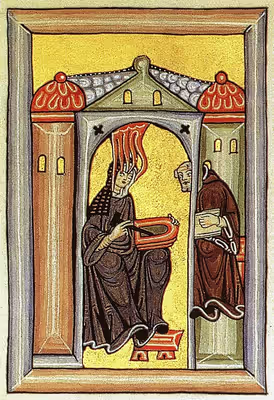
Hildegard's convent at Disibodenberg elected her as magistra (mother superior) in 1136. She founded the monasteries of Rupertsberg in 1150 and Eibingen in 1165. Hildegard wrote theological, botanical, and medicinal works, as well as letters, hymns, and antiphons for the liturgy. She wrote poems, and supervised miniature illuminations in the Rupertsberg manuscript of her first work, Scivias. There are more surviving chants by Hildegard than by any other composer from the entire Middle Ages, and she is one of the few known composers to have written both the music and the words. One of her works, the Ordo Virtutum, is an early example of liturgical drama and arguably the oldest surviving morality play. She is noted for the invention of a constructed language known as Lingua Ignota.
Although the history of her formal canonization is complicated, regional calendars of the Catholic Church have listed her as a saint for centuries. On 10 May 2012, Pope Benedict XVI extended the liturgical cult of Hildegard to the entire Catholic Church in a process known as "equivalent canonization". On 7 October 2012, he named her a Doctor of the Church, in recognition of "her holiness of life and the originality of her teaching."
Biography
Hildegard was born around 1098. Her parents were Mechtild of Merxheim-Nahet and Hildebert of Bermersheim, a family of the free lower nobility in the service of the Count Meginhard of Sponheim. Sickly from birth, Hildegard is traditionally considered their youngest and tenth child, although there are records of only seven older siblings. In her Vita, Hildegard states that from a very young age she experienced visions.
Monastic life
Perhaps because of Hildegard's visions or as a method of political positioning, or both, Hildegard's parents offered her as an oblate to the Benedictine monastery at Disibodenberg, which had been recently reformed in the Palatinate Forest. The date of Hildegard's enclosure at the monastery is the subject of debate. Her Vita says she was eight years old when she was professed with Jutta, who was the daughter of Count Stephan II of Sponheim and about six years older than Hildegard. Jutta's date of enclosure is known to have been in 1112, when Hildegard would have been 14. Their vows were received by Bishop Otto of Bamberg on All Saints Day 1112. Some scholars speculate that Hildegard was placed in Jutta's care at the age of eight and that the two were enclosed together six years later.
In any case, Hildegard and Jutta were enclosed together at Disibodenberg. They formed the core of a growing community of women attached to the monastery of monks, known as a Frauenklause, a type of female hermitage. Jutta was also a visionary and thus attracted many followers who came to visit her at the monastery. Hildegard states that Jutta taught her to read and write, but that she was unlearned, and therefore incapable of teaching Hildegard sound Biblical interpretation. The written record of the Life of Jutta indicates that Hildegard probably assisted her in reciting the psalms, working in the garden, other handiwork, and tending to the sick. This might have been a time when Hildegard learned how to play the ten-stringed psaltery. Volmar, a frequent visitor, may have taught Hildegard simple psalm notation. The time she studied music could have been the beginning of the compositions she would later create.
Upon Jutta's death in 1136, Hildegard was unanimously elected as magistra of the community by her fellow nuns. Abbot Kuno of Disibodenberg asked Hildegard to be prioress, which would be under his authority. Hildegard, wanting more independence for herself and her nuns, asked Abbot Kuno to allow them to move to Rupertsberg. This was to be a move toward poverty, from a stone complex that was well established to a temporary dwelling place. When the abbot declined Hildegard's proposition, Hildegard went over his head and received the approval of Archbishop Henry I of Mainz. Abbot Kuno did not relent, however, until Hildegard was stricken by an illness that rendered her paralyzed and unable to move from her bed, an event that she attributed to God's unhappiness at her not following his orders to move her nuns to Rupertsberg. It was only when the Abbot himself could not move Hildegard that he decided to grant the nuns their own monastery. Hildegard and approximately 20 nuns thus moved to the St. Rupertsberg monastery in 1150, where Volmar served as provost, as well as Hildegard's confessor and scribe. In 1165, Hildegard founded a second monastery for her nuns at Eibingen.
Before Hildegard died in 1179, a problem arose with the clergy of Mainz: a man buried in Rupertsberg had died after being excommunicated by the Catholic Church. Therefore, the clergy wanted to remove his body from the sacred ground. Hildegard rejected this idea, saying it was a sin and that the man had been reconciled to the church at the time of his death.
Friendship with Richardis von Stade
While completing Scivias, Hildegard found a close friend and personal assistant in Richardis von Stade, a fellow nun. In 1151, Richardis was elected abbess of a distant convent, much to Hildegard's displeasure. In a series of letters to multiple church officials (including the Pope), Richardis' family, and even Richardis herself, Hildegard pleaded for her companion to be allowed to stay with her. Hildegard remained adamant that it was "not God's will" for Richardis and her to be separated.
Despite Hildegard's efforts, Richardis was eventually moved. A year later, Richardis' brother sent Hildegard a letter notifying her that Richardis had died, and had met "a good Christian end". In response to this, Hildegard grieved the death of her friend, and assured her brother that she was confident in Richardis' salvation, and that she cherished Richardis with "divine love".
Visions
Hildegard said that she first saw "The Shade of the Living Light" (umbra viventis lucis) at the age of three, and by the age of five, she began to understand that she was experiencing visions. She used the term visio (Latin for 'vision') to describe this feature of her experience, and she recognized that it was a gift that she could not explain to others. Hildegard explained that she saw all things in the light of God through the five senses: sight, hearing, taste, smell, and touch. Her letter to Guibert of Gembloux, which she wrote at the age of 77, describes her experience of this light:
From my early childhood, before my bones, nerves, and veins were fully strengthened, I have always seen this vision in my soul, even to the present time when I am more than seventy years old. In this vision, my soul, as God would have it, rises up high into the vault of heaven and into the changing sky and spreads itself out among different peoples, although they are far away from me in distant lands and places. And because I see them this way in my soul, I observe them in accord with the shifting of clouds and other created things. I do not hear them with my outward ears, nor do I perceive them by the thoughts of my own heart or by any combination of my five senses, but in my soul alone, while my outward eyes are open. So I have never fallen prey to ecstasy in the visions, but I see them wide awake, day and night. And I am constantly fettered by sickness, and often in the grip of pain so intense that it threatens to kill me, but God has sustained me until now. The light which I see thus is not spatial, but it is far, far brighter than a cloud which carries the sun. I can measure neither height, nor length, nor breadth in it; and I call it "the reflection of the living Light." And as the sun, the moon, and the stars appear in water, so writings, sermons, virtues, and certain human actions take form for me and gleam.
Hildegard was hesitant to share her visions, confiding only to Jutta, who in turn told Volmar, Hildegard's tutor and, later, secretary. Throughout her life, she continued to have many visions, and in 1141, at the age of 42, Hildegard received a vision she believed to be an instruction from God, to "write down that which you see and hear." Still hesitant to record her visions, Hildegard became physically ill. The illustrations recorded in the book of Scivias were visions that Hildegard experienced, causing her great suffering and tribulations. In her first theological text, Scivias ("Know the Ways"), Hildegard describes her struggle within:
But I, though I saw and heard these things, refused to write for a long time through doubt and bad opinion and the diversity of human words, not with stubbornness but in the exercise of humility, until, laid low by the scourge of God, I fell upon a bed of sickness; then, compelled at last by many illnesses, and by the witness of a certain noble maiden of good conduct [the nun Richardis von Stade] and of that man whom I had secretly sought and found, as mentioned above, I set my hand to the writing. While I was doing it, I sensed, as I mentioned before, the deep profundity of scriptural exposition; and, raising myself from illness by the strength I received, I brought this work to a close – though just barely – in ten years. [...] And I spoke and wrote these things not by the invention of my heart or that of any other person, but as by the secret mysteries of God I heard and received them in the heavenly places. And again I heard a voice from Heaven saying to me, 'Cry out, therefore, and write thus!'
— Hildegard von Bingen, Scivias, translated by Columba Hart and Jane Bishop, 1990
It was between November 1147 and February 1148 at the synod in Trier that Pope Eugenius heard about Hildegard's writings. It was from this that she received papal approval to document her visions as revelations from the Holy Spirit, giving her instant credence.
On 17 September 1179, when Hildegard died, her sisters said they saw two streams of light appear in the skies and cross over the room where she was dying.
Vita Sanctae Hildegardis
Hildegard's hagiography, Vita Sanctae Hildegardis, was compiled by the monk Theoderic of Echternach after Hildegard's death. He included the hagiographical work Libellus, or "Little Book", begun by Godfrey of Disibodenberg. Godfrey had died before he was able to complete his work. Guibert of Gembloux was invited to finish the work; however, he had to return to his monastery with the project unfinished. Theoderic utilized sources Guibert had left behind to complete the Vita.
Sign in to keep reading
3 more chapters are free with a Lably account.
Significance
During her lifetime
Maddocks claims that it is likely Hildegard learned simple Latin and the tenets of the Christian faith, but was not instructed in the Seven Liberal Arts, which formed the basis of all education for the learned classes in the Middle Ages: the Trivium of grammar, dialectic, and rhetoric plus the Quadrivium of arithmetic, geometry, astronomy, and music. The correspondence she kept with the outside world, both spiritual and social, transcended the cloister as a space of spiritual confinement and served to document Hildegard's grand style and strict formatting of medieval letter writing.
Contributing to Christian European rhetorical traditions, Hildegard "authorized herself as a theologian" through alternative rhetorical arts. Hildegard was creative in her interpretation of theology. She believed that her monastery should exclude novices who were not from the nobility because she did not want her community to be divided based on social status. She also stated that "woman may be made from man, but no man can be made without a woman."
Because of the church's limitations on public discursive rhetoric, the medieval rhetorical arts included preaching, letter writing, poetry, and the encyclopedic tradition. Hildegard's participation in these arts speaks to her significance as a female rhetorician, transcending bans on women's social participation and interpretation of scripture. The acceptance of public preaching by a woman, even a well-connected abbess and acknowledged prophet, does not fit the stereotype of this time. Her preaching was not limited to monasteries; she preached publicly in Germany in 1160. She conducted four preaching tours throughout Germany, speaking to both clergy and laity in chapter houses and in public, mainly denouncing clerical corruption and calling for reform.
Many abbots and abbesses asked her for prayers and opinions on various matters. She traveled widely during her four preaching tours. She had several devoted followers, including Guibert of Gembloux, who wrote to her frequently and became her secretary after Volmar died in 1173. Hildegard also influenced several monastic women, exchanging letters with Elisabeth of Schönau, a nearby visionary.
Hildegard corresponded with popes such as Eugene III and Anastasius IV, politicians such as Abbot Suger, German emperors such as Frederick I Barbarossa, and other notable figures such as Bernard of Clairvaux, who advanced her work, at the behest of her abbot, Kuno, at the Synod of Trier in 1147 and 1148. Hildegard of Bingen's correspondence is an important component of her literary output.
Veneration
Hildegard was among the first for whom the Roman canonization process was officially applied. Still, the process took so long that four attempts at canonization were not completed, and she remained at the level of her beatification. Her name was nonetheless included in the Roman Martyrology at the end of the 16th century up to the current 2004 edition, listing her as "Saint Hildegard" with her feast on 17 September, which would eventually be added to the General Roman Calendar as an optional memorial. Numerous popes have referred to Hildegard as a saint, including Pope John Paul II and Pope Benedict XVI. Hildegard's pilgrimage church in Eibingen houses her relics.
On 10 May 2012, Pope Benedict XVI extended the veneration of Saint Hildegard to the entire Catholic Church in a process known as "equivalent canonization," thus laying the groundwork for naming her a Doctor of the Church. On 7 October 2012, the feast of the Holy Rosary, the pope named her a Doctor of the Church. He called Hildegard "perennially relevant" and "an authentic teacher of theology and a profound scholar of natural science and music."
Hildegard of Bingen also appears in the calendar of saints of various Anglican churches, such as that of the Church of England, in which she is commemorated on 17 September.
Modern interest
In recent years, Hildegard has become of particular interest to feminist scholars. They note her reference to herself as a member of the weaker sex and her belittling of women. Hildegard frequently referred to herself as an unlearned woman, completely incapable of Biblical exegesis. Such a statement on her part, however, worked slyly to her advantage because it made her statements that all of her writings and music came from visions of the Divine more believable, therefore giving Hildegard the authority to speak in a time and place where few women were permitted a voice. Hildegard used her voice to amplify the church's condemnation of institutional corruption, in particular simony.
Hildegard has also become a figure of reverence within the contemporary New Age movement, largely because of her holistic, natural view of healing and her status as a mystic. Although her medical writings were long neglected and then studied without reference to their context, she was the inspiration for Dr. Gottfried Hertzka's "Hildegard-Medicine", and is the namesake for June Boyce-Tillman's Hildegard Network, a healing center that focuses on a holistic approach to wellness and brings together people interested in exploring the links between spirituality, the arts, and healing. Her reputation as a medicinal writer and healer was also used by early feminists to argue for women's rights to attend medical schools.
Reincarnation of Hildegard has been debated since 1924 when Austrian mystic Rudolf Steiner lectured that a nun of her description was the past life of Russian poet-philosopher Vladimir Soloviev, whose visions of Holy Wisdom are often compared to Hildegard's. Sophiologist Robert Powell writes that hermetic astrology proves the match, while mystical communities in Hildegard's lineage include that of artist Carl Schroeder as studied by Columbia sociologist Courtney Bender and supported by reincarnation researchers Walter Semkiw and Kevin Ryerson.
Recordings and performances of Hildegard's music have received critical acclaim and gained popularity since 1979. There is an extensive discography of her musical works.
Hildegard of Bingen has also become of interest to modern scholars of queer medieval studies. In addition to potential queer readings of Hildegard's work as a mystic, there has also been interest in a queer reading of Hildegard's relationship with Richardis von Stade. The language used by Hildegard von Bingen to describe her relationship with Richardis von Stade, in addition to the fervor in which Hildegard expressed her disappointment in Richardis' appointment as abbess to another convent, and her attempts at drawing multiple other church officials to her aid in stopping this appointment, have led scholars of queer medieval studies to suspect that the relationship between Richardis and Hildegard might have been more than simply platonic.
Queer readings of Hildegard von Bingen have inspired a variety of works. In November 2025, the LA Opera debuted a new opera titled "Hildegard," inspired by the life of Hildegard von Bingen. The opera was conceived by Sarah Kirkland Snider, who researched Hildegard and her work for eight years.
Hildegard's life story has also been portrayed in a 2009 film called Vision: From the Life of Hildegard von Bingen, where the relationship between Hildegard and Richardis is explored.
Additionally, Hildegard von Bingen inspired a play by lesbian feminist playwright Carolyn Gage titled "Artemisia and Hildegard."
In art
In culture
The following modern musical works are directly linked to Hildegard and her music or texts:
- Alois Albrecht: Hildegard von Bingen, a liturgical play with texts and music by Hildegard of Bingen, 1998.
- Azam Ali: O Vis Aeternitatis and O Euchari by Hildegard of Bingen, 2020
- The Beloved: The Sun Rising samples O Euchari, sung by Emily Van Evera on the album A Feather on the Breath of God by Gothic Voices
- Orbital: Belfast also samples O Euchari
- Cecilia McDowall: Alma Redemptoris Mater
- Christopher Theofanidis: Rainbow Body, for orchestra, 2000
- David Lynch with Jocelyn Montgomery: Lux Vivens (Living Light): The Music of Hildegard Von Bingen, 1998
- Garmarna: "Euchari" (1999) and Hildegard von Bingen, 2001
- Devendra Banhart: Für Hildegard von Bingen, single from the 2013 album Mala.
- Gordon Hamilton: The Trillion Souls quotes Hildegard's O Ignee Spiritus.
- Ludger Stühlmeyer: O splendidissima gemma. 2012. For alto solo and organ, text: Hildegard of Bingen. Commissioned composition for the declaration of Hildegard of Bingen as Doctor of the Church.
- Naomi Wood, Sophie Seita, The Hildegard von Bingen Society for Gardening Companions, 2022–present. Ongoing publications, performances, and events.
- Peter Janssens: Hildegard von Bingen, a musical in ten scenes, text: Jutta Richter, 1997
- Philipp Ortmeier: Spes for choir based on a text from the Ordo Virtutum, 2026
- Richard Souther, Emily Van Evera, Sister Germaine Fritz (OSB): Vision: The Music Of Hildegard Of Bingen. CDC 7243 5 55246 21 1994.
- Sofia Gubaidulina: Aus den Visionen der Hildegard von Bingen, for contra alto solo, after a text of Hildegard of Bingen, 1994
- Jeremy Thurlow: Earthquake in the Soul: Visions of St. Hildegard. 2020. Oratorio for solo soprano, 8-part chorus and orchestra. Premiered 2025, Lady Clare's Consort & Ensemble; Isaac Chan; Doraly Gill.
- Tilo Medek: Monatsbilder (nach Hildegard von Bingen), twelve songs for mezzo-soprano, clarinet and piano, 1997
- Wolfgang Sauseng: De visione secunda for double choir and percussion, 2011
- John Zorn: The Holy Visions for five female voices, 2012
- David Chalmin and Bryce Dessner: "Electric Fields" for soprano, two pianos, electronics, & multimedia, 2022
- Rosalía, Björk, and Yves Tumor: "Berghain" on the album Lux, 2025
The artwork The Dinner Party bu Judy Chicago features a place setting for Hildegard.
Hildegard was the subject of season 2, episode 3 of the ZDF documentary Die Deutschen, titled Hildegard von Bingen und die Macht der Frauen ("Hildegard of Bingen and the Power of Women"), which was released in 2010.
Hildegard was the subject of a 2012 fictionalized biographic novel Illuminations by Mary Sharatt.
Hildegard was the subject of an episode of the Vision TV Apocalypse-themed documentary series I Prophesy in 2012.
The off-Broadway musical In the Green, written by Grace McLean, followed Hildegard's story.
In his book, The Man Who Mistook His Wife for a Hat, neurologist Oliver Sacks devotes a chapter to Hildegard and concludes that, in his opinion, her visions were migrainous.
In film, Hildegard has been portrayed by Patricia Routledge in a BBC documentary called Hildegard of Bingen (1994), by Ángela Molina in Barbarossa (2009) and by Barbara Sukowa in the film Vision, directed by Margarethe von Trotta.
A feature documentary film, The Unruly Mystic: Saint Hildegard , was released by American director Michael M. Conti in 2014.
Kristin Hayter, known professionally as "Lingua Ignota", was inspired by Hildegard of Bingen.
The plant genus Hildegardia is named after her because of her contributions to herbal medicine.
In space, the 898 Hildegard, a minor planet, is named for her.
The 2025 opera "HILDEGARD" by composer Sarah Kirkland Snider follows the story of Hildegard as she receives and transcribes her visions.