

Homeric Hymns
Ancient Greek poems composed between c. 800 BCE and c. 500 CE
- 22 min read
- 5 chapters

Related on Lably
The Homeric Hymns share compositional similarities with the Iliad and the Odyssey, also traditionally attributed to Homer. They share the same artificial literary dialect of Greek, are composed in dactylic hexameter, and make use of short, repeated phrases known as formulae. It is unclear how far writing, as opposed to oral composition, was involved in their creation. They may initially have served as preludes to the recitation of longer poems, and have been performed, at least originally, by singers accompanying themselves on a lyre or another stringed instrument. Performances of the hymns may have taken place at sympotic banquets, religious festivals and royal courts.
There are references to the Homeric Hymns in Greek poetry from around 600 BCE; they appear to have been used as educational texts by the early fifth century BCE, and to have been collected into a single corpus after the third century CE. Their influence on Greek literature and art was relatively small until the third century BCE, when they were used extensively by Alexandrian poets including Callimachus, Theocritus and Apollonius of Rhodes. They were also an influence on Roman poets, such as Lucretius, Catullus, Virgil, Horace and Ovid. In late antiquity (c. 200 – c. 600 CE), they influenced both pagan and Christian literature, and their collection as a corpus probably dates to this period. They were comparatively neglected during the succeeding Byzantine period (that is, until 1453), but continued to be copied in manuscripts of Homeric poetry; all the surviving manuscripts of the hymns date to the fifteenth century. They were also read and emulated widely in fifteenth-century Italy, and indirectly influenced Sandro Botticelli's painting The Birth of Venus.
The Homeric Hymns were first published in print by Demetrios Chalkokondyles in 1488–1489. George Chapman made the first English translation of them in 1624. Part of their text was incorporated, via a 1710 translation by William Congreve, into George Frideric Handel's 1744 musical drama Semele. The rediscovery of the Homeric Hymn to Demeter in 1777 led to a resurgence of European interest in the hymns. In the arts, Johann Wolfgang von Goethe used the Hymn to Demeter as an inspiration for his 1778 melodrama Proserpina. Their textual criticism progressed considerably over the nineteenth century, particularly in German scholarship, though the text continued to present substantial difficulties into the twentieth. The Homeric Hymns were also influential on the English Romantic poets of the early nineteenth century, particularly Leigh Hunt, Thomas Love Peacock and Percy Bysshe Shelley. Later poets to adapt the hymns included Alfred, Lord Tennyson, and Constantine P. Cavafy. Their influence has also been traced in the works of James Joyce, the film Rear Window by Alfred Hitchcock, and the novel Coraline by Neil Gaiman.
Composition
The Homeric Hymns mostly date to the archaic period (c. 800 – c. 480 BCE) of Greek history, though they often retell much older stories. The earliest of the hymns date to the seventh century BCE; most were probably composed between that century and the sixth century BCE, though the Hymn to Ares was composed considerably later and may date from as late as the fifth century CE. Although the individual hymns can rarely be dated with certainty, the longer poems (Hymns 2–5) are generally considered archaic in date.
The earliest of the Homeric Hymns were composed in a time period when oral poetry was common in Greek culture. It is unclear how far the hymns were composed orally, as opposed to with the use of writing, and scholars debate the degree of consistency or "fixity" likely to have existed between early versions of the hymns in performance. The debate is clouded by the impossibility of determining for certain whether a poem with characteristic features of oral poetry was in fact composed orally, or composed using writing but in imitation of an oral-poetic style. Modern scholarship tends to avoid a sharp distinction between oral and written composition, seeing the poems as traditional texts originating in a strongly oral culture.
The name "Homeric Hymns" derives from the attribution, in antiquity, of the hymns to Homer, then believed to be the poet of the Iliad and Odyssey. The Hymn to Apollo was attributed to Homer by Pindar and Thucydides, who wrote around the beginning and the end of the fifth century BCE respectively. This attribution may have reflected the high esteem in which the hymns were held, as well as their stylistic similarities with the Homeric poems. The dialect of the hymns, an artificial literary language (Kunstsprache) derived largely from the Aeolic and Ionic dialects of Greek, is similar to that used in the Iliad and Odyssey. Like the Iliad and Odyssey, the hymns are composed in the rhythmic form known as dactylic hexameter and make use of formulae: short, set phrases with particular metrical characteristics that could be repeated as a compositional aid.
The attribution to Homer was sometimes questioned in antiquity, such as by the rhetorician Athenaeus, who expressed his doubts about it around 200 CE. Other hypotheses in ancient times included the belief that the Hymn to Apollo was the work of Kynaithos of Chios, one of the Homeridae, a circle of poets claiming descent from Homer. Some ancient biographies of Homer denied his authorship of the Homeric Hymns, and the hymns' comparative absence, relative to the Iliad and Odyssey, from the work of scholars based in Hellenistic (323–30 BCE) Alexandria may suggest that they were no longer considered to be his work by this period. However, few direct statements denying Homer's authorship of the hymns survive from antiquity: in the second century CE, the Greek geographer Pausanias maintained their attribution to Homer.
Irene de Jong has contrasted the narrative focus of the Homeric Hymns with that of the Homeric epics, writing that the gods are the primary focus of the hymns, with mortals serving primarily to witness the gods' actions, whereas the epics focus primarily on their mortal characters and use the gods to support the portrayal of human affairs. The poems also make use of different narrative styles: the Homeric Hymns are unlike the Homeric epics in that they employ iterative narration (accounts of events which repeatedly or habitually occur), which is relatively rare in ancient Greek literature, within passages of singulative narration (accounts of specific events related in sequence). René Nünlist has also suggested that the Homeric Hymns generally place greater focus on single events than the Homeric epics, and cover a shorter span of time, resulting in what he calls a comparatively "slow" narration.
Sign in to keep reading
4 more chapters are free with a Lably account.
Content and performance
The hymns vary considerably in length, between 3 and 580 surviving lines. They are generally considered to have originally functioned as preludes (prooimia) to recitations of longer works, such as epic poems. Many of the hymns end with a verse indicating that another song will follow, sometimes specifically a work of heroic epic. Over time, however, at least some may have lengthened and been recited independently of other works. The hymns which currently survive as shorter works may equally be abridgements of longer works, retaining the introduction and conclusion of a poem whose central narrative has been lost.
The first known sources referring to the poems as "hymns" (hymnoi) date from the first century BCE. In concept, an ancient hymn was an invocation of a deity, often connected with a specific cult or sanctuary associated with that deity. The hymns often cover the deity's birth, arrival on Olympus, and dealings with human beings. Several discuss the origins of the god's cult or the founding of a major sanctuary dedicated to them. Some are aetiological accounts of religious cults, specific rituals, aspects of a deity's iconography and responsibilities, or of aspects of human technology and culture. The hymns have been considered as agalmata, or gifts offered to deities on behalf of a community or social group. In this capacity, Claude Calame has referred to them as "contracts", by which the praise of the deity in the hymn invites reciprocity from that deity in the form of favour or protection for the singer or their community.
Little is known about the musical settings of the Homeric Hymns. The earliest surviving ancient Greek musical compositions date to the end of the fifth century BCE, after the composition of nearly all of the hymns. Originally, the hymns appear to have been performed by singers accompanying themselves on a stringed instrument, such as a lyre; later, they may have been recited, rather than sung, by an orator holding a staff. The Hymn to Apollo makes reference to a chorus of maidens on the island of Delos, the Deliades, who sang hymns to Apollo, Leto and Artemis. References to instruments of the lyre family (known interchangeably as phorminx) occur throughout the Homeric Hymns and other archaic texts, such as the Iliad and Odyssey. These lyres generally had four strings in the early period of the hymns' composition, though seven-stringed versions became more common during the seventh century BCE. A paean, probably written in 138 BCE, mentions the accompaniment of hymnic singing with a kithara (a seven-stringed instrument of the lyre family), and contrasts this style of music with that of the aulos, a reeded wind instrument. It is unlikely that early Greek music was written down; instead, compositions were transmitted aurally and passed on through tradition. Until the fourth century BCE, few compositions appear to have been intended for repeat performance or long-term transmission.
The Homeric Hymns may have been composed to be recited at religious festivals, perhaps at singing contests: several directly or indirectly ask the god's support in competition. Some allude to the deity's cult at a specific place and may have been composed for performance within that cult, though the latter did not necessarily follow from the former. They seem likely to have been performed frequently in various contexts throughout antiquity, such as at banquets or symposia. It has been suggested that the fifth hymn, to Aphrodite, could have been composed for performance at a royal or aristocratic court, perhaps of a family in the Troad claiming descent from Aphrodite via her son Aeneas. The hymns' narrative voice has been described by Marco Fantuzzi and Richard Hunter as "communal", usually making only generalised reference to their place of composition or the identity of the speaker. This made the hymns suitable for recitation by different speakers and for different audiences. Jenny Strauss Clay has suggested that the Homeric Hymns played a role in the establishment of a panhellenic conception of the Olympian pantheon, with Zeus as its head, and therefore in promoting the cultural unity of Greeks from different polities.
Reception
Antiquity
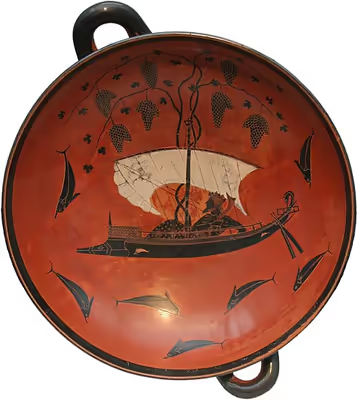
The Homeric Hymns are quoted comparatively rarely in ancient literature. There are sporadic references to them in early Greek lyric poetry, such as the works of Pindar and Sappho. The lyric poet Alcaeus composed hymns around 600 BCE to Dionysus and to the Dioscuri, which were influenced by the equivalent Homeric hymns, as possibly was Alcaeus's hymn to Hermes. The Homeric Hymn to Hermes also inspired the Ichneutae, a satyr play composed in the fifth century BCE by the Athenian playwright Sophocles. Few definite references to the hymns can be dated to the fourth century BCE, though the Thebaid of Antimachus may contain allusions to the hymns to Aphrodite, Dionysus and Hermes. A few fifth-century painted vases show myths depicted in the Homeric Hymns and may have been inspired by the poems, but it is difficult to be certain whether the correspondences reflect direct contact with the hymns or simply the commonplace nature of their underlying mythic narratives.
The hymns do not appear to have been studied by the Hellenistic scholiasts of Alexandria, though they were used and adapted by Alexandrian poets, particularly of the third century BCE. Eratosthenes, the chief librarian at Alexandria, adapted the Homeric Hymn to Hermes for his own Hermes, an account of the god's birth and invention of the lyre. Phainomena, a didactic poem about the heavens by Aratus, drew on the same poem. Callimachus drew on the Homeric Hymns for his own hymns, and is the earliest poet known to have used them as inspiration for multiple works. The hymns were also used by Theocritus, Callimachus's approximate contemporary, in his Idylls 17, 22 and 24, and by the similarly contemporary Apollonius of Rhodes in his Argonautica. The mythographer Apollodorus, who wrote in the second century BCE, may have had access to a collection of the hymns and considered them Homeric in origin. The first century BCE historian Dionysius of Halicarnassus also quoted from the hymns and referred to them as "Homeric". Diodorus Siculus, another historian writing in the first century BCE, quoted verses of the first Hymn to Dionysus.
The Greek philosopher Philodemus, who moved to Italy between around 80 and 70 BCE and died around 40 to 35 BCE, has been suggested as a possible originator for the movement of manuscripts of the Homeric Hymns into the Roman world, and consequently for their reception into Latin literature. His own works quoted from the hymns to Demeter and Apollo. In Roman poetry, the opening of Lucretius's De rerum natura, written around the mid 50s BCE, has correspondences with the Homeric Hymn to Aphrodite, while Catullus emulated the Homeric Hymns in his epyllion on the wedding of Peleus and Thetis. Virgil drew upon the Homeric Hymns in his Aeneid, composed between 29 and 19 BCE. The encounter in Book 1 of the Aeneid between Aeneas and his mother Venus references the Homeric Hymn to Aphrodite, in which Venus's Greek counterpart seduces Aeneas's father, Anchises. Later in the Aeneid, the account of the theft of Hercules's cattle by the monster Cacus is based upon that of the theft of Apollo's cattle by Hermes in the Homeric Hymn to Hermes.
The Roman poet Ovid made extensive use of the Homeric Hymns: his account of Apollo and Daphne in the Metamorphoses, published in 8 CE, references the Hymn to Apollo, while other parts of the Metamorphoses make reference to the Hymn to Demeter, the Hymn to Aphrodite and the second Hymn to Dionysus. Ovid's account of the abduction of Persephone in his Fasti, written and revised between 2 and around 14 CE, likewise references the Hymn to Demeter. Ovid further makes use of the Hymn to Aphrodite in Heroides 16, in which Paris adapts a section of the hymn to convince Helen of his worthiness for her. The Odes of Ovid's contemporary Horace also make use of the Homeric Hymns, particularly the five longer poems. In the second century CE, the Greek-speaking authors Lucian and Aelius Aristides drew on the hymns: Aristides used them in his orations, while Lucian parodied them in his satirical Dialogues of the Gods.
Late antiquity to Renaissance
In late antiquity (that is, from around the third to the sixth centuries CE), the direct influence of the Homeric Hymns was comparatively limited until the fifth century. The Hymn to Hermes was a partial exception, as it was frequently taught in schools. It is possibly alluded to in an anonymous third-century poem praising a gymnasiarch named Theon, preserved by a papyrus fragment found at Oxyrhynchus in Egypt and probably written by a student for a local festival. It also influenced the "Strasbourg Cosmogony", a poem composed around 350 CE (possibly by the poet and local politician Andronicus) in commemoration of the mythical origins of the Egyptian city of Hermopolis Magna. The Homeric Hymns did influence the fourth-century Christian poem The Vision of Dorotheus and a third-century hymn to Jesus transmitted among the Sibylline Oracles. They may also have been a model, alongside the hymns of Callimachus, for the fourth-century Christian hymns known as the Poemata Arcana, written by Gregory of Nazianzus. In the fifth century, the Greek-speaking poet Nonnus quoted and adapted the hymns; from that time onwards, other poets, such as Musaeus Grammaticus and Coluthus, made use of them.
Although the Homeric Hymns were known and transmitted in the Byzantine period, they were only rarely referenced, and never quoted, in Byzantine literature. The sixth-century poet Paul Silentiarius celebrated the restoration of Hagia Sophia by the emperor Justinian I in a poem which borrowed from the Homeric Hymn to Hermes. Later authors, such as the eleventh-century Michael Psellos, may have drawn upon them, but it is often unclear whether their allusions are drawn directly from the Homeric Hymns or from other works narrating the same myths. The hymns have also been cited as an inspiration for the twelfth-century poetry of Theodore Prodromos. The Homeric Hymns were copied and adapted widely in fifteenth-century Italy, for example by the poets Michael Marullus and Francesco Filelfo. Marsilio Ficino made a translation of them around 1462; Giovanni Tortelli used them for examples in his 1478 grammatical treatise De Orthographia. The Stanze per la giostra ('Stanzas for the Joust'), written in the 1470s by Angelo Poliziano, paraphrase the second Homeric Hymn to Aphrodite, and were in turn an inspiration for Sandro Botticelli's The Birth of Venus, painted in the 1480s.
Early modern period onwards
Georgius Dartona made the first translation of the Homeric Hymns into Latin, which was published in Paris by Chrétien Wechel in 1538. Around 1570, the French humanist Jean Daurat gave lectures in which he advanced an allegorical reading of the opening of the first Hymn to Aphrodite. The first English translation of the hymns was made by George Chapman in 1624, as part of his complete translation of Homer's works. Although they received relatively little attention in English poetry in the seventeenth and eighteenth centuries, the playwright and poet William Congreve published a version of the first Hymn to Aphrodite, written in heroic couplets, in 1710. Congreve also wrote an operatic libretto, Semele, set to music by John Eccles in 1707 but not performed until the twentieth century. Congreve published the libretto in 1710; in 1744, George Frideric Handel released a version of the opera with his own music and alterations to the libretto made by an unknown collaborator, including a newly-added passage quoting Congreve's translation of the Hymn to Aphrodite. The rediscovery of the Hymn to Demeter in 1777 sparked a series of scholarly editions of the poem in Germany, and its first translations into German (in 1780) and Latin (in 1782). It was also an influence on Johann Wolfgang von Goethe's melodrama Proserpina, first published as a prose work in 1778.
The hymns were frequently read, praised and adapted by the English Romantic poets of the early nineteenth century. In 1814, the essayist and poet Leigh Hunt published a translation of the second Hymn to Dionysus. Thomas Love Peacock adapted part of the same hymn in the fifth canto of his Rhododaphne, published posthumously in 1818. In January 1818, Percy Bysshe Shelley made a translation of some of the shorter Homeric Hymns into heroic couplets; in July 1820, he translated the Hymn to Hermes into ottava rima. Of Shelley's own poems, The Witch of Atlas, written in 1820, and With a Guitar, to Jane, written in 1822, were most closely influenced by the Homeric Hymns, particularly the Hymn to Hermes. The 1889 poem "Demeter and Persephone" by Alfred, Lord Tennyson, reinterprets the narrative of the Hymn to Demeter as an allegory for the coming of Christ.
The Hymn to Demeter was particularly influential as one of the few sources, and the earliest source, for the religious rituals known as the Eleusinian Mysteries. It became an important nexus of the debate as to the nature of early Greek religion in early-nineteenth-century German scholarship. The anthropologist James George Frazer discussed the hymn at length in The Golden Bough, his influential 1890 work of comparative mythology and religion. James Joyce made use of the same hymn, and possibly Frazer's work, in his 1922 novel Ulysses, in which the character Stephen Dedalus references "an old hymn to Demeter" while undergoing a journey reminiscent of the Eleusinian Mysteries. Joyce also drew upon the Hymn to Hermes in the characterisation of both Dedalus and his companion Buck Mulligan. The Cantos by Joyce's friend and mentor Ezra Pound, written between 1915 and 1960, also draw on the Homeric Hymns: Canto I concludes with parts of the hymns to Aphrodite, in both Latin and English. In modern Greek poetry, the 1901 "Interruption" by Constantine P. Cavafy references the myth of Demophon as told in the Homeric Hymn to Demeter.
The first Homeric Hymn to Aphrodite has also been cited as an influence on Alfred Hitchcock's 1954 film Rear Window, particularly for the character of Lisa Freemont, played by Grace Kelly. Judith Fletcher has traced allusions to the Homeric Hymn to Demeter in Neil Gaiman's 2002 children's novel Coraline and its 2009 film adaptation, arguing that the allusions in the novel's text are "subliminal" but become explicit in the film.
Textual history
Ancient and early modern transmission
Only a few ancient papyrus copies of the Homeric Hymns are known. An Attic vase painted around 470 BCE shows a youth, seated, holding a scroll with the first two words of the second Homeric Hymn to Hermes: this has been used to suggest that the hymns were used as educational texts by this period. At least the longer hymns seem to have been collected into a single edition at some point during the Hellenistic period (323–30 BCE). Alexander Hall has argued that Hymns 1–26, except 6 (the Hymn to Aphrodite) and 8 (the Hymn to Ares), were initially collected into what he calls a "proto-collection", probably no earlier than the Hellenistic period, with the remaining hymns later added as an appendix.
Unlike those of the Iliad and Odyssey, the text of the Homeric Hymns was comparatively little edited by the Hellenistic scholars of Alexandria. Franco Ferrari has suggested that, throughout antiquity, manuscripts of the text may have circulated which intentionally included two different versions ("doublets") of the same word: Alexandrian scholars developed the practice of marking these with a dotted antisigma (ↄ), evidence of which can be found in surviving manuscripts of the Hymn to Apollo.
The grouping of the hymns into their current corpus may date to late antiquity. References to the shorter poems as being within the corpus begin to be found in sources dating from the second and third centuries CE. The assemblage of the thirty-three hymns listed today as "Homeric" dates to no earlier than the third century CE. Between the fifth and the thirteenth centuries CE, the Homeric Hymns were generally transcribed in an edition which also contained the Hymns of Callimachus, the Orphic Hymns, the hymns of Proclus and the Orphic Argonautica.
Manuscripts of the Homeric Hymns, often bundling them with other works such as the hymns of Callimachus, continued to be made during the Byzantine period. The surviving medieval manuscripts of the poems date to the fifteenth century and are drawn primarily from the late-antique compilation of the Homeric Hymns along with Orphic and other hymnic poetry. They all descend from a single, now-lost manuscript, known in scholarship by the siglum Ω (omega) and possibly written in minuscule. In fifteenth-century Italy, the hymns were copied widely. A manuscript known by the siglum V, commissioned by the Byzantine-born Catholic cardinal Bessarion probably in the 1460s, published the hymns at the end of a collection of the other works then considered Homeric. This arrangement became standard in subsequent editions of Homer's works, and played an important role in establishing the perceived relationship between the hymns, the Iliad and the Odyssey. The first printed edition (editio princeps) of the works of Homer, which included the Homeric Hymns, was made by the Florence-based Greek scholar Demetrios Chalkokondyles in 1488–1489. The 1566 edition, made by Henri Estienne, was the first to include line numbers and a Latin translation.
By the end of the eighteenth century, twenty-five Byzantine manuscripts were known. One, known as M or the Codex Mosquensis, was written by the polymath Ioannes Eugenikos in the first half of the fifteenth century, possibly in Constantinople or Italy. This manuscript preserved both the first Hymn to Dionysus and the Hymn to Demeter, but both were lost at some point after its creation and remained unknown until 1777, when the philologist Christian Frederick Matthaei discovered Μ in a barn outside Moscow. All surviving manuscripts, apart from Μ, have among their sources a lost one known by the siglum Ψ (psi), which probably dates to the twelfth or thirteenth century. This may be a manuscript mentioned in a letter by the humanist Giovanni Aurispa in 1424, which he stated he had acquired in Constantinople; Aurispa's manuscript has also been suggested as being Ω. As of 2016, a total of twenty-nine manuscripts of the hymns are known.
Modern scholarship
Until the later twentieth century, the Homeric Hymns received relatively little attention from classical scholars or translators. No collation of the hymns' manuscripts was made between that of Chalkokondyles in 1488 and 1749. Joshua Barnes published an edition of the hymns in 1711, which was the first to attempt to explain textual issues by citing parallels in other texts considered to be Homeric. Friedrich August Wolf published two editions, as part of larger editions of Homer, in 1794 and 1807. The first modern edition of the hymns as a separate text, without the Homeric epics, was made in 1796 by Karl David Ilgen and followed by editions by August Mattiae in 1805 and Gottfried Hermann in 1806. In 1886, Albert Gemoll published a German edition of the hymns: this was both the first modern edition in a vernacular language (that is, not in Latin) and the only edition to date that has printed digammas in their text. The present conventional order of the hymns was established by the Oxford edition of Alfred Goodwin in 1893, following that employed by the manuscript M: previously, the Hymn to Apollo had been placed first. Reviewing Goodwin's work in 1894, Edward Ernest Sikes judged that most of the important work on the Homeric Hymns had previously been done by German scholars, and that "little of importance" had recently been written, apart from Goodwin's edition, on them in English.
In the first half of the eighteenth century, Jacques Philippe d’Orville wrote a book of notes on the text of the Homeric Hymns, in which he condemned Barnes's then-standard 1711 edition and the 1722 edition of Michel Maittaire. The first modern textual criticism of the hymns dates to 1749, when David Ruhnken published his readings of two medieval manuscripts, known as A and C. The hymns' text was a matter of considerable scholarly attention in the nineteenth and early twentieth centuries. August Baumeister published an edition of the hymns in 1860, which was the first to integrate readings based on the Θ (theta) family of manuscripts (a sub-family of those descended from Ψ). Robert Yelverton Tyrrell wrote in 1894 that the text of the Homeric Hymns had been in a "state of chaos" before Baumeister's edition, though their text was still considered problematic at the turn of the 20th century: Thomas Leyden Agar wrote in 1916 of the "manifold and manifest" errors of tradition in the hymns. In 1984, Bruno Gentili suggested that variations found in the manuscript tradition as to the reading of particular passages may have been considered equally-correct alternations (adiaphoroi) available to a rhapsode, and therefore that attempts to discriminate between them in modern editions were misguided.
Between 1894 and 1897, Thomas William Allen published a series of four articles in The Journal of Hellenic Studies on textual problems in the Homeric Hymns, which became the basis of the 1904 edition of the hymns he co-produced with Edward Ernest Sikes. In 1912, Allen published an edition of the hymns in the Oxford Classical Texts series. He published an updated version of his 1904 edition in 1936, co-edited with William Reginald Halliday; Sikes refused to collaborate on it, but remained credited as an editor. The first commentary on a single hymn was that of Nicholas Richardson on the Hymn to Demeter in 1974. In his Loeb Classical Library edition of 2003, Martin West rejected the adiaphoroi argument of Gentili, choosing instead to posit a correct reading for each known alternation.