


Explore on Lably
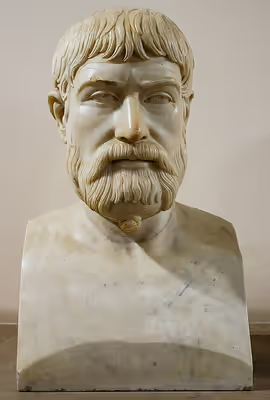
ToursExplore Lably’s 3D toursPindar was the first Greek poet to reflect on the nature of poetry and on the poet's role. His poetry illustrates the beliefs and values of Archaic Greece at the dawn of the Classical period.
Biography
Life
Infancy to adulthood
Pindar was born circa 518 BC (the 65th Olympiad) in Cynoscephalae, a village in Boeotia, not far from Thebes. His father's name is variously given as Daiphantus, Pagondas or Scopelinus, and his mother's name was Cleodice. It is told that in his youth, or possibly infancy, bees built a honeycomb in his mouth and this was the reason he became a poet of honey-like verses. (An identical fate has been ascribed to other poets of the archaic period.) Pindar was about twenty years old in 498 BC when he was commissioned by the ruling family in Thessaly to compose his first victory ode (Pythian 10). He studied the art of lyric poetry in Athens, where his tutor was Lasos of Hermione, and he is also said to have received some helpful criticism from Corinna.
The early to middle years of Pindar's career coincided with the Greco-Persian Wars during the reigns of Darius and Xerxes. This period included the first Persian invasion of Greece, which ended at the Battle of Marathon in 490 BC, and the second Persian invasion of Greece (480–479 BC). During the second invasion, when Pindar was almost forty years old, Thebes was occupied by Xerxes' general, Mardonius, who with many Theban aristocrats subsequently perished at the Battle of Plataea. It is possible that Pindar spent much of this time at Aegina. His choice of residence during the earlier invasion in 490 BC is not known, but he was able to attend the Pythian Games of that year, where he first met the Sicilian prince, Thrasybulus, nephew of Theron of Acragas. Thrasybulus had driven the winning chariot; and he and Pindar were to form a lasting friendship, paving the way for his subsequent visit to Sicily.
Middle age
Pindar seems to have used his odes to advance his, and his friends', personal interests. In 462 BC he composed two odes in honour of Arcesilas, king of Cyrene, (Pythians 4 and 5), pleading for the return from exile of a friend, Demophilus. In the latter ode Pindar proudly mentions his own ancestry, which he shared with the king, as an Aegeid or descendant of Aegeus, the legendary king of Athens. The clan was influential in many parts of the Greek world, having intermarried with ruling families in Thebes, in Lacedaemonia, and in cities that claimed Lacedaemonian descent, such as Cyrene and Thera. The historian Herodotus considered the clan important enough to deserve mention (Histories IV.147). Membership of this clan possibly contributed to Pindar's success as a poet, and it informed his political views, which are marked by a conservative preference for oligarchic governments of the Doric kind.
Pindar might not actually claim to be an Aegeid since his 'I' statements do not necessarily refer to himself. The Aegeid clan did however have a branch in Thebes, and his reference to 'my ancestors' in Pythian 5 could have been spoken on behalf of both Arcesilas and himself – he may have used this ambivalence to establish a personal link with his patrons.
He was possibly the Theban proxenos or consul for Aegina and/or Molossia, as indicated in another of his odes, Nemean 7, in which he glorifies Neoptolemus, a national hero of Aegina and Molossia. According to tradition, Neoptolemus died disgracefully in a fight with priests at the temple in Delphi over their share of some sacrificial meat. Pindar diplomatically glosses over this and concludes mysteriously with an earnest protestation of innocence – "But shall my heart never admit that I with words none can redeem dishonoured Neoptolemus". Possibly he was responding to anger among Aeginetans and/or Molossians over his portrayal of Neoptolemus in an earlier poem, Paean 6, which had been commissioned by the priests at Delphi and which depicted the hero's death in traditional terms, as divine retribution for his crimes.
Some doubt this biographical interpretation of Nemean 7 since it is largely based on marginal comments by scholiasts and Pindaric scholiasts are often unreliable. The fact that Pindar gave different versions of the myth may simply reflect the needs of different genres, and does not necessarily indicate a personal dilemma. Nemean 7 in fact is the most controversial and obscure of Pindar's victory odes, and scholars ancient and modern have been ingenious and imaginative in their attempts to explain it, so far with no agreed success.
In his first Pythian ode, composed in 470 BC in honour of the Sicilian tyrant Hieron, Pindar celebrated a series of victories by Greeks against foreign invaders: Athenian and Spartan-led victories against Persia at Salamis and Plataea, and victories by the western Greeks led by Theron of Acragas and Hieron against the Carthaginians and Etruscans at the battles of Himera and Cumae. Such celebrations were not appreciated by his fellow Thebans: they had sided with the Persians and had incurred many losses and privations as a result of their defeat. His praise of Athens with such epithets as bulwark of Hellas (fragment 76) and city of noble name and sunlit splendour (Nemean 5) induced the authorities in Thebes to fine him 5,000 drachmae, to which the Athenians are said to have responded with a gift of 10,000 drachmae. According to another account, the Athenians even made him their proxenus or consul in Thebes. His association with the fabulously rich Hieron was another source of annoyance at home. It was probably in response to Theban sensitivities over this issue that he denounced the rule of tyrants (i.e. rulers like Hieron) in an ode composed shortly after a visit to Hieron's sumptuous court in 476–75 BC (Pythian 11).
Pindar's actual phrasing in Pythian 11 was "I deplore the lot of tyrants" and though this was traditionally interpreted as an apology for his dealings with Sicilian tyrants like Hieron, an alternative date for the ode has led some scholars to conclude that it was in fact a covert reference to the tyrannical behaviour of the Athenians, although this interpretation is ruled out if we accept the earlier note about covert references. According to yet another interpretation Pindar is simply delivering a formulaic warning to the successful athlete to avoid hubris. It is highly unlikely that Pindar ever acted for Athenians as their proxenus or consul in Thebes.
Lyric verse was conventionally accompanied by music and dance, and Pindar himself wrote the music and choreographed the dances for his victory odes. Sometimes he trained the performers at his home in Thebes, and sometimes he trained them at the venue where they performed. Commissions took him to all parts of the Greek world – to the Panhellenic festivals in mainland Greece (Olympia, Delphi, Corinth and Nemea), westwards to Sicily, eastwards to the seaboard of Asia Minor, north to Macedonia and Abdera (Paean 2) and south to Cyrene on the African coast. Other poets at the same venues vied with him for the favours of patrons. His poetry sometimes reflects this rivalry. For example, Olympian 2 and Pythian 2, composed in honour of the Sicilian tyrants Theron and Hieron following his visit to their courts in 476–75 BC, refer respectively to ravens and an ape, apparently signifying rivals who were engaged in a campaign of smears against him – possibly the poets Simonides and his nephew Bacchylides. Pindar's original treatment of narrative myth, often relating events in reverse chronological order, is said to have been a favourite target for criticism. Simonides was known to charge high fees for his work and Pindar is said to have alluded to this in Isthmian 2, where he refers to the Muse as "a hireling journeyman". He appeared in many poetry competitions and was defeated five times by his compatriot, the poet Corinna, in revenge of which he called her Boeotian sow in one of his odes (Olympian 6. 89f.).
It was assumed by ancient sources that Pindar's odes were performed by a chorus, but this has been challenged by some modern scholars, who argue that the odes were in fact performed solo. It is not known how commissions were arranged, nor if the poet travelled widely: even when poems include statements like "I have come" it is not certain that this was meant literally. Uncomplimentary references to Bacchylides and Simonides were found by scholiasts but there is no reason to accept their interpretation of the odes. In fact, some scholars have interpreted the allusions to fees in Isthmian 2 as a request by Pindar for payment of fees owed to himself. His defeats by Corinna were probably invented by ancient commentators to account for the Boeotian sow remark, a phrase moreover that was completely misunderstood by scholiasts, since Pindar was scoffing at a reputation that all Boeotians had for stupidity.
Old age and death
His fame as a poet drew Pindar into Greek politics. Athens, the most important city in Greece throughout his poetic career, was a rival of his home city, Thebes, and also of the island state Aegina, whose leading citizens commissioned about a quarter of his Victory Odes. There is no open condemnation of the Athenians in any of his poems but criticism is implied. For example, the victory ode mentioned above (Pythian 8) describes the downfall of the giants Porphyrion and Typhon and this might be Pindar's way of covertly celebrating a recent defeat of Athens by Thebes at the Battle of Coronea (447 BC). The poem ends with a prayer for Aegina's freedom, long threatened by Athenian ambitions.
Covert criticism of Athens (traditionally located in odes such as Pythian 8, Nemean 8 and Isthmian 7) is now dismissed as highly unlikely, even by scholars who allow some biographical and historical interpretations of the poems.
One of his last odes (Pythian 8) indicates that he lived near a shrine to the oracle Alcmaeon and that he stored some of his wealth there. In the same ode he says that he had recently received a prophecy from Alcmaeon during a journey to Delphi ("...he met me and proved the skills of prophecy that all his race inherit") but he does not reveal what the long-dead prophet said to him nor in what form he appeared. The ode was written to commemorate a victory by an athlete from Aegina.
Pindar doesn't necessarily mean himself when he uses the first person singular. Many of his 'I' statements are generic, indicating somebody engaged in the role of a singer i.e. a 'bardic' I. Other 'I' statements articulate values typical of the audience, and some are spoken on behalf of the subjects celebrated in the poems. The 'I' that received the prophecy in Pythian 8 therefore might have been the athlete from Aegina, not Pindar. In that case the prophecy must have been about his performance at the Pythian Games, and the property stored at the shrine was just a votive offering.
Nothing is recorded about Pindar's wife and son except their names, Megacleia and Daiphantus.
About ten days before he died, the goddess Persephone appeared to him and complained that she was the only divinity to whom he had never composed a hymn. She said he would come to her soon and compose one then.
Pindar lived to about eighty years of age. He died around 438 BC while attending a festival at Argos. His ashes were taken back home to Thebes by his musically gifted daughters, Eumetis and Protomache.
Post mortem
One of Pindar's female relatives claimed that he dictated some verses to her in honour of Persephone after he had been dead for several days. Some of Pindar's verses were inscribed in letters of gold on a temple wall in Lindos, Rhodes. At Delphi, where he had been elected a priest of Apollo, the priests exhibited an iron chair on which he used to sit during the festival of the Theoxenia. Every night, while closing the temple doors, they intoned: "Let Pindar the poet go unto the supper of the gods!"
Pindar's house in Thebes became one of the city's landmarks. When Alexander the Great demolished Thebes in 335 BC, as punishment for its resistance to Macedonian expansionism, he ordered the house be left intact out of gratitude for verses praising his ancestor, Alexander I of Macedon.
Values and beliefs
Pindar's values and beliefs have been inferred from his poetry. No other ancient Greek poet has left so many comments about the nature of his art. He justified and exalted choral poetry at a time when society was turning away from it. It "... had for two centuries reflected and shaped the sentiments, the outlook, and the convictions of the Greek aristocracies ... and Pindar spoke up for it with passionate assurance". His poetry is a meeting ground for gods, heroes and men – even the dead are spoken of as participants: "Deep in the earth their heart listens".
His view of the gods is traditional but more self-consistent than Homer's and more reverent. He never depicts gods in a demeaning role. He seems indifferent to the intellectual reforms that were shaping the theology of the times. Thus an eclipse is not a mere physical effect, as contemplated by early thinkers such as Thales, Anaximander and Heraclitus, nor was it even a subject for bold wonder, as it was for an earlier poet, Archilochus; instead Pindar treated an eclipse as a portent of evil.
Gods are the embodiment of power, uncompromisingly proud of their nature and violent in defense of their privileges. There is some rationalization of religious belief, but it is within a tradition at least as old as Hesiod, where abstractions are personified, such as "Truth the daughter of Zeus". Sometimes the wording suggests a belief in 'God' rather than 'a god' (e.g. "What is God? Everything"), but the implications are not given full expression and the poems are not examples of monotheism. Nor do they vocalize a belief in Fate as the background to the gods, unlike the plays of Aeschylus for example. Pindar subjects both fortune and fate to divine will (e.g. "child of Zeus ... Fortune").
He selects and revises traditional myths so as not to diminish the dignity and majesty of the gods. Such revisionism was not unique. Xenophanes had castigated Homer and Hesiod for the misdeeds they ascribed to gods, such as theft, adultery and deception, and Pythagoras had envisioned those two poets being punished in Hades for blasphemy. A subtle example of Pindar's approach can be found in his treatment of the myth of Apollo's rape of the nymph Cyrene. As the god of the Delphic oracle, Apollo is all-knowing, yet in keeping with his anthropomorphic nature he seeks information about the nymph from a third party, in this case the centaur Chiron. Chiron however affirms the god's omniscience with an elegant compliment, as if Apollo had only pretended to be ignorant: "You, Sire, who know the appointed end of all, and all paths..." Apollo's abduction of the nymph is not presented as a shameful act. Pindar's gods are above such ethical issues and it is not for men to judge them by ordinary human standards. Indeed, the finest breeds of men resulted from divine passions: "For Pindar a mortal woman who is loved by a god is an outstanding lesson in divine favours handsomely bestowed".
Being descendants of divine unions with privileged mortals, mythical heroes are an intermediate group between gods and men, and they are sympathetic to human ambitions. Thus, for example, Pindar not only invokes Zeus for help on behalf of the island of Aegina but also its national heroes Aeacus, Peleus and Telamon. Unlike the gods, however, heroes can be judged according to ordinary human standards and they are sometimes shown in the poems to demean themselves. Even in that case, they receive special consideration. Thus Pindar refers obliquely to the murder of Phocus by his brothers Peleus and Telamon ("I am shy of speaking of a huge risk, hazarded not in right"), telling the audience that he will not talk of it ("silence is a man's wisest counsel"). The Theban hero Heracles was a favourite subject but in one poem he is depicted as small in order to be compared with a small Theban patron who had won the pankration at the Isthmian Games: a unique example of Pindar's readiness to shape traditional myths to fit the occasion, even if not always flattering to the mythical hero. A hero's status is not diminished by an occasional blemish but rests on a summary view of his heroic exploits.
Some of his patrons claimed divine descent, such as Diagoras of Rhodes, but Pindar makes all men akin to gods if they realize their full potential: their innate gifts are divinely bestowed, and even then success still depends on the gods' active favour. In honouring such men, therefore, Pindar was honouring the gods too. His statements about life after death were not self-consistent but that was typical for the times. Traditional ambivalence, as expressed by Homer, had been complicated by a growth of religious sects, such as the Eleusinian Mysteries and Pythagoreanism, representing various schemes of rewards and punishments in the next life. However, for the poet, glory and lasting fame were men's greatest assurance of a life well-lived. He presents no theory of history apart from the view that Fortune is variable even for the best men, an outlook suited to moderation in success, courage in adversity. Notions of 'good' and 'bad' in human nature were not analysed by him in any depth nor did he arrive at anything like the compassionate ethics of his near contemporary, Simonides of Ceos. His poems are indifferent to the ordinary mass of people. They are dismissed with phrases such as "the brute multitude" (Pythian Ode 2.87). Nor are the poems concerned with the fate of rich and powerful men once they lose their wealth and social status (compared for example with the bitter and disillusioned poems of Theognis of Megara). They are more interested in what successful men do with their good fortune: success brings obligations, and religious and artistic activities need patrons.
Whereas the Muses inspired Homer with relevant information and with the language to express it, Pindar seems to receive only their inspiration: his role is to shape that inspiration with his own wisdom and skill. Like his patrons, whom he immortalizes in verse, he owes his success to hard work as well as to innate gifts; though he hires himself out, he has a vocation. The Muses are to him as an oracle is to a prophet, and lesser poets are to him as ravens are to an eagle; the art of such men is as hackneyed as garland-making; his is magical:
Sign in to keep reading
One more chapter is free with a Lably account.
Influence and legacy
- The influential Alexandrian poet Callimachus was fascinated by Pindar's originality. His masterpiece Aetia included an elegy in honour of Queen Berenice, celebrating a chariot victory at the Nemean Games, composed in a style and presented in a manner that recall Pindar.
- The Hellenistic epic Argonautica, by Apollonius Rhodius, was influenced by some aspects of Pindar's style and his use of episodic vignettes in narrative. The epic concerns the adventures of Jason, also touched on by Pindar in Pythian 4, and both poems link the myth to a Greek audience in Africa.
- There seems to have been a vogue for Pindaric-style lyrics following the 'publication' of Horace's Odes 1–3. Horace had mastered other styles such as Sapphic and Alcaeic, which had discouraged his contemporaries from attempting anything in the same form, but he had not composed anything in triadic stanzas in the manner of Pindar.
- Pindar was much read, quoted, and copied during the Byzantine Era. For example, Christophoros Mytilenaios of the 11th century parodied a chariot race in his sixth poem, employing explicit allusions to Pindar.
- During the 17th and 18th centuries, literary theorists in Europe distinguished between two types of lyric poetry, loosely associated with Horace and Pindar. Regular verses in four line stanzas were associated with Horace's Odes, which did in fact inspire and influence poets of the period. Irregular verses in longer stanzas were termed Pindarics, though the association with Pindar was largely fanciful. Abraham Cowley was considered the main exponent of English Pindarics. In fact, the two styles were not always easy to distinguish and many 'Pindaric' odes were quite Horatian in content, as in some poems by Thomas Gray.
- A 'Pindaric Ode' was composed for the revived 1896 Olympic Games in Athens by the Oxford scholar George Stuart Robinson, and similar compositions were commissioned from and composed by classicist Armand D'Angour for the Athens Olympics in 2004 and the London Olympics in 2012.
Horace's tribute
The Latin poet Quintus Horatius Flaccus was an admirer of Pindar's style. He described it in one of his Sapphic poems, addressed to a friend, Iullus Antonius:
Bowra's tribute
C. M. Bowra, the leading Pindaric scholar of his generation and the editor of the 1935 OUP edition of his poems, summarized Pindar's qualities in the following words:
His innate, unquestioning pride in his poetical mission means that he gives to it all his gifts and all his efforts. The result is a poetry that by any standards deserves the name because it is based on a radiant vision of reality and fashioned with so subtle, so adventurous, and so dedicated an art that it is worthy to be an earthly counterpart of the songs which Pindar regards as the archetype of music on those lofty occasions when all discords are resolved and all misgivings obliterated by the power of the life-giving word.