

Sappho
Ancient Greek lyric poet (c. 630–c. 570 BC)
- 20 min read
- 5 chapters

Related on Lably
Through Apollo
Little is known of Sappho's life. She was from a wealthy family from Lesbos, though her parents' names are uncertain. Ancient sources say that she had three brothers: Charaxos, Larichos and Eurygios. Two of them, Charaxos and Larichos, are mentioned in the Brothers Poem discovered in 2014. She also appears to have had a daughter, traditionally identified with Cleïs, who is mentioned in two of Sappho's fragments, 98 and 132. Sappho was exiled to Sicily around 600 BC, and may have continued to work until around 570 BC. According to legend, she killed herself by leaping from the Leucadian cliffs due to her unrequited love for the ferryman Phaon.
Sappho was a prolific poet, probably composing around 10,000 lines. She was best-known in antiquity for her love poetry; other themes in the surviving fragments of her work include family and religion. She probably wrote poetry for both individual and choral performance. Most of her best-known and best-preserved fragments explore personal emotions and were probably composed for solo performance. Her works are known for their clarity of language, vivid images, and immediacy. The context in which she composed her poems has long been the subject of scholarly debate; the most influential suggestions have been that she had some sort of educational or religious role, or wrote for the symposium.
Sappho's poetry was well-known and greatly admired through much of antiquity, and she was among the canon of Nine Lyric Poets most highly esteemed by scholars of Hellenistic Alexandria. Sappho's poetry is still considered extraordinary and her works continue to influence other writers. Beyond her poetry, she is well known as a symbol of love and desire between women, with the English words sapphic and lesbian deriving from her name and that of her home island, respectively.
Ancient sources
Modern knowledge of Sappho comes both from what can be inferred from her own poetry and from mentions of her in other ancient texts. Her poetry – which, with the exception of a single complete poem, survives only in fragments – is the only contemporary source for her life. The earliest surviving biography of Sappho dates to the late second or early third century AD, approximately eight centuries after her own lifetime; the next is the Suda, a tenth-century Byzantine encyclopedia. Other sources that mention details of her life were written much closer to her own era, beginning in the fifth century BC; one of the earliest is Herodotus' account of the relationship between the Egyptian courtesan Rhodopis and Sappho's brother Charaxos. The information about her life recorded in ancient sources was derived from statements in her own poetry that ancient authors assumed were autobiographical, along with local traditions. Some of the ancient traditions about her, such as those about her sexuality and appearance, may derive from ancient Athenian comedy.
Until the 19th century, ancient biographical accounts of archaic poets' lives were largely accepted as factual. In the 19th century, classicists began to be more sceptical of these traditions, and instead tried to derive biographical information from the poets' own works. In the latter half of the 20th century, scholars became increasingly sceptical of Greek lyric poetry as a source of autobiographical information, questioning whether the first person narrator in the poems was meant to express the experiences and feelings of the poets. Some scholars, such as Mary Lefkowitz, argue that almost nothing can be known about the lives of early Greek poets such as Sappho; most scholars believe that ancient testimonies about poets' lives contain some truth but must be treated with caution.
Sign in to keep reading
4 more chapters are free with a Lably account.
Life
Little is known about Sappho's life for certain. She was from the island of Lesbos and lived at the end of the seventh and beginning of the sixth centuries BC. This is the date given by most ancient sources, who considered her a contemporary of the poet Alcaeus and the tyrant Pittacus, both also from Lesbos. She therefore may have been born in the third quarter of the seventh century – Franco Ferrari infers a date of around 650 or 640 BC; David Campbell suggests around or before 630 BC. Greek tradition often credited poets with unusually long lives, but though several of Sappho's surviving fragments allude to old age, there is no record of such a tradition for her. Gregory Hutchinson suggests she was active until around 570 BC.
Tradition names Sappho's mother as Cleïs. This may derive from a now-lost poem or record, though ancient scholars may simply have guessed this name, assuming that Sappho's daughter was named Cleïs after her mother. Ancient sources record ten different names for Sappho's father; this proliferation of possible names suggests that he was not explicitly named in any of her poetry. The earliest and most commonly attested name for him is Scamandronymus. In Ovid's Heroides, Sappho's father died when she was six. He is not mentioned in any of her surviving works, but Campbell suggests that this detail may have been based on a now-lost poem. Her own name is found in numerous variant spellings; the form that appears in her own extant poetry is Psappho (Ψάπφω).
Sappho was said to have three brothers: Eurygios, Larichos, and Charaxos. According to Athenaeus, she praised Larichos for being a cupbearer in the town hall of Mytilene, an office held by boys of the best families. This indication that Sappho was born into an aristocratic family is consistent with the sometimes-rarefied environments that her verses record. One ancient tradition tells of a relationship between Charaxos and the Egyptian courtesan Rhodopis. In the fifth century BC Herodotus, the oldest source of the story, reports that Charaxos ransomed Rhodopis for a large sum and that Sappho wrote a poem rebuking him for this. The names of two of the brothers, Charaxos and Larichos, are mentioned in the Brothers Poem, discovered in 2014; the final brother, Eurygios, is mentioned in three ancient sources but nowhere in the extant works of Sappho.
Sappho may have had a daughter named Cleïs, who is referred to in two fragments. Not all scholars accept that Cleïs was Sappho's daughter. Fragment 132 describes Cleïs as "pais", which, as well as meaning "child", can also refer to the "youthful beloved in a male homosexual liaison". It has been suggested that Cleïs was one of her younger lovers, rather than her daughter, though Judith Hallett argues that the description of Cleis as "agapata" ("beloved") in fragment 132 suggests that Sappho was referring to Cleïs as her daughter, as in other Greek literature the word is used for familial but not sexual relationships.
According to the Suda, Sappho was married to Kerkylas of Andros. This name appears to have been invented by a comic poet: the name Kerkylas appears to be a diminutive of the word kerkos, a possible meaning of which is "penis", and which is not otherwise attested as a name, while "Andros", as well as being the name of a Greek island, is a form of the Greek word aner, which means "man". Thus the name, for which an English equivalent could be "Prick (of the isle) of Man", is likely to have originated from a comic play.
One tradition said that Sappho was exiled from Lesbos around 600 BC. The only ancient source for this story is the Parian Chronicle, which records her going into exile in Sicily some time between 604 and 595. This may have been as a result of her family's involvement with the conflicts between political elites on Lesbos in this period. It is unknown which side Sappho's family took in these conflicts, but most scholars believe that they were in the same faction as her contemporary Alcaeus, who was exiled when Myrsilus took power.
A tradition going back at least to Menander (Fr. 258 K) suggested that Sappho killed herself by jumping off the Leucadian cliffs due to her unrequited love of Phaon, a ferryman. This story is related to two myths about the goddess Aphrodite. In one, Aphrodite rewarded the elderly ferryman Phaon with youth and good looks as a reward for taking her in his ferry without asking for payment; in the other, Aphrodite was cured of her grief at the death of her lover Adonis by throwing herself off the Leucadian cliffs on the advice of Apollo. The story of Sappho's leap is regarded as ahistorical by modern scholars, perhaps invented by the comic poets or originating from a misreading of a first-person reference in a non-biographical poem. It was used to reassure ancient audiences of Sappho's heterosexuality, and became particularly important in the nineteenth century to writers who saw homosexuality as immoral and wished to construct Sappho as heterosexual.
Social context
One of the major focuses of scholars studying Sappho has been to attempt to determine the cultural context in which Sappho's poems were composed and performed. Various cultural contexts and social roles played by Sappho have been suggested: primarily teacher, priestess, chorus leader, and symposiast. However, the performance contexts of many of Sappho's fragments are not easy to determine, and more than one possible context is conceivable for many.
One longstanding suggestion of a social role for Sappho is that of "Sappho as schoolmistress". This view, popular in the nineteenth and early twentieth centuries, was advocated by the German classicist Ulrich von Wilamowitz-Moellendorff, to "explain away Sappho's passion for her 'girls'" and defend her from accusations of homosexuality. More recently the idea has been criticised by historians as anachronistic and has been rejected by several prominent classicists as unjustified by the evidence. In 1959, Denys Page, for example, stated that Sappho's extant fragments portray "the loves and jealousies, the pleasures and pains, of Sappho and her companions"; and he adds, "We have found, and shall find, no trace of any formal or official or professional relationship between them... no trace of Sappho the principal of an academy." Campbell in 1967 judged that Sappho may have "presided over a literary coterie", but that "evidence for a formal appointment as priestess or teacher is hard to find". None of Sappho's own poetry mentions her teaching, and the earliest source to support the idea of Sappho as a teacher comes from Ovid, six centuries after Sappho's lifetime.
In the second half of the twentieth century, scholars began to interpret Sappho as involved in the ritual education of girls, for instance as a trainer of choruses of girls. Though not all of her poems can be interpreted in this light, Lardinois argues that this is the most plausible social context to site Sappho in. Another interpretation which became popular in the twentieth century was of Sappho as a priestess of Aphrodite. However, though Sappho wrote hymns, including some dedicated to Aphrodite, there is no evidence that she held a priesthood. More recent scholars have proposed that Sappho was part of a circle of women who took part in symposia, for which she composed and performed poetry, or that she wrote her poetry to be performed at men's symposia. Though her songs were certainly later performed at symposia, there is no external evidence for archaic Greek women's symposia, and even if some of her works were composed for a sympotic context, it is doubtful that the cultic hymns or poems about family would have been.
Despite scholars' best attempts to find one, Yatromanolakis argues that there is no single performance context to which all of Sappho's poems can be attributed. Camillo Neri argues that it is unnecessary to assign all of her poetry to one context, and suggests that she could have composed poetry both in a pedogogic role and as part of a circle of friends.
Sexuality
The word lesbian is an allusion to Sappho, originating from the name of the island of Lesbos, where she was born. However, though in modern culture Sappho is seen as a lesbian, she has not always been considered so. In classical Athenian comedy (from the Old Comedy of the fifth century to Menander in the late fourth and early third centuries BC), Sappho was caricatured as a promiscuous heterosexual woman, and the earliest surviving sources to explicitly discuss Sappho's homoeroticism come from the Hellenistic period. The earliest of these is the Papyrus Oxyrhynchus 1800, a fragmentary biography written in the late second century A.D, which states that Sappho was "accused by some of being irregular in her ways and a woman-lover". Denys Page comments that the phrase "by some" implies that even the full corpus of Sappho's poetry did not provide conclusive evidence of whether she described herself as having sex with women. These ancient authors do not appear to have believed that Sappho did, in fact, have sexual relationships with other women, and as late as the 10th century the Suda records that Sappho was "slanderously accused" of having sexual relationships with her "female pupils".
Among modern scholars, Sappho's sexuality is still debated: André Lardinois has described it as the "Great Sappho Question". Early translators of Sappho sometimes heterosexualised her poetry. Ambrose Philips' 1711 translation of the Ode to Aphrodite portrayed the object of Sappho's desire as male, a reading that was followed by virtually every other translator of the poem until the 20th century, while in 1781 Alessandro Verri interpreted fragment 31 as being about Sappho's love for Phaon. Friedrich Gottlieb Welcker argued that Sappho's feelings for other women were "entirely idealistic and non-sensual", while Karl Otfried Müller wrote that fragment 31 described "nothing but a friendly affection": Glenn Most comments that "one wonders what language Sappho would have used to describe her feelings if they had been ones of sexual excitement", if this theory were correct. By 1970, the psychoanalyst George Devereux argued that the same poem contained "proof positive of [Sappho's] lesbianism".
Today, it is generally accepted that Sappho's poetry portrays homoerotic feelings: as Sandra Boehringer puts it, her works "clearly celebrate eros between women". Toward the end of the 20th century, though, some scholars began to reject the question of whether Sappho was a lesbian – Glenn Most wrote that Sappho herself "would have had no idea what people mean when they call her nowadays a homosexual", André Lardinois stated that it is "nonsensical" to ask whether Sappho was a lesbian, and Page duBois calls the question a "particularly obfuscating debate". Some scholars argue that although Sappho would not have understood modern conceptions of sexuality, lesbianism has always existed and she was fundamentally a lesbian. Others, influenced by Michel Foucault's work on the history of sexuality, believe that it is incoherent to project the concept of lesbianism onto an ancient figure like Sappho. Melissa Mueller argues that Sappho's poetry can be read as queer even if the question of her lesbianism is undecidable.
Legacy
Ancient reputation
In antiquity, Sappho's poetry was highly admired, and several ancient sources refer to her as the "tenth Muse". The earliest surviving text to do so is a third-century BC epigram by Dioscorides, but poems are preserved in the Greek Anthology by Antipater of Sidon and attributed to Plato on the same theme. She was sometimes referred to as "The Poetess", just as Homer was "The Poet". The scholars of Alexandria included her in the canon of nine lyric poets. According to Aelian, the Athenian lawmaker and poet Solon asked to be taught a song by Sappho "so that I may learn it and then die". This story may well be apocryphal, especially as Ammianus Marcellinus tells a similar story about Socrates and a song of Stesichorus, but it is indicative of how highly Sappho's poetry was considered in the ancient world.
Sappho's poetry also influenced other ancient authors. Plato cites Sappho in his Phaedrus, and Socrates' second speech on love in that dialogue appears to echo Sappho's descriptions of the physical effects of desire in fragment 31. Many Hellenistic poets alluded to or adapted Sappho's works. The Locrian poet Nossis was described by Marilyn B. Skinner as an imitator of Sappho, and Kathryn Gutzwiller argues that Nossis explicitly positioned herself as an inheritor of Sappho's position as a female poet. Several of Theocritus' poems allude to Sappho, including Idyll 28, which imitates both her language and meter. Poems such as Erinna's Distaff and Callimachus' Lock of Berenice are Sapphic in theme, being concerned with separation – Erinna from her childhood friend; the lock of Berenice's hair from Berenice herself.
In the first century BC, the Roman poet Catullus established the themes and metres of Sappho's poetry as a part of Latin literature, adopting the Sapphic stanza, believed in antiquity to have been invented by Sappho, giving his lover in his poetry the name "Lesbia" in reference to Sappho, and adapting and translating Sappho's 31st fragment in his poem 51. Fragment 31 is widely referenced in Latin literature: as well as by Catullus, it is alluded to by authors including Lucretius in the De rerum natura, Plautus in Miles Gloriosus, and Virgil in book 12 of the Aeneid. Latin poets also referenced other fragments: the section on Eppia in Juvenal's sixth satire references fragment 16, a poem in Sapphic stanzas from Statius' Silvae may reference the Ode to Aphrodite, and Horace's Ode 3.27 alludes to fragment 94.
Other ancient poets wrote about Sappho's life. She was a popular character in ancient Athenian comedy, and at least six separate comedies called Sappho are known. The earliest known ancient comedy to take Sappho as its main subject was the late-fifth or early-fourth century BC Sappho by Ameipsias, though nothing is known of it apart from its name. As these comedies survive only in fragments, it is uncertain exactly how they portrayed Sappho, but she was likely characterised as a promiscuous woman. In Diphilos' play, she was the lover of the poets Anacreon and Hipponax.
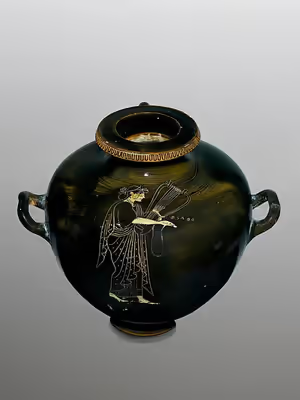
Sappho was also a favourite subject in the visual arts. She was the most commonly depicted poet on sixth and fifth-century Attic red-figure vase paintings – though unlike male poets such as Anacreon and Alcaeus, in the four surviving vases in which she is identified by an inscription she is never shown singing. She was also shown on coins from Mytilene and Eresos from the first to third centuries AD, and reportedly depicted in a sculpture by Silanion at Syracuse, statues in Pergamon and Constantinople, and a painting by the Hellenistic artist Leon.
From the fourth century BC, ancient works portray Sappho as a tragic heroine, driven to suicide by her unrequited love for Phaon. A fragment of a play by Menander says that Sappho threw herself off of the cliff at Leucas out of her love for him. Ovid's Heroides 15 is written as a letter from Sappho to Phaon, and when it was first rediscovered in the 15th century was thought to be a translation of an authentic letter by Sappho. Sappho's suicide was also depicted in classical art, for instance on the first-century BC Porta Maggiore Basilica in Rome.
While Sappho's poetry was admired in the ancient world, her character was not always so well considered. In the Roman period, critics found her lustful and perhaps even homosexual. Horace called her "mascula Sappho" ("masculine Sappho") in his Epistles, which the later Porphyrio commented was "either because she is famous for her poetry, in which men more often excel, or because she is maligned for having been a tribad". By the third century AD, the difference between Sappho's literary reputation as a poet and her moral reputation as a woman had become so significant that the suggestion that there were in fact two Sapphos began to develop. In his Historical Miscellanies, Aelian wrote that there was "another Sappho, a courtesan, not a poetess".
Modern reception
By the medieval period, Sappho's works had been lost, though she was still quoted in later authors. Her work became more accessible in the 16th century through printed editions of those authors who had quoted her. In 1508 Aldus Manutius printed an edition of Dionysius of Halicarnassus, which contained Sappho 1, the Ode to Aphrodite, and the first printed edition of Longinus' On the Sublime, complete with his quotation of Sappho 31, appeared in 1554. In 1566, the French printer Robert Estienne produced an edition of the Greek lyric poets that contained around 40 fragments attributed to Sappho.
In 1652, the first English translation of a poem by Sappho was published, in John Hall's translation of On the Sublime. In 1681 Anne Le Fèvre's French edition of Sappho made her work even more widely known. Theodor Bergk's 1854 edition became the standard edition of Sappho in the second half of the 19th century; in the first part of the 20th century, the papyrus discoveries of new poems by Sappho led to editions and translations by Edwin Marion Cox and John Maxwell Edmonds, and culminated in the 1955 publication of Edgar Lobel's and Denys Page's Poetarum Lesbiorum Fragmenta.
Like the ancients, modern critics have tended to consider Sappho's poetry "extraordinary". As early as the ninth century, Sappho was referred to as a talented female poet, and in works such as Boccaccio's De Claris Mulieribus and Christine de Pisan's Book of the City of Ladies she gained a reputation as a learned lady. Even after Sappho's works had been lost, the Sapphic stanza continued to be used in medieval lyric poetry, and with the rediscovery of her work in the Renaissance, she began to increasingly influence European poetry. In the 16th century, members of La Pléiade, a circle of French poets, were influenced by her to experiment with Sapphic stanzas and with writing love-poetry with a first-person female voice.
From the Romantic era, Sappho's work – especially her Ode to Aphrodite – has been a key influence of conceptions of what lyric poetry should be. Poets such as Alfred Lord Tennyson in the 19th century, and A. E. Housman in the 20th century, have been influenced by her poetry. Tennyson based poems including "Eleanore" and "Fatima" on Sappho's fragment 31, while three of Housman's works are adaptations of the Midnight Poem, long thought to be by Sappho though the authorship is now disputed. At the beginning of the 20th century, the Imagists – especially Ezra Pound, H. D., and Richard Aldington – were influenced by Sappho's fragments; a number of Pound's poems in his early collection Lustra were adaptations of Sapphic poems, while H. D.'s poetry frequently echoed Sappho stylistically and thematically, and in some cases, such as "Fragment 40", more specifically invoke Sappho's writing.
Western classical composers have also been inspired by Sappho. The story of Sappho and Phaon began to appear in opera in the late 18th century, for example in Simon Mayr's Saffo; in the 19th century Charles Gounod's Sapho and Giovanni Pacini's Saffo portrayed a Sappho involved in political revolts. In the 20th century, Peggy Glanville-Hicks' opera Sappho was based on the play by Lawrence Durrell. Instrumental works inspired by Sappho include Chant sapphique by Camille Saint-Saëns, and the percussion piece Psappha by Iannis Xenakis. Composers have also set Sappho's own poetry to music: for example Xenakis' Aïs, which uses text from fragment 95, and Charaxos, Eos and Tithonos (2014) by Theodore Antoniou, based on the 2014 discoveries.
It was not long after the rediscovery of Sappho that her sexuality once again became the focus of critical attention. In the early 17th century, John Donne wrote "Sapho to Philaenis", returning to the idea of Sappho as a hypersexual lover of women. The modern debate on Sappho's sexuality began in the 19th century, with Welcker publishing, in 1816, an article defending Sappho from charges of prostitution and lesbianism, arguing that she was chaste – a position that was later taken up by Wilamowitz at the end of the 19th and Henry Thornton Wharton at the beginning of the 20th centuries. In the 19th century Sappho was co-opted by Charles Baudelaire in France and later Algernon Charles Swinburne in England for the Decadent Movement. The critic Douglas Bush characterised Swinburne's sadomasochistic Sappho as "one of the daughters of de Sade", the French author known for his violent pornographic books. By the late 19th century, lesbian writers such as Michael Field and Amy Levy became interested in Sappho for her sexuality, and by the turn of the 20th century she was considered a "patron saint of lesbians".
From the beginning of the 19th century, women poets such as Felicia Hemans (The Last Song of Sappho) and Letitia Elizabeth Landon (Sketch the First. Sappho, and in Ideal Likenesses) took Sappho as one of their progenitors. Sappho also began to be regarded as a role model for campaigners for women's rights, beginning with works such as Caroline Norton's The Picture of Sappho. Later in that century, she became a model for the so-called New Woman – independent and educated women who desired social and sexual autonomy – and by the 1960s, the feminist Sappho was – along with the hypersexual, often but not exclusively lesbian Sappho – one of the two most important cultural perceptions of her.
The discoveries of new poems by Sappho in 2004 and 2014 excited both scholarly and media attention. The announcement of the Tithonus poem was the subject of international news coverage, and was described by Marilyn Skinner as "the trouvaille of a lifetime". The publication of the Brothers Poem a decade later saw further news coverage and discussion on social media, while M. L. West described the 2014 discoveries as "the greatest for 92 years".