

Hyaenodonta
Extinct order of mammals
- 14 min read
- 4 chapters

Related on Lably
Through Extinction, Europe and North America
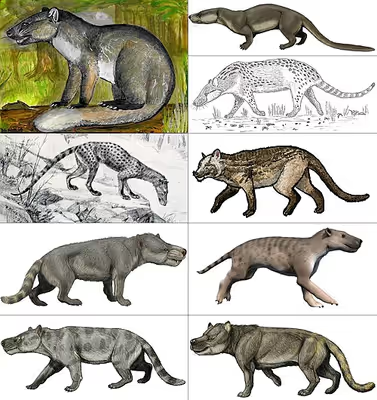
The order currently consists of three superfamilies, Hyaenodontoidae, Hyainailouroidea, and Limnocyonoidea, in addition to smaller groups such as the Galecyon clade. The hyaenodontoids consisted of Hyaenodontidae and Proviverrinae, the hyainailouroids consisted of Hyainailouridae, Prionogalidae, and Teratodontidae, and with the limnocyonoids consisted of Limocyoninae, Sinopinae, and Arfiinae. Hyaenodonts saw their diversification peak during the Middle-Late Eocene, before seeing a significant decline in diversity following the Eocene-Oligocene extinction event. In Afro-Arabia and Europe, they saw a recovery in diversity following the extinction event before seeing a terminal decline something during the Late Oligocene and Early Miocene respectively. The last hyaenodont would go extinct 7.5 Ma.
The extinction of the order has been debated by experts, many experts argued that their extinction was the result of competition with carnivorans. But over the recent years, many experts have questioned that hypothesis and argued their decline and extinction in most of their range was due to climatic changes.
Taxonomy
Classification
Hyaenodonts were considerably more widespread and successful than the oxyaenids, the other clade of mammals originally classified along with the hyaenodonts as part of Creodonta. In 2015 phylogenetic analysis of Paleogene mammals, by Halliday et al., monophyly of Creodonta was supported and was placed in the clade Ferae, closer to Pholidota than to Carnivora. However, most experts consider Creodonta to be considered to be a polyphyletic order as it contains two unrelated clades. Most experts have now recovered Hyaenodonta and Oxyaenodonta as distinct orders within Pan-Carnivora.
Recent phylogenetic modeling suggests hyaenodonts were sister group to the Oxyaenodonta-Carnivoraformes clade.
Phylogeny
Cladogram of Hyainailourinae recovered by Al-Ashqar et al. (2025):
Evolution
When the order arose exactly has changed over the years, Solé and Smith (2013) suggested hyaenodonts arose in the Late Paleocene roughly 58 Ma. Solé et al. (2009), as well as Borths and Stevens (2019), suggested an Early Paleocene origin for the order. However, majority of phylogenetic modeling over the recent years had support a Late Cretaceous origin for the order.
The biogeographic origin of the group has also been hotly debated by experts. Solé et al. (2009) suggested an African origin for the order as the known oldest hyaenodonts were recovered there, in additional to the diversity of hyaenodonts within the Ouarzazate basin. Bayesian analysis by various studies had found strong evidence of hyaenodonts originating from Europe. Borths et al. (2016) noted while European and North America origins were problematic due to hyaneodonts not being recorded before the Paleocene-Eocene boundary, European Paleocene records were poor unlike North America. They also noted Afro-Arabian origins for the order have never been tested using phylogenetic analysis and was based on the assumption that Lahimia was a basal hyaenodont although more recent analysis suggest it wasn't a basal hyaenodont. On the other hand, Bayesian analysis by Al-Ashqar et al. (2025) found stronger evidence of a North American origin than a European origin.
From Europe, hyaenodonts would have dispersed into Africa and from there dispersed into India. The oldest known hyaenodonts were Lahimia and Tinerhodon from the middle Paleocene of Morocco. Afterwards, hyaenodonts dispersed into Asia from either Europe or India, and dispersed into North America from either Europe or Asia. Proviverrines experience a radiation in diversity during the Early Eocene, due to the lack of competition and the Early Eocene Climatic Optimum. In Africa, hyaenodonts saw an increase in subfamilial richness after the end of the Early Eocene Climatic Optimum. During the middle to late Eocene, hyaenodonts, along with carnivorans, replaced oxyaenids, mesonychians, and miacoids in North America and Europe. With the former, the extinction of European mesonychids and oxyaenids resulted in the diversification of hyaenodonts, as well as an increase in body size. For most of the Paleogene, hyaenodonts were the dominant group of mammalian carnivores in Africa and Europe.
The order saw a massive decline globally during the Eocene-Oligocene extinction event due to the decline of favorable prey and the expansion of open environments. Following the boundary event, hyaenodonts experienced a rebound in diversity in Europe and Afro-Arabia. During the Early Miocene, the formation of the Gomphotherium land bridge saw the dispersal of hyaenodonts into Eurasia.
Sign in to keep reading
3 more chapters are free with a Lably account.
Anatomy
Size
They generally ranged in size from 30–140 cm (1 ft 0 in – 4 ft 7 in) at the shoulder, with most hyaenodonts weighing within the 5–15 kg (11–33 lb) range, equivalent to a mid-sized dog. However, hyaenodonts have been known to reach larger sizes. Hyaenodon horridus was one of the largest North American species, with limb regressions suggesting the adults weighed 41.42 kg (91 lb 5 oz) on average, with the largest adults weighing no more than 60 kg (130 lb). Hyaenodon megaloides was the largest North American Hyaenodon species being three times heavier than Hyaenodon horridus, weighing 30–120 kg (66–265 lb). However, Van Valkenburgh (1994) suggested this species may have weighed 165 kg (364 lb), making it about the size of a lion. Simbakubwa kutokaafrika may have weighed up to 1,500 kg (3,300 lb), with Megistotherium estimated to have reached an even larger size of 1,794–3,002 kg (3,955–6,618 lb). However estimate is suspect due to being based on skull-body size ratios derived from felids, which have much smaller skulls for their body size. Additionally, it was estimated that the maximum size a terrestrial mammalian carnivores could reach was 1,100 kg (2,400 lb), further suggesting the higher body mass estimates for Megistotherium was unlikely.
Other large hyaenodonts include the hyainailourine Hyainailouros and the much earlier-living Hyaenodon gigas and Hyaenodon mongoliensis (two of the largest species of the genus, Hyaenodon), all three taxa had a skull length of 60 cm (2.0 ft).
Skull and dentition
Compared to carnivorans, who have one pair of carnassial teeth, hyaenodonts possessed as many as three sequential pairs of carnassials or carnassial-like molar teeth in their jaws. Their skulls are known to have high sagittal crests which supported attachment for powerful temporalis muscles. Hyaenodonts, like all "creodonts", lacked post-carnassial crushing molar teeth, such as those found in many carnivoran families, especially the Canidae and Ursidae.
The anatomy of their skulls show that they had a particularly acute sense of smell, while their teeth were adapted for shearing, rather than crushing. Hyaenodonts differed from Carnivora in that they replaced their deciduous dentition slower in development than carnivorans. Studies on Hyaenodon show that juveniles took 3 to 4 years in the last stage of tooth eruption, implying a very long adolescent phase. In North American forms, the first upper premolar erupts before the first upper molar, while European forms show an earlier eruption of the first upper molar.
Postcranial anatomy
While the neck of Hyaenodon was relatively short, the body and tail were longer in comparison. Compared to Hyainailouros, the spine of Hyaenodon was longer and more robust, suggesting it didn't bore its head as low. Cervical vertebrae of Hyaenodon was relatively short and resembled that of a felid than a canid. The femur of Hyaenodon was found to have been nearly as long as the humerus, which was short and massive, supporting a large, rounded head. Compared to carnivorans, the greater tuberosity has a more irregular shape and faces anteromedially. It would've been an insertion site for the infraspinatous muscles, which isn't seen in carnivorans. Despite this, the humerus of Hyaenodon was similar to that of wolves and hyenas. Compared to hyenas, it shows an anconeal fossa, a well-developed brachial flange and a similarly elongated trochlea shape. Despite this, the trochela shape of Hyaenodon is more similar in to the red fox.
Regressions found Hyainailouros had a humerus as robust as an average felid. Compared to the humerus of a tiger, the deltoid scar of Hyainailouros was more distally than tigers. The ulna of Hyainailouros sulzeri was arched and supported a high, well-developed olecranon, as well as a long, but strong diaphysis to the distal end of ulna. Compared to carnivorans, the fibula of Hyainailouros was thicker in comparison, with the diaphysis being twice as antero-posteriorly elongated in its distal area compared to the proximal area.
Paleobiology
Locomotion
Hyaenodonts were ancestrally plantigrade, but the derived, larger hyaenodonts were generally digitigrade or semidigitigrade. Most hyaenodonts were recovered as terrestrial predators, with large hyainailourines, such as Simbakubwa and Hyainailouros were thought to have been capable of large, leaping bounds, although neither were thought to be fast runners. However, there have been notable exceptions in regards of locomotion. Several limnocyonoids Prototomus and Prolimnocyon were found to be scansorial predators. Analysis on the bony labyrinth of Hyaenodon exiguus suggests this species was semi-arboreal. However, some hyaenodonts, such as some species of Hyaenodon and Oxyaenoides, were recovered as cursorial predators. Castellanos (2025) that based on elbow morphology found that Hyaenodon crucians and Hyaenodon horridus likely practiced pounce-pursuit predation. While Hyaenodon was recovered as a cursorial predator, it wasn't as cursorial as modern canids, such as wolves.
Postcranial analysis on Apterodontinae found the subfamily were semiaquatic, fossorial mammals with strong forelimbs equipped for digging similar to badgers, with tail, torso and hindlimbs showing adaptations for an aquatic lifestyle similar to otters and pinnipeds.
Diet
Many hyaenodonts were recovered as hypercarnivorous predators, meaning most of their diet consisted of flesh. Fossil evidence found Hyaenodon horridus occasionally targeted smaller predators such as Dinictis and juvenile Archaeotherium. Some hyaenodonts, such as Megistotherium, Hyainailouros, and Simbakubwa, were believed to be hyperspecalized on large herbivores such as proboscideans. Savage (1973) suggested Megistotherium likely had a gap of around 30 cm (12 in), wide enough to bite down around the leg of some modern elephants. The reduction in incisor count would have minimised the damage which could be inflicted by struggling prey. Hunter-Schreger bands observed in the tooth enamel of Hyaenodon horridus, Hyainailouros, and Pterodon were zigzag, suggesting that these predators were osteophagous. Whereas those of Hyaenodon brevirostris and Hyaenodon mustelinus transition from undulating at the base of the tooth to zigzag at the tip, indicating that these species were not as well adapted for feeding on bone.
However, dental microwear patterns suggests that North American Hyaenodon had a diet more similar to lions, suggesting it ate mostly meat with various intakes of bone. On the other hand, European Hyaenodon microwear were more similar to that of spotted hyenas, suggesting bone cracking was likely a major part of their diet.
However, other hyaenodonts such as were noted to not have a hypercarnivorous diet. Hyaenodonts such as Anasinopa, Limnocyon, and Pakakali, were found to have been mesocarnivores or omnivores. Lesmesodon was found to have been an insectivorous diet based on chewing cycle analysis. Despite this, hyaenodonts weren't as versatile in their diet as carnivorans.
Extinction
In North America, hyaenodonts experienced a terminal decline from the Eocene to Oligocene, with only Hyaenodon persisting into the Oligocene before going extinct around 28 Ma. In Afro-Arabia, hyainailouroids experienced a massive decline with only 5 lineages persisting following the Eocene-Oligocene extinction event and several other extinctions. Eocene-Oligocene boundary correlated with the decline of hyaenodont diversity in Europe, which saw the extinction of hyainailourines and proviverrines, only one species of Hyaenodon present from the Eocene persisted into the Oligocene. Starting from the middle of the Early Oligocene, hyaenodonts saw a terminal decline in diversity, with their last occurrence being dating to MP30. After a period of diversification, Afro-Arabian hyaenodonts experienced a permanent decline during the early Miocene onwards. By the Late Miocene, the order was represented by Dissopsalis, Hyaenodon, Megistotherium (or Hyainailouros), and Metapterodon. The last hyaenodont, Dissopsalis carnifex, went extinct around 7.5 Ma.
Many experts argued that the decline and extinction of the hyaenodonts was due to competition with the carnivorans. Lang and colleagues found that the evolutionary success of carnivorans compared to hyaenodonts may have been largely influenced by the retention of a basal morphotype throughout their evolutionary history. The authors also suggested that carnivorans likely contributed in some way to the extinction of hyaenodonts, with the difference in functional morphology and adaptive potential of their carnassials possibly being a factor.
Within North America, Friscia and Valkenburgh (2010) argued that carnivorans may have limited the evolution of “creodonts”, resulting with only the large, hypercarnivorous ecomorphs remaining. They also note the size increase among carnivorans throughout the Eocene, reaching the body sizes of hyaenodonts during the Oligocene. In addition, Serio and colleagues found that North American “creodonts” had a significant degree of morphological differentiation until the middle Eocene, around this time disparity among carnivorans increasing around the same time. The authors argue that carnivoran disparity negatively impacted the disparity of creodonts, suggesting carnivorans may have outcompeted hyaenodonts.
Within Africa, experts had hypothesized that hyaenodonts suffered from competitive displacement, as the invading carnivorans forced hyainailourids to tend towards carnivory. This was due to some of the smallest Miocene hyainailourids, Isohyaenodon and Mlanyama, showing adaptations towards hypercarnivory compared to older, mesocarnivorous hyaenodonts such as Boualitomus and Pakakali. Borths and Stevens (2019) argued that pack hunting carnivorans had larger and more complex brains, suggesting this enabled them to steal carcasses from large, solitary hyainailourines.
The decline of hyaenodonts in the late Eocene to early Oligocene extinction of European hyaenodonts, such as proviverrines and Pterodon, was thought to have been the result of Grande Coupure, a faunal turnover that was contemporary with the global Eocene-Oligocene extinction event. The Eocene-Oligocene extinction event correlates with abrupt shift towards a icehouse world, which stems from the expansion of the Antarctic ice sheets and saw sea level decline by 70 m (230 ft). Grande Coupure saw an extinction rate of 60% of western European mammalian lineages, which were replaced by Asian faunal immigrants. This included the arrival of carnivorans from Asia such as later amphicyonids, amphicynodontids, nimravids, and ursids which deprised into Western Europe via new land connection with Asia following the receding of the Turgai Strait. Lange-Badré (1979) suggested the decline of the proviverrines coincided with the arrival of carnivorans, hyaenodontines, and hyainailourines. Within the same paper, they hypothesized that Pterodon went extinct due to the climatic cooling and competition from the arriving carnivorans.
However, competitive replacement has been contested by many experts. Among large hyainailourids, the discovery of Simbakubwa suggests the evolution of large hyainailourines was thought to have been changes in the herbivore fauna instead of competition with carnivorans. Additionally, studies have found brain size have little to no correlation with sociality in carnivorans, with the relative size of the anterior brain having a larger correlation to sociality than overall brain size. Experts also argued due to the absence of canids (who dispersed into Africa by the latest Miocene), pack hunting would be difficult to assess among carnivorans in early Miocene Africa. Furthermore, vegetation in the early Miocene was generally more closed, preventing pack hunting and shorter, high speed chases from being effective. Morales and colleagues argued the decline of hyainailourids was due to the increase in aridity, as they were more adapted for forested environments as opposed to savannas, steppes, or deserts. The decline of Afro-Arabian hyaenodonts from the late Eocene to early Oligocene was due to the decline of their preferred prey such as anthropoids and hystricognaths. Their decline was also linked to the uplifting of the Ethiopian plateau, volcanism from the Afro-Arabian Large Igneous Province, and the opening of the Red Sea and Gulf of Aden.
Christison and colleagues analyzed hyaenodonts and carnivorans from Calf Creek locality of Cypress Hills Formation and found that only the smallest hyaenodont, Hyaenodon microdon had asignificant niche overlap with carnivorans. On the other hand, larger hyaenodonts, Hemipsalodon grandis and Hyaenodon horridus had very distinct niches from large carnivorans, such as Hoplophoenus. They argue this would suggest that competitive replacement wasn't the driving factor the decline and extinction of North American hyaenodonts. Instead, global climatic cooling during the earliest Oligocene resulted in drier, more open landscapes and resulted in the extinction of large browsing herbivores, including brontotheres, who were replaced by grazing mammals such as equids and rhinoceroses, which were better suited for the open environments. Because rhinoceroses didn't reach their large sizes until the Miocene, hyaenodonts were at a disadvantage due to the lack of large prey available. In addition, because of their shorter legs, they were likely at a disadvantage in the increasingly open environments. Despite recovering North American hyaenodonts as a relatively cursorial clade, Castellanos also hypothesized due their short distal limbs, hyaenodonts had less cursorial adaptations than contemporary amphicyonids and couldn't exploit open environments as well which likely led to their extinction in addition to the extinction of large browsing prey and low diversity of the order at the start the Oligocene.
In Europe, Solé et al. (2015) found no evidence of hyainailourines being responsible for the decline of proviverrines, as the latter ever exceeded 20 kg (44 lb). This made them significantly smaller than the contemporary hyainailourines, which weighed at least 40 kg (88 lb). This suggested hyainailourines occupied different niches than proviverrines, with the latter possibly even being predated upon. Solé et al. (2022) found no evidence of competitive replacement by carnivoranforms have been found in Europe as hyaenodonts were more diverse than carnivoraforms until the Grand Coupure. They also found the carnivorous fauna transition was gradual as proviverrines and hyainailourines went extinct during disappeared MP19-20, while newcomers appeared MP21. Hyaenodon, who survived the Grande Coupure, niche partitoned from amphicyonids by preferring different habitats, with Hyaenodon preferring more forested environments compared to amphicyonids, who preferred more open environments. Analysis on the body mass dynamics of European hyaenodonts and carnivoramorphans found hyaenodonts didn't experience a decrease in body mass when the body mass of carnivoramorphans increased suggesting a notable niche partition between the two clades. This suggests the extinction of European hyaenodonts during the Oligocene is believed to have been caused by climatic changes rather than competition with carnivorans.