


Related on Lably
Through Basal (phylogenetics) and Invertebrate
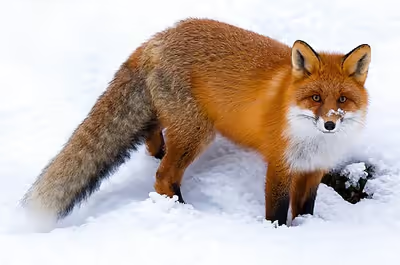
The red fox originated in Eurasia during the Middle Pleistocene at least 400,000 years ago and later colonised North America sometime prior to 130,000 years ago. Apart from its large size, the red fox is distinguished from other fox species by its ability to adapt quickly to new environments. Despite its name, the species often produces individuals with other colourings, including leucistic and melanistic individuals. Forty-five subspecies are currently recognised, which can be divided into two categories: the large northern foxes and the small, basal southern grey desert foxes of Asia and North Africa.
The red fox usually occurs in pairs or in small family groups consisting of a mated pair and their young, or a male with several females related to each other. The young of the mated pair stay with their parents to help care for the new kits. The red fox primarily feeds on small rodents, though it also hunts rabbits, squirrels, game birds, reptiles, invertebrates and young ungulates. It also eats fruit and vegetables. Although it tends to kill smaller predators, including other fox species, it is vulnerable to attack from predators, such as the golden eagle, Eurasian goshawk, Bonelli's eagle, Eurasian eagle-owl, long-tailed weasel, stoat, striped skunk, American mink, snakes, and martens.
The red fox has been extensively hunted as a pest and furbearer for many centuries, and is represented in human folklore and mythology. Due to its widespread distribution and large population, the red fox is one of the most important fur-bearing animals harvested for the fur trade. Too small to pose a significant threat to humans, it has greatly benefited from the presence of human habitation, and has successfully colonised many suburban and urban areas. The domestication of the red fox is also underway in Russia, and has resulted in the domesticated silver fox.
Terminology
Male foxes are called tods or dogs, females are called vixens, and young are known as cubs or kits. Although the Arctic fox has a small native population in northern Scandinavia, and while the corsac fox's range extends into European Russia, the red fox is the only fox native to Western Europe. For this reason, it is simply called "the fox" in colloquial British English.
Etymology
The word "fox" comes from Old English, which in turn derived from Proto-Germanic *fuhsaz. Compare with West Frisian foks, Dutch vos, and German Fuchs. This, in turn, derives from Proto-Indo-European *puḱ- 'thick-haired; tail'. Compare to the Hindi pū̃ch 'tail', Tocharian B päkā 'tail; chowrie', and Lithuanian pūkas 'fur / fluff'. The fox's bushy tail also forms the basis for its Welsh name, llwynog, literally 'bushy', from llwyn 'bush'. Likewise, Portuguese: raposa from rabo 'tail', Lithuanian uodẽgis from uodegà 'tail', and Ojibwe waagosh from waa, which refers to the up and down "bounce" or flickering of an animal or its tail.
The scientific term vulpes derives from the Latin word for fox, and gives the adjectives vulpine and vulpecular.
Sign in to keep reading
6 more chapters are free with a Lably account.
Evolution
The red fox is Eurasian in origin and may have evolved from either Vulpes alopecoides or the related Chinese V. chikushanensis, both of which lived during the Middle Villafranchian of the Pleistocene Epoch. The earliest fossil red fox specimens were uncovered in Baranya County, Hungary, dating from 3.4 to 1.8 million years ago. The ancestral red fox was likely more diminutive compared to today's extant foxes, as the earliest red fox fossils have shown a smaller build than living specimens. The earliest fossil remains of the modern red fox date back to the mid-Pleistocene, found in association with middens and refuse left by early human settlements. This has led to the theory that the red fox was hunted by primitive humans as both a source of food and pelts; the possibility also exists of red foxes scavenging from middens or butchered animal carcasses.
The sister lineage to the red fox is the Rüppell's fox, but the two species are surprisingly closely related through mitochondrial DNA markers, with Rüppell's fox nested within the red fox lineage. Such a nesting of one species within another is called paraphyly. Several hypotheses have been suggested to explain this, including (1) recent divergence of Rüppell's fox from a red fox lineage, (2) incomplete lineage sorting, or introgression of mtDNA between the two species. Based on the fossil record, the last scenario seems the most likely. This is further supported by the clear ecological and morphological differences between the two species.
Colonisation of North America
Red foxes colonised the North American continent in two waves: before and during the Illinoian glaciation, and during the Wisconsinan glaciation about 130,000 years ago. Gene mapping demonstrates that red foxes in North America have been isolated from their Old World counterparts for over 400,000 years, thus raising the possibility that speciation has occurred, and that the previous binomial name of Vulpes fulva may be valid. In the far north, red fox fossils have been found in Sangamonian Stage deposits near the Fairbanks District, Alaska, and Medicine Hat, Alberta. Fossils dating from the Wisconsinan are present in 25 sites across Arkansas, California, Colorado, Idaho, Missouri, New Mexico, Ohio, Tennessee, Texas, Virginia, and Wyoming. Although they ranged far south during the Wisconsinan, the onset of warm conditions shrank their range toward the north, and they have only recently reclaimed their former North American ranges because of human-induced environmental changes. Genetic testing indicates that two distinct red fox refugia exist in North America, which have been separated since the Wisconsinan. The northern refugium occurs in Alaska and western Canada, and consists of the larger subspecies V. v. alascensis, V. v. abietorum, V. v. regalis, and V. v. rubricosa. The southern (or montane) refugium occurs in the subalpine parklands and alpine meadows of the west, from the Rocky Mountains to the Cascades and the Sierra Nevada ranges, consisting of the smaller subspecies V. v. cascadensis, V. v. macroura, V. v. necator, and V. v. patwin. The latter clade has been isolated from all other red fox populations since at least the last glacial maximum and may have developed unique ecological or physiological adaptations.
Although European foxes (V. v. crucigera) were introduced to parts of the United States in the 1900s, genetic research suggests that there are no European fox mitochondrial haplotypes present in any North American populations. Additionally, introduced eastern North American red foxes have colonised most of inland California, from Southern California to the San Joaquin Valley, Monterey and north-coastal San Francisco Bay Area (including urban San Francisco and adjacent cities). In spite of the red fox's adaptability to city life, they are still found in somewhat greater numbers in the northern portions of California (north of the Bay Area) than in the south, as the wilderness is more alpine and isolated. The eastern red foxes appear to have mixed with the Sacramento Valley red fox (V. v. patwin) only in a narrow hybrid zone. In addition, no evidence is seen of interbreeding of eastern American red foxes in California with the montane Sierra Nevada red fox (V. v. necator) or other populations in the Intermountain West (between the Rocky Mountains to the east and the Cascade and Sierra Nevada Mountains to the west).
Subspecies
The third edition of Mammal Species of the World listed 45 subspecies as valid. In 2010, a distinct 46th subspecies, the Sacramento Valley red fox (V. v. patwin), which inhabits the grasslands of the Sacramento Valley, was identified through mitochondrial haplotype studies. Castelló (2018) recognized 30 subspecies of the Old World red fox and nine subspecies of the North American red fox as valid.
It is known that substantial gene pool mixing occurs between different subspecies. For example, British red foxes have crossbred extensively with red foxes imported from Germany, France, Belgium, Sardinia and possibly Siberia and Scandinavia. However, genetic studies suggest very little differences between red foxes sampled across Europe. Lack of genetic diversity is consistent with the red fox being a highly agile species, with one red fox covering 320 km (200 mi) in under a year's time.
Heptner & Naumov (1998) divide subspecies in Eurasia and North Africa into two categories based on morphological features:
- Northern foxes are large and brightly coloured.
- Southern grey desert foxes include the Asian subspecies V. v. griffithi, V. v. pusilla, and V. v. flavescens. These foxes display transitional features between the northern foxes and other, smaller fox species; their skulls possess more primitive, neotenous traits than the northern foxes and they are much smaller; the maximum sizes attained by southern grey desert foxes are invariably less than the average sizes of northern foxes. Their limbs are also longer and their ears larger.
Red foxes living in Middle Asia show physical traits intermediate to the two.
Description
Build
The red fox has an elongated body and relatively short limbs. The tail, which is longer than half the body length (70 percent of head and body length), is fluffy and reaches the ground when in a standing position. Their pupils are oval and vertically oriented. Nictitating membranes are present, but move only when the eyes are closed. The forepaws have five digits, while the hind feet have only four and lack dewclaws. They are very agile, being capable of jumping over 2 m (6 ft 7 in) high fences, and swim well. Vixens normally have four pairs of teats, though vixens with seven, nine, or ten teats are not uncommon. The testes of males are smaller than those of Arctic foxes.
Their skulls are fairly narrow and elongated, with small braincases. Their canine teeth are relatively long. Sexual dimorphism of the skull is more pronounced than in corsac foxes, with female red foxes tending to have smaller skulls than males, with wider nasal regions and hard palates, as well as having larger canines. Their skulls are distinguished from those of dogs by their narrower muzzles, less crowded premolars, more slender canine teeth, and concave rather than convex profiles.
Dimensions
Red foxes are the largest species of the genus Vulpes. However, relative to their size, red foxes are much lighter than similarly sized dogs in the genus Canis. For example, their limb bones weigh 30 percent less per unit area of bone than expected for similarly sized dogs. They display significant individual, sexual, age and geographical variation in size. On average, adults measure 35–50 cm (14–20 in) high at the shoulder and 45–90 cm (18–35 in) in body length with tails measuring 30–55.5 cm (11.8–21.9 in). The ears measure 7.7–12.5 cm (3.0–4.9 in) and the hind feet 12–18.5 cm (4.7–7.3 in). Weights range from 2.2–14 kg (4.9–30.9 lb), with vixens typically weighing 15–20% less than tods. Adult red foxes have skulls measuring 129–167 mm (5.1–6.6 in), while those of vixens measure 128–159 mm (5.0–6.3 in). The forefoot print measures 60 mm (2.4 in) in length and 45 mm (1.8 in) in width, while the hind foot print measures 55 mm (2.2 in) long and 38 mm (1.5 in) wide. They trot at a speed of 6–13 km/h (3.7–8.1 mph), and have a maximum running speed of 50 km/h (31 mph). They have a stride of 25–35 cm (9.8–13.8 in) when walking at a normal pace. North American red foxes are generally lightly built, with comparatively long bodies for their mass and have a high degree of sexual dimorphism. British red foxes are heavily built, but short, while continental European red foxes are closer to the general average among red fox populations. The largest red fox on record in Great Britain was a 1.4 m (4 ft 7 in) long male, that weighed 17.2 kg (38 lb), killed in Aberdeenshire, Scotland, in early 2012.
Fur
The winter fur is dense, soft, silky and relatively long. For the northern foxes, the fur is very long, dense and fluffy, but it is shorter, sparser and coarser in southern forms. Among northern foxes, the North American varieties generally have the silkiest guard hairs, while most Eurasian red foxes have coarser fur. The fur on areas such as the head and lower legs, known as "thermal windows", is kept short and dense all year round, while the fur on other areas changes with the seasons. Foxes actively control the peripheral vasodilation and peripheral vasoconstriction in these areas to regulate heat loss. There are three main colour morphs; red, silver/black and cross (see Mutations). In the typical red morph, their coats are usually bright reddish-rust colour with yellowish tints. Along the spine, there is a stripe of weak, diffuse patterns of brown, reddish and chestnut hairs. Two additional stripes run down the shoulder blades and, together with the spinal stripe, form a cross. The lower back is often a mottled silvery colour. The flanks are lighter coloured than the back, while the chin, lower lips, throat and front of the chest are white. The remaining lower surface of the body is dark, brown or reddish. During lactation, the belly fur of vixens may turn brick red. The upper parts of the limbs are rusty red, while the paws are black. The front of the face and the upper neck are bright brownish-red, while the upper lips are white. The backs of the ears are black or brownish-reddish, while the inner surface is whitish. The top of the tail is brownish-reddish, but lighter in colour than the back and flanks. The underside of the tail is pale grey with a straw-coloured tint. A black spot, the location of the supracaudal gland, is usually present at the base of the tail. The tip of the tail is white.
Colour morphs
There are three main colour variants of the wild red fox: red, cross (partially melanistic), and silver (melanistic). Albino foxes may be found in the wild, although they are rare. Other colour variants are extremely rare in the wild, and most are only known to occur in domestic fur-farm foxes.
Senses
Red foxes have binocular vision, but their sight reacts mainly to movement. They have acute auditory perception, being able to hear black grouse changing roosts at 600 paces, crows flying at 0.25–0.5 km (0.16–0.31 mi) and mice squeaking at about 100 m (330 ft). They can locate sounds with an accuracy of one degree at frequencies of 700–3,000 Hz, though less accurately at higher frequencies. Their sense of smell is good, but weaker than that of dogs specialised in scent work.
Scent glands
Red foxes have a pair of anal sacs lined with sebaceous glands that open through a single duct. The size and volume of the anal sacs increases with age, ranging in size from 5–40mm in length, 1–3mm in diameter, and with a capacity of 1–5 mL. The anal sacs act as fermentation chambers in which aerobic and anaerobic bacteria convert sebum into odorous compounds, including aliphatic acids. The oval-shaped caudal gland is 25 mm (0.98 in) long and 13 mm (0.51 in) wide, and reportedly smells of violets. The presence of foot glands is equivocal. The interdigital cavities are deep, with a reddish tinge and smell strongly. Sebaceous glands are present on the angle of the jaw and mandible.
Distribution and habitat
The red fox is the most widespread member of the order Carnivora, and is present on every continent except for South America and Antarctica. Its range covers nearly 70,000,000 km2 (27,000,000 sq mi), extending as far north as the Arctic Circle. It is found throughout Europe, in Africa north of the Sahara Desert, throughout Asia apart from extreme Southeast Asia, and across North America apart from most of the southwestern United States and Mexico. It is absent from the Arctic islands, the most northerly parts of central Siberia, and in extreme deserts. It is not present in New Zealand and is classed as a "prohibited new organism" under the Hazardous Substances and New Organisms Act of 1996, which does not allow its import.
Australia
In Australia, estimates in 2012 indicated that there were more than 7.2 million red foxes, with a range extending throughout most of the continental mainland. They were introduced Australia in the 1830s and 1840s by settlers in the British colonies of Van Diemen's Land (as early as 1833) and the Port Phillip District of New South Wales (as early as 1845). The settlers wanted to foster the traditional English sport of fox hunting. However, a permanent red fox population did not become established on the island of Tasmania, and it is widely believed that foxes were outcompeted by the Tasmanian devil. On the mainland, however, the species was successful as an apex predator. The fox is generally less common in areas where the dingo is more prevalent, but it has achieved niche differentiation with both the feral dog and the feral cat, primarily through its burrowing behaviour. Consequently, the fox has become one of the continent's most destructive invasive species, and it is listed in IUCN's 100 of the World's Worst Invasive Alien Species.
The red fox has been implicated in the extinction or decline of several native Australian species, particularly those of the family Potoroidae, including the desert rat-kangaroo. The spread of red foxes across the southern part of the continent has coincided with the spread of rabbits in Australia, and corresponds with declines in the distribution of several medium-sized ground-dwelling mammals, including brush-tailed bettongs, burrowing bettongs, rufous bettongs, bilbies, numbats, bridled nail-tail wallabies and quokkas. Most of those species are now limited to areas (such as islands) where red foxes are absent or rare. Local fox eradication programs exist, although elimination has proven difficult due to the fox's denning behaviour and nocturnal hunting, so the focus is on management, including the introduction of state bounties. According to the Tasmanian government, red foxes were accidentally introduced to the previously fox-free island of Tasmania in 1999 or 2000, posing a significant threat to native wildlife, including the eastern bettong, and an eradication program was initiated, conducted by the Tasmanian Department of Primary Industries and Water.
Sardinia
The origin of the ichnusae subspecies in Sardinia, Italy is uncertain, as it is absent from Pleistocene deposits in their current homeland. It is possible it originated during the Neolithic following its introduction to the island by humans. It is likely then that Sardinian fox populations stem from repeated introductions of animals from different localities in the Mediterranean. This latter theory may explain the subspecies' phenotypic diversity.
Behaviour and ecology
Social and territorial behaviour
Red foxes either establish stable home ranges within particular areas or are itinerant with no fixed abode. They use their urine to mark their territories. A male fox raises one of his hind legs, spraying his urine forward in front of him. In contrast, a female fox squats down, spraying her urine onto the ground between her hind legs. Urine is also used to mark empty cache sites where found food is stored. This serves as a reminder not to waste time investigating them. Males generally have higher urine marking rates during late summer and autumn, but the rest of the year the rates between male and female are similar. The use of up to 12 different urination postures allows them to precisely control the position of the scent mark.
Red foxes live in family groups that share a territory. In favourable habitats and/or areas with low hunting pressure, a range of subordinate foxes may be present. There may be one or two subordinate foxes, or sometimes up to eight, in one territory. These subordinates may formerly have been dominant animals, but they are mostly young from the previous year and act as helpers in rearing the breeding vixen's kits. Alternatively, their presence has been explained as a response to temporary food surpluses unrelated to assisting reproductive success. Non-breeding vixens guard, play with, groom, provision and retrieve kits, an example of kin selection. Red foxes may leave their families once they reach adulthood if they have a high chance of winning of their own. Otherwise, they will stay with their parents, postponing their own reproduction in the process.
Reproduction and development
Red foxes reproduce once a year in spring. Two months prior to oestrus (typically December), the reproductive organs of vixens change shape and size. By the time they enter their oestrus period, their uterine horns double in size, and their ovaries grow 1.5–2 times larger. Sperm formation in males begins in August–September, with the testicles attaining their greatest weight in December–February. The vixen's oestrus period lasts three weeks, during which the dog-foxes mate with the vixens for several days, often in burrows. The male's bulbus glandis enlarges during copulation, forming a copulatory tie which may last for more than an hour. The gestation period lasts 49–58 days. Though foxes are largely monogamous, DNA evidence from one population indicated large levels of polygyny, incest and mixed paternity litters. Subordinate vixens may become pregnant, but usually fail to whelp, or have their kits killed postpartum by either the dominant female or other subordinates.
The average litter size consists of four to six kits, though litters of up to 13 kits have been reported. Large litters are typical in areas where fox mortality is high. Kits are born blind, deaf and toothless, with dark brown fluffy fur. At birth, they weigh 56–110 g (2.0–3.9 oz) and measure 14.5 cm (5.7 in) in body length and 7.5 cm (3.0 in) in tail length. At birth, they are short-legged, large-headed and have broad chests. Mothers remain with the kits for 2–3 weeks as they are unable to thermoregulate. During this period, the fathers or barren vixens feed the mothers. Vixens are very protective of their kits, and have been known to even fight off terriers in their defence. If the mother dies before the kits are independent, the father takes over as their provider. The kits' eyes open after 13–15 days, during which time their ear canals open and their upper teeth erupt, with the lower teeth emerging 3–4 days later. Their eyes are blue at birth, but change to amber at 4–5 weeks. Their coat begins to change colour at three weeks of age, when a black streak appears around the eyes. By one month of age, red and white patches appear on their faces. During this time, their ears become erect and their muzzles elongate. Kits begin to leave their dens and experiment with solid food provided by their parents at the age of 3–4 weeks. The lactation period lasts 6–7 weeks. Their woolly coats begin to be coated by shiny guard hairs after 8 weeks. By the age of 3–4 months, the kits are long-legged, narrow-chested and sinewy. They reach adult proportions at the age of 6–7 months. Some vixens may reach sexual maturity at the age of 9–10 months, thus bearing their first litters at one year of age. In captivity, their longevity can be as long as 15 years, though in the wild they typically do not survive past 5 years of age.
Denning behaviour
Outside of the breeding season, most red foxes prefer to live in the open, in densely vegetated areas, although they may enter burrows to escape bad weather. Their burrows are often dug on hill or mountain slopes, in ravines and on steep riverbanks, as well as in ditches, depressions and gutters, and in rock clefts and neglected human environments. Red foxes prefer to dig their burrows in well-drained soil. Dens built among tree roots can last for decades, whereas those dug in steppe regions only last several years. They may permanently abandon their dens during mange outbreaks, possibly as a defence mechanism against the spread of disease. In the Eurasian desert regions, foxes may use the burrows of wolves, porcupines and other large mammals, as well as those dug by gerbil colonies. Compared to burrows constructed by Arctic foxes, badgers, marmots and corsac foxes, red fox dens are not overly complex. Red fox burrows consist of a den and temporary burrows. The latter comprise only a small passage or cave for concealment. The main entrance of the burrow leads downwards (40–45°) and opens into a den, from which numerous side tunnels branch off. The depth of the burrow ranges from 0.5–2.5 m (1 ft 8 in – 8 ft 2 in), rarely extending to ground water. The main passage can reach 17 m (56 ft) in length, standing an average of 5–7 m (16–23 ft). In spring, red foxes clear their dens of excess soil by making rapid movements with their forepaws and hind legs. They throw the discarded soil up to 2 m (6 ft 7 in) from the burrow. Once kits are born, the discarded debris is trampled to form an area where the kits can play and receive food. They may share their dens with woodchucks or badgers. Unlike badgers, which fastidiously clean their earths and defecate in latrines, red foxes habitually leave pieces of prey around their dens. The average sleep time of a captive red fox is 9.8 hours per day.
Communication
The body language of red foxes consists of movements of the ears and tail, as well as postures. Their body markings emphasise certain gestures. These postures can be categorised as either aggressive/dominant or fearful/submissive. Some postures may blend the two together. Inquisitive foxes will rotate and flick their ears while they sniff. Playful individuals will perk their ears up and stand on their hind legs. Male foxes will turn their ears outward and raise their tails horizontally with the tips raised upwards when courting females or after successfully evicting intruders. When afraid, red foxes grin in submission, arching their backs, curving their bodies, crouching their legs and lashing their tails back and forth with their ears pointing backwards and pressed against their skulls. When merely expressing submission to a dominant animal, they adopt a similar posture, but without arching their backs or curving their bodies. Submissive foxes approach dominant animals with their muzzles reaching up in greeting, in a low posture. When two evenly matched foxes confront each other over food, they approach side by side and push against each other's flanks. They betray a mixture of fear and aggression through their actions: they lash their tails and arch their backs, but do not crouch or pull their ears back and flatten them against their skulls. When launching an assertive attack, red foxes approach directly, with their tails held high and their ears rotated sideways. During such fights, red foxes will stand on each other's upper bodies with their forelegs, using open mouthed threats. Such fights typically only occur among juveniles or adults of the same sex.
Red foxes have a wide vocal range, and produce different sounds spanning five octaves which blend into each other. Recent analyses have identified 12 different sounds produced by adults and eight by kits. The majority of sounds can be categorised as either "contact" or "interaction" calls. The former vary according to the distance between individuals, while the latter vary according to the level of aggression.
- Contact calls: The most commonly heard contact call is a barking sound consisting of three to five syllables, transcribed as "wow wow wow", which is often made by two foxes approaching one another. This call is most frequently heard from December to February (when they can be confused with the territorial calls of tawny owls). The "wow wow wow" call varies from one fox to another. Captive foxes have been recorded to answer pre-recorded calls of their pen-mates, but not those of strangers. Kits begin emitting the "wow wow wow" call at the age of 19 days, when craving attention. When red foxes draw close together, they emit trisyllabic greeting warbles similar to the clucking of chickens. Adults greet their kits with gruff huffing noises.
- Interaction calls: When greeting one another, red foxes emit high pitched whines, particularly submissive animals. A submissive fox approached by a dominant animal will emit a ululating siren-like shriek. During aggressive encounters with conspecifics, they emit a throaty rattling sound, similar to a ratchet, called "gekkering". Gekkering occurs mostly during the courting season from rival males or vixens rejecting advances.
Another call that does not fit into the two categories is a long, drawn-out, monosyllabic "waaaaah" sound. As it is commonly heard during the breeding season, it is thought to be emitted by vixens summoning males. When danger is detected, foxes emit a monosyllabic bark. At close quarters, it is a muffled cough, while at long distances it is sharper. Kits make warbling whimpers when nursing, these calls being especially loud when they are dissatisfied. Red fox calls sound like a person screaming.
Diet and hunting
The red fox is an omnivore with a highly varied diet. It consumes over 300 animal species including small rodents like mice, ground squirrels, hamsters, gerbils, woodchucks, muskrats, voles, pocket gophers, deer mice, leporids, porcupines, raccoons, opossums, birds with passeriformes, galliformes and waterfowl predominating, reptiles, insects and invertebrates. In Doñana National Park, the European rabbit (Oryctolagus cuniculus) is a major prey item. It attacks young or small ungulates on rare occasions. In southern Italy, red foxes were observed eating pond slider eggs excavated from nests. Camera traps at an Australian rookery documented red foxes preying on flatback sea turtle eggs. The behavior of red foxes hunting wolf cubs was documented in Italy in 2025.
The red fox typically targets mammals with a weight of up to 3.5 kg (7.7 lb) and requires 500 g (18 oz) of food daily. It hunts its preferred prey when it is abundant, but it can still survive on different prey, as well as seeds and fruit, when it is not available. It occasionally commits acts of surplus killing; during one breeding season, four red foxes were recorded to have killed around 200 black-headed gulls each, with peaks during dark, windy hours when flying conditions were unfavourable. Losses to poultry and penned game birds can be substantial because of this. In some areas, fruit amounts to 100% of its diet in autumn, including blueberry, blackberry, raspberry, cherry, persimmon, mulberry, apple, plum, grape and acorn. Other plant material includes grass, sedge and tuber.
Visual cues are the most important ones for the hunting behaviour of the red fox. It prefers to hunt in the early morning hours before sunrise and late evening. Successful hunting in long vegetation or under snow appears to involve its alignment with the Earth's magnetic field. It typically forages alone, but occasionally aggregates in resource-rich environments. When hunting mouse-like prey, it first pinpoints the prey's location by sound, then leap, sailing high above the quarry, steering in mid-air with its tail before landing on target up to 5 m (16 ft) away. It feeds on carrion in the late evening hours and at night. It seems to dislike the taste of moles, but nonetheless catches them alive and presents them to its young for playing. It is possessive of its food and defends its catches even from dominant animals.
Competitors
The red fox typically dominates other fox species. Where the red fox and Arctic fox are sympatric, the Arctic fox feeds on lemmings and flotsam rather than voles, as favoured by red foxes. Both species kill each other's kits, given the opportunity. The southern range of the Arctic fox is limited by the presence of the red fox; both were introduced to almost every island from the Aleutian Islands to the Alexander Archipelago during the 1830s–1930s by fur companies. The red fox invariably displaced the Arctic fox, with one male red fox having been reported to have killed off all resident Arctic foxes on a small island in 1866.
The red fox is a competitor of the corsac fox, as they hunt the same prey all year. The red fox is stronger, better adapted to hunting in snow deeper than 10 cm (3.9 in) and is more effective in hunting and catching medium-sized to large rodents. The corsac fox seems to only outcompete the red fox in semi-desert and steppe areas. In Israel, the Blanford's fox escapes competition with the red fox by being restricted to rocky cliffs and actively avoiding the open plains inhabited by the red fox. The red fox dominate kit and swift foxes. Kit foxes usually avoid competition with their larger cousins by living in more arid environments, though red foxes have been increasing in ranges formerly occupied by kit foxes due to human-induced environmental changes. Red foxes will kill both species and compete with them for food and den sites. The gray fox dominates the red fox wherever their ranges meet. Historically, interactions between the two species were rare, as the gray fox favoured heavily wooded or semiarid habitats as opposed to the open and mesic ones preferred by the red fox. However, interactions have become more frequent due to deforestation, allowing the red fox to colonise gray fox-inhabited areas.
The wolf is known to kill and eat the red fox in disputes over carcasses. In North America where the red fox and coyote are sympatric, their home ranges do not overlap, and interactions between the two species vary in nature, ranging from active antagonism to indifference. The majority of aggressive encounters are initiated by coyotes, and there are few reports of red foxes acting aggressively toward coyotes except when attacked or when their kits were approached. Foxes and coyotes have sometimes been seen feeding together. In Israel, the red fox shares habitat with the golden jackal, and where their ranges meet, they compete due to near-identical diets. The red fox ignores golden jackal scents or tracks and avoids close physical proximity; in areas where the golden jackal is abundant, the red fox population decreases significantly, apparently because of competitive exclusion. However, multiple red foxes interacting peacefully with a golden jackal have been observed in southwestern Germany.
The red fox is dominant over the raccoon dog and will sometimes kill its kits or bite adults to death. There are documented cases of red foxes killing raccoon dogs by entering their dens. Both species compete for prey similar in size to mice. This competition peaks in early spring when food is scarce. In Tatarstan, red fox predation accounted for 11.1% of deaths among 54 raccoon dogs and amounted to 14.3% of 186 raccoon dog deaths in northwestern Russia.
The red fox occasionally kills small mustelids like least weasel, stone marten, pine marten, stoat, Siberian weasel, European polecat and young sables. Eurasian badgers may live alongside red foxes in isolated sections of large burrows. The two species may tolerate each other out of mutualism: red foxes provide Eurasian badgers with food scraps, while Eurasian badgers keep the shared burrow clean. However, there are known cases of Eurasian badgers driving vixens from their dens and destroying their litters without eating them. Wolverines may kill red foxes, often while the latter is sleeping or near carrion. In turn, red foxes may kill young wolverines.
The red fox competes with the striped hyena over large carcasses. The striped hyena's stronger jaws can easily tear open flesh that is too tough for the red fox. When harassing striped hyenas, it avoids attacks by outrunning them. Sometimes, red foxes seem to deliberately torment striped hyenas even when food is not at stake. However, some red foxes misjudge their attacks and are killed. The remains of red foxes are often found in striped hyena dens, and striped hyenas steal red foxes from traps.
The red fox may be preyed upon by the leopard, caracal and Eurasian lynx. The Eurasian lynx chases the red fox into deep snow, where its long legs and larger paws gives it an advantage over the red fox, especially when the depth of the snow exceeds one meter. In the Velikoluksky District in Russia, the red fox is absent or seen only occasionally where the Eurasian lynx established permanent territories. In North America, the red fox is predated by the cougar, Canada lynx and bobcat.
The red fox competes with common buzzard (Buteo buteo) and northern goshawk (Accipiter gentilis) and even steals their kills. The golden eagle (Aquila chrysaetos) regularly takes young red foxes and preys on adults if needed. Other large eagles such as the wedge-tailed eagle (Aquila audax), eastern imperial eagle (Aquila heliaca), white-tailed eagle (Haliaeetus albicilla) and steller's sea eagle (Haliaeetus pelagicus) occasionally kill red foxes. Large owls such as the Eurasian eagle-owl (Bubo bubo) and snowy owl (Bubo scandiacus) prey on young foxes and adults on occasions.
Diseases and parasites
Red foxes are the most important rabies vector in Europe. In London, arthritis is common in foxes, being particularly frequent in the spine. Foxes may be infected with leptospirosis and tularemia, though they are not overly susceptible to the latter. They may also fall ill from listeriosis and spirochetosis, as well as acting as vectors in spreading erysipelas, brucellosis and tick-borne encephalitis. A mysterious fatal disease near Lake Sartlan in the Novosibirsk Oblast occurred among red foxes, but the cause was unclear. Individual cases of foxes infected with Yersinia pestis are known.
Red foxes are not readily prone to infestation with fleas. Species like Spilopsyllus cuniculi are probably only caught from the fox's prey species, while others like Archaeopsylla erinacei are caught whilst traveling. Fleas that feed on red foxes include Pulex irritans, Ctenocephalides canis and Paraceras melis. Ticks such as Ixodes ricinus and I. hexagonus are not uncommon in red foxes, and are typically found on nursing vixens and kits still in their earths. The louse Trichodectes vulpis specifically targets red foxes, but is found infrequently. The mite Sarcoptes scabiei is the most important cause of mange in red foxes. It causes extensive hair loss, starting from the base of the tail and hindfeet, then the rump before moving on to the rest of the body. In the final stages of the condition, red foxes can lose most of their fur, 50% of their body weight and may gnaw at infected extremities. In the epizootic phase of the disease, it usually takes red foxes four months to die after infection. Other endoparasites include Demodex folliculorum, Notoderes, Otodectes cynotis (which is frequently found in the ear canal), Linguatula serrata (which infects the nasal passages) and ringworms. Up to 60 helminth species are known to infect captive-bred foxes in fur farms, while 20 are known in the wild. Several coccidian species of the genera Isospora and Eimeria are also known to infect them. The most common nematode species found in red fox guts are Toxocara canis and Uncinaria stenocephala, Capillaria aerophila and Crenosoma vulpis; the latter two infect their lungs and trachea. Capillaria plica infects the red fox's bladder. Trichinella spiralis rarely affects them. The most common tapeworm species in red foxes are Taenia spiralis and T. pisiformis. Others include Echinococcus granulosus and E. multilocularis. Eleven trematode species infect red foxes, including Metorchis conjunctus. A red fox from was found to be a host of intestinal parasitic acanthocephalan worms, Pachysentis canicola in Bushehr Province, Iran, Pachysentis procumbens and Pachysentis ehrenbergi in both in Egypt.
Relationship with humans
In folklore, religion and mythology
The red fox features prominently in the folklore and mythology. In Greek mythology, the Teumessian fox, or Cadmean vixen, was a gigantic fox that was destined never to be caught. The fox was one of the children of Echidna.
In Celtic mythology, the red fox is a symbolic animal. In the Cotswolds, witches were thought to transform into foxes in order to steal butter from their neighbours. In later European folklore, the figure of Reynard the Fox symbolises trickery and deceit. He first appeared as a secondary character under the name of "Reinardus" in the 1150 poem "Ysengrimus", and then in Pierre Saint Cloud's Le Roman de Renart in 1175. He made his debut in England in Geoffrey Chaucer's The Nun's Priest's Tale. Many of Reynard's adventures may stem from actual observations of fox behaviour: he is an enemy of the wolf and has a fondness for blackberries and grapes.
Chinese folk tales tell of fox-spirits called huli jing that may have up to nine tails, or kumiho as they are known in Korea. In Japanese mythology, the kitsune are fox-like spirits possessing magical abilities that increase with their age and wisdom. Foremost among these is the ability to disguise as human. While some folktales speak of kitsune employing this ability to trick others, other stories portray them as faithful guardians, friends, lovers and wives. In Arab folklore, the fox is considered a cowardly, weak, deceitful and cunning animal that feigns death by filling its abdomen with air to appear bloated, then lies on its side, awaiting the approach of unwitting prey. The animal's cunning was noted by the authors of the Bible who applied the word "fox" to false prophets in the Book of Ezekiel 13:4 and the hypocrisy of Herod Antipas in Luke 13:32.
The cunning Fox is a common character in native American mythology, where it is often portrayed as a constant companion to Coyote. Fox, however, is a deceitful companion who often steals Coyote's food. In the Achomawi creation myth, Fox and Coyote are the co-creators of the world, that leave just before the arrival of humans. The Yurok tribe believed that in a fit of anger, Fox captured the Sun and tied him to a hill, causing him to burn a great hole in the ground. In an Inuit story, Fox is portrayed as a beautiful woman who tricks a hunter into marrying her, only to resume her true form and leave after he offends her. A Menominee story tells of how Fox is an untrustworthy friend to Wolf.
Hunting
The earliest historical records of fox hunting date back to the 4th century BC; Alexander the Great is known to have hunted foxes, and a seal dated from 350 BC depicts a Persian horseman in the process of spearing a fox. Xenophon, who believed that hunting was part of a cultured man's education, promoted killing foxes as pests because they distracted hounds from hares. The Romans were hunting foxes by AD 80. During the Dark Ages in Europe, foxes were considered a secondary quarry, but gradually grew in importance. Cnut the Great reclassified foxes as Beasts of the Chase, which was a lower category of quarry than Beasts of Venery. Foxes were gradually hunted less as vermin and more as Beasts of the Chase, to the point that by the late 1200s, Edward I had a royal pack of foxhounds and a specialised fox huntsman. In this period, foxes were increasingly hunted above ground with hounds, rather than underground with terriers. Edward, Second Duke of York assisted the climb of foxes as more prestigious quarries in his The Master of Game. By the Renaissance, fox hunting became a traditional sport of the nobility. After the English Civil War caused a drop in deer populations, fox hunting grew in popularity. By the mid-1600s, Great Britain was divided into fox hunting territories, with the first fox hunting clubs being formed (the first was the Charlton Hunt Club in 1737). The popularity of fox hunting in Great Britain reached a peak during the 1700s. Although already native to North America, red foxes from England were imported for sporting purposes to Virginia and Maryland in 1730 by prosperous tobacco planters. These American fox hunters considered the red fox more sporting than the grey fox.
The grays furnished more fun, the reds more excitement. The grays did not run so far, but usually kept near home, going in a circuit of six or eight miles. 'An old red, generally so called irrespective of age, as a tribute to his prowess, might lead the dogs all day, and end by losing them as evening fell, after taking them a dead stretch for thirty miles. The capture of a gray was what men boasted of; a chase after 'an old red' was what they 'yarned' about.
Red foxes are still widely persecuted as pests, with human-caused deaths being one of the main causes of mortality for the species. Annual red fox kills are: UK 21,500–25,000 (2000); Germany 600,000 (2000–2001); Austria 58,000 (2000–2001); Sweden 58,000 (1999–2000); Finland 56,000 (2000–2001); Denmark 50,000 (1976–1977); Switzerland 34,832 (2001); Norway 17,000 (2000–2001); Saskatchewan (Canada) 2,000 (2000–2001); Nova Scotia (Canada) 491 (2000–2001); Minnesota (US) 4,000–8,000 (average annual trapping harvest 2002–2009); New Mexico (US) 69 (1999–2000).
Fur use
Red foxes are among the most important fur-bearing animals harvested by the fur trade. Their pelts are used for trimmings, scarfs, muffs, jackets and coats. They are primarily used as trimming for both cloth coats and fur garments, including evening wraps. The pelts of silver foxes are popular as capes, while cross foxes are mostly used for scarves and rarely for trimming. The number of sold fox scarves exceeds the total number of scarves made from other fur-bearers. However, this amount is overshadowed by the total number of red fox pelts used for trimming purposes. The silver colour morphs are the most valued by furriers, followed by the cross colour morphs and the red colour morphs, respectively. In the early 1900s, over 1,000 American red fox skins were imported to Great Britain annually, while 500,000 were exported annually from Germany and Russia. The total worldwide trade of wild red foxes in 1985–86 was 1,543,995 pelts. Red foxes amounted to 45% of U.S. wild-caught pelts worth $50 million. Pelt prices are increasing, with 2012 North American wholesale auction prices averaging $39 and 2013 prices averaging $65.78.
Red foxes in North America, particularly those in northern Alaska, are highly valued for their fur. They have guard hairs with a silky texture that allows unrestricted mobility after dressing. However, red foxes living in southern Alaska's coastal areas and the Aleutian Islands are an exception, as their pelts are extremely coarse and rarely fetch more than a third of the price of those from northern Alaska. Compared to North American varieties, most European peltries have coarse-textured fur. The only exceptions are Nordic and Far Eastern Russian pelts, which are still inferior to North American pelts in terms of silkiness.
Livestock and pet predation
Red foxes may occasionally prey on lambs. Usually but not always, the lambs targeted are physically weakened specimens. Lambs belonging to smaller breeds, such as the Scottish Blackface, are more vulnerable than larger breeds, such as the Merino. Twins may be more vulnerable to red foxes than single lambs, as ewes cannot effectively defend both simultaneously. Crossbreeding small, upland ewes with larger, lowland rams can result in difficult and prolonged labour for ewes due to the heaviness of the resulting offspring, making them more vulnerable to predation by red foxes. Lambs born to first-time mothers (gimmers) are more often killed by red foxes than lambs born to experienced mothers, who stick closer to their young.
Red foxes may prey on domestic rabbits and guinea pigs if they are kept in open runs or are allowed to roam freely in gardens. This problem can be avoided by housing them in robust hutches and runs. Urban red foxes often encounter cats and may feed alongside them. In physical confrontations, the cats usually have the upper hand. Cases where red foxes have killed cats usually involve kittens. While most red foxes do not prey on cats, some may do so and may treat them more as competitors rather than food.
Taming and domestication
In their unmodified wild state, red foxes are generally unsuitable as pets. Many supposedly abandoned kits are adopted by well-meaning people in spring, although it is unlikely that vixens would abandon their young. Actual orphans are rare, and those that are adopted are probably just kits that have strayed from their dens. Kits require almost constant supervision; when still suckling, they require milk at four-hour intervals day and night. Once weaned, they may become destructive to leather objects, furniture and electric cables. Though generally friendly toward people when young, captive red foxes become fearful of humans, save for their handlers, once they reach 10 weeks of age. They maintain their wild counterparts' strong instinct of concealment and may pose a threat to domestic birds, even when well-fed. Although suspicious of strangers, they can form bonds with cats and dogs, even ones bred for fox hunting. Tame red foxes were once used to draw ducks close to hunting blinds.
White to black individual red foxes have been selected and raised on fur farms as "silver foxes". In the second half of the 20th century, a lineage of domesticated silver foxes was developed by Russian geneticist Dmitry Belyayev who, over a 40-year period, bred several generations selecting only those individuals that showed the least fear of humans. Eventually, Belyayev's team selected only those that showed the most positive response to humans, thus resulting in a population of silver foxes whose behaviour and appearance was significantly changed. After about 10 generations of controlled breeding, these foxes no longer showed any fear of humans and often wagged their tails and licked their human caretakers to show affection. These behavioural changes were accompanied by physical alterations, which included piebald coats, floppy ears in kits and curled tails; these traits are caused by neoteny, which is also the cause of some of the differences between domestic dogs and grey wolves.
Urban red foxes
Red foxes have been extremely successful in colonising built-up environments, particularly lower-density suburbs, although they have also been sighted in densely populated urban areas far from the countryside. Throughout the 20th century, they have established themselves in many Australian, European, Japanese and North American cities. The species first colonised British cities during the 1930s, entering Bristol and London during the 1940s, and later established themselves in Cambridge and Norwich. In Ireland, they are now common in suburban Dublin. In Australia, red foxes were recorded in Melbourne as early as the 1930s, while in Zurich, Switzerland, they only started appearing in the 1980s.
Urban red foxes are most common in residential suburbs consisting of privately owned, low-density housing. They are rare in areas where industry, commerce or council-rented houses predominate. In these latter areas, the distribution is of a lower average density because they rely less on human resources; the home range of these foxes average from 80–90 ha (0.80–0.90 km2), whereas those in more residential areas average from 25–40 ha (0.25–0.40 km2).
In the UK, it is estimated that the number of urban foxes rose from 33,000 in 1995 to 150,000 foxes in 2017. City-dwelling red foxes may scavenge food from litter bins and bin bags: research in 2025 suggests that human-generated food comprises 35% of urban fox diet, compared to just 6% for their rural counterparts. As a result of this difference in diet between urban and rural populations, city-dwelling red foxes tend to grow larger than their rural counterparts. It has been observed that urban foxes tend to have shorter and wider muzzles, smaller braincases and reduced sexual dimorphism relative to rural individuals: this is thought to be as a result of differing biomechanical demands of feeding or cognition between habitats.
Behaviour
While urban red foxes can scavenge successfully in cities, eating anything that humans eat, some people deliberately leave food out for them, finding them endearing. Doing this regularly can attract red foxes to one's home, where they can become accustomed to human presence. They may even allow themselves to be approached or played with, particularly the young kits.
Urban red fox control
Urban red foxes can cause problems for local residents. They are known to steal chickens, rummage through rubbish bins and damage gardens. Most complaints about urban red foxes made to local authorities occur during the breeding season, which is from late January to early August. In the UK, hunting red foxes in urban areas is banned, and shooting them in an urban environment is not a suitable alternative. Trapping them appears to be a more viable alternative to hunting urban red foxes. However, killing red foxes has little effect on their urban population; the foxes that are killed are quickly replaced by new kits during the breeding season or by other foxes moving into the territory of those that were killed. A more effective method of controlling red foxes in urban areas is to deter them from specific areas. Deterrents such as creosote, diesel oil or ammonia can be used for this purpose. Cleaning up and blocking access to dens can also discourage red foxes from returning to urban areas.
Relationship between urban and rural red foxes
In January 2014 it was reported that "Fleet", a relatively tame urban red fox tracked as part of a wider study by the University of Brighton in partnership with the BBC TV series Springwatch, had unexpectedly traveled 195 miles in 21 days from his neighbourhood in Hove at the western edge of East Sussex across rural countryside as far as the town of Rye, near the eastern edge of the county. He was still continuing his journey when the GPS collar stopped transmitting due to suspected water damage. Along with setting a record for the longest journey undertaken by a tracked red fox in the United Kingdom, his travels have highlighted the fluidity of movement between rural and urban red fox populations.