


Related on Lably
Through COVID-19 pandemic
Nyctereutes entered the fossil record 5.5 million years ago (Mya) in northern China. It was one of the earliest canines in the Old World. All but two species became extinct before the end of the Pleistocene. A study suggests that the evolution of Nyctereutes was influenced by environmental and climatic changes, such as the expansion and contraction of forests and the fluctuations of temperature and precipitation. The two extant species diverged around 0.5 million years ago, which is before the last glacial period of the Pleistocene.
Captive common raccoon dogs are one of the leading possibilities for the 2019 transmission of SARS-CoV-2, the virus that caused the COVID-19 pandemic, from animals to humans.
Characteristics
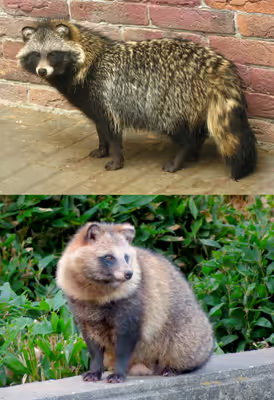
They are typically recognized by their short snouts, round crania and the shaping of their molars, specifically the ratio between M1 and M2. Nyctereutes is considered mainly an opportunistic carnivore, feeding on small mammals, fish, birds, and insects, alongside occasional plants, specifically roots. Their diet is mostly influenced by environmental factors. Japanese raccoon dogs are considered distinct from the mainland species because of the larger skull size found in Russian and Hokkaido raccoon dogs and molecular divergence.
Sign in to keep reading
One more chapter is free with a Lably account.
Species
Extant species
Fossil species
- †Nyctereutes abdeslami 3.6—1.8 Mya (Morocco)
- †Nyctereutes donnezani 9.0—3.4 Mya (Eastern Europe, Spain)
- †Nyctereutes lockwoodi 3.42—3.2 Mya (Ethiopia)
- †Nyctereutes megamastoides (Europe)
- †Nyctereutes sinensis 3.6 Mya—781,000 years ago (Eastern Asia)
- †Nyctereutes tingi
- †Nyctereutes urartuensis
- †Nyctereutes vinetorum