

Landform
Feature of the solid surface of a planetary body
- 3 min read
- 3 chapters
- 4 labs on Lably

Learn it on Lably
Physical characteristics
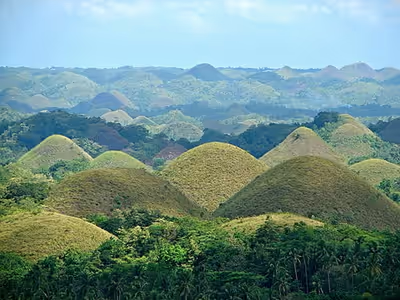
Landforms are categorized by characteristic physical attributes such as elevation, slope, orientation, and structure stratification, rock exposure, and soil type. Gross physical features or landforms include intuitive elements such as berms, cliffs, hills, mounds, peninsulas, ridges, rivers, valleys, volcanoes, and numerous other structural and size-scaled (e.g. ponds vs. lakes, hills vs. mountains) elements including various kinds of inland and oceanic waterbodies and sub-surface features. Hills, mountains, plains, and plateaus are the four major types of landforms on Earth. Minor landforms include basins, buttes, canyons, and valleys. The tectonic plate movements under Earth's crust can create landforms by pushing up hills and mountains.
Sign in to keep reading
2 more chapters are free with a Lably account.
Hierarchy of classes
Continents and oceans exemplify the highest-order landforms. Landform elements are parts of a high-order landforms that can be further identified and systematically given a cohesive definition such as hill-tops, shoulders, saddles, foreslopes and backslopes.
Some generic landform elements including: pits, peaks, channels, ridges, passes, pools and plains.
Terrain (or relief) is the third or vertical dimension of land surface. Topography is the study of terrain, although the word is often used as a synonym for relief itself. When relief is described underwater, the term bathymetry is used. In cartography, many different techniques are used to describe relief, including contour lines and triangulated irregular networks.
Elementary landforms (segments, facets, relief units) are the smallest homogeneous divisions of the land surface, at the given scale/resolution. These are areas with relatively homogeneous morphometric properties, bounded by lines of discontinuity. A plateau or a hill can be observed at various scales, ranging from a few hundred meters to hundreds of kilometers. Hence, the spatial distribution of landforms is often scale-dependent, as is the case for soils and geological strata.
A number of factors, ranging from plate tectonics to erosion and deposition (also due to human activity), can generate and affect landforms. Biological factors can also influence landforms—for example, note the role of vegetation in the development of dune systems and salt marshes, and the work of corals and algae in the formation of coral reefs.
Landforms do not include several man-made features, such as canals, ports and many harbors; and geographic features, such as deserts, forests, and grasslands. Many of the terms are not restricted to refer to features of the planet Earth, and can be used to describe surface features of other planets and similar objects in the Universe. Examples are mountains, hills, polar caps, and valleys, which are found on all of the terrestrial planets.
The scientific study of landforms is known as geomorphology.
In onomastic terminology, toponyms (geographical proper names) of individual landform objects (mountains, hills, valleys, etc.) are called oronyms.
Recent developments
Landforms may be extracted from a digital elevation model (DEM) using some automated techniques where the data has been gathered by modern satellites and stereoscopic aerial surveillance cameras. Until recently, compiling the data found in such data sets required time consuming and expensive techniques involving many man-hours. The most detailed DEMs available are measured directly using LIDAR techniques.