


Related on Lably
Through Zionism, Jews and Six-Day War
During the foundational events of the Nakba in 1948, about half of Palestine's predominantly Arab population – around 750,000 people – were expelled from their homes or made to flee through various violent means, at first by Zionist paramilitaries, and after the establishment of the State of Israel, by the IDF. Dozens of massacres targeted Palestinian Arabs, and over 500 Arab-majority towns, villages, and urban neighborhoods were depopulated. Many of the settlements were either completely destroyed or repopulated by Jews and given new Hebrew names. Israel employed biological warfare against Palestinians by poisoning village wells. By the end of the war, Israel controlled 78% of the land area of the former Mandatory Palestine.
The Palestinian national narrative views the Nakba as a collective trauma that defines Palestinians' national identity and political aspirations. The Israeli national narrative views the Nakba as a component of the War of Independence that established Israel's statehood and sovereignty. Israel negates or denies the atrocities it committed, claiming that many of the expelled Palestinians left willingly or that their expulsion was necessary and unavoidable. Nakba denial has been increasingly challenged since the 1970s in Israeli society, particularly by the New Historians, but the official narrative has not changed.
Palestinians observe Nakba Day on 15 May, the day after the anniversary of the declaration of the establishment of the State of Israel, which Israel celebrates as its Independence Day. In 1967, after the Six-Day War, another series of Palestinian exodus occurred; this came to be known as the Naksa (النَّكْسَة lit. 'Setback'), and also has its own day, 5 June. The Nakba has greatly influenced Palestinian culture and is a foundational symbol of Palestinian national identity, together with the political cartoon character Handala, the Palestinian keffiyeh, and the Palestinian 1948 keys. Many books, songs, and poems have been written about the Nakba.
Terminology
The word nakba (Arabic: نَكْبَة), meaning "misfortune, calamity; disaster, catastrophe", is an Arabic verbal noun (مصدر, maṣdar) of instance (اسم مرة, ism marra) of the verb nakaba (نَكَبَ), meaning "to make unhappy, miserable, afflict, distress".
The first usage of nakba for the Zionist conquest of Palestine is attributed to the Syrian intellectual Constantin Zureiq, a professor of history at the American University of Beirut, in his 1948 book Ma'na an-Nakba (معنى النكبة [The Meaning of the Disaster]). Zureiq wrote, "the tragic aspect of the Nakba is related to the fact that it is not a regular misfortune or a temporal evil, but a Disaster in the very essence of the word, one of the most difficult that Arabs have ever known over their long history." Until 1948, the "Year of the Catastrophe" among Arabs referred to 1920, when European colonial powers partitioned the Ottoman Empire into a series of separate states along lines of their own choosing.
In 1949, the Palestinian poet Burhan al-Deen al-Abushi used the word again. In a six-volume encyclopedia Al-Nakba: Nakbat Bayt al-Maqdis Wal-Firdaws al-Mafqud (النكبة: نكبة بيت المقدس والفردوس المفقود [The Catastrophe: The Catastrophe of Jerusalem and the Lost Paradise]) published between 1958 and 1960, Aref al-Aref wrote: "How can I call it but Nakba? When we the Arab people generally and the Palestinians particularly, faced such a disaster (Nakba) that we never faced like it along the centuries, our homeland was sealed, we [were] expelled from our country, and we lost many of our beloved sons." Muhammad Nimr al-Hawari also used the term in the title of his book Sirr an-Nakba (سِرّ النكبة [The Secret behind the Disaster]), written in 1955.
The use of the term has evolved over time. Initially, its use among Palestinians was not universal. For example, for many years after 1948, Palestinian refugees in Lebanon avoided and even actively resisted using the term, because it lent permanence to a situation they viewed as temporary, and they often insisted on being called "returnees". In the 1950s and 1960s, terms they used to describe the events of 1948 included al-'ightiṣāb (الاغتصاب the 'forcible, illegal seizure or usurpation; violation; rape'), or were more euphemistic, such as al-ʾaḥdāth (الأحداث 'the events'), al-hijra (الهجرة 'the exodus'), and lammā sharnā wa-tla'nā ("when we blackened our faces and left"). In the 1970s, Nakba narratives were avoided by the leadership of the Palestine Liberation Organization (PLO) in Lebanon in favor of a narrative of revolution and renewal. Interest in the Nakba by organizations representing refugees in Lebanon surged in the 1990s due to the perception that the refugees' right of return might be negotiated away in exchange for Palestinian statehood, and the desire was to send a clear message to the international community that this right was non-negotiable.
Sign in to keep reading
11 more chapters are free with a Lably account.
Ottoman and British Mandate periods (prior to 1948)
The roots of the Nakba are traced to the arrival of Zionists and their purchase of land in Ottoman Palestine in the late 19th century. Zionists wanted to create a Jewish state in Palestine with as much land, as many Jews, and as few Palestinian Arabs as possible. By the time the British announced their official support for Zionism in the 1917 Balfour Declaration during World War I, Palestine's population was about 750,000, approximately 94% Arab and 6% Jewish.
After the partition of the Ottoman Empire, British-ruled Mandatory Palestine began in 1922. By then, Jews had become about 10% of the population. Both the Balfour Declaration and the Mandate for Palestine called the 90% Arab population "existing non-Jewish communities".
In February 1947, after World War II and the Holocaust, the British declared they would end the Mandate and submit Palestine's future to the newly created United Nations for resolution. The United Nations Special Committee on Palestine (UNSCOP) was created, and in September, it submitted a report to the UN General Assembly recommending partition. Palestinians and most of the Arab League opposed the partition. Zionists accepted it, but planned to expand Israel's borders beyond what the UN allocated to it. In the autumn of 1947, Israel and Jordan, with British approval, secretly agreed to divide the land allocated to Palestine between them after the end of the British Mandate.
On 29 November 1947, the General Assembly passed Resolution 181 (II), the United Nations Partition Plan for Palestine. At the time, Arabs made up about two-thirds of the population and owned about 90% of the land, while Jews made up between a quarter and a third of the population and owned about 7% of the land. The UN partition plan allocated to Israel about 55% of the land, where the population was about 500,000 Jews and 407,000–438,000 Arabs. Palestine was allocated the remaining 45% of the land, where the population was about 725,000–818,000 Arabs and 10,000 Jews. Jerusalem and Bethlehem were to be an internationally governed corpus separatum with a population of about 100,000 Arabs and 100,000 Jews.
The partition plan's detractors considered it pro-Zionist, with 56% of the land allocated to the Jewish state although the Palestinian Arab population was twice the Jewish population. The plan was celebrated by most Jews in Palestine, with Zionist leaders, in particular David Ben-Gurion, viewing it as a tactical step and a stepping stone to future territorial expansion over all of Palestine. The Arab Higher Committee, the Arab League, and other Arab leaders and governments rejected it on the basis that the Arabs not only formed a two-thirds majority but owned a majority of the land. They also indicated unwillingness to accept any form of territorial division, arguing that it violated the principles of national self-determination in the UN Charter that grant people the right to decide their own destiny. They announced their intention to take all necessary measures to prevent the resolution's implementation.
The 1948 Nakba
The central facts of what happened in the Nakba during the 1948 Palestine war are well established, documented, and widely agreed upon by most Israeli, Palestinian, and other historians.
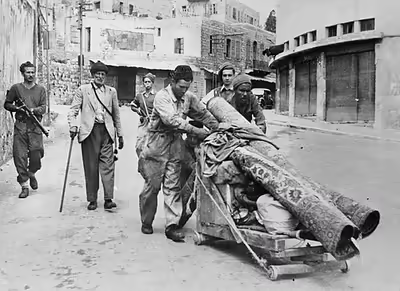
About 750,000 Palestinians – over 80% of the population living in the territory of what became the State of Israel – were expelled or fled from their homes and became refugees. Eleven Arab towns and cities, and over 500 villages were destroyed or depopulated. Thousands of Palestinians were killed in dozens of massacres. About a dozen rapes of Palestinians by regular and irregular Israeli military forces have been documented, and more are suspected. Israelis used psychological warfare tactics to frighten Palestinians into flight, including targeted violence, whispering campaigns, radio broadcasts, and loudspeaker vans. Looting by Israeli soldiers and civilians of Palestinian homes, business, farms, artwork, books, and archives was widespread.
Nov 1947 – May 1948
Small-scale local skirmishes began on 30 November and gradually escalated until March 1948. When the violence started, Palestinians had already begun fleeing, expecting to return after the war. The massacre and expulsion of Palestinian Arabs and destruction of villages began in December, including massacres at Al-Khisas (18 December 1947) and Balad al-Shaykh (31 December). By March, between 70,000 and 100,000 Palestinians, mostly middle- and upper-class urban elites, were expelled or fled.
In early April 1948, the Israelis launched Plan Dalet, a large-scale offensive to capture land and empty it of Palestinian Arabs. During the offensive, Israel captured and cleared land that the UN partition resolution had allocated to the Palestinians. Over 200 villages were destroyed during this period. Massacres and expulsions continued, including at Deir Yassin (9 April 1948). Major Palestinian cities were depopulated, including Tiberias (18 April), Haifa (23 April), Acre (6–18 May), Safed (10 May), Jaffa (13 May), and West Jerusalem's Palestinian Arab neighborhood (24 April). Israel began engaging in biological warfare in April and poisoned the water supplies of certain towns and villages. In May, one such operation caused a typhoid epidemic in Acre; the Egyptians foiled another attempt in Gaza.
Under intense public anger over Palestinian losses, and seeking to take Palestinian territory for themselves to counter the Israeli-Jordanian deal, the remaining Arab League states decided in late April and early May to enter the war after the British left. But the newly independent Arab League states' armies were still weak and unprepared for war, and none of the Arab League states were interested in establishing an independent Palestinian state with Amin al-Husseini at its head. Neither the expansionist King Abdullah I of Jordan nor the British wanted the establishment of an independent Palestinian state. On 14 May, the Mandate formally ended, the last British troops left, and Israel declared independence. By that time, Palestinian society was destroyed and over 300,000 Palestinians had been expelled or fled.
May 1948 – Oct 1948
On 15 May, Arab League armies entered the territory of former Mandatory Palestine, beginning the 1948 Arab–Israeli War, the second half of the 1948 Palestine war. Most of the earlier violence had occurred in and around urban centers, in the Israeli portion of the partitioned land, while British troops were still present. After the Mandate ended, Israel seized more land allocated to the Palestinians by the UN partition plan, and expulsions, massacres, and the destruction of villages in rural areas increased. The Tantura massacre was committed on 22–23 May.
The first truce between Israel and the Arab League nations was signed in early June and lasted about a month. In the summer of 1948, Israel began implementing anti-repatriation policies to prevent the return of Palestinians to their homes. A Transfer Committee coordinated and supervised efforts to prevent Palestinian return, including the destruction of villages, resettlement of Arab villages with Jewish immigrants, confiscation of land, and dissemination of propaganda discouraging return. During the ten days of renewed fighting between Israel and the Arab states after the first truce, over 50,000 Palestinians were expelled from Lydda and Ramle (9–13 July). A second truce was signed in mid-July and lasted until October. During the two truces, Palestinians who returned to their homes or crops, called "infiltrators" by the Israelis, were killed or expelled.
Oct 1948 – Jul 1949
Expulsions, massacres, and Israeli expansion continued in the autumn of 1948. This period saw the depopulation of Beersheba (21 October), the al-Dawayima massacre (29 October), and the Safsaf massacre (also 29 October). In October, Israel converted the ad hoc military governates ruling Palestinian Arabs in Israel into a formal military government. The new system controlled nearly all aspects of their lives, including curfews, travel restrictions, employment and other economic restrictions, arbitrary detention and other punishments, and political control. Martial law assisted Israeli efforts to find and expel or kill "infiltrators" in order to prevent Palestinians from repopulating their villages.
Most of the fighting between Israel and the Arab states ended by the winter. On 11 December 1948, the UN passed Resolution 194, which declared that Palestinians should be permitted to return to their homes and be compensated for lost or damaged property. The Resolution also established the United Nations Conciliation Commission. Armistices formally ending the war were signed between February and July 1949, but massacres and expulsions of Palestinians continued in 1949 and beyond.
By the end of the war, Palestine was divided and Palestinians were scattered. Israel held about 78% of Palestine, including the 55% allocated to it by the UN partition plan and about half of the land allocated for a Palestinian state. The West Bank and Gaza Strip comprised the remaining half, and were held by Jordan and Egypt, respectively. The capital that was meant to be governed internationally (corpus separatum) was divided between an Israeli-held West Jerusalem and a Jordanian-held East Jerusalem. Israel, with its expanded borders, was admitted as a member to the United Nations in May 1949. About 156,000 Palestinians remained under military rule in Israel, including many internally displaced persons. The approximately 750,000 Palestinians who were expelled or fled from their homes were living in refugee camps in the West Bank, Gaza Strip, Jordan, Syria, and Lebanon. None were allowed to return. No Palestinian state was created.
Post-1948 Nakba
Martial law period (1949–1966)
The Nakba continued after the end of the war in 1949. Israel prevented Palestinian refugees outside Israel from returning. Palestinians continued to be expelled, and more Palestinian towns and villages were destroyed, with new Israeli settlements established in their place. Palestinian place names and the name "Palestine" itself were removed from maps and books.
Massacres of Palestinians also continued after the war. Sixty-nine Palestinians were killed in the 1953 Qibya massacre. A few years later, 49 Palestinians were killed in the Kafr Qasim massacre, on the first day of the 1956 Suez Crisis.
Palestinians in Israel remained under strict martial law until 1966.
Naksa period (1967–1986)
During the 1967 Six-Day War, hundreds of thousands of Palestinian refugees were driven from the West Bank, Gaza, and East Jerusalem. Most were driven into Jordan. This has become known as al-Naksa (the "setback"). After the war, Israel occupied the West Bank and Gaza Strip.
Some 2,000 Palestinians were killed in a massacre led by the Lebanese Front at the Siege of Tel al-Zaatar in 1976, during the Lebanese Civil War. Palestinian refugees in Lebanon were killed or displaced during the 1982 Lebanon War, including between 800 and 3,500 killed in the Sabra and Shatila massacre.
Since the First Intifada (1987–present)
The First Intifada began in 1987 and lasted until the 1993 Oslo Accords. The Second Intifada began in 2000. In 2005, Israel withdrew from Gaza and blockaded it. In the West Bank and East Jerusalem, Israel built the Israeli West Bank barrier and created Palestinian enclaves.
In 2011, Israel passed the Nakba Law, which denies government funding to institutions that commemorate the Nakba.
The 2023 Gaza war has caused the highest Palestinian casualties since the 1948 war, and has raised fear among Palestinians that history will repeat itself. This fear was exacerbated when Israeli Agricultural Minister Avi Dichter said that the war would end with "Gaza Nakba 2023". Prime Minister Benjamin Netanyahu rebuked Dichter.
Components
The Nakba encompasses the violent displacement and dispossession of Palestinians, along with the destruction of their society, culture, identity, political rights, and national aspirations.
Displacement
During the 1947–49 Palestine war, an estimated 750,000 Palestinians fled or were expelled, comprising around 80% of the Palestinian Arab inhabitants of what became Israel. Almost half of this figure (over 300,000 Palestinians) had fled or had been expelled ahead of the Israeli Declaration of Independence in May 1948. This fact was named as a casus belli for the entry of the Arab League into the country, sparking the 1948 Arab–Israeli War.
Clause 10.(b) of the telegram from the Secretary-General of the League of Arab States to the UN Secretary-General of 15 May 1948 justifying the intervention by the Arab States, the Secretary-General of the League alleged that "approximately over a quarter of a million of the Arab population have been compelled to leave their homes and emigrate to neighbouring Arab countries." In the period after the war, a large number of Palestinians attempted to return to their homes. Between 2,700 and 5,000 of them were killed by Israel, the vast majority being unarmed and intending to return for economic or social reasons.
The Nakba is described as ethnic cleansing by many scholars. They include Palestinian scholars such as Saleh Abd al-Jawad, Beshara Doumani, Rashid Khalidi, Adel Manna, Nur Masalha, Nadim Rouhana, Ahmad H. Sa'di, and Areej Sabbagh-Khoury, Israeli scholars such as Alon Confino, Amos Goldberg, Baruch Kimmerling, Ronit Lentin, Ilan Pappé, and Yehouda Shenhav, and foreign scholars such as Abigail Bakan, Elias Khoury, Mark Levene, Derek Penslar, and Patrick Wolfe, among other scholars.
Other scholars, such as Yoav Gelber, Benny Morris, and Seth J. Frantzman, disagree that the Nakba constitutes an ethnic cleansing. Morris in 2016 rejected the description of "ethnic cleansing" for 1948, while also saying that the label of "partial ethnic cleansing" for 1948 was debatable. In 2004 Morris responded to the claim that ethnic cleansing occurred in 1948 by saying that, given the alternative was "genocide – the annihilation of your people", there were "circumstances in history that justify ethnic cleansing ... It was necessary to cleanse the hinterland ... ['cleanse' was] the term they used at the time ... there was no choice but to expel the Palestinian population. To uproot it in the course of war". Morris said this resulted in a "partial" expulsion of Arabs.
Still other scholars use different frameworks than "ethnic cleansing": for example, Richard Bessel and Claudia Haake use "forced removal" and Alon Confino uses "forced migration".
At the same time, many of those Palestinians who remained in Israel became internally displaced. In 1950, UNRWA estimated that 46,000 of the 156,000 Palestinians who remained inside the borders demarcated as Israel by the 1949 Armistice Agreements were internally displaced refugees. As of 2003, some 274,000 Arab citizens of Israel – or one in four in Israel – were internally displaced from the events of 1948.
Dispossession and erasure
The UN Partition Plan of 1947 assigned 56% of Palestine to the future Jewish state, while the Palestinian majority (66%) were to receive 44% of the territory. 80% of the land in the to-be Jewish state was already owned by Palestinians; 11% had a Jewish title. Before, during and after the 1947–1949 war, hundreds of Palestinian towns and villages were depopulated and destroyed. Geographic names throughout the country were erased and replaced with Hebrew names, sometimes derivatives of the historical Palestinian nomenclature, and sometimes new inventions. Numerous non-Jewish historical sites were destroyed, not just during the wars, but in a subsequent process over a number of decades. For example, over 80% of Palestinian village mosques have been destroyed, and artefacts have been removed from museums and archives.
A variety of laws were promulgated in Israel to legalize the expropriation of Palestinian land.
Statelessness and denationalization
The creation of Palestinian statelessness is a central component of the Nakba and continues to be a feature of Palestinian national life to the present day. All Arab Palestinians became immediately stateless as a result of the Nakba, although some took on other nationalities. After 1948, Palestinians ceased to be simply Palestinian, instead divided into Israeli-Palestinians, East Jerusalem Palestinians, UNRWA Palestinians, West Bank-Palestinians, and Gazan-Palestinians, each with different legal statuses and restrictions. In addition to these there was also the wider Palestinian diaspora, who were able to achieve residency outside of historic Palestine and the refugee camps.
The first Israeli Nationality Law, passed on 14 July 1952, denationalized Palestinians, rendering the former Palestinian citizenship "devoid of substance", "not satisfactory and [..] inappropriate to the situation following the establishment of Israel".
Fracturing of society
The Nakba was the primary cause of the Palestinian diaspora. At the same time as Israel was created as a Jewish homeland, the Palestinians were turned into a "refugee nation" with a "wandering identity". Today a majority of the 13.7 million Palestinians live in the diaspora, i.e. they live outside of the historical area of Mandatory Palestine, primarily in other countries of the Arab world. Of the 6.2 million people registered by the UN's dedicated Palestinian refugee agency, UNRWA, about 40% live in the West Bank and Gaza, and 60% in the diaspora. A large number of these diaspora refugees are not integrated into their host countries, as illustrated by the ongoing tension of Palestinians in Lebanon or the 1990–91 Palestinian exodus from Kuwait.
These factors have resulted in a Palestinian identity of "suffering", whilst the deterritorialization of the Palestinians has created a uniting factor and focal point in the desire to return to their lost homeland.
Long-term implications and "ongoing Nakba"
The most important long-term implications of the Nakba for the Palestinian people were the loss of their homeland, the fragmentation and marginalization of their national community, and their transformation into a stateless people.
Since the late 1990s, the phrase "ongoing Nakba" (Arabic: النکبة المستمرة, romanized: al-nakba al-mustamirra) has emerged to describe the "continuous experience of violence and dispossession" experienced by the Palestinian people. This term enjoins the understanding of the Nakba not as an event in 1948, but as an ongoing process that continues through to the present day.
On November 11, 2023, Israeli Agriculture Minister Avi Dichter remarked in an interview on N12 News on the nature of the Gaza war that "From an operational standpoint, you cannot wage a war like the IDF wants to in Gaza while the masses are between the tanks and the soldiers," he said. "It's the 2023 Gaza Nakba."
Israeli legislative measures
Israeli officials have repeatedly described the term as embodying an "Arab lie" or as a justification for terrorism. In 2009, the Israeli Education Ministry banned using the term "nakba" in textbooks for Arab children.
In May 2009, Yisrael Beiteinu introduced a bill that would outlaw all Nakba commemorations, with a three-year prison sentence for such acts of remembrance. Following public criticism, the bill draft was changed, the prison sentence dropped and instead the Minister of Finance would have the authority to reduce state funding for Israeli institutions found to be "commemorating Independence Day or the day of the establishment of the state as a day of mourning". The new draft was approved by the Knesset in March 2011, and became known as the Nakba Law. In 2011, the Knesset passed the Nakba Law, blocking state funds from institutions that commemorated the event. The law's implementation created intimidation, but also unintentionally increased awareness of the Nakba in Israeli society, continuing a trend in which right-wing Nakba denial generates more public discourse than left-wing activism about it.
In 2023, after the United Nations instituted a commemoration day for the Nakba on 15 May, Israeli ambassador Gilad Erdan said the event was antisemitic.
Nakba denial
The denial of the Nakba is central to Zionist narratives of 1948. The term "Nakba denial" was used in 1998 by Steve Niva, editor of the Middle East Report, in describing how the rise of the early Internet led to competing online narratives of the events of 1948. In the 21st century the term came to be used by activists and scholars to describe narratives that minimized elements of the expulsion and its aftermath, particularly in Israeli and Western historiography before the late 1980s, when Israel's history began to be reviewed and rewritten by the New Historians.
Nakba denial has been described as still prevalent in both Israeli and American discourse and linked to various tropes associated with anti-Arab racism. The 2011 'Nakba Law' authorized the withdrawal of state funds from organizations that commemorate the day on which the Israeli state was established as a day of mourning, or that deny the existence of Israel as a "Jewish and democratic state". Israeli grassroots movements, such as Zochrot, aim to commemorate the Nakba through public memorials and events. In May 2023, following the 75th anniversary of the Nakba, Palestinian president Mahmoud Abbas made the denial of the 1948 expulsion a crime punishable by two years in jail.
International positions
On 16 May 2023, the World Council of Churches condemned the Nakba, stating that "the catastrophe Palestinian families experienced 75 years ago, continues to cause unresolved dispossession and suffering for many Palestinians". At that time, Munther Isaac, moderator of the Global Kairos for Justice Coalition, recalled that a number of Arab Christian villages were destroyed during the Nakba.
On 17 May 2024, the United Nations commemorated the Palestinian Nakba for a second year, calling on the international community to redouble its efforts to end the Israeli occupation. An event, "1948-2024: The Continuing Palestinian Nakba" was also held.
Historiography
The term nakba has been used to refer to the events of 1948 since Constantin Zureiq, a professor of history at the American University of Beirut, did so in his book Ma'na an-Nakba (The Meaning of the Disaster), which was published that year.
Israeli historians Avraham Sela and Alon Kadish claim that the Palestinian national memory of the Nakba has evolved over time, reconstructing the events of 1948 to serve contemporary Palestinian national demands. They argue that the Palestinian historiography of the Nakba tends to "entirely ignore" the attacks launched by Arab irregular and volunteer forces against the Yishuv, downplaying the role of Palestinian leaders in the events leading to the 1948 war and defeat.
Elias Khoury writes that the works of Edward Said were important for taking a "radically new approach" to the Nakba than those of Zureiq and other early adopters of the term, whose usage had "the connotation of a natural catastrophe" and thus freed "Palestinian leadership and Arab governments from direct responsibility for the defeat."
During the ongoing Gaza war and genocide, Palestinian legal scholar Rabea Eghbariah argued in "Toward Nakba as a Legal Concept" (2024) that the term nakba should be adopted as a legal framework on its own terms, calling genocide, apartheid, and nakba "different, yet overlapping, modalities of crimes against humanity". The article identifies Zionism and the Nakba as mutually constitutive counterparts, analyzes the legal anatomy of the ongoing Nakba, and describes the foundational violence of the Nakba as displacement, its structure as fragmentation, and its purpose as the denial of Palestinian self-determination.
National narratives
Palestinian national narrative
The Palestinian national narrative regards the Nakba's repercussions as a formative trauma defining its identity and its national, political, and moral aspirations. The Palestinian people developed a victimized national identity in which they had lost their country as a result of the 1948 war. From the Palestinian perspective, they, rather than those who were responsible, have been forced to pay for the Holocaust perpetrated in Europe with their freedom, properties, and bodies.
In the Jewish Political Studies Review, Shmuel Trigano outlined the evolution of the Nakba narrative through three stages. Initially, it depicted Palestinians as victims displaced by Israel's creation to make way for Jewish immigrants. The next phase recast the Six-Day War as Israel's colonization of Palestinian lands, aligning the Palestinian cause with anti-colonial sentiment. The final stage leverages Holocaust memories, accusing Israel of apartheid, resonating with Western guilt over the Holocaust. He argues these evolving interpretations omit complex historical factors involving failed attempts to eliminate Israel, contested territorial claims, and Jewish refugee displacement from Arab nations.
Israeli national narrative
The Israeli national narrative rejects the Palestinian characterization of 1948 as a Nakba (catastrophe), instead viewing it as a War of Independence that established Israel's statehood and sovereignty. It sees the events of 1948 as the culmination of the Zionist movement and Jewish national aspirations, resulting in military success against invading Arab armies, armistice agreements, and recognition of Israel's legitimacy by the United Nations. The narrative accommodates some Israeli responsibility for the Palestinian refugee crisis, as documented by historians like Benny Morris, within the context of Israel's emergence as a state under difficult war conditions, without negating Israel's foundational story and identity. It perceives the 1948 war and its outcome as an equally formative and fundamental event—an act of justice and redemption for the Jewish people after centuries of historical suffering, and the key step in the "negation of the Diaspora".
According to this narrative, Palestinian Arabs voluntarily fled their homes during the war, encouraged by Arab leaders who told them to temporarily evacuate so that Arab armies could destroy Israel, and then upon losing the war, refused to integrate them. Historian Walid Khalidi and his colleagues refute the narrative of a voluntary Palestinian exodus as a result of evacuation orders from Arab leaders, espoused in English most prominently by Jon Kimche and David Kimche.
The Israeli national narrative also contrasts Jewish refugees absorbed by Israel with Palestinian refugees kept stateless by Arab countries as political pawns. It claims that Arabs were not expelled from their villages, nor was their property confiscated, but that a "population exchange" took place during which property was "abandoned".
In films and literature
Farha, a film about the Nakba directed by Jordanian director Darin J. Sallam, was chosen as Jordan's official submission for the 2023 Academy Awards International Feature Film category. In response, Avigdor Lieberman, the Israeli Finance Minister, ordered the treasury to withdraw government funding for Jaffa's Al Saraya Theater, where the film was scheduled for projection.
Museums
The Al Qarara Cultural Museum held a collection of pre-Nakba jewellery. It was destroyed in an explosion as a result of an Israeli attack in October 2023.